
TL;DR:
- Playable ads involve active user interaction, leading to higher engagement and better retention than static formats.
- No-code platforms now enable small teams to create, test, and optimize playable ads quickly and cost-effectively.
- Focusing on rapid iteration, key metrics, and genre-specific strategies enhances the effectiveness of playable engagement campaigns.
Playable engagement is no longer the exclusive domain of large studios with deep development budgets. Interactive mini-game ads allow users to try a game before downloading it, creating a fundamentally different relationship between ad and audience. Modern no-code tools have shifted the balance considerably, making it possible for lean marketing teams to build, test, and scale playable ads without writing a single line of code. This guide covers the core mechanics, key performance metrics, cost implications, and genre-specific strategies that will help you make smarter decisions about playable engagement in your user acquisition campaigns.
Table of Contents
- What is playable engagement and why does it matter?
- Core mechanics and structure of an engaging playable ad
- Key metrics to measure playable engagement success
- No-code solutions and the changing cost equation
- Genre nuances and optimising playable engagement strategies
- What most marketers miss about playable engagement
- Ready to boost user acquisition with playable engagement?
- Frequently asked questions
Key Takeaways
| Point | Details |
|---|---|
| Playable engagement defined | It means real users interact with an ad’s core gameplay before downloading, not just watching a video. |
| Superior ad performance | Playable ads consistently deliver higher engagement, conversion, and retention than static or video ads. |
| No-code platforms lower barriers | Drag-and-drop tools allow marketers without coding skills to produce effective, optimised playables quickly and affordably. |
| Metric-driven optimisation | Success is measured by engagement rate, CTR, and retention, with rapid A/B testing outperforming guesswork. |
| Genre and structure matter | High-performing playables match their genre’s pace and complexity, focusing on simplicity to maximise results. |
What is playable engagement and why does it matter?
Playable engagement refers to the active, hands-on interaction a user has with an ad, rather than passively watching a video or glancing at a static banner. In practical terms, playable ads are interactive mini-versions of mobile games embedded directly within the ad unit. A user taps, swipes, or drags within the ad itself, experiencing a slice of genuine gameplay before ever visiting the app store.
This distinction matters enormously. Traditional ad formats ask users to imagine what a game feels like. Playable ads remove the guesswork entirely. The user already knows whether the core loop appeals to them, which means those who do install are far more motivated and far less likely to churn within the first session. User participation in playables far surpasses what video or static formats can achieve, and the downstream effect on retention is measurable.
Several myths still circulate about playable ads, and it is worth addressing them directly:
- Too expensive to produce: No-code platforms have drastically reduced this barrier.
- Requires a development team: Modern drag-and-drop builders need no coding knowledge.
- Only effective for hypercasual games: Examples of effective playable ads span genres from puzzle to strategy.
- Hard to iterate quickly: Templates and AI asset generation allow rapid variant testing.
- Difficult to measure: Playables generate rich in-ad event data that static formats cannot.
The table below illustrates how playable ads compare to other common formats across the metrics that matter most to user acquisition teams.
| Format | Engagement rate | CTR | Install quality | Cost per creative |
|---|---|---|---|---|
| Static banner | 0.1–0.5% | 0.1–0.3% | Low | Very low |
| Video ad | 2–8% | 1–2% | Medium | Medium |
| Playable ad | 15–30% | 2.5–5% | High | Medium to high |
“Playable ads consistently outperform passive formats because they create genuine intent signals, not just impressions.”
For marketers exploring creative playable ad concepts, the data makes a compelling case. Understanding industry terms around playable formats also helps when briefing media buying partners or platform representatives.
Core mechanics and structure of an engaging playable ad
Knowing that playable ads work is one thing. Understanding precisely how they are constructed is what separates marketers who see consistent results from those who treat playables as a one-off experiment.
A playable ad typically features an intro prompt, 10 to 30 seconds of core gameplay interaction, and an end card with a call to action, with the total experience lasting between 15 and 60 seconds. Each phase serves a specific purpose, and optimising each one independently is how you lift overall performance.
Here is a breakdown of the standard phases and what to focus on within each:
- Intro prompt (0–2 seconds): Communicate the action immediately. Use a visual cue or a single instruction such as “Tap to play.” Avoid lengthy explanations.
- Core gameplay loop (3–30 seconds): Replicate the single most satisfying mechanic from your game. Complexity is the enemy here. One action, one reward signal.
- Win or loss state (5–10 seconds): Give users a clear outcome. Both win and loss states can be effective, but the emotional response must feel fair and motivating.
- End card CTA (final 5–10 seconds): Make the install button prominent. Reinforce the emotional peak from the gameplay moment just experienced.
The technology underpinning most playable ads is HTML5, which enables instant loading without app downloads and consistent rendering across iOS, Android, and web environments. This cross-platform reliability is a significant operational advantage. Reviewing playable vs. video ad structure comparisons reveals just how much richer the playable format is in terms of data collection and user feedback.

For best playable ad structures across different game types, studying high-performing examples is a worthwhile investment of time before building your first variant.
Pro Tip: Keep your time-to-engage under three seconds. If a user has not performed their first meaningful action within three seconds of the ad loading, completion rates drop sharply. Design the opening state so the correct action is visually obvious without reading any text.
Key metrics to measure playable engagement success
Measuring playable engagement requires a more nuanced approach than standard display advertising. The richness of in-ad event data means you have far more to work with, but only if you know which numbers to prioritise.
The primary KPIs for playable ads are:
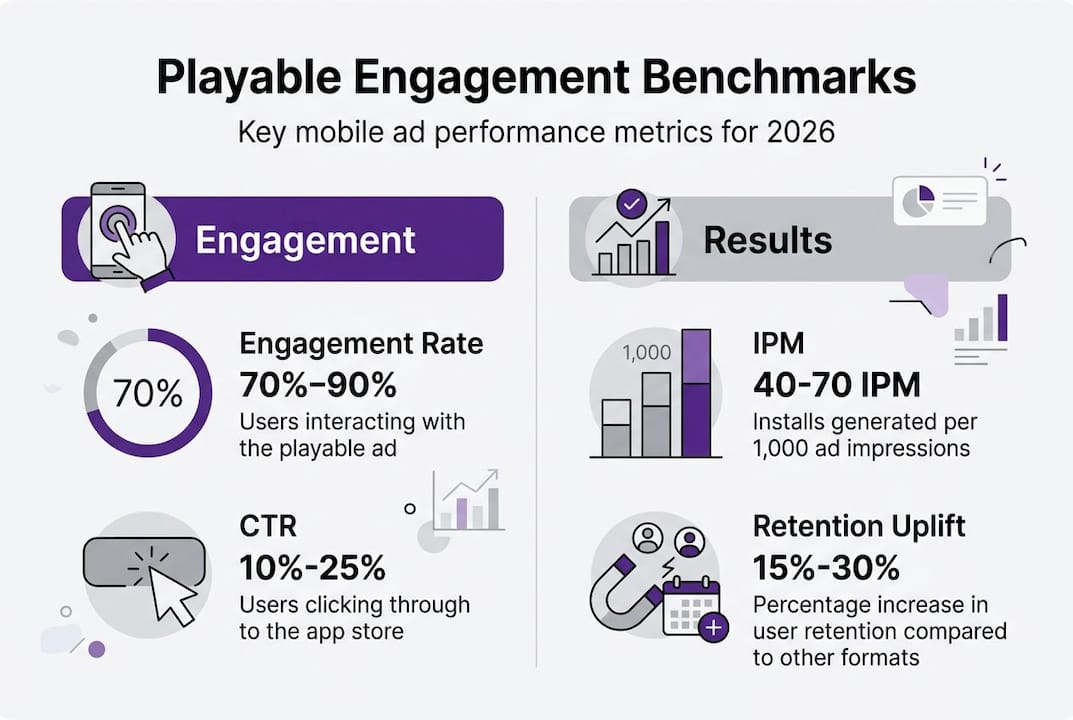
- Engagement rate: The percentage of users who interact with the ad at all. Target range is 15–30%.
- Time-to-engage (TTE): How quickly the first interaction occurs. Under three seconds is the benchmark.
- Click-through rate (CTR): The proportion who tap the CTA after engaging. Target range is 2.5–5%.
- Installs per mille (IPM): Installs per 1,000 impressions. An IPM of 8.2 is a solid industry reference point.
- Completion rate: The percentage who reach the end card. Low completion often signals a mechanics problem.
- Day 7 (D7) retention: Whether players acquired via playable ads are still active a week after install.
The table below provides indicative benchmarks based on current playable ad data for 2026.
| Metric | Underperforming | Average | Strong |
|---|---|---|---|
| Engagement rate | Below 10% | 15–20% | Above 25% |
| CTR | Below 1.5% | 2.5–3.5% | Above 4% |
| IPM | Below 4 | 6–9 | Above 12 |
| D7 retention uplift | Below 10% | 15–25% | Above 30% |
Engagement rate, CTR, IPM, and retention uplift benchmarks of 15–30%, 2.5–5%, 8.2 IPM, and 15–35% retention improvement respectively give you a realistic baseline for evaluating your own campaigns.
One important nuance: CTR is only meaningful once engagement rate is healthy. A high CTR from a low engagement rate simply means a small, self-selected group of highly motivated users tapped through, which distorts your cost-per-install calculations. Fix engagement first, then optimise CTR.
For measuring playable ad performance rigorously, cohort analysis is essential. Group users by the specific variant they interacted with and track their downstream behaviour separately. This reveals whether conversion rate lifts hold up over time or fade after the first session. Require a minimum of 50 conversions per variant before drawing conclusions from any A/B test.
No-code solutions and the changing cost equation
For years, the cost and complexity of building playable ads kept them out of reach for smaller teams. Specialist developers, lengthy production cycles, and significant creative budgets made playables a premium tactic reserved for publishers with substantial resources. That equation has changed.
No-code tools reduce costs by 25–70% and build times by 50–70%, making playable ad production scalable for small marketing teams. Platforms like PlayableMaker and Sett AI offer drag-and-drop editors, pre-built game mechanic templates, and AI-driven asset generation that allow a single marketer to produce and iterate multiple variants in a single working day.
The practical benefits for user acquisition teams are substantial:
- Lower barrier to entry: No coding knowledge required. If you can use a presentation tool, you can build a playable ad.
- Faster iteration cycles: Launch a variant, gather data, revise the mechanic, and relaunch within days rather than weeks.
- AI-assisted asset generation: Generate background art, character animations, and UI elements without a design team.
- Template libraries: Start from proven structures rather than building from scratch, reducing the risk of structural errors.
- Budget predictability: Fixed subscription costs replace unpredictable agency or developer fees.
For teams comparing no-code pricing for playable ads, the cost difference versus traditional development is often dramatic enough to justify the switch on a single campaign. Exploring no-code playable ad tools in detail reveals just how feature-rich these platforms have become.
Pro Tip: Prioritise rapid iteration over initial production quality. A technically polished ad that has never been tested against an audience is worth far less than three rough variants that have generated real performance data. Let the numbers guide your investment in production value.
Genre nuances and optimising playable engagement strategies
Not all playable ads perform equally across game genres, and understanding these differences allows you to calibrate expectations and tailor your approach accordingly.
Playable ad usage is highest in hypercasual games at 13% and lowest in RPGs at around 1%, with engagement improving significantly when time-to-engage is under three seconds. Hypercasual games benefit from mechanics that are immediately intuitive, requiring no context or backstory. RPGs, by contrast, struggle to compress their core value proposition into a 30-second experience without oversimplifying to the point of misrepresentation.
Key optimisation levers applicable across genres include:
- Time-to-engage under 3 seconds: The single most impactful variable across all genre types.
- Test both win and loss states: Some audiences respond better to a near-miss loss; others convert better after a satisfying win.
- Simplify complex mechanics: Strip the playable down to one action. If users need to read instructions, the mechanic is too complex.
- Geo-targeted difficulty: Player tolerance for difficulty varies significantly by market. Test easy and hard variants separately by geography.
- Sound-off compatibility: A significant proportion of users experience ads with sound disabled. Ensure the core mechanic communicates clearly without audio.
“Analytics on in-ad events predict retention 3x better than post-install data, making playable engagement signals some of the most valuable in mobile marketing.”
For UA success strategies that account for these genre-specific nuances, the key is treating each playable variant as a hypothesis rather than a finished product. Using playable ad analytics tools to track in-ad event sequences reveals exactly where users disengage, giving you precise data to act on rather than assumptions.
What most marketers miss about playable engagement
The most common mistake in playable ad campaigns is overinvesting in production value before validating the core mechanic. Teams spend weeks refining visual polish, sound design, and animation quality on a single ad, only to discover that the fundamental interaction does not resonate with the target audience. The production investment then becomes a psychological barrier to changing the mechanic, because no one wants to discard expensive work.
The more effective approach is to treat your first five variants as experiments. Build quickly, launch with sufficient budget to gather statistically meaningful data, and let performance dictate which direction to develop further. Empirical evidence consistently shows that simple core loops with immediate feedback drive better ROI than elaborate experiences that require user orientation.
This is a lesson that applies well beyond gaming. UA guide lessons increasingly inform playable engagement frameworks in e-commerce and interactive learning, where the same principles of immediate feedback and low cognitive load apply. The marketers who extract the most value from playable engagement are those who resist the creative urge to overcomplicate and instead let the data lead every significant decision.
Pro Tip: Set a rule before you start: no variant receives additional production investment until it has generated at least 50 conversions. This one discipline will save significant budget and redirect creative energy toward what actually works.
Ready to boost user acquisition with playable engagement?
Understanding how playables revolutionise engagement is the first step. Acting on that understanding is where the real gains are made. PlayableMaker is built specifically for marketing teams who want to create high-performing playable ads without developer dependencies or inflated production budgets. The platform’s no-code editor, template library, and AI tools mean you can move from concept to live campaign in a fraction of the time traditional methods require. If you want to understand why playable ads are so effective from a psychological standpoint, or simply want to explore no-code playable ad tools in practice, PlayableMaker gives you everything you need to start testing today.
Frequently asked questions
What is playable engagement in mobile advertising?
It is when users interact with a playable mini-game ad, trying core gameplay before downloading, which yields higher-quality installs and stronger intent signals than passive formats.
Why are playable ads more effective than video ads for games?
Playables generate 3–20 times more installs and a 32% higher conversion rate than video ads, because users self-select based on genuine gameplay experience rather than a produced trailer.
How do no-code playable ad builders benefit small teams?
No-code tools cut development time and costs by up to 70%, enabling small marketing teams to build, test, and iterate playable ads without any coding knowledge or specialist developers.
What KPIs should I track to optimise playable engagement?
Prioritise engagement rate, CTR, and retention uplift alongside time-to-engage and IPM, targeting an engagement rate of 15–30% and a CTR above 2.5% as foundational benchmarks.
Recommended
- User Engagement in Ads: Unlocking Mobile Success – playablemaker.com User Engagement in Ads: Unlocking Mobile Success
- Game Ad Engagement Techniques for Playable Ad Success – playablemaker.com Game Ad Engagement Techniques for Playable Ad Success
- From Zero to Wow: The Power of Playable Ad Templates to Skyrocket Engagement – playablemaker.com From Zero to Wow: The Power of Playable Ad Templates to Skyrocket Engagement
- What is Engagement Rate? Understanding Its Impact in Gaming – playablemaker.com What is Engagement Rate? Understanding Its Impact in Gaming