Most british mobile gaming campaigns miss valuable opportunities by overlooking precise engagement metrics for playable ads. With competition rising across American, European, and Asian markets, understanding what truly captivates users is more critical than ever. Learning how to pinpoint, measure, and act on key player behaviours using affordable, no-code solutions positions campaigns to outpace rivals. Discover which strategies provide real insight and see why over 60 percent of user acquisition teams now depend on rapid, code-free tools to sharpen their edge.
Table of Contents
- Step 1: Define Engagement Metrics For Playable Ads
- Step 2: Select No-Code Tools For Rapid Ad Creation
- Step 3: Design Interactive Experiences To Drive Interaction
- Step 4: Integrate Compelling Calls-To-Action Seamlessly
- Step 5: Test And Analyse Ad Engagement Performance
Quick Summary
| Key Point | Explanation |
|---|---|
| 1. Define Engagement Metrics | Identifying key metrics helps track user interactions and ad effectiveness for playable ads in mobile gaming. |
| 2. Use No-Code Tools | Select intuitive no-code platforms to streamline the ad creation process, enhancing flexibility and speed in development. |
| 3. Design Interactive Experiences | Create engaging gameplay that transforms viewers into active participants, increasing their likelihood to explore the game further. |
| 4. Integrate Effective CTAs | Position clear and motivating calls-to-action within gameplay to encourage users to install the game seamlessly. |
| 5. Test and Analyse Performance | Employ systematic tracking of engagement metrics to refine strategies based on user interaction patterns and insights. |
Step 1: Define engagement metrics for playable ads
Defining precise engagement metrics is crucial for understanding the performance of playable ads in mobile gaming. You will learn how to identify and track key indicators that reveal user interaction and ad effectiveness.
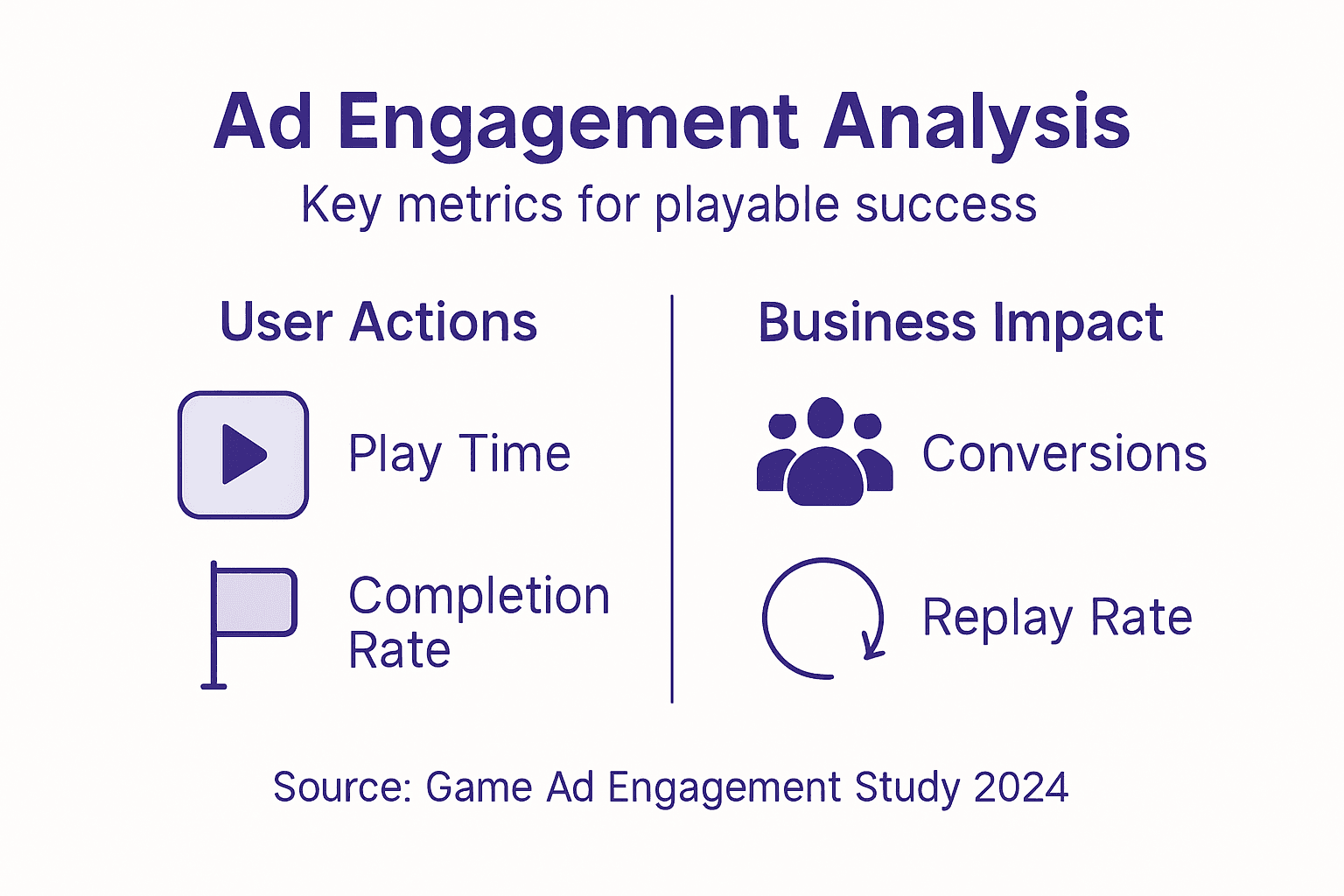
To effectively measure playable ad engagement, focus on metrics that capture user behaviour and interaction depth. Interactivity levels in gaming ads demonstrate how users connect with your content, revealing critical insights into ad performance. Key metrics include:
- Time spent interacting with the ad
- Number of interactions performed
- Completion rate of mini gameplay
- Voluntary replay or replay attempts
- Click through rates to game installation
Beyond quantitative measurements, consider qualitative factors like user experience and content relevance. Each metric provides a nuanced view of how potential players engage with your playable advertisement. Advanced tracking allows you to understand not just whether users interact, but how meaningfully they do so.
Here is a summary of key engagement metrics and their strategic significance:
| Engagement Metric | What It Measures | Business Impact |
|---|---|---|
| Interaction Duration | Time users spend on ad | Indicates content’s attractiveness |
| Gameplay Completion Rate | Level of mini-game completion | Reflects effectiveness of core loop |
| Replay Attempts | Voluntary replays | Reveals user satisfaction |
| Click-Through to Install | Users moving to app download | Shows conversion effectiveness |
| User Experience Feedback | Qualitative interaction feedback | Uncovers design and messaging issues |
Pro tip: Track engagement metrics consistently and compare across different ad variations to continuously refine your playable ad strategy.
Step 2: Select no-code tools for rapid ad creation
Selecting the right no-code tools can dramatically transform your playable ad creation process, enabling faster development and more creative flexibility. This section will guide you through choosing platforms that streamline your ad production workflow.
No-code development platforms enable marketers and designers to build interactive advertisements without extensive programming knowledge. When evaluating tools, consider key features such as drag-and-drop interfaces, pre-built templates, visual design capabilities, and integration potential. Look for platforms that offer:
- Intuitive user interfaces
- Robust template libraries
- Animation and interactive element controls
- Mobile responsive design options
- Quick export capabilities
- Affordable pricing models
Prioritise tools that provide flexibility and ease of use. Some popular options include Bubble, Adalo, and specific gaming ad creation platforms that understand mobile gaming marketing dynamics. Your selection should align with your technical skills, budget constraints, and specific playable ad requirements.
This table contrasts popular no-code platforms for playable ad creation:
| Platform | Strengths | Ideal Use Case |
|---|---|---|
| Bubble | Highly customisable, flexible UI | Complex interactive ads |
| Adalo | Rapid prototyping, easy templates | Quick iterations, simple concepts |
| Game-specific Tool | Prebuilt gaming features, analytics | Ad creation in game-centric niches |
Pro tip: Test multiple no-code tools using free trials to determine which platform best matches your specific playable ad creation workflow and creative vision.
Step 3: Design interactive experiences to drive interaction
Creating compelling interactive experiences in playable ads requires strategic design that transforms passive viewers into active participants. Your goal is to craft an engaging mini experience that immediately captures potential players’ attention and motivates them to explore further.
Interactive design strategies focus on creating environments that promote user autonomy and meaningful participation. When designing your playable ad, consider these critical elements:
- Intuitive gameplay mechanics
- Clear objective or challenge
- Immediate visual feedback
- Short but compelling gameplay loop
- Minimal learning curve
- Rewarding interaction points
The key is to create a microexperience that feels both familiar and exciting. Implement game design principles that encourage exploration while providing just enough complexity to maintain interest. Your interactive ad should feel less like an advertisement and more like an enticing game preview that leaves users wanting more.

Pro tip: Prototype multiple interaction designs and conduct quick user testing to identify which version generates the most engagement and excitement.
Step 4: Integrate compelling calls-to-action seamlessly
Crafting effective calls-to-action (CTAs) in playable ads requires a delicate balance between motivation and user experience. Your goal is to guide potential players towards installation without disrupting the immersive gameplay interaction.
Playable ad CTAs must provide clear, motivational prompts that transition smoothly from gameplay to conversion. When designing your CTA strategy, focus on these critical elements:
- Positioning the CTA at a natural gameplay break
- Using action oriented language
- Creating visual contrast for the CTA button
- Matching the CTA style to your game aesthetic
- Keeping the text concise and energetic
- Offering a clear value proposition
The most successful CTAs feel like a natural extension of the gameplay experience rather than an interruption. They should appear at moments of peak excitement or achievement, when players are most likely to feel motivated to continue their gaming journey. Remember that your CTA is not just a button it is an invitation to an exciting new adventure.
Pro tip: A/B test multiple CTA variations to discover which emotional triggers and language resonate most powerfully with your target audience.
Step 5: Test and analyse ad engagement performance
Testing and analysing playable ad performance requires a strategic approach that goes beyond surface level metrics. Your mission is to uncover deep insights that reveal how potential players interact with your mobile game advertisement.
Systematic performance tracking enables marketers to validate creative elements and understand user interaction patterns. When analysing ad engagement, focus on these critical measurement strategies:
- Track user interaction duration
- Monitor replay and engagement rates
- Analyse conversion funnel progression
- Compare performance across different device types
- Identify drop off points in user experience
- Evaluate emotional response triggers
Successful performance analysis involves treating each data point as a narrative about user behaviour. Look beyond raw numbers to understand the psychological triggers that motivate players to engage with your advertisement. By combining quantitative metrics with qualitative insights, you can continuously refine your playable ad strategy.
Pro tip: Create a standardised performance tracking dashboard that allows real time comparison of multiple ad variations to accelerate your optimization process.
Unlock Full Potential of Playable Ads with Ease
The article highlights the challenges of defining precise engagement metrics and designing interactive experiences that truly captivate users. You want to measure interaction duration, gameplay completion, and click-through rates without draining resources or relying heavily on developers. Playable ads should be quick to build yet deeply engaging to convert viewers into players. This is where PlayableMaker steps in to solve your pain points with a no-code platform that empowers you to create compelling interactive ads fast and budget-friendly. Forget about complex programming or costly delays and focus on delivering mini gameplay loops that boost user satisfaction and conversion.
If you are ready to transform your playable ad strategy and integrate effective calls-to-action that convert seamlessly, explore how our solution simplifies every step of the process. Discover helpful guides and tips in our Help Archives. Don’t wait to elevate your ads and capture engagement like never before. Start building your first interactive ad today at PlayableMaker and see how easy it is to bring your creative vision to life. Learn more about our innovative approach in the Uncategorized Archives and take your ads from concept to performance with confidence.
Frequently Asked Questions
What key engagement metrics should I track for playable ads?
To assess the performance of playable ads, focus on metrics such as interaction duration, gameplay completion rate, replay attempts, click-through rates to installations, and user experience feedback. Tracking these metrics consistently can help you identify areas for improvement and drive better results in your ad strategy.
How can I choose the right no-code tools for creating playable ads?
Select no-code tools that offer intuitive user interfaces, robust template libraries, and mobile-responsive design options. To find the best fit, test multiple platforms and evaluate their features that align with your playable ad requirements within your budget constraints.
What design elements enhance interaction in playable ads?
Incorporate intuitive gameplay mechanics, clear objectives, and immediate visual feedback to create engaging interactive experiences. Aim to design a short, compelling gameplay loop that encourages exploration and maintains user interest.
How should I integrate calls-to-action in my playable ads?
Position calls-to-action at natural breaks in gameplay, using action-oriented language and clear visual contrast to capture attention. Ensure they match the game’s aesthetic and present a value proposition that entices users to install the game.
What steps should I take to analyse ad engagement performance effectively?
Implement systematic performance tracking to monitor user interaction duration, replay rates, and conversion funnel progression. Create a standardised dashboard for real-time comparison of ad variations and focus on identifying drop-off points to refine your strategy.
How can I continuously improve my playable ad campaigns?
Regularly test and iterate on your ad designs, engagement metrics, and call-to-action strategies based on user feedback and performance data. Set measurable goals and assess performance at least every 30 days to identify improvements that can enhance user engagement.
Recommended
- Google Ad Performance: Maximising Mobile Game ROI – playablemaker.com Google Ad Performance: Maximising Mobile Game ROI
- Integrating Playable Ads into Your Marketing Strategy – playablemaker.com Integrating Playable Ads into Your Marketing Strategy
- Understanding Ad Placement Strategy in Mobile Gaming – playablemaker.com Understanding Ad Placement Strategy in Mobile Gaming
- 7 Best Examples of Mobile Game Ads and Why They Work – playablemaker.com 7 Best Examples of Mobile Game Ads and Why They Work
- Complete Guide to Experimental Storytelling Techniques – The Mansion Press