Launching new playable ads often feels like a race against time and resources. For specialists managing campaigns across the United States, Europe, or Asia, traditional coding workflows slow everything down. No-code tools eliminate the need for manual programming, letting teams build sophisticated, interactive ad experiences in days, not weeks. This means you can focus on rapid creative testing and genuine performance gains without burning through developer hours or budgets.
Table of Contents
- What No-Code Tools Really Mean Today
- Types of No-Code Tools and Key Features
- Building Playable Ads with No-Code Platforms
- Hidden Costs, Pitfalls, and Limitations
- No-Code vs Traditional and Low-Code Approaches
Key Takeaways
| Point | Details |
|---|---|
| No-Code Tools Accelerate Development | Non-developers can create interactive ads quickly, significantly reducing the time from concept to launch. |
| Enhanced Budget Flexibility | Eliminating the need for developer hours allows for more efficient use of advertising budgets. |
| Creative Control and Iteration Speed | Marketers can rapidly test and modify campaigns themselves, boosting overall campaign efficiency. |
| Potential Limitations and Hidden Costs | While effective, no-code platforms may have hidden expenses and constraints that should be considered before commitment. |
What No-Code Tools Really Mean Today
No-code tools have fundamentally shifted how playable ads get created. They eliminate the need for manual coding entirely, letting non-developers build sophisticated interactive experiences using intuitive visual interfaces.
Think of it this way: traditional playable ad creation required your development team to write thousands of lines of code. No-code platforms replace that coding process with drag-and-drop builders and pre-built components.
How No-Code Really Works
No-code platforms operate on a simple principle. Users build applications through intuitive interfaces instead of writing syntax, compiling code, or debugging technical errors. Modern no-code platforms now support complex, enterprise-grade applications with embedded data intelligence, enabling rapid deployment without any coding knowledge.
For mobile gaming specialists, this translates directly into speed. Your campaigns launch faster when you’re not waiting for developer sprints or code reviews.
Why This Matters for User Acquisition
Your biggest challenge right now isn’t creativity—it’s iteration speed. Here’s what changes:
- Budget flexibility: No developer hours burned on playable ad creation
- Campaign velocity: Test new concepts in days instead of weeks
- Creative control: Make changes yourself without development bottlenecks
- Reduced resource drain: Your dev team focuses on the actual game, not ad infrastructure
No-code tools break down barriers in software development, accelerating digital transformation by enabling non-developers to build applications that previously required specialised technical skills.
The Evolution From Code-Heavy to Code-Free
The shift from traditional coding to no-code represents decades of automation progress. No-code represents a variant of low-code development that enables algorithm and application development through intuitive interfaces, allowing non-programmers to harness advanced computing capabilities.

What does that mean practically? You’re no longer restricted by your technical staff’s availability or capacity. A single person with design skills can now create what previously required a small development team.
Real-World Impact for Your Campaigns
No-code tools give you genuine competitive advantages. Testing becomes iterative rather than methodical. A/B testing playable ad variants happens at velocity that’s impossible with traditional development workflows.
Your team focuses on what matters: understanding player psychology, crafting narratives that resonate, and optimising user acquisition spend.
Pro tip: Start by mapping which of your current playable ads would benefit most from rapid iteration—usually the high-spend campaigns where even small performance improvements multiply across thousands of installs.
Types of No-Code Tools and Key Features
No-code tools come in different varieties, each designed for specific tasks in playable ad creation. Understanding which type suits your needs saves time and budget during campaign development.
Core Categories of No-Code Platforms
No-code tools divide into distinct categories based on their primary function. Visual, model-driven platforms require no coding and focus on business users or citizen developers, automating routine tasks whilst building complex applications through preconfigured components.
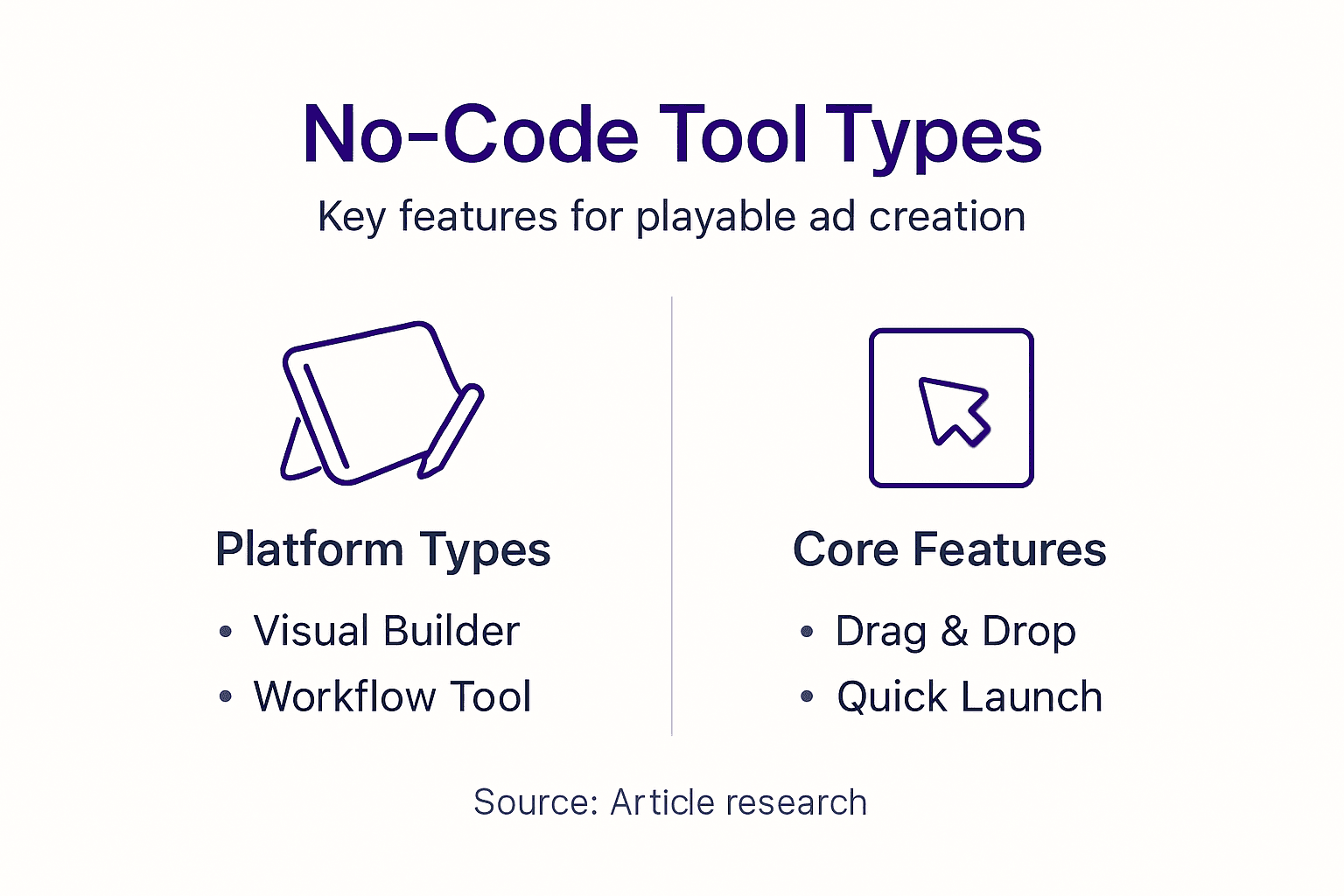
For playable ads specifically, you’ll encounter tools designed for:
To clarify what distinguishes the main categories, here is a summary of key no-code tool types and their primary strengths:
| No-Code Tool Type | Main Purpose | Typical User | Key Impact on Campaigns |
|---|---|---|---|
| Interactive Ad Builder | Create game-like ads visually | Designers, Marketers | Faster creative testing cycles |
| Workflow Automation | Link campaign tools, automate reporting | Campaign Managers | Reduces manual data tasks |
| Process Management | Streamline approvals and deployment | Project Coordinators | Fewer bottlenecks, quicker launches |
| Integration Platform | Connect ads with analytics, networks, CRM | UA Specialists | Unified campaign analytics, real-time |
- Interactive ad builders: Drag-and-drop interfaces for creating game mechanics
- Workflow automation: Connecting ad performance data to your campaign management systems
- Process management: Handling review cycles and deployment pipelines
- Integration platforms: Linking your ads with analytics, ad networks, and player databases
Essential Features That Matter
Drag-and-drop interfaces and integration capabilities form the foundation of effective no-code tools. These features enable faster development cycles without sacrificing functionality.
Here’s what you actually need:
- Pre-built components: Templates for common game mechanics (tapping, swiping, puzzle solving)
- Automation of deployment pipelines: Push updates to ad networks without manual intervention
- Real-time monitoring: Track performance metrics directly within the platform
- Multi-system integration: Connect with your existing UA tools and analytics platforms
The best no-code tools balance ease of use with powerful customisation options, letting non-technical users create sophisticated experiences without learning code.
Real Constraints You Should Know
No-code tools aren’t perfect solutions. Key challenges include limited customisation for highly specific requirements, security considerations with vendor-hosted platforms, and potential vendor lock-in when switching platforms becomes difficult.
These limitations matter less for standard playable ads but become critical if you need highly experimental mechanics or custom integrations.
Selecting the Right Tool for Your Needs
Your choice depends on three factors: campaign complexity, customisation requirements, and team skill level. Start with platforms offering pre-built templates that match your game genre, then evaluate whether additional customisation capabilities justify the learning curve.
Pro tip: Test the tool’s integration capabilities with your existing ad network and analytics stack before committing—platform compatibility often determines whether you’ll save time or create data silos.
Building Playable Ads with No-Code Platforms
Building playable ads shifts from complex development work to strategic creative thinking when you use no-code platforms. The process becomes accessible to anyone with a clear vision, regardless of technical background.
The Basic Workflow
No-code platforms facilitate building executable content through user-friendly interfaces and predefined templates that simplify creation, deployment, and iteration. You start with a template matching your game genre, then customise mechanics, visuals, and messaging without touching code.
The typical workflow follows this pattern:
- Select a template that matches your game type (puzzle, action, casual, etc.)
- Customise game mechanics using drag-and-drop builders
- Add your branding, game assets, and ad messaging
- Test performance across different devices and screen sizes
- Deploy directly to ad networks with one click
- Monitor performance and iterate based on player behaviour
What Actually Happens During Creation
You design interactive mechanics without writing syntax. Highly customisable visual editors and workflow automation let you incorporate interactive elements easily, from tap responses to puzzle logic to narrative branching.
Key actions you perform:
- Define tap zones and interactions: Click areas respond to player input
- Create win/loss conditions: Set what triggers success or failure states
- Design visual feedback: Animations play when players complete actions
- Link to your game: Connect the ad to your app store listing or deep links
- A/B test variants: Create multiple versions with different hooks or mechanics
No-code platforms speed up time-to-market significantly by eliminating development bottlenecks whilst promoting creative experimentation through rapid iteration cycles.
Real Speed Advantages You Get
Traditional playable ad creation took weeks. From concept to launch across multiple ad networks now takes days. Your team tests hypotheses instead of waiting for development sprints.
Speed translates directly into cost savings. You test creative variations quickly, finding winning formulas before scaling spend. Failed experiments consume hours, not weeks of development time.
Integration with Your Marketing Stack
No-code playable ad builders connect directly to your existing tools. Analytics data flows back automatically, tracking which ad variations drive the best user acquisition metrics.
Pro tip: Start with your highest-spend game and test three playable ad variants simultaneously—one highlighting gameplay, one emphasising narrative, one focused on reward mechanics—to identify which hook resonates most with your audience before scaling budgets.
Hidden Costs, Pitfalls, and Limitations
No-code platforms look cost-effective on the surface. But hidden expenses and constraints emerge once you commit to a platform. Understanding these realities prevents expensive surprises later.
The Real Cost Structure
Initial platform fees represent just the beginning. Platform costs accumulate through subscription tiers, per-deployment charges, and premium features, extending far beyond the advertised entry price.
Common hidden expenses include:
- Per-deployment or per-ad fees: Charges based on how many playable ads you publish monthly
- Premium feature unlocks: Advanced customisation, integrations, or analytics cost extra
- Overage fees: Exceeding bandwidth, API calls, or user limits triggers additional charges
- White-label or branding options: Custom domain or removed platform branding adds cost
- Priority support tiers: Faster response times require premium support subscriptions
These pile up quickly when you’re managing multiple game titles across various ad networks.
For reference, here is an overview of common hidden costs found in most no-code platforms beyond their advertised prices:
| Cost Type | Description | Business Impact |
|---|---|---|
| Per-Ad Deployment Fees | Extra charges for each published ad | Increases costs as volume grows |
| Premium Feature Pricing | Higher fee for analytics and custom options | Raises total platform spend |
| Overage Charges | Additional cost for extra usage or traffic | Harder to predict overall costs |
| White-Label Add-ons | Paid upgrades for removing platform branding | Essential for full brand control |
| Priority Support | Quicker help available at extra subscription | Needed for mission-critical ads |
Vendor Lock-In Risk
Vendor lock-in creates dependency risks where migrating from no-code platforms becomes difficult, especially when integrating complex business logic or accumulating months of work within proprietary systems.
Once you’ve built hundreds of playable ads within a platform, switching becomes painful. Your assets, configurations, and optimised workflows exist only within that ecosystem. Exporting data or rebuilding elsewhere consumes enormous time and resources.
Customisation and Scalability Constraints
No-code tools work brilliantly for standard mechanics. But they struggle with highly experimental concepts or genre-specific innovations. Limited scope for customisation and scalability means ambitious creative ideas sometimes require falling back to custom development anyway.
Scalability also suffers. As your playable ad volume grows to thousands monthly, performance sometimes degrades or costs escalate unexpectedly.
Security and Performance Concerns
Potential security vulnerabilities and performance issues emerge since you lack control over the underlying codebase. Platform outages directly impact your campaigns. Data handling practices remain opaque.
Carefully evaluate total cost of ownership before committing to any platform, accounting for hidden fees, potential scaling costs, and long-term maintenance challenges beyond initial development speed.
These limitations don’t eliminate no-code’s value. But they demand realistic planning and platform selection based on your specific constraints.
Pro tip: Before signing up, request a detailed cost breakdown for your expected monthly volume, ask about migration policies if you need to switch platforms, and start with a single high-performing playable ad to understand the true cost structure before scaling.
No-Code vs Traditional and Low-Code Approaches
Three distinct approaches exist for building playable ads: traditional development, low-code platforms, and no-code tools. Each delivers different trade-offs between speed, control, and customisation. Understanding these differences helps you choose the right approach for your specific campaigns.
Traditional Development: Full Control, Maximum Time
Traditional development means your engineers write code from scratch. You gain complete control over every interaction, animation, and data flow. But speed suffers dramatically.
Your development cycle looks like this:
- Specification and planning: 1-2 weeks
- Development and testing: 2-4 weeks
- Iteration based on performance data: 1-2 weeks
- Total: 4-8 weeks per playable ad concept
This approach works when you need highly experimental mechanics or genre-specific innovations that no-code templates can’t support. But the resource cost becomes prohibitive when testing multiple variations.
Low-Code Platforms: The Middle Ground
Low-code platforms combine coding flexibility with visual tools, offering compromise between speed and customisation. Developers write some code whilst using visual builders for the rest.
Your team uses low-code when:
- Standard mechanics need minor customisation
- Your developers want to extend functionality beyond templates
- You require tight integration with proprietary systems
- Performance optimisation demands direct code access
Low-code accelerates development but still requires technical expertise. You’re trading some speed for greater control than pure no-code offers.
No-Code: Speed and Accessibility
No-code provides significantly faster development cycles and lowers entry barriers, allowing non-developers to contribute directly without writing code. Playable ads launch in days instead of weeks.
No-code works best when:
- Testing multiple creative variations rapidly
- Your team lacks in-house development capacity
- Budget prioritises speed over perfect customisation
- Standard game mechanics match your needs
Choose no-code when speed matters more than absolute control; choose low-code when you need flexibility; choose traditional development only when templates fundamentally cannot deliver your vision.
Direct Comparison for Playable Ads
| Factor | Traditional | Low-Code | No-Code |
|---|---|---|---|
| Speed to launch | 4-8 weeks | 1-2 weeks | 2-5 days |
| Customisation ceiling | Unlimited | High | Medium |
| Skill requirement | Senior developers | Mid-level developers | No technical skills |
| Cost per ad | £3,000-£10,000 | £800-£2,000 | £50-£400 |
| Iteration speed | Slow | Fast | Very fast |
For user acquisition specialists, no-code platforms deliver the best return on investment when you’re testing hooks and mechanics. Traditional development makes sense only for your highest-performing games where experimental mechanics could move the needle.
Pro tip: Start campaigns with no-code playable ads to test creative concepts quickly, then invest in traditional development only for proven winners that warrant custom optimisation.
Accelerate Your Playable Ads with No-Code Solutions
The article highlights a common challenge in user acquisition today: speeding up playable ad creation without draining developer resources or exploding your budget. If you find yourself stuck waiting weeks for traditional development cycles or struggling with costly coding demands, you are not alone. The concept of no-code tools promises rapid iteration, greater creative freedom, and budget-friendly campaigns—exactly what your team needs to gain a competitive edge.
At PlayableMaker, we share your goal to make playable ads simple, quick and affordable. Our platform specifically addresses the pain points discussed, offering a fully no-code experience that lets marketers and designers build effective interactive ads faster than ever. Ready to test more concepts and launch winning campaigns with zero coding knowledge? Discover how no-code playable ads can transform your user acquisition strategy today.
Unlock rapid creative testing, reduce dependency on precious developer hours and cut hidden costs by starting your first project with PlayableMaker. Experience the future of interactive ads by visiting https://app.playablemaker.com and turning your ideas into live playable ads in days, not weeks.
Frequently Asked Questions
What are no-code tools for playable ads?
No-code tools allow non-developers to create playable ads using intuitive visual interfaces, eliminating the need for coding. They enable rapid development and iteration of interactive ad experiences.
How do no-code platforms accelerate the ad creation process?
No-code platforms streamline the ad creation workflow by providing drag-and-drop builders and pre-configured components, allowing campaigns to be launched in days instead of weeks, increasing the speed of testing and iteration.
What types of no-code tools are available for creating playable ads?
Key types of no-code tools include interactive ad builders which focus on creating visual ads, workflow automation tools for linking campaign elements, process management platforms for approvals, and integration platforms that connect ads with analytics and CRM systems.
What are the potential limitations of using no-code platforms?
While no-code tools offer accessibility and speed, they may have limited customisation for unique requirements, potential vendor lock-in risks, and could pose security issues due to reliance on external platforms.
Recommended
- Playable Ad Trends 2025: Build Engaging Ads Without Coding – playablemaker.com Playable Ad Trends 2025: Build Engaging Ads Without Coding
- Iterating Playable Ads: Transforming User Acquisition – playablemaker.com Iterating Playable Ads: Transforming User Acquisition
- 7 Essential Ad Design Tips for Mobile Games in 2025 – playablemaker.com 7 Essential Ad Design Tips for Mobile Games in 2025
- Master Effective Playable Ad Techniques for Mobile Gaming – playablemaker.com Master Effective Playable Ad Techniques for Mobile Gaming