Every mobile game studio faces tight budgets and mounting pressure to deliver profitable player growth. For user acquisition managers, the difference between campaigns that attract loyal spenders and those that waste marketing spend often hinges on the advertising conversion rate. This metric reveals whether your ads and app store pages actually prompt installs, in-app purchases, and subscriptions. Discover how focusing on cost-efficient conversion rate improvements using no-code, interactive ad formats creates real and measurable impact without demanding extra development resources.
Table of Contents
- Advertising Conversion Rate Defined For Gaming
- Major Interactive Ad Formats Compared
- Characteristics Of Effective Playable Ads
- Measuring Conversion Rate And Success Metrics
- Requirements For High-Performing Campaigns
- Common Pitfalls In Optimising Conversion Rate
Key Takeaways
| Point | Details |
|---|---|
| Understand Conversion Metrics | Track different conversion events like installs and in-app purchases to optimise ad campaigns effectively. |
| Choose Effective Ad Formats | Select ad formats based on player stage; use playable ads for new users and rewarded ads for engaged players. |
| Focus on Audience Segmentation | Segment audiences by gaming behaviour and demographics to improve targeting and conversion rates. |
| Measure Retention Alongside Conversion | Combine conversion metrics with retention and revenue data for a complete assessment of ad campaign success. |
Advertising Conversion Rate Defined For Gaming
In mobile gaming, advertising conversion rate isn’t just another metric to track. It’s the foundation that determines whether your user acquisition campaigns succeed or drain your budget. Conversion rate in online advertising measures the percentage of users who click on an ad and then complete a desired action, such as downloading your game, making an in-app purchase, or reaching specific milestones. For mobile game studios, this metric directly translates to whether your marketing pounds are generating genuine, profitable players or simply burning cash on inactive installs.
Understand this clearly: not all installs are equal. A player who installs your game after clicking an ad might uninstall within seconds. Another might stay for months and spend money. The conversion rate isolates the initial critical moment, but in gaming specifically, it encompasses multiple conversion events. You measure conversions when a user clicks an ad and installs the game, when they make their first in-app purchase, when they reach specific progression milestones, or when they subscribe to premium features. This distinction matters because different campaigns optimise for different outcomes. A user acquisition campaign focuses on installation rates, whilst a retention campaign measures whether existing players convert to paying customers. When you’re planning your ad strategy, knowing which conversion event you’re actually optimising for prevents wasted effort and misaligned budgets.
The reason conversion rate matters so much in mobile gaming comes down to cost efficiency. Your customer acquisition cost (CAC) is your total marketing spend divided by the number of conversions you generate. If you spend £1,000 on ads and get 100 conversions, your CAC is £10 per conversion. If you improve your conversion rate by just 20%, you’re now acquiring those same 100 players for £800, freeing up £200 for other campaigns or improving your profit margins. This is why understanding how conversion rates function across different advertising channels becomes essential as you scale your user acquisition efforts. When you’re building a no-code playable ad without burning resources or requiring specialist developers, you’re essentially creating an interactive experience that increases this conversion rate by letting potential players experience your game before committing to an install.
Pro tip: Track conversions separately by ad campaign, platform, and audience segment rather than as a single aggregate number. This reveals which specific ads and targeting combinations deliver the best conversion rates, allowing you to reallocate budget away from underperformers within days instead of waiting for monthly reports.
Major Interactive Ad Formats Compared
When you’re choosing which ad format to deploy for your mobile game user acquisition campaign, you’re essentially choosing between different levels of player engagement and different conversion pathways. The three dominant formats in gaming today are playable ads, rewarded video ads, and native in-game advertisements, and each delivers results through distinctly different mechanisms. Playable ads let potential players interact with a simplified version of your game directly within the ad experience, creating a hands-on preview before they commit to installation. Rewarded video ads play a full video advertisement in exchange for an in-game reward, turning the ad into a transaction rather than an interruption. Native ads embed promotional content seamlessly into the gaming environment itself, whether as billboards, product placements, or branded elements that feel part of the game world. The critical difference lies in when and how users convert. Playable ads convert during the ad experience itself because users install after trying the game. Rewarded ads convert based on incentive structures that encourage players already engaged with your game to watch promotional content. Native ads work on brand integration and contextual relevance.
Understanding how interactive advertising formats differ in their mechanics helps you allocate budget strategically. Consider your audience stage. If you’re acquiring new players cold (people who’ve never heard of your game), playable ads outperform because they reduce friction between curiosity and action. A user sees an ad, plays a 30-second snippet, and either installs or moves on. No guesswork. Rewarded ads work best with existing engaged players because they already understand your game’s value proposition and just need a motivational nudge to watch an advertisement. Native ads function differently still, operating on brand recall and environmental storytelling rather than immediate action. They build perception and trust over time, making them better suited for long-term brand campaigns rather than aggressive user acquisition sprints.
The conversion rate differences between formats are substantial. Playable ads and advergames represent distinct advertising strategies with different engagement and conversion profiles. Playable ads typically generate 25 to 40 per cent higher conversion rates than static video ads because the interactive element drastically increases engagement. Rewarded videos maintain decent conversion rates but cost less per impression, making them efficient for scale. Native ads deliver lower conversion rates but significantly higher lifetime value because players who engage with native advertising tend to stay longer and spend more. Your choice ultimately depends on your current position. New game launching? Playable ads. Established game needing scale? Mix rewarded ads with native placements. Limited budget? Start with playable ads on a no-code platform that doesn’t require engineering resources or massive creative investment, then layer in rewarded and native once you understand your player acquisition cost targets.
Here’s how key interactive ad formats differ for mobile gaming:
| Ad Format | Main Engagement Method | Typical Conversion Rate Impact | Best Use Case |
|---|---|---|---|
| Playable Ads | Interactive game demo | Highest, boosts by 25–40% | Rapid new user acquisition |
| Rewarded Video Ads | Video for in-game reward | Moderate, cost-effective at scale | Monetising engaged players |
| Native In-Game Ads | Seamless brand integration | Lowest rate, high lifetime value | Long-term brand building |
Pro tip: Test one primary ad format intensively for two weeks before adding a second format, measuring cost per install and seven-day retention for each separately, which reveals which format actually delivers players who stick around rather than just installing and quitting immediately.
Characteristics Of Effective Playable Ads
Effective playable ads share a cluster of distinct characteristics that separate them from static banners or video content. The most obvious one is brevity. Your playable ad needs to capture the core gameplay loop within 15 to 60 seconds, not showcase every feature your game offers. A user scrolling through their social feed has approximately 3 seconds to decide whether to engage with your ad or keep scrolling. That makes immediate clarity crucial. Within those first 3 seconds, a player needs to understand what they’re about to experience and why it matters. A puzzle game should show a level immediately with intuitive tap mechanics. A strategy game should display a unit on screen ready to be commanded. A shooting game should put a weapon in the player’s hands. The gameplay preview must feel authentic to the actual game, not a watered-down simulation that disappoints players after they install. This authenticity builds trust. When a player experiences the real core mechanic of your game in an ad and then installs it to find the exact same experience, their conversion from install to active player improves dramatically.
High interactivity and engaging gameplay mechanics drive conversion because they create emotional investment in seconds. Rather than passively watching something happen, players actively participate. This participation triggers deeper engagement patterns in the brain compared to watching a video. Beyond interactivity, load speed matters intensely. A playable ad that takes more than 3 seconds to become interactive loses players to abandonment. Users on 3G connections, users with older phones, users with limited patience all exit if your ad feels sluggish. Additionally, your call to action must be crystal clear and timely. Some playable ads fail because they bury the install button or time it poorly. The ideal moment for the install prompt is right after a satisfying gameplay moment, when a player feels momentum and achievement. That’s when they’re most likely to commit to downloading the full game.

The last critical characteristic is relevance alignment. Intuitive design and relevance to actual game content determine whether players who install actually stay engaged. If your playable ad features a core mechanic that’s barely present in the full game, or if the art style differs dramatically, players experience buyer’s remorse within minutes of installing. This directly damages your retention metrics and undermines your user acquisition investment. Effective playable ads use the exact same art style, character designs, and visual polish as the actual game. They showcase the primary mechanic players will spend 80 per cent of their time with, not a secondary minigame. When everything aligns, players install expecting exactly what they experienced in the ad, and that predictability drives better lifetime value. Building these ads without stretching your team’s engineering capacity or burning budget is why no-code platforms have become essential for user acquisition managers at growth-focused studios.
Pro tip: Record gameplay footage of your playable ad in production and compare it side-by-side with footage from your actual game, paying particular attention to visual fidelity, control responsiveness, and how long it takes to reach a satisfying gameplay moment, since misalignment between ad and game is one of the top causes of high install rates paired with poor retention.
Measuring Conversion Rate And Success Metrics
Measuring conversion rate accurately requires understanding exactly what you’re measuring and why the specific numbers matter to your bottom line. At its core, conversion rate is a ratio: the number of desired actions (installs, purchases, subscriptions) divided by the number of opportunities (clicks or impressions). If your playable ad receives 10,000 clicks and generates 1,200 installs, your conversion rate is 12 per cent. Straightforward maths. But here’s where most user acquisition managers stumble. Conversion rate alone tells you almost nothing about campaign profitability. You could have a 15 per cent conversion rate with a £5 cost per click, yielding a £33.33 cost per install. You could have an 8 per cent conversion rate with a £1 cost per click, yielding a £12.50 cost per install. The second campaign is financially superior despite its lower conversion rate. This is why measuring conversion rate alongside cost metrics reveals the true picture. You need to track conversion rate, but pair it immediately with cost per install (CPI), cost per action (CPA), and return on advertising spend (ROAS).
Beyond the immediate install metrics, success requires measuring what happens after installation. A player could install your game and never open it again, representing zero value despite contributing to your conversion rate. This is where retention metrics become non-negotiable. Track day-one retention (D1), day-seven retention (D7), and day-thirty retention (D30). These metrics reveal whether your playable ad is accurately representing your game or whether you’re acquiring players who feel deceived. If your D1 retention is below 25 per cent, your playable ad is likely overselling the experience or attracting the wrong audience. Additionally, measure in-app purchase frequency and average revenue per user to understand monetisation performance. A player with a 40 per cent D7 retention but £0 lifetime value represents a different problem than a player with 15 per cent D7 retention but £8 lifetime value. The second player is financially more valuable despite appearing weaker on retention alone. This is why comprehensive success measurement requires simultaneously tracking acquisition metrics, engagement metrics, and monetisation metrics rather than obsessing over conversion rate in isolation.
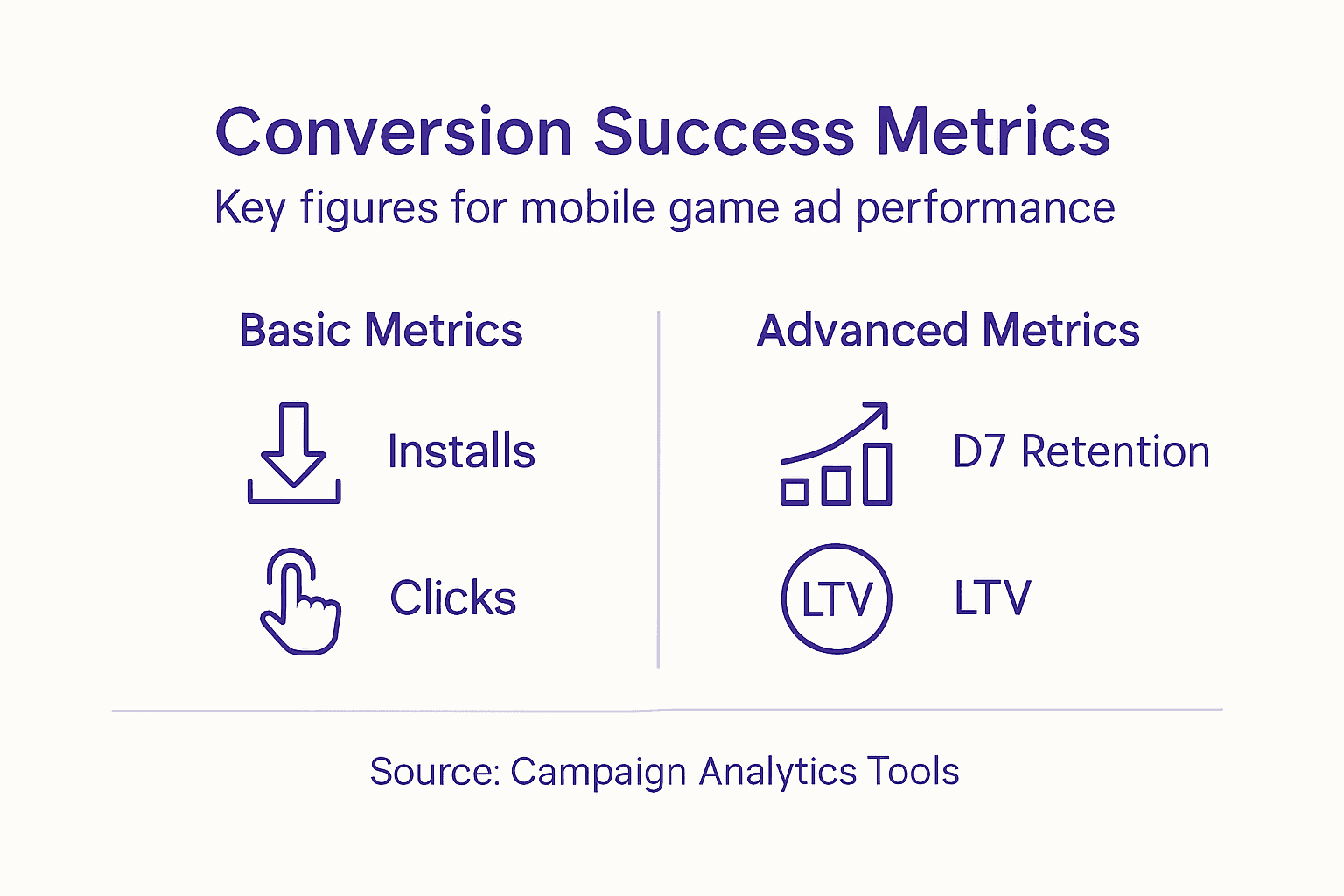
Implementing this measurement requires setting up proper analytics infrastructure before launching campaigns. Use platforms that allow you to track individual players from ad click through to their first purchase and beyond. Segment your data by ad format, platform, audience demographic, and creative variation so you can identify which specific campaigns drive both conversion and value. Establish baseline targets before launch. If industry benchmarks show a 10 per cent conversion rate with £1.50 CPI and 25 per cent D7 retention for your game category, use these as reference points. Monitor your campaigns weekly rather than monthly. A campaign performing poorly reveals itself within days, and pausing or adjusting it saves thousands in wasted spend. Poor conversion rate today means poor player acquisition efficiency today, not a problem to address next quarter.
Below is a summary of metrics crucial for campaign success and why each matters:
| Metric | What It Measures | Why It Matters |
|---|---|---|
| Conversion Rate | Clicks to installs/actions | Assesses initial ad efficiency |
| Cost Per Install (CPI) | Ad spend per install | Shows acquisition efficiency |
| D7 Retention Rate | Installs still active at day 7 | Indicates real player quality |
| Average Revenue Per User | User spend over time | Reveals monetisation success |
Pro tip: Create a simple spreadsheet that calculates lifetime value payback period for each ad campaign by dividing cost per install by average revenue per user, which shows you exactly how many days of player activity are required to break even on acquisition spend and identifies which campaigns generate profitable players fastest.
Requirements For High-Performing Campaigns
High-performing mobile game ad campaigns don’t happen by accident. They require systematic attention to several critical components that work together to drive both conversion and value. The first requirement is precise audience segmentation. Blast campaigns targeting “everyone aged 18 to 65” produce mediocre results because you’re funding conversions from players who’ll uninstall within days alongside genuine long-term players. Instead, segment your audiences by prior gaming behaviour, device type, geographic location, and purchase history. A player who previously spent money on puzzle games should see different ads than someone who plays free-to-play shooters. A player on a flagship device with 8GB RAM should see graphically demanding gameplay, whilst a player on a mid-range device should see your game’s optimised experience. Data-driven audience segmentation and creative alignment directly improve conversion rates because you’re matching the right game experience preview to the right player. When your targeting precision improves, your cost per install drops and your retention improves simultaneously.
The second requirement is creative testing at scale. You cannot know which playable ad variation performs best without testing multiple versions. Create variations that test different hooks, different gameplay mechanics, different visual styles, and different call-to-action placements. Run each variation to a statistically significant sample (typically 1,000 to 5,000 conversions per variation) before declaring a winner. Most user acquisition managers test three to five variations, discover one clear winner with a 30 per cent higher conversion rate, and scale into that winner. This process takes two to three weeks but yields compounding returns. The conversion rate improvement you discover from testing doesn’t decay. That 30 per cent uplift applies to your entire user acquisition volume going forward, directly multiplying your profitable player acquisition. Additionally, balancing reach and engagement through data-backed creative testing prevents the common trap of optimising purely for volume at the expense of quality. A playable ad might achieve high conversion rate by targeting the lowest common denominator, attracting players who uninstall immediately. Testing reveals whether high conversion rate actually correlates with strong retention.
The third requirement is cross-platform optimisation and network diversification. Different ad networks and platforms attract different player populations with different behaviour patterns. Facebook and Instagram audiences often respond better to social-proof and community messaging. TikTok audiences respond to novelty and entertainment value. Google and Apple Search audiences are actively searching for games. Unity and ironSource audiences comprise existing mobile gamers with high purchase intent. Running your campaign on a single network leaves substantial volume on the table. Allocate your budget across networks proportional to their historical performance, then adjust weekly as new data arrives. Don’t chase volume on underperforming networks just because they’re cheap. A low-cost network with 3 per cent D7 retention wastes money faster than an expensive network with 35 per cent D7 retention. Your goal is profitable players, not cheap installs.
Pro tip: Before launching any campaign, set a minimum threshold for D7 retention below which you’ll pause regardless of cost per install, typically around 20 to 25 per cent for casual games and 15 to 20 per cent for hardcore games, which prevents you from scaling campaigns that acquire players destined to churn and eliminates the most toxic spend from your budget automatically.
Common Pitfalls In Optimising Conversion Rate
Optimising conversion rate looks straightforward until you realise how many ways this seemingly simple task can go badly wrong. The first major pitfall is obsessing over conversion rate in isolation whilst ignoring retention and value metrics. A playable ad could generate a 20 per cent conversion rate by showing something flashy that bears no resemblance to your actual game, attracting players who install and uninstall within hours. Your conversion metric looks fantastic. Your retention metrics look catastrophic. Your lifetime value is negative. This happens because conversion rate measures only the ad click to install moment, not the outcomes that actually drive profitability. You optimised the wrong metric. Instead, treat conversion rate as one component of a larger system. Optimise for the combination of conversion rate, cost per install, and day-seven retention simultaneously. If improving conversion rate by 5 per cent causes retention to drop by 8 percentage points, you’ve made your campaign worse, not better.
The second pitfall is data attribution bias and cross-platform confusion. When a player sees your ad on Facebook, clicks, installs your game, and makes a purchase three days later, which touchpoint gets credit? Facebook takes credit. But that same player might have seen your Google ad yesterday, your TikTok ad last week, or received an organic recommendation from a friend. Data biases and multi-channel attribution challenges distort your understanding of which campaigns actually drive conversions. You might be scaling a Google campaign that appears high-performing when Facebook is actually the driver, and Google is simply catching players already interested from other sources. To counteract this, use multi-touch attribution models that assign fractional credit across all touchpoints rather than last-click attribution. If that feels too complex, at least segment your analysis by cohort. Track players acquired from each channel separately and measure their retention independently. A channel with 15 per cent conversion rate but 8 per cent D7 retention is underperforming compared to a channel with 10 per cent conversion rate but 28 per cent D7 retention, regardless of which shows higher raw conversion numbers.
The third pitfall is testing too many variables simultaneously and declaring winners prematurely. You test five playable ad variations, run them for three days, and pause four of them because one shows higher conversion rate. That’s statistical nonsense. With small sample sizes, random variation masquerades as genuine performance differences. You need 1,000 to 5,000 conversions minimum per variation before you can confidently say one version outperforms another. Additionally, testing five variables at once (hook, gameplay mechanic, visual style, call-to-action, difficulty level) creates noise that obscures which variable actually matters. Test one variable at a time, reach statistical significance, lock in the winner, then test the next variable. This methodical approach takes longer but yields reliable insights you can actually scale. The temptation to move fast and test everything creates an illusion of progress whilst burning budget on inconclusive experiments.
Pro tip: Create a simple testing calendar that specifies which variable you’re testing each week, minimum sample size required before declaring a winner, and launch date for scaling winning variations, which prevents the chaos of simultaneous testing and ensures you’re always learning from statistically valid data rather than chasing noise.
Boost Your Mobile Game Installs with Effortless Playable Ads
The article highlights a common challenge faced by mobile game studios: how to optimise advertising conversion rates without draining valuable time and budgets. Creating authentic playable ads that truly reflect your game often demands extensive developer resources and significant costs. This slows down your ability to test creative variations quickly and scale campaigns that attract high-quality, engaged players who stick around beyond the install.
At PlayableMaker, we understand the pain points of balancing conversion efficiency, retention alignment, and limited resources. Our no-code platform lets you build interactive playable ads fast and budget-friendly, eliminating the engineering bottleneck while maintaining authenticity and visual fidelity. Whether you want to rapidly test multiple ad variations or launch high-conversion campaigns, our solution empowers growth teams to act now and elevate your conversion rates without the heavy lift.
Ready to transform your user acquisition strategy with cost-effective playable ads tailored for real player engagement? Explore insights on campaign publishing in our Publishing Archives and get expert support via our Help Archives. Discover how easy creating impactful playable ads can be at PlayableMaker. Take control of your mobile game installs and see measurable improvements today.
Frequently Asked Questions
What is advertising conversion rate in mobile gaming?
Advertising conversion rate measures the percentage of users who click on an ad and subsequently complete a desired action, such as downloading a game or making an in-app purchase. It is crucial for assessing the effectiveness of user acquisition campaigns.
How can I improve my mobile game’s advertising conversion rate?
To improve your advertising conversion rate, consider using playable ads, as they allow potential players to interact with a simplified version of your game. Additionally, ensure your ads are clear and relevant to the actual gameplay to build trust and maintain retention.
What are the key metrics to measure alongside conversion rate for mobile games?
Key metrics to measure alongside conversion rate include cost per install (CPI), day-one (D1) and day-seven (D7) retention rates, and average revenue per user (ARPU). These metrics provide insights into the profitability and overall success of your user acquisition campaigns.
Why is audience segmentation important for mobile game advertising?
Precise audience segmentation is essential as it allows you to tailor your ads to specific player profiles based on prior gaming behaviour and preferences. This targeting enhances conversion rates by ensuring that your ad content resonates with potential players who are more likely to engage with your game.
Recommended
- Conversions Advertising: Maximising Mobile Game Installs – playablemaker.com Conversions Advertising: Maximising Mobile Game Installs
- Understanding Conversion Rate in Advertising: A Complete Guide – playablemaker.com Understanding Conversion Rate in Advertising: A Complete Guide
- Facebook Ad Conversion Rates: Boosting Mobile Games – playablemaker.com Facebook Ad Conversion Rates: Boosting Mobile Games
- 8 Key Ad Performance Metrics for Mobile Gaming Success – playablemaker.com 8 Key Ad Performance Metrics for Mobile Gaming Success