Not all creatives perform equally, and if you’re still relying on static images or standard video ads, you’re likely leaving conversions on the table. Playable ads have emerged as a game-changing format in mobile gaming user acquisition, delivering substantially higher engagement and conversion rates than traditional approaches. This interactive format allows potential players to experience your game before installing, qualifying interest and driving higher-quality traffic. Throughout this guide, you’ll discover the data-backed reasons playable ads outperform conventional creatives, the structural elements that make them effective, and budget-friendly tactics to implement them successfully in your 2026 campaigns.
Table of Contents
- How Playable Ads Drive Higher User Engagement And Conversion
- The Essential Three-Part Structure Of Effective Playable Ads
- Key Performance Metrics And Creative Strategies For Maximising Conversion
- Budget-Friendly Tactics: Optimising Playable Creatives For Mobile Game User Acquisition
- Explore PlayableMaker’s Tools For Effective Playable Ad Campaigns
Key takeaways
| Point | Details |
|---|---|
| Interactive engagement drives quality | Playable ads qualify user interest through hands-on experience, leading to higher Day 1 retention and lower bounce rates compared to passive ad formats |
| Three-part structure maximises impact | Successful playable ads combine a lead-in video, interactive experience, and end card to capture attention, engage users, and drive action efficiently |
| Critical metrics guide optimisation | Focus on installs per mille (IPM), engagement rate, and time to engage to measure and improve playable ad performance systematically |
| Budget-friendly tactics reduce costs | Simplified game loops, no-code tools, asset repurposing, and iterative A/B testing enable high-converting playable ads without excessive spend |
How playable ads drive higher user engagement and conversion
Playable ads fundamentally differ from static images and video ads because they require active participation rather than passive consumption. When users interact with a mini-game experience embedded in your ad, they’re making a conscious decision about whether your game appeals to them before ever clicking through to the app store. This self-qualification process means that users who do install have already demonstrated genuine interest, resulting in dramatically higher-quality traffic.
The conversion advantage becomes clear when examining key performance indicators. Playable ads generate higher intent users because the click happens after meaningful engagement, reducing bounce rates and increasing Day 1 retention. Instead of attracting casual scrollers who might install on impulse and immediately delete your game, playable ads filter for users who’ve already enjoyed a taste of your core gameplay loop.
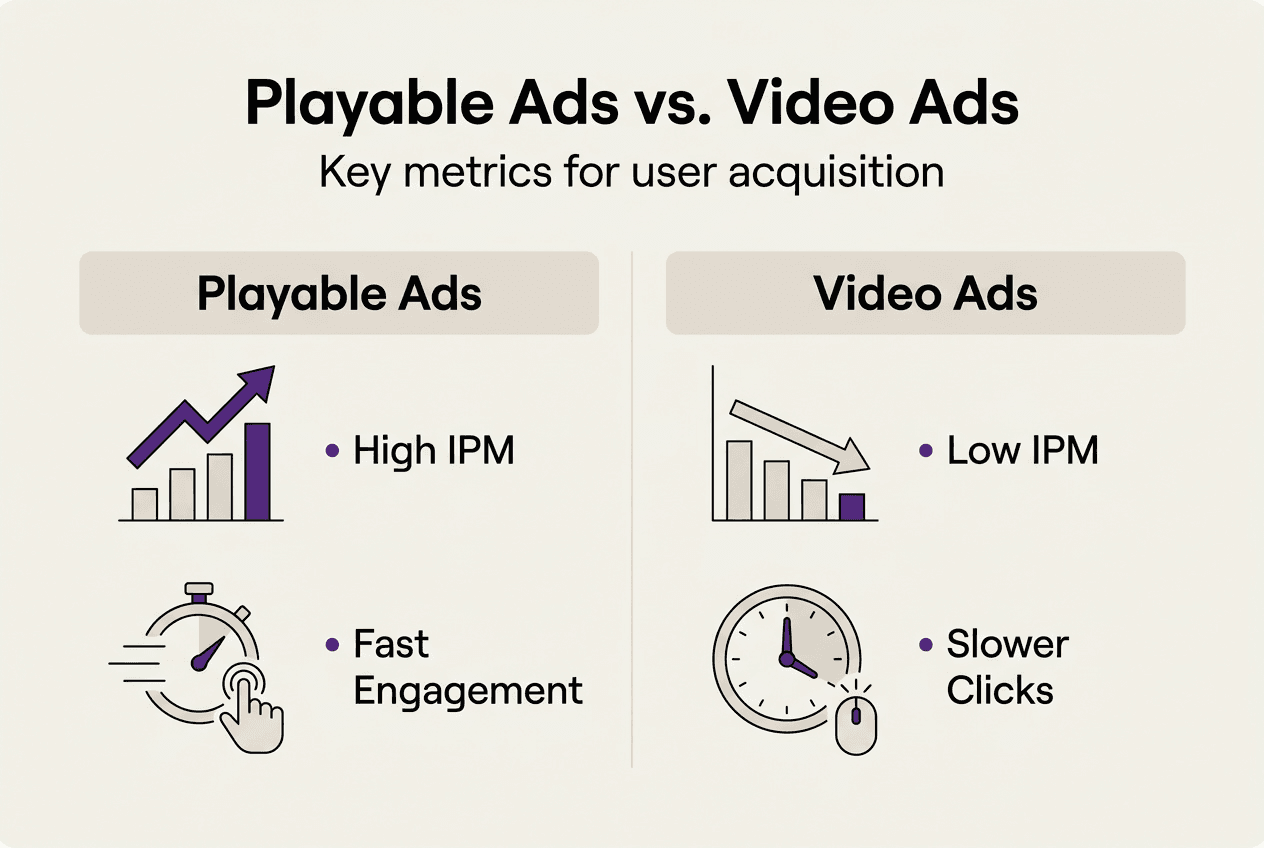
Installs per mille (IPM) serves as a crucial efficiency metric here. Higher IPM values indicate that more users within every thousand impressions are converting to installs, which directly translates to better return on ad spend. Playable ads consistently demonstrate superior IPM compared to static or video alternatives because the interactive element creates memorable experiences that motivate action.
Retention metrics tell an equally compelling story. When users experience gameplay mechanics before installing, they arrive with accurate expectations about what your game offers. This trial-like experience eliminates the disappointment factor that plagues traditional ads where the actual game differs from promotional materials. The result is improved Day 1, Day 7, and Day 30 retention rates that compound into significantly better lifetime value per user.
Key advantages of playable ads for user engagement:
- Users self-qualify through interaction, filtering out low-intent traffic automatically
- Memorable hands-on experiences increase brand recall and install likelihood
- Accurate gameplay previews set proper expectations, reducing early churn
- Higher engagement depth signals quality to platform algorithms, improving ad delivery
The engagement depth also matters for platform optimisation algorithms. Networks like Facebook and Google favour ads that generate meaningful interaction because engaged users represent better experiences for their platforms. This creates a virtuous cycle where well-performing playable ads receive preferential delivery, further amplifying your reach efficiency. Understanding the differences between playable ads vs static ads helps you appreciate why this format consistently outperforms in competitive user acquisition landscapes.
The essential three-part structure of effective playable ads
Successful playable ads follow a proven framework that maximises engagement whilst respecting users’ limited attention spans. The success of playable ads relies on a three-part structure: Lead-in Video, Interactive Experience, and End Card. Each component serves a specific purpose in the conversion journey, and removing or weakening any element diminishes overall performance.

The lead-in video functions as your hook, capturing attention within the first two seconds as users scroll through their feeds. This brief video segment, typically three to five seconds, establishes context and entices users to engage with the interactive portion. Effective lead-ins showcase exciting gameplay moments, highlight unique mechanics, or present intriguing challenges that make users curious enough to interact. The goal isn’t to explain everything but to generate sufficient interest that users want to try the experience themselves.
Following the lead-in, the interactive experience represents the core value proposition of playable ads. This simplified version of your game allows users to engage with fundamental mechanics without overwhelming complexity. The interaction should last 15 to 30 seconds, providing enough time to demonstrate your game’s appeal whilst maintaining momentum toward conversion. Successful interactive segments focus on one or two core mechanics rather than attempting to showcase every feature, ensuring users grasp the gameplay concept quickly.
The end card completes the journey by presenting a clear call-to-action alongside compelling visuals and messaging. This final component reinforces the value users just experienced and provides explicit direction on the next step, whether that’s installing the game, claiming a reward, or exploring additional content. Effective end cards include prominent install buttons, highlight key game features or rewards, and create urgency through limited-time offers or exclusive bonuses.
Optimal playable ad structure follows this sequence:
- Lead-in video captures attention and establishes context within three to five seconds
- Interactive experience demonstrates core gameplay through simplified, engaging mechanics lasting 15 to 30 seconds
- End card drives conversion with clear calls-to-action, compelling visuals, and incentive messaging
- Total experience duration remains under 45 seconds to maintain engagement and prevent drop-off
Pro Tip: Resist the temptation to create full game demos within your playable ads. Users don’t need to experience every feature before installing; they need to understand and enjoy your core value proposition. Simplified interactions that highlight one compelling mechanic convert better than complex experiences that overwhelm or confuse potential players.
This structured approach ensures consistency whilst allowing creative flexibility within each component. Different creative ad formats list mobile marketers can leverage, but the three-part playable structure remains foundational for driving conversions. Examining successful playable ads campaign breakdown mobile games reveals how top-performing ads execute this framework with genre-specific variations that maintain the essential structure whilst adapting to unique gameplay elements.
Key performance metrics and creative strategies for maximising conversion
Measuring playable ad performance requires focusing on metrics that reflect both efficiency and engagement quality. Focus on IPM (Installs Per Mille), Engagement Rate, and Time to Engage as key metrics for playable ads. These indicators provide actionable insights that enable continuous optimisation of your creative assets and targeting strategies.
Installs per mille (IPM) measures how many installs you generate per thousand ad impressions, serving as a direct efficiency indicator. Higher IPM values mean you’re converting a larger percentage of users who see your ad, which translates to lower acquisition costs and better return on ad spend. Tracking IPM across different playable ad variations helps identify which creative approaches resonate most strongly with your target audience.
Engagement rate gauges the depth of user interaction within your playable ad experience. This metric tracks what percentage of users who see your ad actually engage with the interactive component, and how thoroughly they interact once engaged. High engagement rates indicate compelling creative that successfully motivates users to participate, whilst low engagement suggests your lead-in video or initial presentation needs refinement.
Time to engage measures how quickly users begin interacting with your playable ad after it appears in their feed. Faster engagement times correlate with higher conversion rates because they indicate immediate interest and reduce the likelihood users will scroll past before the interactive element loads. Optimising load times and creating irresistible lead-in content both contribute to improved time to engage metrics.
Creative strategies that enhance these metrics include simplifying gameplay loops to their most engaging elements, communicating reward structures clearly within the interactive experience, and ensuring seamless transitions between the lead-in, interaction, and end card. Testing variations of each component helps identify optimal combinations that maximise both engagement and conversion.
| Metric | Playable Ads | Standard Video Ads | Improvement |
|---|---|---|---|
| IPM | 8.2 | 4.7 | 74% higher |
| Click-Through Rate | 3.8% | 1.9% | 100% higher |
| Conversion Rate | 12.4% | 7.1% | 75% higher |
| Cost Per Install | £1.85 | £2.94 | 37% lower |
Pro Tip: Optimise your lead-in video length based on platform-specific user behaviour. Facebook users typically engage faster with shorter lead-ins of two to three seconds, whilst other platforms may benefit from slightly longer contextual setups. A/B testing different lead-in durations reveals platform-specific preferences that significantly impact overall engagement rates.
Implementing best practices for playable ads insights and strategies requires continuous testing and refinement. The mobile gaming landscape evolves rapidly, and creative fatigue affects even high-performing ads over time. Establishing systematic testing protocols ensures you’re always improving performance rather than relying on static creative assets. Exploring diverse creative ad concepts mobile game marketers can leverage provides inspiration for fresh approaches that maintain engagement whilst your core playable ad structure remains consistent.
Budget-friendly tactics: optimising playable creatives for mobile game user acquisition
Creating effective playable ads doesn’t require massive budgets or extensive development resources when you apply strategic, cost-conscious approaches. Campaigns with well-defined interactive objectives can boost brand recommendation by 21% and purchase intent by 9%, demonstrating that thoughtful creative execution matters more than production budgets. Additionally, playable ads can lead to a reduction in Cost Per Install (CPI), making them financially advantageous even for teams with limited resources.
Simplifying your interactive gameplay loop represents the most impactful budget-friendly tactic. Rather than building complex mini-games that require extensive development time, focus on one core mechanic that exemplifies your game’s appeal. A puzzle game might showcase a single challenging level, whilst an action game could highlight a brief combat sequence. This focused approach reduces development complexity whilst maintaining the engagement benefits that make playable ads effective.
Leveraging no-code tools democratises playable ad creation, enabling creative teams to produce interactive experiences without relying on engineering resources. These platforms provide templates and drag-and-drop interfaces that significantly accelerate production timelines whilst containing costs. The accessibility of no-code solutions means you can iterate rapidly, testing multiple creative variations to identify top performers without accumulating substantial development expenses.
Repurposing existing game assets maximises the value of resources you’ve already created. Character models, background art, sound effects, and UI elements from your actual game can be adapted for playable ads, ensuring visual consistency whilst eliminating redundant asset creation. This approach also guarantees that your playable ad accurately represents the installed game experience, setting proper user expectations that improve retention.
Iterative A/B testing accelerates optimisation whilst containing costs by revealing which creative elements drive performance improvements. Rather than investing heavily in a single elaborate playable ad, create multiple simpler variations that test different hooks, interactive mechanics, or end card messaging. This data-driven approach identifies winning formulas that inform future creative development, ensuring your budget focuses on proven approaches rather than speculative experiments.
| Approach | Budget Impact | Complexity | Conversion Lift |
|---|---|---|---|
| Playable ads (simplified) | Low | Medium | High (60-80%) |
| Video ads (standard) | Medium | Low | Medium (20-30%) |
| Playable ads (complex) | High | High | High (70-90%) |
| Static ads | Low | Low | Low (baseline) |
Budget-friendly playable ad tactics:
- Focus on one core gameplay mechanic rather than comprehensive game demonstrations
- Utilise no-code platforms that enable rapid prototyping without engineering resources
- Repurpose existing game assets to maintain consistency whilst reducing production costs
- Implement systematic A/B testing to identify high-performing creative elements efficiently
- Start with shorter interactive sequences that require less development whilst proving engagement potential
Pro Tip: Begin with three simple playable ad variations testing different core mechanics or hooks rather than investing heavily in a single elaborate concept. This diversified approach provides comparative performance data that guides future creative investment toward proven engagement drivers, maximising return on your initial budget allocation.
Understanding repurposing ad creatives mobile gaming strategies extends your creative assets’ value across multiple campaigns and platforms. A well-designed playable ad can be adapted for different audience segments, seasonal promotions, or platform-specific requirements with minimal additional investment. Exploring tools like the playable builder drag and drop creator empowers teams to execute these tactics efficiently, transforming playable ad creation from a resource-intensive process into a manageable, repeatable workflow that consistently delivers strong acquisition results.
Explore PlayableMaker’s tools for effective playable ad campaigns
PlayableMaker provides user acquisition specialists with intuitive, no-code solutions for creating engaging playable ads that drive conversions without exhausting budgets or engineering resources. The platform integrates proven psychological principles and structural best practices into accessible tools that enable rapid prototyping, testing, and deployment of interactive ad experiences. Whether you’re launching your first playable ad campaign or optimising existing creative strategies, PlayableMaker’s resources support every stage of the process.
Understanding why playable ads are effective from a psychological perspective helps you create more compelling interactive experiences that resonate with potential players. The platform’s educational content demystifies the cognitive and behavioural factors that make playable ads superior to traditional formats, empowering you to apply these insights in your creative development. For comprehensive foundational knowledge, exploring playable ads explained provides context on how this format revolutionises digital engagement across mobile gaming.
The playable builder drag and drop creator eliminates technical barriers, enabling creative teams to build interactive ad experiences through intuitive visual interfaces. This approach accelerates production timelines, reduces costs, and facilitates the iterative testing essential for optimising conversion performance in competitive user acquisition landscapes.
FAQ
What makes playable ads more effective than video or static ads?
Playable ads provide hands-on experience with your game before users install, allowing them to evaluate gameplay mechanics and decide if the experience appeals to them. Users who click through after interacting have already demonstrated genuine interest, resulting in higher-quality traffic that converts better and retains longer. This self-qualification process eliminates low-intent users who might install based on misleading static images or video clips but immediately uninstall when the actual game differs from expectations.
How can mobile game marketers measure playable ad success?
Focus on installs per mille (IPM) to gauge how efficiently your ad converts impressions to installs, engagement rate to measure interaction depth, and time to engage to assess how quickly users begin interacting. These metrics provide actionable insights for optimising creative elements, targeting strategies, and budget allocation. Tracking these indicators across different playable ad variations helps identify which creative approaches resonate most strongly with your target audience and deliver the best return on ad spend.
What budget-friendly strategies improve playable ad conversion rates?
Simplify interactive gameplay loops to focus on one compelling core mechanic, repurpose existing game assets to reduce production costs, and leverage no-code tools that eliminate engineering dependencies. Implement systematic A/B testing with multiple simple variations rather than investing heavily in single elaborate concepts, allowing data to guide creative investment toward proven engagement drivers. This iterative approach accelerates optimisation whilst containing costs, making high-converting playable ads accessible even for teams with limited budgets.
How long should a playable ad interactive experience last?
Optimal interactive experiences last 15 to 30 seconds, providing sufficient time to demonstrate core gameplay appeal whilst maintaining momentum toward conversion. Shorter interactions risk failing to convey your game’s value proposition, whilst longer experiences increase drop-off rates as users lose interest or become overwhelmed. Focus on showcasing one or two core mechanics that exemplify your game’s appeal rather than attempting comprehensive feature demonstrations within the limited timeframe.
Recommended
- 7 Types of Ad Experiences for Better User Acquisition Results – playablemaker.com 7 Types of Ad Experiences for Better User Acquisition Results
- The Benefits of Playable Ads for Mobile Marketers – playablemaker.com The Benefits of Playable Ads for Mobile Marketers
- 7 Smart Mobile Gaming Ad Ideas for Faster User Growth – playablemaker.com 7 Smart Mobile Gaming Ad Ideas for Faster User Growth
- Why Test Playable Ads: Boost Mobile Game UA – playablemaker.com Why Test Playable Ads: Boost Mobile Game UA