You might think longer ads equal better engagement, but data reveals the opposite. Engagement peaks within 10 seconds, and interactive ads can slash acquisition costs by 25% whilst boosting post-install retention by 15%. For user acquisition specialists juggling tight budgets and performance targets, understanding how engagement drives installs and retention is essential. This guide reveals the frameworks, metrics, and cost-efficient strategies that transform ad engagement into measurable growth for mobile gaming campaigns.
Table of Contents
- Understanding Engagement In Mobile Gaming Ads
- Why Engagement Matters For Mobile Gaming Ads
- Common Misconceptions About Engagement In Ads
- How Engagement Enhances Ad Performance Metrics
- Creating Engaging Ads Cost-Efficiently
- Frameworks For Leveraging Engagement In Marketing
- How Playablemaker Can Boost Your Mobile Game User Acquisition
- Frequently Asked Questions About Engagement In Mobile Gaming Ads
Key takeaways
| Point | Details |
|---|---|
| Retention boost | Engagement in ads improves post-install retention by approximately 15% through enhanced memory encoding. |
| Higher click rates | Interactive ads achieve up to 25% higher click-through rates compared to passive ad formats. |
| Cost efficiency | No-code playable ad tools reduce development time by over 50% and cut costs by roughly 25%. |
| Predictive power | Engagement metrics outperform traditional clicks and views by 30% in predicting quality installs. |
| ROI improvement | Practical engagement frameworks enhance campaign ROI by 10-20% through data-driven optimisation. |
Understanding engagement in mobile gaming ads
Engagement is active user involvement with ads, distinct from passive viewing. When users watch a video ad without interaction, that’s passive engagement. Active engagement means playing a mini-game, swiping through interactive elements, or exploring ad features.
Interactive formats enable this active participation. Playable ads let users experience gameplay mechanics. Interactive videos offer branching narratives or tappable hotspots. Swipe ads invite users to explore product features through gestures.
Psychological mechanisms explain why active participation works. Active user participation during ads enhances memory retention of the game brand, increasing likelihood of install and improving post-install retention by approximately 15%. When users interact rather than watch, their brains encode information more deeply. This creates emotional investment and stronger brand recall.
Key interactive ad formats include:
- Playable ads offering 15-60 seconds of actual gameplay
- Interactive videos with decision points or tappable elements
- Swipe-based ads showcasing features through gesture controls
- Augmented reality experiences demonstrating game mechanics
The engagement rate in mobile gaming measures how effectively these formats capture user attention. Active engagement creates motivation to install because users have already experienced value. They’re not gambling on an unknown product; they’ve tested it.
Why engagement matters for mobile gaming ads
Engagement directly influences user acquisition outcomes. Active user participation during ads enhances memory retention of the game brand, increasing likelihood of install and improving post-install retention by approximately 15%. This retention uplift translates to better lifetime value and lower effective acquisition costs.
Brand recall improves when users actively engage. Traditional banner ads suffer from banner blindness, users unconsciously filtering out passive advertising. Interactive formats break through this cognitive filter. Users remember games they’ve played, even briefly.
Engagement reduces ad fatigue through novelty and agency. When users control the ad experience, each interaction feels fresh rather than repetitive. This maintains campaign effectiveness longer.
Key benefits of engagement-focused advertising:
- Higher install intent from users who’ve experienced gameplay
- Better user quality post-install due to self-selection
- Reduced ad fatigue extending campaign lifespan
- Improved brand recall driving organic installs
- Enhanced monetisation potential from engaged users
Sequential effects matter too. Users who engage deeply with ads tend to engage deeply with games. They complete tutorials, return for daily rewards, and explore in-app purchases. This correlation makes interactive ad impact a reliable predictor of user quality.
The relationship between engagement and install rates isn’t linear. Moderate interaction often predicts better retention than extremely brief or extremely lengthy engagement. Users who spend 15-30 seconds actively playing typically convert better than those who disengage after 5 seconds or play for 2 minutes.
Common misconceptions about engagement in ads
Many marketers believe longer ads generate more engagement. Research shows engagement peaks within 10 seconds, then declines. Users decide quickly whether to continue. Front-loading compelling gameplay beats stretching weak content.
Another myth suggests interactive ads always cost more. Whilst custom development was expensive historically, no-code platforms now reduce costs by approximately 25%. The entry barrier has collapsed. Small teams create sophisticated playable ads without developer resources.
Traditional metrics mislead many campaigns. Click-through rate and view counts capture quantity but miss quality. A user who watches a 30-second video passively differs fundamentally from one who plays a 20-second interactive demo. Standard metrics treat these identically.
Key misconceptions include:
- Believing complexity equals engagement (simplicity often wins)
- Assuming playable ads suit only certain genres (they adapt to most)
- Thinking high engagement guarantees installs (quality matters more than quantity)
- Expecting immediate ROI (engagement builds value over time)
Pro Tip: Focus on the first 5 seconds. If users don’t interact immediately, they rarely will. Design openings that demand instant participation rather than explaining mechanics through text.
Misallocated resources follow from these myths. Teams overspend on lengthy videos when short interactive moments deliver better results. They avoid playable ads assuming prohibitive costs, missing opportunities for efficient acquisition. Understanding ad experiences for user acquisition clarifies which formats truly drive performance.
How engagement enhances ad performance metrics
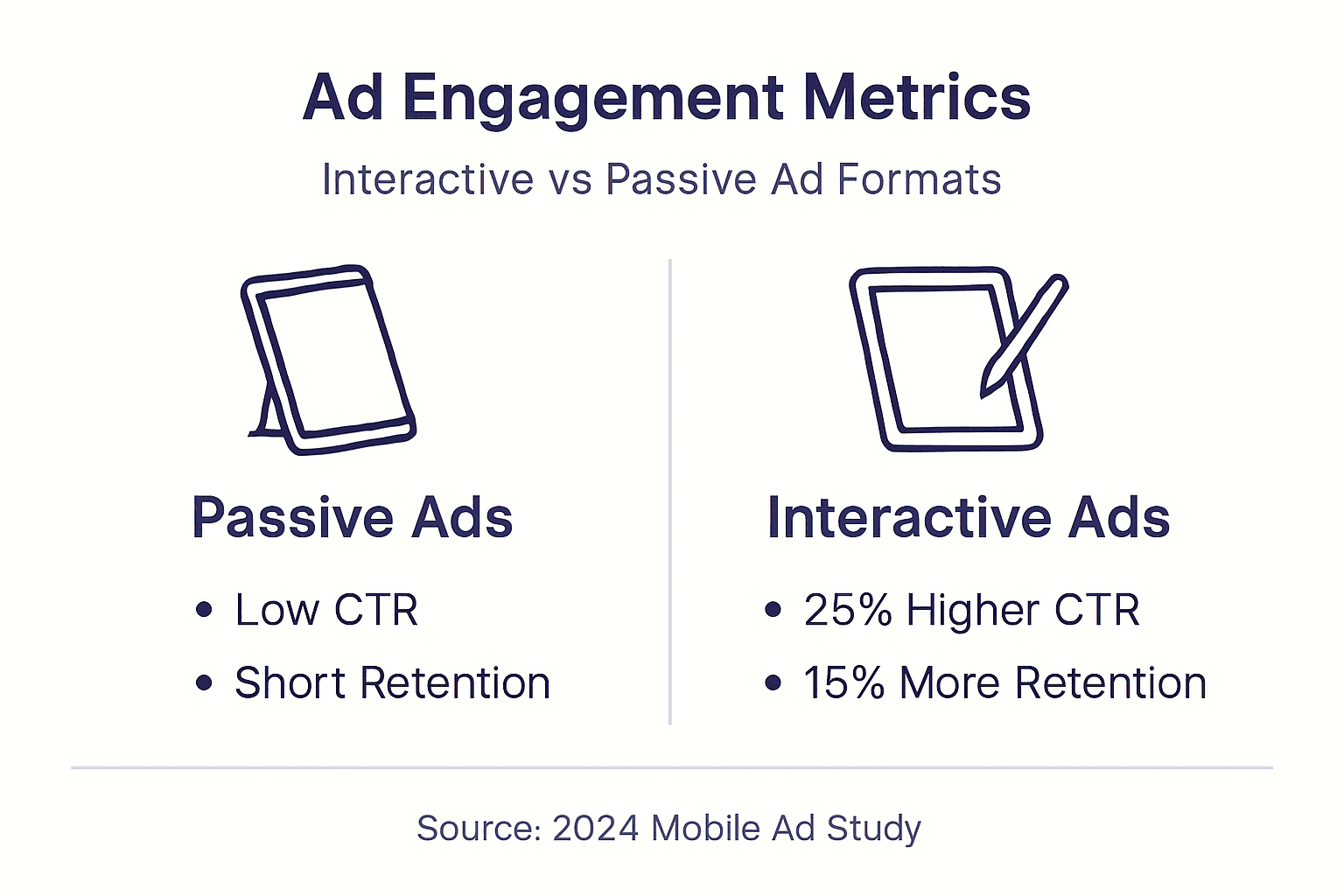
Engagement in ads reduces ad fatigue and banner blindness, leading to higher click-through rates by up to 25% compared to passive ads. This CTR improvement stems from users actively choosing to engage rather than passively scrolling past.

Engagement metrics such as interaction rate, dwell time, and completion rate provide better signals of ad effectiveness than traditional view or click metrics alone in mobile gaming campaigns. These metrics outperform standard measures by 30% in predicting quality installs.
| Metric Type | Passive Ad | Interactive Ad | Improvement |
|---|---|---|---|
| Click-through rate | 1.2% | 1.5% | 25% higher |
| Install prediction accuracy | 65% | 85% | 30% better |
| Post-install retention (Day 7) | 18% | 21% | 15% uplift |
| Cost per quality install | £3.20 | £2.40 | 25% lower |
Post-install quality correlates strongly with engagement depth. Users who complete playable ads show 40% higher Day 30 retention than those who bounce after 3 seconds. They’ve self-selected based on genuine interest.
Key engagement metrics to track:
- Interaction rate (percentage of users who engage vs view)
- Dwell time (seconds spent actively interacting)
- Completion rate (users who finish the interactive experience)
- Replay rate (users who restart the playable demo)
These metrics enable predictive modelling. If interaction rate exceeds 35%, campaigns typically deliver above-target install quality. Below 20%, even high view counts rarely convert efficiently. Understanding successful mobile game ads reveals patterns in high-performing engagement metrics.
Creating engaging ads cost-efficiently
No-code platforms revolutionise playable ad creation. Traditional development required dedicated programmers, lengthy timelines, and substantial budgets. Modern tools cut development time by over 50% and reduce costs by approximately 25%.
These platforms offer drag-and-drop interfaces where marketers build interactive experiences without writing code. Template libraries provide starting points for common game mechanics. Real-time preview enables rapid iteration until the ad achieves desired engagement patterns.
Cost efficiency comes from speed and accessibility. A playable ad that previously took developers 2 weeks now takes marketers 2 days. This compression enables more experimentation. Teams test 5 creative variations instead of 1, identifying winners faster.
Benefits of no-code playable ad creation:
- Reduced dependency on development resources
- Faster time-to-market for new campaigns
- Lower cost per creative variation
- Easier A/B testing of engagement mechanics
- Greater creative control for marketing teams
Pro Tip: Start with proven templates rather than building from scratch. Modify core mechanics to match your game’s unique features. This approach combines speed with customisation, delivering engaging ads without reinventing foundational interactivity.
Rapid iteration transforms campaign optimisation. When creating a new playable ad takes days instead of weeks, teams respond quickly to performance data. Poor engagement? Rebuild and retest within 48 hours. This agility compounds over campaign lifespans.
The playable ads introduction explains how no-code tools democratise interactive advertising. Small studios compete with major publishers because creation barriers have vanished. Budget no longer determines whether you leverage engagement; execution quality does.
Frameworks for leveraging engagement in marketing
Effective frameworks balance three dimensions: engagement depth, cost efficiency, and post-install quality. Optimising one whilst ignoring others creates imbalances. High engagement that costs £10 per install rarely sustains profitable campaigns. Low-cost ads with poor retention waste budget on churning users.
A dynamic framework tracks these metrics concurrently:
- Set baseline engagement targets (interaction rate above 30%, dwell time exceeding 15 seconds)
- Define cost thresholds based on lifetime value models
- Monitor Day 1, Day 7, and Day 30 retention cohorts
- Calculate engagement-adjusted cost per quality install
- Iterate creative elements based on weekly performance reviews
| Framework Component | Metric to Track | Target Range | Action Threshold |
|---|---|---|---|
| Engagement depth | Interaction rate | 30-45% | Below 25%: redesign |
| Cost efficiency | Cost per install | £2.00-£3.00 | Above £3.50: pause |
| Quality signal | Day 7 retention | 18-25% | Below 15%: retarget |
| Predictive value | Completion rate | 40-60% | Below 35%: simplify |
Balancing interactivity depth with costs requires trade-offs. Complex playable ads with 60 seconds of gameplay engage deeply but cost more to produce and may fatigue users. Simple 15-second interactions cost less and often convert better despite lower engagement duration.
Key engagement metrics warrant continuous monitoring. Interaction rate reveals initial appeal. Dwell time indicates sustained interest. Completion rate shows commitment. Together, these predict install quality better than any single measure.
Iterative A/B testing within this framework refines campaigns. Test one variable weekly: tutorial length, difficulty curve, visual style, or call-to-action placement. Measure impact across all three dimensions. This disciplined approach improves ROI by 10-20% over static campaigns.
The interactive ad frameworks guide demonstrates structured approaches to campaign optimisation. Successful user acquisition combines creative excellence with analytical rigour. Neither alone suffices; the framework integrates both. Marketing measurement frameworks provide broader context for tracking return on advertising spend across channels.
How Playablemaker can boost your mobile game user acquisition
Playablemaker’s no-code platform embodies the engagement principles discussed throughout this guide. Create sophisticated playable ads in days without developer support. The drag-and-drop interface enables rapid prototyping, testing multiple creative concepts before committing full budget.
Cost efficiency meets engagement depth. Reduce ad development time by over 50% whilst maintaining the interactivity that drives 25% higher CTR. Template libraries cover common game mechanics from puzzle-solving to endless runners. Customise these foundations to match your unique gameplay without rebuilding core functionality.
The platform supports iterative optimisation. Launch campaigns quickly, gather engagement data, and refine creative elements based on performance. This cycle compresses traditional timelines, enabling continuous improvement rather than quarterly creative refreshes. The benefits of playable ads extend beyond initial installs to sustained user quality.
Real-time analytics track the engagement metrics that predict install quality. Monitor interaction rates, dwell times, and completion rates within unified dashboards. Connect ad engagement to post-install behaviour, closing the loop between creative execution and user lifetime value. Playable ads explained reveals how these tools transform user acquisition strategy.
The playable builder empowers marketing teams to own creative production. No waiting for developer availability. No technical bottlenecks delaying campaign launches. Build, test, and deploy engaging ads at the speed your market demands.
Frequently asked questions about engagement in mobile gaming ads
What is the ideal length for an engaging mobile game ad?
Engagement peaks within 10-15 seconds for most users. Design ads that deliver core gameplay value immediately rather than building slowly to a payoff. Users who engage in the first 5 seconds typically complete the full experience, whilst those who don’t interact early rarely convert. Aim for 15-30 second interactive experiences that front-load the most compelling mechanics.
How can I measure engagement beyond CTR and views?
Track interaction rate (percentage who engage vs view), dwell time (seconds of active participation), completion rate (users finishing the experience), and replay rate (users restarting the demo). These metrics predict install quality 30% better than traditional measures. Combine engagement depth with post-install cohort analysis to understand which interaction patterns correlate with retention and lifetime value.
Are playable ads suitable for all mobile game genres?
Most genres adapt well to playable formats. Puzzle games translate naturally, strategy games can showcase core decision-making loops, and even narrative games work through branching choice mechanics. The key is extracting your game’s most engaging 15 seconds rather than replicating entire tutorials. Genres with steep learning curves benefit from simplified playable versions that communicate feel rather than complexity.
Can small teams effectively create interactive ads without heavy development?
No-code platforms enable small teams to produce professional playable ads without programmers. Drag-and-drop interfaces, template libraries, and visual scripting replace traditional coding requirements. Development time drops by over 50%, making sophisticated interactive ads accessible to teams of any size. Focus shifts from technical implementation to creative strategy and performance optimisation.
How often should I A/B test my engagement-driven ads?
Test one variable weekly once campaigns reach statistical significance (typically 1,000-2,000 impressions per variation). Focus tests on elements that directly impact engagement: tutorial clarity, difficulty progression, visual feedback, or reward timing. Avoid testing multiple variables simultaneously, which complicates attribution. Continuous weekly iteration compounds improvements, typically enhancing campaign ROI by 10-20% over static approaches.
Recommended
- What’s a Good CTR for Facebook Ads Success – playablemaker.com What’s a Good CTR for Facebook Ads Success
- What Is a Good Facebook Ad CTR? Complete Guide – playablemaker.com What Is a Good Facebook Ad CTR? Complete Guide
- The Benefits of Playable Ads for Mobile Marketers – playablemaker.com The Benefits of Playable Ads for Mobile Marketers
- Game Ad Engagement Techniques for Playable Ad Success – playablemaker.com Game Ad Engagement Techniques for Playable Ad Success
- Social Media Marketing: non solo Facebook Ads | The Rope