
TL;DR:
- Playable ads now can be created quickly and affordably using no-code platforms, reducing build time from weeks to days. Effective playables are interactive, simple, authentic, and 15 to 30 seconds long, driving higher engagement and better user quality. Prioritizing velocity, authenticity, and iterative testing leads to stronger campaign performance and lower costs.
Many user acquisition specialists still assume that playable ads demand months of developer time, five-figure budgets, and a dedicated engineering team. That assumption is increasingly outdated. The playable demo landscape has shifted dramatically, and no-code platforms now allow UA managers in mobile gaming to build interactive ad experiences quickly and affordably. This guide covers everything you need: a precise definition of playable prototypes, the anatomy of high-performing creatives, cost and time benchmarks, campaign performance data, and expert strategies to avoid common pitfalls.
Table of Contents
- Defining a playable prototype: what is it really?
- Core mechanics and anatomy of successful playable prototypes
- Building playable prototypes: toolkits, speed and cost efficiencies
- Performance benchmarks and campaign results: why playables win
- Expert nuances: maximising success and avoiding pitfalls
- Perspective: why velocity and authenticity are the new superpowers
- Get started: next steps for building high-performing playable prototypes
- Frequently asked questions
Key Takeaways
| Point | Details |
|---|---|
| Playable prototypes defined | They are short, interactive demos that allow users to experience core gameplay before downloading. |
| Efficiency revolution | No-code tools now let marketing teams create quality playables in days, slashing costs and production cycles. |
| Superior performance | Playables drive 2–4x more engagement and conversions compared to static or video ads. |
| Keys to success | Authentic representation, fast load times, weekly iteration, and simple mechanics are critical. |
Defining a playable prototype: what is it really?
Now that we’ve set the stage, let’s clarify exactly what a playable prototype is and why it’s a game changer for mobile UA.
A playable prototype is an interactive mini-game embedded within an ad unit, allowing prospective users to experience core gameplay before committing to a download. You may encounter this format under several names: playable ad, playable demo, or interactive creative. The terminology varies by platform and team, but the underlying mechanic is the same. The user taps, swipes, or interacts with a simplified version of the game, gets a taste of the experience, and is then presented with a call to action (CTA) to install.
The format sits at a distinct position in the ad funnel. Unlike a video ad, which passively shows gameplay, or a static banner, which relies entirely on visual appeal, a playable prototype actively involves the user. That involvement creates a stronger emotional connection and a more informed install decision.
Optimal playable prototypes typically run between 15 and 30 seconds. This window is long enough to communicate the core loop but short enough to hold attention. For a broader introduction to the format, the playable ads introduction resource offers useful context.
Here is how the three main ad formats compare:
| Feature | Playable prototype | Video ad | Static banner |
|---|---|---|---|
| User interaction | High | None | None |
| Gameplay demonstration | Direct, hands-on | Passive viewing | None |
| Emotional engagement | Very high | Moderate | Low |
| Typical CTR range | 2.5–5% | 1–2% | 0.5–1% |
| Install intent quality | High | Moderate | Low |
Key characteristics that define a strong playable prototype include:
- Interactivity: The user must actively participate, not just watch.
- Clarity: Controls and objectives are immediately obvious, with no tutorial overload.
- Authentic representation: The mini-game reflects the actual core loop of the full title.
- Concise CTA: A compelling end screen with a clear install prompt closes the experience.
These characteristics separate genuinely effective playables from interactive ads that simply add a tap mechanic to a video.
Core mechanics and anatomy of successful playable prototypes
With the basics defined, it’s crucial to explore what makes a playable prototype truly effective at driving installs and retaining quality users.
Every high-performing playable follows a recognisable three-part structure. First comes the tutorial phase, which should last no more than three to five seconds. Its only job is to orient the user with a single, clear instruction. Second is the core gameplay loop, where the user actually plays. This is the heart of the creative and should feel genuinely fun. Third is the end screen, which presents the CTA and, optionally, a reward mechanic to incentivise the install.

The optimal playable demonstrates the game loop within 15 to 30 seconds and closes with a clear CTA. Exceeding 30 seconds consistently increases drop-off rates, particularly on rewarded video placements where users are already impatient.
Reviewing a playable ads campaign breakdown reveals that the most successful creatives share a common trait: they prioritise fun over instruction. Users who enjoy the 20-second experience are far more likely to install than those who spent that time reading prompts.
Here are the four essential elements of a successful playable, in order of priority:
- Immediate interactivity — The user should be able to interact within the first two seconds.
- Authentic core loop — The mechanic must reflect what players will actually do in the full game.
- Progressive challenge — A brief difficulty curve keeps the experience engaging without frustrating the user.
- Frictionless CTA — The end screen should appear naturally and not feel like an interruption.
Common pitfalls include overly complex mechanics that confuse users, and playables that showcase a polished but unrepresentative version of the game. Both lead to poor post-install retention because users arrive with incorrect expectations. For a deeper look at effective techniques for playables, there are practical frameworks worth reviewing before your next build.
Pro Tip: A/B test an onboarding variant (with a brief tutorial) against an instant-play variant (no instruction, just action). In many genres, instant-play drives lower cost per install (CPI) because it removes friction from the first interaction.
Building playable prototypes: toolkits, speed and cost efficiencies
Knowing what to build is only half the story; finding the most efficient way to build it is just as vital for UA teams working under budget constraints.
Traditionally, producing a single playable ad required a developer, a designer, a QA pass, and often an external agency. The timeline ran from two to six weeks, and costs ranged from £5,000 to £25,000 per creative. For teams that needed to test multiple variants, this model was financially unsustainable.
No-code platforms have changed the equation entirely. No-code drag-and-drop platforms reduce production time by 60 to 70 per cent, compressing weeks into days, and cut costs by up to 90 per cent. That is not a marginal improvement; it is a structural shift in how UA teams can operate.
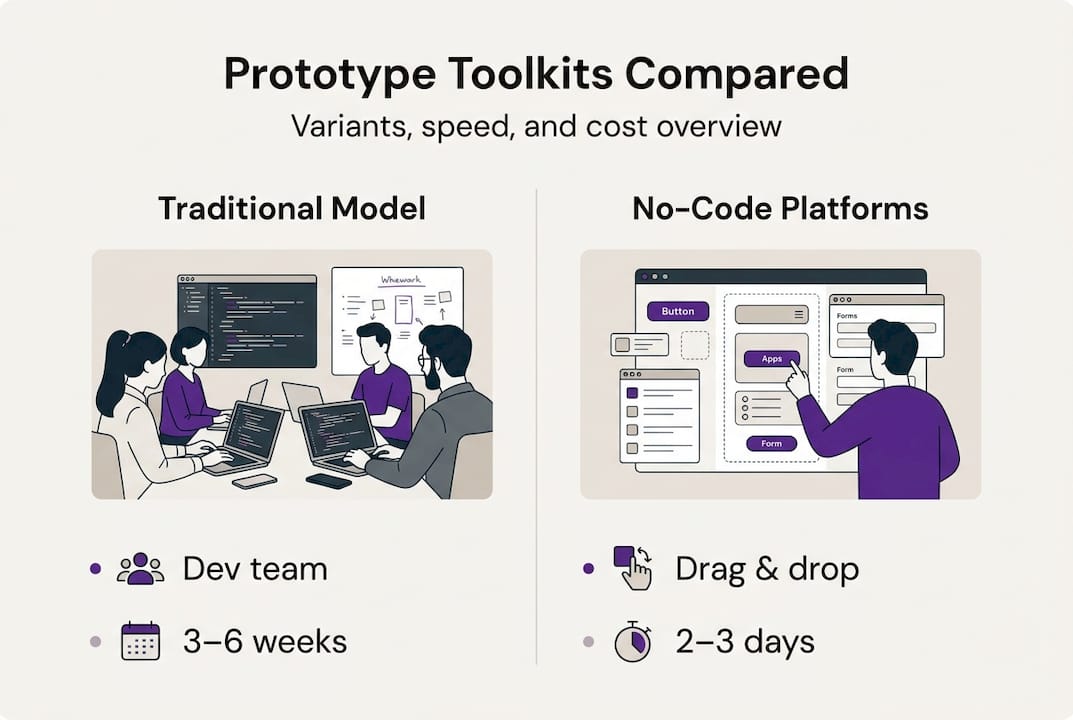
| Method | Avg. build time | Estimated cost | Variants per month |
|---|---|---|---|
| Traditional (dev team) | 3–6 weeks | £8,000–£25,000 | 1–2 |
| Agency outsourcing | 2–4 weeks | £4,000–£12,000 | 2–3 |
| No-code platform | 2–5 days | £200–£800 | 10–20 |
The strategic implication is significant. When production costs drop this dramatically, UA managers can shift from a perfectionist mindset to a velocity mindset. Instead of spending three weeks perfecting one creative, you can test ten variants in the same period and let performance data guide your investment. The mobile playable ad workflow guide outlines how to structure this iterative process effectively.
Key advantages of no-code production for UA teams include:
- Faster creative response to seasonal trends or competitor activity.
- Reduced dependency on engineering resources for ad creative.
- Lower financial risk per creative, enabling broader hypothesis testing.
- Faster learning cycles that compound over time into a stronger creative library.
Pro Tip: Reinvest the budget saved through no-code production directly into creative iteration. Running ten variants at £500 each will almost always outperform a single polished creative at £5,000, because the data you collect is worth more than the production quality.
Performance benchmarks and campaign results: why playables win
With creation streamlined, it’s results that justify investment. Let’s examine how playables perform where it matters most for UA managers.
Playable CTRs range from 2.5 to 5 per cent, which is three to four times higher than static or video equivalents. Conversion rates run 20 to 32 per cent higher than video ads, D7 retention improves by 15 to 30 per cent, and CPI drops by an average of 37 per cent. These are not marginal gains; they represent a meaningful shift in campaign economics.
| KPI | Playable prototype | Video ad | Static banner |
|---|---|---|---|
| Average CTR | 2.5–5% | 1–2% | 0.5–1% |
| Conversion rate lift | +20–32% vs video | Baseline | Below baseline |
| D7 retention improvement | +15–30% | Baseline | N/A |
| Average CPI reduction | 37% lower | Baseline | Higher |
The D7 retention figure is particularly telling. Users who install after playing a playable ad arrive with accurate expectations of the game. They have already experienced the core mechanic and chosen to engage further. This self-selection effect means playable-driven installs are structurally higher quality than those driven by passive formats. For real-world playable ads examples that illustrate these numbers, case studies offer useful reference points.
“Playables are 20 times more likely to drive installs than banner ads.”
This figure underscores why the format has become a central pillar of mobile UA strategy. A thorough ad campaign analysis confirms that interactive formats consistently outperform passive ones across verticals. For a structured summary of the playable ads benefits, the data makes a compelling case for reallocation of creative budgets.
Expert nuances: maximising success and avoiding pitfalls
Finally, to make playables work long-term, smart marketers learn from both successes and mistakes in equal measure.
Even well-resourced teams produce underperforming playables. The most common reasons are mechanics that are too complex for a 20-second window, a core loop that does not accurately represent the full game, and poor technical optimisation that causes slow load times. Each of these issues is avoidable with the right process.
Iteration, authentic core loop representation, MRAID compliance, and testing tutorial variants are the consistent factors behind sustained performance lift. MRAID (Mobile Rich Media Ad Interface Definitions) is the industry standard for interactive mobile ads; non-compliant creatives are rejected by major networks or load incorrectly on device.
Expert recommendations for sustained playable performance:
- Iterate weekly, not monthly. Creative fatigue sets in faster with interactive formats because engaged users exhaust the experience quickly.
- Track installs per mille (IPM) and engagement rate alongside CTR. IPM is the most reliable single metric for playable quality.
- Keep load time under two seconds. Every additional second of load time reduces engagement meaningfully.
- Focus the core loop on one mechanic only. Complexity is the enemy of a 20-second ad experience.
- Test tutorial variants systematically. Some genres benefit from a single instruction; others perform better with zero onboarding.
For inspiration on structuring creative hypotheses, creative ad concepts provides a practical starting point. It is also worth noting that MRAID compliance requirements apply across all major ad networks and should be treated as a non-negotiable baseline, not an afterthought.
Pro Tip: Non-gaming verticals including finance, retail, and health apps are now adopting playable formats with strong results. If you manage campaigns outside pure gaming, the format is worth testing.
Perspective: why velocity and authenticity are the new superpowers
Having covered the practical strategies, here is what experienced UA leaders are genuinely learning in 2026.
The old approach to playable production was rooted in perfectionism. Teams would spend weeks refining a single creative, treating it almost like a product launch. That model made sense when production costs were high and iteration was expensive. It no longer makes sense.
The UA managers achieving the strongest results today are not producing the most polished playables. They are producing the most testable ones. They launch quickly, read the data honestly, and iterate without attachment to any single version. The creative that works is rarely the one the team was most proud of.
Authenticity matters more than visual fidelity. A playable that accurately represents a mid-core strategy game, even with simple graphics, will consistently outperform a visually impressive creative that misrepresents the experience. Users who feel misled after installing churn immediately, and that churn destroys the retention metrics that make playables valuable in the first place.
The most important shift is cultural. Teams that treat playable prototypes as creative UA concepts to be tested rather than finished products to be perfected will compound their learning faster than any competitor relying on a slower, higher-cost model.
Get started: next steps for building high-performing playable prototypes
Ready to put these strategies into action? Here are your next steps.
If the benchmarks and frameworks in this guide have made one thing clear, it is that the barrier to building effective playable prototypes has never been lower. No-code playable tools now give UA teams the ability to move from concept to live creative in days rather than weeks. PlayableMaker’s drag-and-drop playable builder is built specifically for marketers who need speed, affordability, and quality without engineering overhead. Whether you are building your first interactive creative or scaling an existing programme, playable ads explained is a strong starting point to align your team on format fundamentals before you build.
Frequently asked questions
How long does it take to create a playable prototype?
With no-code tools, most teams can build a playable prototype in as little as two to three days. No-code reduces production time from weeks to days, removing the traditional dependency on developer resources.
What are the most common reasons playable ads fail?
Overly complex mechanics and poor core loop representation are the primary causes of drop-off and poor post-install retention. Keeping the mechanic simple and authentic to the full game addresses both issues directly.
Do playable prototypes work for non-gaming apps?
Yes, adoption is growing strongly across non-gaming verticals. Non-gaming verticals are now adopting playables because the engagement metrics translate well to finance, retail, and health app categories.
What benchmarks define a successful playable ad?
Aim for a CTR above 3 per cent and conversions 20 to 32 per cent higher than video equivalents. A D7 retention improvement of 15 per cent or more indicates that the playable is attracting genuinely well-matched users.
Recommended
- Game Ad Engagement Techniques for Playable Ad Success – playablemaker.com Game Ad Engagement Techniques for Playable Ad Success
- 7 Key Advantages of Interactive Ads for Mobile Games – playablemaker.com 7 Key Advantages of Interactive Ads for Mobile Games
- Boost mobile game growth with interactive ads in 2026 – playablemaker.com Boost mobile game growth with interactive ads in 2026
- 7 Best Examples of Mobile Game Ads and Why They Work – playablemaker.com 7 Best Examples of Mobile Game Ads and Why They Work
- 8 Top Ecommerce Ads Examples to Boost Sales in 2025 – Affinsy Blog | Affinsy
- Vidéo interactive : Engager et convertir votre audience