Playable ads deliver up to 30% higher conversion rates than standard video formats, yet many mobile gaming marketers struggle to unlock their full potential. Understanding how to systematically break down and optimise these interactive campaigns transforms guesswork into data-driven strategy. This guide provides a practical framework for analysing creative elements, interaction flows, and technical performance to maximise ROI whilst reducing costs through modern no-code approaches.
Table of Contents
- Introduction To Playable Ads In Mobile Gaming
- Why Playable Ads Are More Effective
- How To Conduct A Playable Ad Campaign Breakdown
- Common Misconceptions About Playable Ads
- Cost-Effective Playable Ad Creation Strategies
- Best Practices For Optimisation And Iteration
- Unlock Your Playable Ad Potential With Playablemaker
- Frequently Asked Questions
Key takeaways
| Point | Details |
|---|---|
| Engagement advantage | Playable ads boost conversion rates by 30% and improve post-install engagement by 25% compared to traditional formats. |
| Systematic analysis | Breaking down campaigns into creative, interaction, and technical components isolates bottlenecks and guides effective iteration. |
| Cost reduction | No-code platforms reduce development time by 70%, making playable ads accessible without large budgets or developer resources. |
| Continuous improvement | Real-time analytics and iterative testing cycles increase ROI by up to 35% through rapid optimisation. |
Introduction to playable ads in mobile gaming
Playable ads are interactive mini-games embedded within advertising that let users experience gameplay before installing. Unlike static banners or passive video ads, they require active participation. This fundamental shift transforms the ad from interruption to experience.
The mobile gaming industry has embraced interactivity as engagement metrics prove traditional formats lose effectiveness. Users scroll past static images instantly. Video ads face high skip rates. Playable ads demand attention by inviting participation, creating memorable brand moments that translate to installs.
Key advantages include:
- Higher quality users who understand gameplay mechanics before downloading
- Improved retention rates as expectations align with actual game experience
- Better conversion metrics through try-before-you-buy psychology
- Reduced cost per acquisition despite initially higher production costs
Playable formats work because they solve the disconnect between ad promise and product reality. When users interact with actual gameplay mechanics, they self-select based on genuine interest rather than curiosity alone. This pre-qualification means fewer early uninstalls and better lifetime value metrics.
The rise of interactive ad formats reflects broader shifts in consumer expectations. Modern users expect participation, not passive consumption. Playable ads meet this demand whilst providing marketers with rich behavioural data that static formats cannot capture.
Why playable ads are more effective
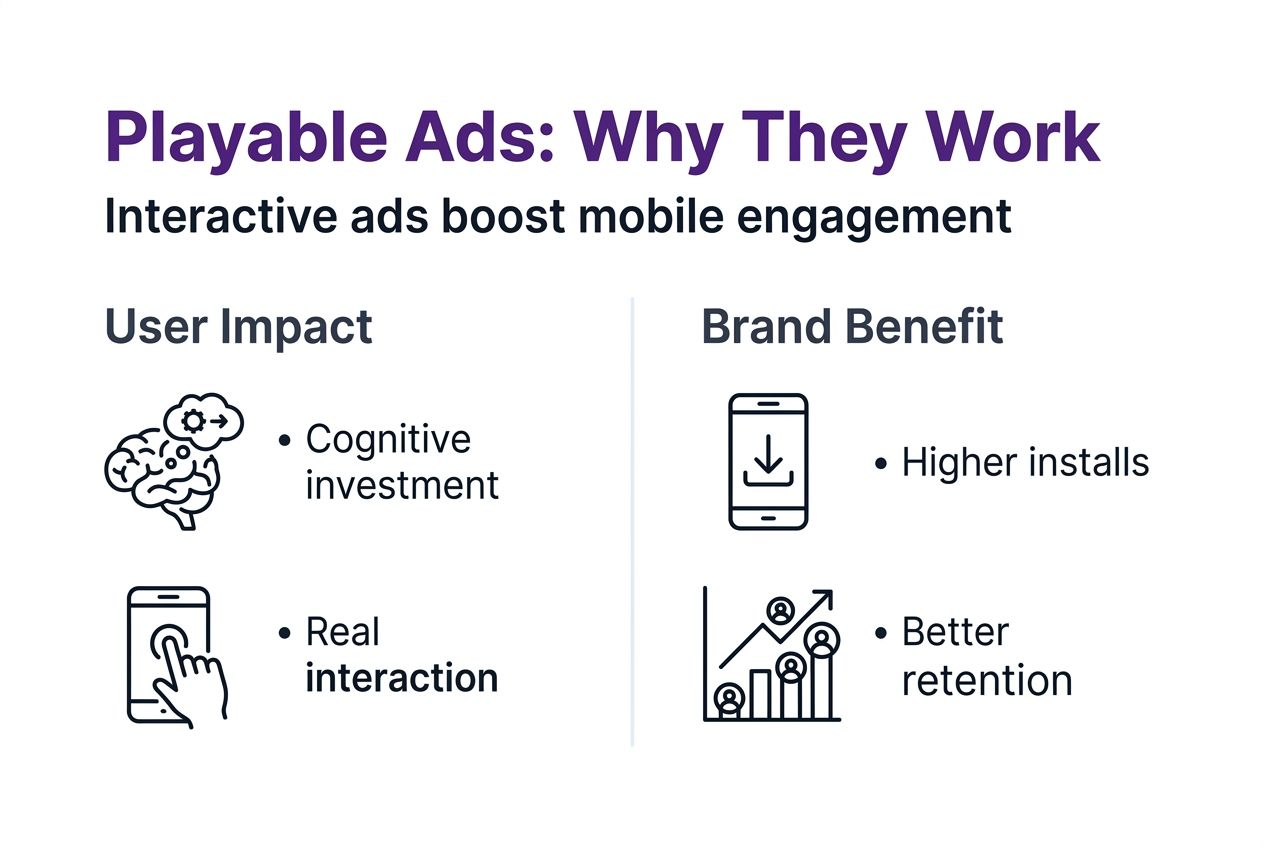
Interactivity creates cognitive investment that passive viewing cannot match. When users manipulate game elements, solve puzzles, or achieve objectives within an ad, they form emotional connections to the product. This psychological engagement explains why interactive formats boost conversion by 30%.
Clear calls to action within playable experiences guide users naturally towards installation. Rather than interrupting gameplay, install prompts feel like logical next steps. Users who complete ad objectives want to continue the experience, making conversion feel rewarding rather than transactional. Post-install engagement improves 25% when CTAs align with gameplay achievements.
Gamification elements trigger reward mechanisms in user psychology. Points, progress bars, and achievement unlocks within ads activate the same dopamine responses that make games compelling. This neurological engagement creates stronger memory formation and brand recall compared to passive ad formats.
Behavioural advantages include:
- Users demonstrate actual interest through interaction rather than accidental clicks
- Gameplay mechanics act as filters, attracting genuinely interested players
- Completion rates provide early signals about user quality and retention potential
- Interactive data reveals preferences that inform post-install personalisation
The psychology behind playable ads centres on autonomy and competence. Users feel in control of their experience whilst demonstrating skill. This combination builds confidence and positive associations with your game before installation occurs.
How to conduct a playable ad campaign breakdown
Systematic campaign analysis requires segmenting performance into distinct components. Start by separating creative assets, user interaction flows, and technical delivery metrics. This compartmentalisation helps isolate specific bottlenecks rather than treating campaigns as black boxes.
Follow this breakdown framework:
- Asset identification: Catalogue all creative elements including graphics, animations, audio, and UI components. Document loading sequences and asset file sizes.
- Interaction flow analysis: Map every user touchpoint from ad impression through gameplay to install prompt. Identify friction points where users abandon.
- Technical evaluation: Measure load times, frame rates, and compatibility across devices. Test network performance under various connection speeds.
- Conversion measurement: Track click-through rates, completion rates, and install conversion at each funnel stage. Calculate cost per completed playable versus cost per install.
- Iteration planning: Use data to prioritise testing hypotheses. Focus on high-impact changes that address identified bottlenecks.
Structured campaign breakdowns increase ROI by 40% by replacing guesswork with evidence. Real data reveals whether poor performance stems from creative issues, technical problems, or targeting misalignment.
Key performance indicators to track:
| Metric | Target Range | Insight Provided |
|---|---|---|
| Load completion | 85-95% | Technical performance and file optimisation |
| Gameplay completion | 60-75% | Creative engagement and difficulty balance |
| Install conversion | 15-25% | Overall campaign effectiveness and audience fit |
| Post-install D1 retention | 35-45% | User quality and expectation alignment |
The playable ad workflow should include regular breakdown cycles. Monthly comprehensive reviews combined with weekly quick-win optimisations create momentum. Small improvements compound into significant performance gains over time.
Common misconceptions about playable ads
Many marketers avoid playable ads believing they require massive budgets and developer resources. This misconception stems from early playable formats that did demand custom coding. Modern no-code platforms have democratised creation, making playable ads accessible to teams without technical expertise.
Another myth suggests playable ads work only for specific game genres. Data shows interactive formats perform across puzzle, strategy, action, and casual categories. The key lies in matching interaction mechanics to core gameplay rather than genre restrictions.
Cost concerns often prove unfounded:
- Initial production costs are offset by higher conversion rates and better user quality
- No-code tools eliminate ongoing developer maintenance expenses
- Modular templates allow rapid variant creation without rebuilding from scratch
- Improved targeting reduces wasted ad spend on unqualified users
Some teams worry that playable ads generate lower click-through rates than video. Reality contradicts this fear. Playable formats typically achieve higher CTR because engaged users who complete gameplay convert at premium rates. Quality trumps quantity in user acquisition.
The misconceptions surrounding playable ads often prevent teams from testing formats that could dramatically improve their acquisition efficiency. Starting with small test budgets allows validation without major risk.
Pro Tip: Run parallel campaigns comparing your best-performing video ad against a playable variant. Track not just install rates but D7 and D30 retention to measure true user quality differences. This data-driven approach removes guesswork from format decisions.
Cost-effective playable ad creation strategies
No-code platforms revolutionise playable ad production by eliminating technical barriers. Drag-and-drop interfaces let marketing teams create interactive experiences without writing code. This democratisation reduces development time by 70% compared to traditional custom development approaches.

Modular asset libraries accelerate creation whilst maintaining quality. Build reusable component libraries including UI elements, gameplay mechanics, and animation sequences. When launching new campaigns, combine and customise existing modules rather than starting from scratch. This approach cuts both time and budget requirements.
Rapid prototyping shortens the path from concept to testing. Create multiple low-fidelity variants quickly, test with small audiences, then invest in polishing winners. This iterative approach prevents expensive production of untested concepts.
Budget-friendly tactics include:
- Starting with template-based designs that can be customised rather than building custom experiences
- Reusing successful gameplay mechanics across multiple game titles with asset swaps
- Creating variant libraries that test different difficulty levels and interaction patterns
- Leveraging platform analytics to identify winning patterns before scaling production
The no-code playable builder approach means marketing teams control iteration speed without developer bottlenecks. Quick adjustments based on performance data become possible within hours rather than weeks.
External no-code tools for playable creation continue evolving with better templates and easier customisation. Staying current with platform capabilities ensures you leverage the most efficient creation methods available.
Pro Tip: Build a swipe file of competitor playable ads that perform well. Analyse their interaction patterns, difficulty curves, and CTA placements. Adapt successful patterns to your game’s unique mechanics rather than copying directly.
Best practices for optimisation and iteration
Data-driven iteration separates high-performing campaigns from mediocre ones. Establish A/B testing frameworks that isolate single variables whilst keeping other elements constant. Test creative variants, interaction mechanics, and CTA placements systematically rather than changing everything simultaneously.
Iterative testing improves KPIs by 20% per cycle when executed with discipline. Each test cycle should validate specific hypotheses derived from previous performance data. Random testing wastes budget without generating insights.
Real-time analytics dashboards enable immediate optimisation. Monitor performance metrics hourly during campaign launches to catch issues before they consume significant budget. Real-time monitoring enhances ROI by 35% through rapid response to performance anomalies.
Optimisation workflow:
- Establish baseline performance with your current best-performing creative across key metrics.
- Generate hypotheses based on user behaviour data, identifying specific friction points or opportunities.
- Design focused tests that isolate single variables whilst maintaining statistical validity.
- Launch with sufficient budget to reach significance quickly, typically 1000+ impressions per variant.
- Analyse results looking beyond surface metrics to understand why variants performed differently.
- Scale winners whilst continuing to test incremental improvements on successful variants.
User feedback loops provide qualitative insights that quantitative data misses. Conduct small user testing sessions where participants think aloud whilst playing your ad. These sessions reveal confusion points, difficulty imbalances, and UX friction that metrics alone cannot identify.
“The best playable ads iterate constantly based on real user behaviour rather than assumptions about what should work. Data reveals truth that intuition misses.”
Integrate learnings from your mobile game ad best practices into systematic testing roadmaps. Successful optimisation requires commitment to ongoing experimentation rather than set-and-forget mentality. Markets evolve, competitor tactics shift, and user preferences change. Continuous iteration keeps campaigns performing at peak efficiency.
External resources on iterative testing methodologies provide frameworks for structuring test programmes that compound improvements over time.
Unlock your playable ad potential with PlayableMaker
Implementing the breakdown framework and optimisation strategies outlined above requires the right tools. PlayableMaker’s drag-and-drop builder empowers user acquisition teams to create, test, and iterate playable ads without developer dependencies. Our no-code platform eliminates the technical barriers and budget constraints that traditionally limited playable ad adoption.
The platform supports rapid A/B testing cycles and integrates with real-time analytics systems, enabling the data-driven iteration essential for maximising ROI. Whether you’re addressing common playable ad misconceptions within your team or leveraging psychological engagement principles, PlayableMaker provides the foundation for cost-effective, high-performing campaigns that drive quality user acquisition.
Frequently asked questions
What are playable ads in mobile gaming?
Playable ads are interactive mini-experiences that let users try gameplay mechanics before installing a game. Unlike passive video or static banner ads, they require active participation where users manipulate game elements, solve challenges, or complete objectives. This hands-on approach creates cognitive investment and helps users self-select based on genuine interest in gameplay mechanics.
How can I measure the success of a playable ad campaign?
Track conversion rate from impression to install, completion rate of the playable experience, and post-install retention metrics at D1, D7, and D30 milestones. Real-time analytics dashboards should monitor load completion rates and interaction drop-off points to identify technical or creative bottlenecks. Quality metrics matter more than volume, so focus on lifetime value and retention alongside raw install counts.
Are playable ads always expensive to create?
No, modern no-code platforms reduce development time by up to 70% and eliminate ongoing developer costs. Modular asset libraries and template-based approaches allow rapid creation and iteration without custom coding requirements. Whilst initial creative investment exists, improved conversion rates and user quality typically deliver better ROI than cheaper traditional formats that generate low-quality installs.
What is the best way to optimise playable ads?
Implement systematic A/B testing that isolates single variables such as difficulty levels, CTA timing, or visual styles. Use real-time analytics to identify performance issues quickly and iterate based on actual user behaviour rather than assumptions. Conduct regular user testing sessions to uncover qualitative insights about friction points that quantitative metrics alone cannot reveal. Continuous iteration compounds improvements over time.
Recommended
- Ad tech trends 2026: create playable ads fast and affordably – playablemaker.com Ad tech trends 2026: create playable ads fast and affordably
- Playable Ad Trends 2025: Build Engaging Ads Without Coding – playablemaker.com Playable Ad Trends 2025: Build Engaging Ads Without Coding
- Playable Ads vs Static Ads: Impact on Retention – playablemaker.com Playable Ads vs Static Ads: Impact on Retention
- 7 Essential Mobile Game Ad Trends to Know for 2025 – playablemaker.com 7 Essential Mobile Game Ad Trends to Know for 2025
- 6 esempi di marchi famosi e lezioni per startup innovative
- E-commerce Growth Through Multilingual Localisation | Glocco