
Static ads are quietly losing the battle for player attention. Mobile users now scroll past banners in milliseconds, and video ads are skipped before the first five seconds are up. Yet many user acquisition teams still default to the same formats they used three years ago, often because interactive ads feel complicated or expensive to produce. This guide breaks down exactly what interactive ads are, why they outperform traditional formats, how they drive real retention gains, and how you can build them without burning through your development budget.
Table of Contents
- What makes interactive ads stand out?
- How interactive ads improve user acquisition and retention
- Cost efficiency and simplicity: myths and realities
- Application: best practices for creating interactive ads that convert
- Unlock powerful interactive ad solutions with PlayableMaker
- Frequently asked questions
Key Takeaways
| Point | Details |
|---|---|
| Higher user engagement | Interactive ads drive significantly greater user interaction compared to traditional ads. |
| Improved retention rates | Mobile gamers stay engaged longer with playable and interactive ad formats. |
| Efficient creation process | Modern platforms and tools have made building interactive ads fast and cost-effective. |
| Practical campaign strategies | Applying best practices for interactive ads leads to measurable increases in conversions and ROI. |
What makes interactive ads stand out?
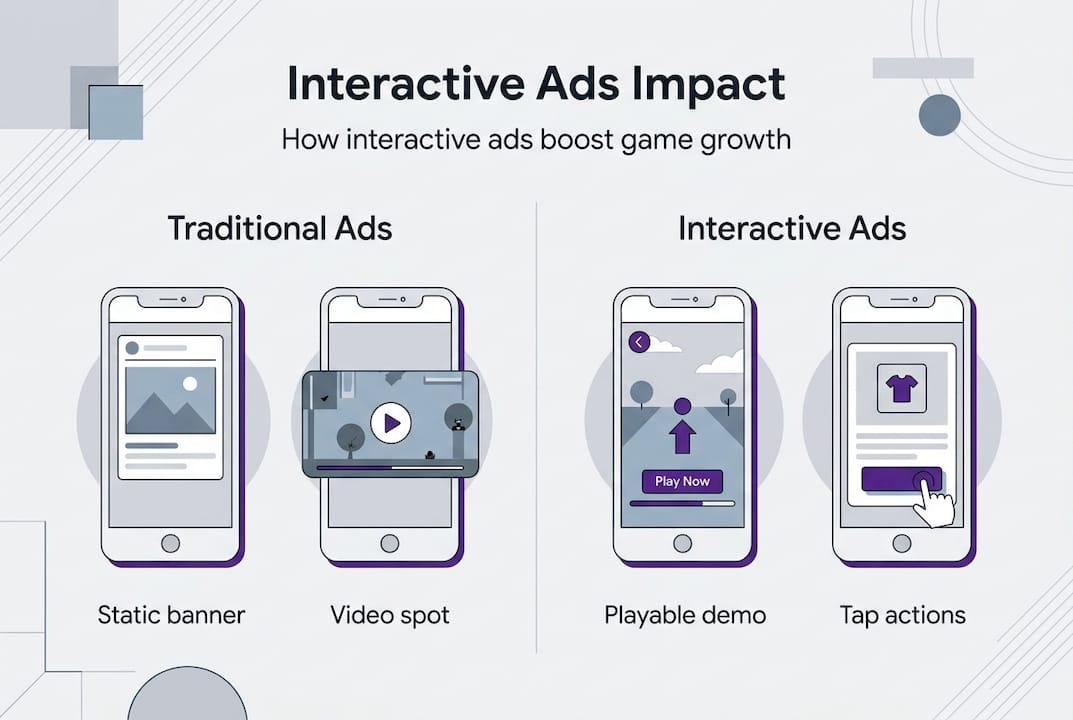
An interactive ad is any ad format that invites the user to do something rather than simply watch or read. That action could be tapping to play a mini-game, swiping through a quiz, or using their camera in an AR experience. The key distinction is participation: the user becomes a player, not a passive viewer.
Compare that to static banner ads, which deliver a single image and hope for a click. Video ads add motion but still ask nothing of the viewer. Interstitial ads interrupt the experience entirely, often generating frustration rather than interest. Interactive formats flip this dynamic by giving users a reason to engage on their own terms.
Common formats include playable ads (a short, functional demo of your game), quiz-based ads, AR try-on or overlay experiences, and spin-to-win mechanics. Each format creates a micro-commitment from the user, which is far more powerful than passive exposure.
Before we look at the numbers, it is worth clearing up a few misconceptions:
- Interactive ads are only for big budgets. Not true. No-code tools have made them accessible to teams of any size.
- They require a developer to build. Modern platforms remove this barrier entirely.
- Users find them annoying. The opposite is true when the interaction is relevant and well-designed.
- They only work for casual games. Playable and interactive formats perform across genres, from hypercasual to mid-core RPGs.
| Format | Engagement rate | Retention lift | Cost efficiency |
|---|---|---|---|
| Static banner | Low | Minimal | High (low cost, low return) |
| Video ad | Medium | Moderate | Medium |
| Interactive/playable | High | Significant | High (higher return per spend) |
Interactive ads significantly outperform static formats, with CTR boosts reaching 3.17% for digital ad campaigns in 2026, making them one of the most cost-effective formats available to mobile marketers.
How interactive ads improve user acquisition and retention
The mechanics behind interactive ad performance are not accidental. Three core drivers explain why these formats consistently outperform their traditional counterparts: personalisation, real-time feedback, and emotional connection.
Personalisation works because interactive ads can adapt based on user choices. A player who selects a strategy-style mini-game within an ad is signalling their preference, and that signal can inform retargeting. Real-time feedback, such as a score appearing after a tap sequence, triggers a dopamine response that static ads simply cannot replicate. Emotional connection forms when a user genuinely enjoys the ad experience, associating that positive feeling with your game before they have even installed it.
Mobile game marketers report up to 35% higher engagement with interactive and AR-based ad formats compared to standard creative. That is not a marginal improvement. It is the difference between a campaign that breaks even and one that scales.
Here is how a typical user journey through an interactive ad unfolds:
- First impression. The ad appears in a natural break within another app or game.
- Invitation to interact. A clear prompt (“Tap to play” or “Try it now”) removes ambiguity.
- Micro-gameplay or interaction. The user engages for 10 to 30 seconds, experiencing your game’s core loop.
- Feedback moment. A score, result, or reward appears, creating a sense of achievement.
- Call to action. A contextual CTA (“Keep playing, install now”) appears at peak engagement.
- Install or re-engagement. The user converts, already familiar with your game’s mechanics.
| Metric | Traditional ads | Interactive ads |
|---|---|---|
| Average engagement rate | 0.5% to 1.2% | 2.8% to 5.4% |
| Cost per install (CPI) | Higher | Lower (better qualified users) |
| Day 7 retention | Baseline | Up to 35% higher |
| Creative fatigue | Fast | Slower (variety of interactions) |
Understanding interactive ad ROI is critical before you allocate budget. The data consistently shows that users acquired through interactive formats stay longer and spend more. Explore the full breakdown of playable ad benefits to see how these numbers translate across different game genres.
Pro Tip: Do not test just one interaction model. Run two or three variants simultaneously, such as a tap-based mechanic versus a swipe mechanic, and let your retention data tell you which resonates with your target audience.
Cost efficiency and simplicity: myths and realities
The most common reason marketing teams avoid interactive ads is the assumption that they are expensive and technically demanding. This assumption made sense in 2018. It does not hold up in 2026.
Historically, building a playable ad meant briefing your development team, waiting weeks for a prototype, iterating through multiple rounds of feedback, and spending thousands before a single impression was served. That process was genuinely prohibitive for smaller studios or lean UA teams.

Modern no-code ad creation platforms have fundamentally changed this. Drag-and-drop builders allow marketers to assemble interactive experiences in hours, not weeks. Automation platforms enable no-code interactive ad creation, cutting both time and budget without sacrificing quality.
Here are the features in leading tools that directly reduce your time and cost:
- Visual drag-and-drop editors that require zero coding knowledge
- Pre-built templates designed specifically for mobile game genres
- One-click export to major ad networks (Meta, Google, Unity, IronSource)
- Built-in A/B testing so you can iterate without rebuilding from scratch
- Asset reuse across multiple campaigns to maximise existing creative investment
- Real-time preview on device before publishing, eliminating costly post-launch fixes
The cost reduction strategies available today mean that a well-structured interactive ad campaign can actually reduce your overall UA spend by improving install quality. Fewer wasted impressions, better-qualified users, and lower churn all contribute to a healthier cost per loyal user. The interactive ad workflow has been simplified to the point where a single marketer can manage the entire creation and iteration cycle.
Pro Tip: Schedule A/B tests at the start of every campaign sprint rather than as an afterthought. Testing two creative variants from day one means you gather actionable data faster and avoid spending budget on underperforming creatives.
If you want to see what a modern build process looks like in practice, the drag-and-drop ad creation tool from PlayableMaker is a strong starting point for teams new to the format.
Application: best practices for creating interactive ads that convert
Knowing that interactive ads work is one thing. Knowing how to build ones that actually convert is where most teams either win or waste their budget. The difference usually comes down to three areas: targeting precision, creative design, and CTA placement.
Targeting precision means serving your interactive ad to users who are already predisposed to enjoy your game’s genre. A playable ad for a city-builder served to users of strategy games will always outperform the same ad served to a broad demographic. Use lookalike audiences based on your highest-retention players as your primary targeting layer.
Creative design should reflect your game’s actual core loop, not a polished but misleading version of it. Players who install based on an accurate preview have significantly higher Day 1 and Day 7 retention. Optimising creative content based on real user feedback increases conversion rates by up to 72%, which is a compelling case for iterating on your creatives regularly rather than running the same asset for months.
Here is a step-by-step framework for building and optimising an interactive ad:
- Define your core loop moment. Identify the single mechanic that makes your game fun and build the ad around that.
- Choose your format. Playable demo, quiz, or AR experience based on your genre and audience.
- Build a first draft. Use a no-code tool to assemble the interaction in under a day.
- Test internally. Play the ad yourself on the target device. Time the interaction at 15 to 30 seconds maximum.
- Launch with two variants. Change one variable between them (mechanic, CTA copy, or end screen design).
- Analyse after 72 hours. Look at engagement rate, completion rate, and install conversion.
- Iterate and scale. Double down on the winning variant and build the next test.
Common mistakes to avoid:
- Making the interaction too complex. Users abandon ads that require more than two or three taps to understand.
- Misleading creative. Showing gameplay that does not match the actual game destroys post-install retention.
- Weak or delayed CTA. Place your install prompt at the moment of peak engagement, not after it has passed.
- Ignoring creative fatigue. Rotate new variants every two to three weeks to maintain performance.
- Skipping mobile-first design. Every element must be thumb-friendly and readable on a small screen.
For inspiration, explore interactive ad content ideas tailored specifically to mobile gaming in 2026. You can also browse a full list of creative ad formats to find the right fit for your campaign goals. When you are ready to build, the practical guide on building interactive ads walks you through the entire process from concept to live campaign.
Unlock powerful interactive ad solutions with PlayableMaker
Everything covered in this guide points to one practical conclusion: interactive ads deliver better results, and the barrier to creating them is lower than ever. PlayableMaker is built specifically for mobile marketing professionals who need to move fast without handing the work to a development team. Our no-code builder lets you create, test, and publish playable and interactive ads in a fraction of the time and cost of traditional production. If you want to understand the full picture before you build, start with our playable ads overview or explore why playable ads work from a psychological standpoint. When you are ready to put these strategies into action, start creating your first ad today.
Frequently asked questions
How do interactive ads impact user retention in mobile games?
Interactive ads give users a genuine preview of your game’s mechanics, which means installs come from better-qualified players. Up to 35% higher engagement with interactive formats translates directly into improved Day 7 and Day 30 retention rates.
Are interactive ads more expensive to produce?
Not with modern tools. No-code platforms reduce both production time and cost significantly, making interactive ads accessible even for lean UA teams without a dedicated developer.
Which formats of interactive ads work best for mobile games?
Playable ads consistently deliver the strongest results because they let users experience your core loop directly. Interactive ads outperform static formats across engagement and CTR metrics, with quizzes and AR experiences also performing well for specific genres.
Can interactive ads be created without technical skills?
Yes. Drag-and-drop builders and no-code creation tools mean any marketer can build a fully functional interactive ad without writing a single line of code.
How can I measure the effectiveness of interactive ads?
Focus on engagement rate, completion rate, install conversion, and Day 7 retention as your primary metrics. 35% higher engagement is a realistic benchmark to target when switching from traditional to interactive formats.
Recommended
- 2025 SocialPeta & Newsbreak Mobile Game Report: 9M+ Monthly Advertisers & the Rise of Weekly Creative Iteration – playablemaker.com 2025 SocialPeta & Newsbreak Mobile Game Report: 9M+ Monthly Advertisers & the Rise of Weekly Creative Iteration
- Ad tech trends 2026: create playable ads fast and affordably – playablemaker.com Ad tech trends 2026: create playable ads fast and affordably
- 7 Best Examples of Mobile Game Ads and Why They Work – playablemaker.com 7 Best Examples of Mobile Game Ads and Why They Work
- What is an Interactive Ad? Understanding Its Impact – playablemaker.com What is an Interactive Ad? Understanding Its Impact
- Ad Creative Examples: 72% Higher Engagement for SMBs 2026