
Users who complete a playable ad before installing a mobile game are 40% more likely to still be playing 30 days later. That single figure should reframe how you think about playable ad performance. Most user acquisition teams measure success at the install, but the real value is what happens after. Playable ads do something no static banner or video pre-roll can: they let users experience the game before committing. That experience sets expectations, filters out low-intent users, and directly shapes long-term retention. This article explains what playable ad retention means, how to measure it accurately, and what you can do right now to improve it.
Table of Contents
- Defining playable ad retention and why it matters
- How playable ads boost retention: the mechanics explained
- Key metrics for measuring playable ad retention
- Strategies to improve playable ad retention
- Common pitfalls and expert tips
- How to get started with high-retention playable ads
- Frequently asked questions
Key Takeaways
| Point | Details |
|---|---|
| Define retention impact | Playable ad retention measures the improvement in user stickiness driven by interactive ads, not just installs. |
| Mechanics drive loyalty | Matching ad gameplay to real in-app experience is key to keeping users engaged long-term. |
| Metrics to watch | High interaction, dwell time, and completion rates in playable ads signal stronger post-install engagement. |
| Avoid common pitfalls | Misleading ad mechanics or poor targeting can increase churn instead of retention. |
| Test for best results | A/B testing and data-driven adjustments optimise both ad performance and retention outcomes. |
Defining playable ad retention and why it matters
The term “playable ad retention” is sometimes misunderstood. It does not simply refer to how long someone spends inside the ad itself. As explained in the comparison of playable ads vs static ads, playable ad retention refers to the measurable improvement in post-install retention that results from users experiencing core gameplay before they install. It is an outcome metric, not an engagement metric.
This distinction matters enormously for budget allocation. Retained users generate higher lifetime value, produce more in-app purchases, and churn at lower rates. A user who installs because a video ad looked exciting but finds the actual game different will leave within 24 hours. A user who played a faithful mini-version of the game and still chose to install is far more likely to stay.
“Pre-qualification through interactive experience is the defining advantage of playable ads over every passive format.”
The core mechanism is alignment. When the ad accurately represents the product, users self-select. Those who enjoy the ad mechanic are precisely the users who will enjoy the game. For a broader introduction to playable ads and how they differ from traditional formats, the contrast with static and video ads is stark: passive formats drive higher raw install volumes but consistently produce lower Day 7 and Day 30 retention figures.
Key reasons playable ads outperform on retention:
- Pre-qualification: Users opt in knowing what the game feels like
- Accurate expectations: No post-install surprise or disappointment
- Higher intent: Completing an interactive ad signals genuine interest
- Better user-product fit: The mechanic match filters for compatible players
How playable ads boost retention: the mechanics explained
Retention is not an accident. It is built into the structure of a well-designed playable ad from the first second. Top-performing playable ads follow a three-part structure: a short lead-in video to establish context, a core gameplay segment that mirrors the actual in-app experience, and a strong call-to-action. Notably, tutorial prompts appear in 85% of top-performing ads, guiding users through the mechanic without frustrating them.
The lead-in video primes emotional engagement. The gameplay segment is where retention is won or lost. If the mechanic feels satisfying, appropriately challenging, and representative of the real game, the user who installs is already invested. If the mechanic is misleading or artificially easy, the post-install drop-off is severe regardless of how high the click-through rate appears.

Pro Tip: When reviewing your playable ad creative, ask one question: does this mechanic exist in the actual game? If the answer is no, you are optimising for installs at the direct expense of retention.
Immediate feedback loops, clear win or loss states, and progressive difficulty within the ad all contribute to a sense of competence. That feeling of competence is a strong predictor of continued play post-install. You can study playable ad engagement techniques and review examples of mobile game ads to see how leading studios apply these principles in practice.
| Ad element | Retention impact | Common mistake |
|---|---|---|
| Lead-in video | Sets context and tone | Too long, loses attention |
| Core gameplay segment | Drives self-selection | Mechanic differs from real game |
| Tutorial prompts | Reduces friction | Absent or too complex |
| Call-to-action | Converts engaged users | Generic or poorly timed |
| Win/loss feedback | Builds competence signal | Missing or misleading |
Key metrics for measuring playable ad retention
Measuring retention from playable ads requires tracking both ad-side and app-side data in parallel. Neither set of numbers tells the full story alone. The target benchmarks for healthy playable ad performance are an interaction rate of 30 to 45%, dwell time of 15 seconds or more, and a completion rate of 40 to 60%. On the app side, Day 7 retention with playable ads typically reaches 15 to 21%, compared to lower figures from static or video campaigns.
Drop-off analytics are particularly valuable. If users consistently exit the ad at a specific point in the gameplay segment, that moment is either too difficult, too confusing, or misrepresenting the game. Replay rate is another underused signal: users who replay the ad before installing tend to show stronger Day 30 retention, because they are genuinely curious rather than impulsively clicking.
Pro Tip: Set up a side-by-side dashboard comparing ad dwell time against D1 and D7 retention by creative variant. Patterns emerge quickly, and they tell you exactly which creative elements are driving quality installs versus volume installs.
| Metric | Playable ads benchmark | Static/video benchmark |
|---|---|---|
| Interaction rate | 30–45% | N/A (passive) |
| Dwell time | 15+ seconds | 5–8 seconds |
| Completion rate | 40–60% | 60–80% (video) |
| Day 1 retention | 35–45% | 25–35% |
| Day 7 retention | 15–21% | 10–15% |
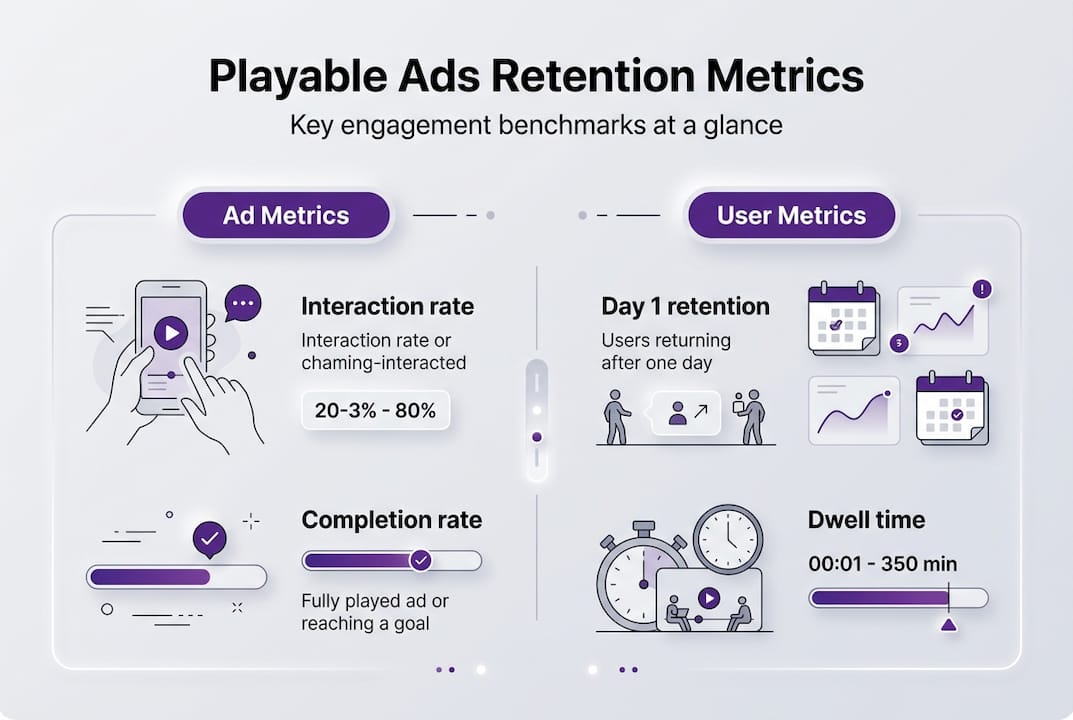
For a structured view of how these numbers fit into campaign planning, the playable ads campaign breakdown and the mobile ad glossary are useful references when briefing your team or reporting to stakeholders.
Key metrics to track consistently:
- Interaction rate per creative variant
- Average dwell time segmented by network
- Completion rate as a proxy for install quality
- Replay rate as a signal of genuine interest
- D1, D7, D30 retention mapped back to ad creative
Strategies to improve playable ad retention
Improving retention from playable ads is a systematic process, not a one-time creative decision. The following steps reflect what high-performing user acquisition teams do consistently.
- Match ad mechanics to in-game experience. The single most impactful change you can make is ensuring the playable ad mechanic is a faithful representation of the core gameplay loop. Shortcuts here cost you in lifetime value.
- A/B test difficulty and call-to-action phrasing. Testing ad difficulty, CTA wording, and network placement simultaneously gives you faster learning cycles. AppLovin carries 59% of playable ad traffic, making it the primary testing ground for most campaigns.
- Monitor dwell time against app retention. If dwell time is high but D7 retention is low, the ad is engaging but misrepresenting the game. If dwell time is low but retention is strong, the ad may be too short to filter effectively.
- Avoid over-simplifying for broad reach. Reducing mechanic complexity to appeal to the widest possible audience lowers the quality of self-selection. You attract more installs but fewer retained users.
- Segment by network and creative variant. Different networks attract different user profiles. Retention data should always be segmented by traffic source to identify which combinations of network and creative produce the best long-term outcomes.
For a deeper look at ad conversion optimisation and how these strategies translate into campaign structure, the principles apply across both hyper-casual and mid-core game categories.
Common pitfalls and expert tips
Even experienced teams make avoidable mistakes with playable ads. The most damaging errors are not technical. They are strategic.
- Using mechanics not found in the actual game. This is the most common cause of poor retention. A completion rate above 35% is an early indicator of quality installs, but only if the mechanic is honest. Fake mechanics inflate completion rates while destroying lifetime value.
- Over-complicating the demo for broad campaigns. A playable ad designed for a niche audience should not be simplified to the point where it no longer represents the game accurately.
- Neglecting drop-off and replay data. These two signals are often ignored in favour of top-line install numbers. They are, however, the clearest indicators of creative quality.
- Ignoring network-level traffic differences. AppLovin, Unity Ads, and ironSource each attract different user demographics. Retention benchmarks should be set per network, not as a single campaign average.
“The teams that consistently achieve strong Day 30 retention from playable ads are the ones treating the ad as the first level of the game, not as a marketing asset separate from the product.”
For practical starting points, playable ad templates offer a structured way to build retention-focused creatives without starting from scratch each time.
How to get started with high-retention playable ads
Understanding the mechanics of playable ad retention is one thing. Building and iterating on creatives quickly is another challenge entirely. PlayableMaker is designed specifically for mobile marketing teams who need to produce, test, and optimise playable ads without pulling developers off their core work. The platform requires no coding, keeps production costs manageable, and supports the kind of rapid iteration that retention optimisation demands. If you want to understand the broader context first, the guide on playable ads explained and the analysis of why playable ads work psychologically are strong starting points. When you are ready to build, the PlayableMaker platform gives you the tools to create retention-focused playable ads at scale, without the overhead.
Frequently asked questions
What is a good retention rate for playable ads in mobile games?
Aim for Day 1 retention of 35–45% and Day 7 retention of 15–21% when running playable ad campaigns. These figures sit meaningfully above typical benchmarks for passive ad formats.
How do playable ads increase mobile game retention?
Playable ads allow users to experience core mechanics before installing, which means they self-select based on genuine interest. This pre-install gameplay experience produces users who already know what to expect, reducing early churn significantly.
Which metrics indicate strong playable ad retention?
A completion rate above 35%, dwell time of 15 seconds or more, and a measurable replay rate are the clearest ad-side signals that your creative is attracting users likely to be retained post-install.
What mistakes lower playable ad retention?
Using fake mechanics not present in the actual game is the most damaging error, as it attracts users who will churn immediately after install. Over-simplifying the demo to chase broad reach produces a similar outcome.
Recommended
- Why playable ads convert better: user acquisition guide 2026 – playablemaker.com Why playable ads convert better: user acquisition guide 2026
- Playable Ad Trends 2025: Build Engaging Ads Without Coding – playablemaker.com Playable Ad Trends 2025: Build Engaging Ads Without Coding
- Master the ad design process for playable ads in 2026 – playablemaker.com Master the ad design process for playable ads in 2026
- 7 Creative Ad Concepts for Mobile Game User Acquisition – playablemaker.com 7 Creative Ad Concepts for Mobile Game User Acquisition
- Music Video Best Practices: 28% More Reach With YouTube Ads | Music Video Marketplace Blog