Bold strategies matter when every marketing pound must deliver results. The choice between static and playable ads shapes how prospective players connect with your mobile game. Playable ads empower users to interact with your product before downloading, delivering higher engagement and stronger retention compared to traditional formats. This article offers practical insight for user acquisition specialists seeking no-code, cost-efficient ways to create interactive ad experiences that truly hold player attention.
Table of Contents
- Defining Playable Ads And Static Ads
- Core Features And User Engagement Dynamics
- Production Complexity And Cost Considerations
- How Each Format Affects Player Retention
- Choosing The Right Format For Your Campaigns
Key Takeaways
| Point | Details |
|---|---|
| Difference in Engagement | Playable ads offer high user engagement through direct interaction, while static ads provide a passive viewing experience. |
| Production Complexity | Playable ads require advanced design and programming skills, making them more resource-intensive than static ads. |
| User Retention Impact | Playable ads enhance user retention by allowing a real-time preview of app functionality, reducing post-install disappointment. |
| Campaign Format Selection | The choice between playable and static ads should align with campaign objectives, target audience, and budget constraints for optimal effectiveness. |
Defining Playable Ads and Static Ads
Advertising technologies have dramatically transformed digital marketing strategies, introducing innovative approaches like playable ads that revolutionise user engagement. Interactive advertisement techniques have emerged as powerful alternatives to traditional static display formats, offering immersive experiences that captivate potential users.
Playable ads represent an interactive advertising format that allows users to experience a miniature version of an app or game directly within the advertisement itself. These dynamic ads differ fundamentally from static ads by providing:
- Direct user interaction
- Immediate product demonstration
- Enhanced engagement potential
- Lower barrier to understanding product functionality
- Real-time preview of user experience
Static ads, by contrast, remain passive communication tools that display information without enabling user manipulation. These traditional advertisements typically include fixed images, text, or graphic elements designed to convey a message or promote a product through visual representation.
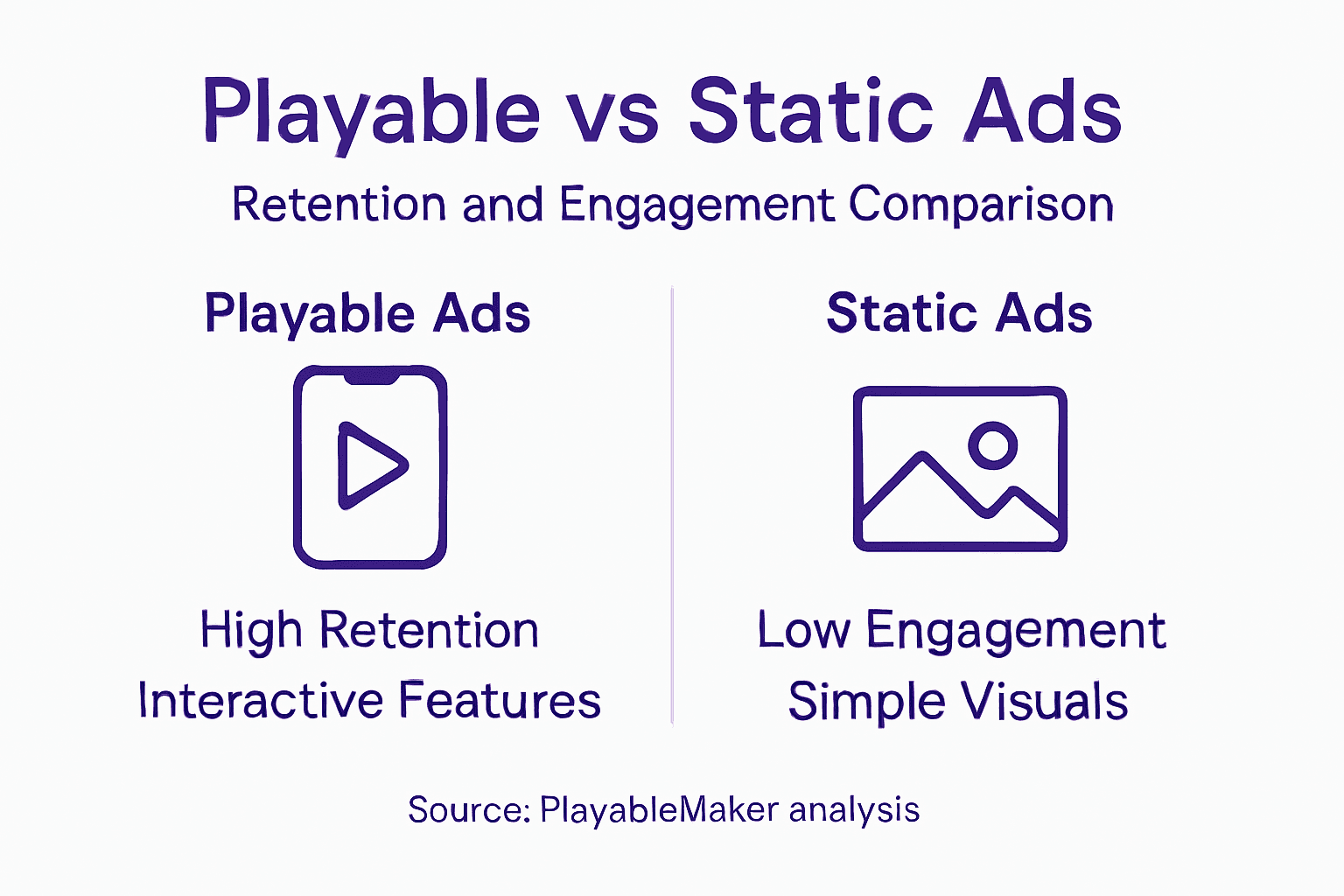
Here’s a comparison of playable ads and static ads across four key marketing dimensions:
| Aspect | Playable Ads | Static Ads |
|---|---|---|
| User Engagement | High; encourages direct interaction | Low; relies on passive viewing |
| Production Complexity | Advanced programming and design required | Basic design tools sufficient |
| Cost Range | £5,000–£50,000 depending on features | Generally under £1,000 per unit |
| Impact on Retention | Enhances long-term user retention | Often leads to higher churn |
The primary distinction between playable and static ads lies in their core interaction model. While static ads present information unidirectionally, playable ads create a two-way communication channel that transforms advertising from a passive viewing experience into an interactive engagement opportunity.
Pro Tip: When designing playable ads, focus on creating a compelling 15-30 second interactive experience that genuinely represents your product’s core value proposition.
Core Features and User Engagement Dynamics
User engagement dynamics in digital advertising have undergone significant transformation, with interactive ad performance revealing compelling differences between playable and static ad formats. These innovative advertising approaches fundamentally reshape how brands communicate with potential users.
The core features distinguishing playable ads from static advertisements include:
- Immersive interaction capabilities
- Real-time user experience simulation
- Dynamic content manipulation
- Immediate feedback mechanisms
- Personalised engagement pathways
Playable ads create a micro-experience that allows users to interact directly with the product before committing to a download or purchase. This approach dramatically reduces uncertainty and increases user confidence by providing a tangible preview of the product’s functionality and entertainment value.
Static ads, in contrast, remain passive communication channels that rely solely on visual representation and textual information. While traditional in nature, they lack the dynamic engagement potential of interactive formats. The fundamental limitation of static ads is their inability to provide users with a genuine sense of product interaction, making them significantly less compelling in capturing and maintaining user attention.
Interactive advertisements transform passive viewing into active participation, bridging the gap between marketing communication and user experience.
Pro Tip: Design playable ads that showcase your product’s most engaging feature within the first 10 seconds to maximise user interest and interaction.
Production Complexity and Cost Considerations
Playable ad production represents a significantly more complex and resource-intensive process compared to traditional static advertisements. The intricate development requirements demand specialised skills, advanced design capabilities, and a deeper understanding of interactive user experiences.
The key cost and complexity factors for playable ads include:
- Advanced programming and design expertise
- Multiple iterative development cycles
- Interactive game mechanics design
- High-fidelity graphical requirements
- Complex user experience testing
- Cross-platform compatibility considerations
Static advertisements, by comparison, involve relatively straightforward production processes. Designers can typically create these ads using standard graphic design tools, with minimal technical complexity. The visual elements are predetermined and do not require dynamic interaction mechanisms.
While playable ads demand higher initial investment, their superior engagement metrics often justify the increased production costs for brands seeking meaningful user interaction.
The financial investment in playable ads varies substantially depending on complexity. Simple interactive experiences might cost £5,000-£15,000, while sophisticated mini-game advertisements could require investments ranging from £20,000 to £50,000. These higher production expenses are typically offset by significantly improved user acquisition and retention rates, making them an attractive option for companies with substantial marketing budgets.

Pro Tip: Start with a minimum viable interactive experience and incrementally enhance complexity based on initial user engagement metrics.
How Each Format Affects Player Retention
Player retention strategies demonstrate profound differences between playable and static advertisements in maintaining user interest and engagement. The interactive nature of playable ads fundamentally transforms how potential users experience and connect with mobile applications.
Key retention impact factors include:
- Immediate user experience preview
- Reduced installation uncertainty
- Lower uninstallation probability
- Enhanced user expectation management
- More authentic product representation
- Stronger initial user connection
Playable ads offer a transparent preview of app functionality, allowing users to assess the product’s value before committing to a full download. This approach dramatically reduces the likelihood of post-installation disappointment, creating a more informed and satisfied user base.
Static advertisements, by contrast, provide limited insight into app performance and user experience. Without interactive elements, these traditional formats rely solely on visual representation and descriptive text, which often fail to communicate the genuine appeal of a mobile application. The lack of direct interaction increases the risk of user disengagement and higher uninstallation rates.
Interactive advertisements bridge the expectation gap, transforming passive marketing into a user-driven discovery process.
Pro Tip: Design playable ad experiences that showcase your app’s most compelling feature within the first 10 seconds to maximise user retention potential.
Choosing the Right Format for Your Campaigns
Campaign strategy selection requires careful consideration of marketing objectives, target audience, and available resources. Understanding the nuanced differences between playable and static ad formats can significantly impact campaign performance and user engagement.
Key selection criteria for ad formats include:
- Campaign primary objectives
- Target audience demographics
- Budget constraints
- Product complexity
- Desired user interaction level
- Performance measurement goals
Playable ads excel in scenarios demanding high user interaction and detailed product demonstration. These interactive experiences are particularly effective for mobile games, utility applications, and complex software products where users benefit from hands-on exploration before commitment.
Static advertisements remain valuable for broad awareness campaigns, brand recognition, and scenarios with limited budgetary resources. They provide a cost-effective method of communicating core messaging to wider audiences, though with substantially reduced engagement potential compared to interactive alternatives.
The following table summarises the strategic suitability of each ad format:
| Campaign Goal | Best Suited Format | Primary Benefit |
|---|---|---|
| Product demonstration | Playable Ads | Hands-on user experience |
| Broad brand awareness | Static Ads | Cost-effective mass reach |
| Complex product explanation | Playable Ads | Detailed feature exploration |
| Limited marketing budget | Static Ads | Low-cost, easy implementation |
Selecting the right ad format is less about choosing between formats and more about aligning advertising strategy with specific campaign objectives.
Pro Tip: Develop a hybrid approach that utilises both static and playable ad formats strategically across different campaign stages to maximise overall marketing effectiveness.
Effortless Playable Ads That Boost Retention Without Breaking Your Budget
The article highlights a crucial challenge faced by marketers: creating engaging playable ads that improve player retention often demands significant development time, specialised skills, and high costs. Many businesses struggle with the complexity and expense of producing interactive ads that truly showcase their product’s value while retaining users effectively. If you want to transform static advertisements into captivating interactive experiences but worry about budget constraints and technical hurdles, there is a solution designed just for you.
At PlayableMaker, we understand that playable ads should be quick to build, affordable, and accessible to everyone. Our no-code platform lets you craft compelling interactive ads that captivate users and reduce churn without the need for extensive programming or heavy resource investment. Explore our Publishing Archives to learn practical tips on deploying playable ads that drive retention. If you want to get started today and create budget-friendly interactive experiences that convert, visit PlayableMaker. For support as you build engaging playable ads, check out our Help Archives. Take control of your user engagement now and see the difference interactive ads make in keeping players hooked.
Frequently Asked Questions
What are playable ads?
Playable ads are interactive advertisements that allow users to experience a miniature version of an app or game directly within the advertisement. They encourage direct interaction and provide an immediate product demonstration.
How do playable ads impact user retention compared to static ads?
Playable ads enhance user retention by offering a transparent preview of app functionality, reducing installation uncertainty and creating a more satisfied user base, while static ads often lead to higher churn due to their passive nature.
What are the key differences between playable ads and static ads?
The key differences include user engagement dynamics, production complexity, cost, and how each format affects user retention. Playable ads involve direct interaction and are more immersive, while static ads are passive and rely solely on visual representation.
When should I choose static ads over playable ads for my marketing campaign?
Static ads are suitable for broad brand awareness campaigns, low-budget initiatives, or when the product doesn’t require detailed user interaction or demonstration. They are cost-effective for communicating core messages to broader audiences.
Recommended
- What is User Retention? Understanding Its Importance – playablemaker.com What is User Retention? Understanding Its Importance
- 7 Key Advantages of Interactive Ads for Mobile Games – playablemaker.com 7 Key Advantages of Interactive Ads for Mobile Games
- 7 Key Differences: Video vs Playable Ads for UA Success – playablemaker.com 7 Key Differences: Video vs Playable Ads for UA Success
- Conversions Advertising: Maximising Mobile Game Installs – playablemaker.com Conversions Advertising: Maximising Mobile Game Installs