Mobile gaming marketers often feel overwhelmed by complex advertising jargon and rising costs. Without technical resources or deep budgets, creating engaging ads that drive quality installs seems impossible. This guide clarifies essential mobile advertising terminology, explores how playable ads boost engagement, and reveals how no-code platforms make creating effective campaigns affordable and fast. You’ll gain the vocabulary and tools to maximize user acquisition results without breaking the bank.
Table of Contents
- Introduction To Mobile Advertising In Mobile Gaming
- Core Mobile Advertising Terminology Essential For Mobile Gaming
- Playable Ads: Definition, Benefits, And Effectiveness
- No-Code Tools For Creating Playable Ads
- Comparison Of Mobile Advertising Formats In Mobile Gaming
- Common Misconceptions About Playable Ads
- Practical Steps To Implement Playable Ads In Mobile Game User Acquisition
- Conclusion: Leveraging Mobile Advertising Knowledge For Better User Acquisition
- Explore PlayableMaker: Simplify Your Playable Ads Today
Key Takeaways
| Point | Details |
|---|---|
| Glossary clarifies critical mobile ad terminology and metrics | Understanding CPI, CPM, LTV, and ROAS enables smarter campaign decisions and budget allocation. |
| Playable ads boost engagement and retention in mobile gaming | Interactive ad formats improve 7-day retention by up to 20% compared to static ads. |
| No-code platforms reduce cost and time for playable ad creation | Marketing teams can cut production time by 70% and costs by 50% without developer involvement. |
| Comparison of ad formats guides optimal user acquisition strategies | Banner, interstitial, rewarded video, and playable ads each serve different campaign goals and budgets. |
| Stepwise approach helps implement playable ads effectively | Following structured steps from design to measurement ensures successful playable ad deployment. |
Introduction to Mobile Advertising in Mobile Gaming
Mobile advertising powers user acquisition for gaming apps by connecting developers with potential players across millions of devices. Unlike traditional advertising, mobile gaming campaigns face intense competition, shrinking attention spans, and the challenge of converting viewers into loyal players who stay engaged beyond the first session.
The gaming vertical presents unique obstacles:
- High user acquisition costs averaging $2 to $5 per install depending on genre and market
- Retention rates that often drop below 20% after day one
- Crowded app stores with millions of competing titles
- Users who expect instant entertainment value and seamless experiences
Interactive ad formats address these challenges by letting users experience gameplay before installing. This hands-on preview increases engagement time, sets accurate expectations, and attracts higher quality users who understand what they’re downloading. Playable ads exemplify this approach, offering mini-game experiences within the ad itself.
No-code playable ad platforms have emerged as game changers for marketing specialists. These tools eliminate technical barriers, allowing you to create interactive ads without coding skills or developer time. You can launch campaigns faster, test creative variations quickly, and control costs while maintaining quality. The democratization of playable ad creation means small teams can now compete with larger studios in producing engaging, conversion-focused advertising.
This shift matters because understanding user acquisition strategies and leveraging affordable interactive formats directly impacts your bottom line. By mastering the terminology and tools covered ahead, you’ll make informed decisions that improve campaign performance and ROI.
Core Mobile Advertising Terminology Essential for Mobile Gaming
Navigating mobile gaming campaigns requires fluency in industry-specific terms and metrics. These concepts form the foundation of how you plan, execute, and measure advertising success.
Key cost models and metrics include:
- CPI (Cost Per Install): You pay each time a user installs your game. CPI accounts for over 60% of mobile gaming ad spend globally as of 2024, making it the dominant pricing model for user acquisition.
- CPM (Cost Per Mille): Cost per thousand impressions. Used for brand awareness campaigns where visibility matters more than immediate installs.
- CPC (Cost Per Click): You pay when users click your ad. Useful for driving traffic but doesn’t guarantee installs.
- CPA (Cost Per Action): Payment tied to specific user actions like level completion or purchase. Aligns spend with value-generating behaviors.
- LTV (Lifetime Value): Total revenue a user generates throughout their engagement with your game. Critical for determining sustainable acquisition costs.
- ROAS (Return on Ad Spend): Revenue generated divided by advertising costs. A ROAS above 1.0 means profitable campaigns.
Understanding the advertising ecosystem components helps you optimize campaigns:
- Ad Networks: Platforms connecting advertisers with publishers (Facebook Ads, Google Ads, Unity Ads). Each offers different targeting capabilities and inventory.
- Ad Mediation Platforms: Tools that manage multiple ad networks simultaneously. Ad mediation can increase eCPM by up to 30% by optimizing demand sources in real-time.
- Ad Units: The actual ad placements like banners, interstitials, or rewarded videos shown to users.
Fundamental performance terms you’ll track daily:
- Impressions: Number of times your ad appears on screens. High impressions with low clicks indicate creative or targeting issues.
- Clicks: User taps on your ad. Click-through rate (CTR) measures ad appeal.
- Conversions: Completed desired actions, typically installs in mobile gaming.
- Attribution: The process of connecting installs and in-app actions back to specific ad campaigns and channels.
Mastering these terms lets you speak confidently with ad platform reps, analyze campaign data accurately, and align your strategies with business goals. When you understand that CPI dominance reflects gaming’s install-focused nature, or how ad mediation optimizes revenue, you make smarter budget allocation decisions.
For deeper exploration of specific terms and calculations, consult comprehensive resources like this mobile advertising terminology guide and mobile marketing glossary.
Playable Ads: Definition, Benefits, and Effectiveness
Playable ads transform passive viewing into active participation by letting users interact with a simplified version of your game before installing. Think of them as interactive demos that run directly within the ad placement, requiring no download to experience core gameplay mechanics.
How playable ads work: Users see your ad, tap to start, and immediately play a 15 to 60 second mini-version of your game. They control characters, solve puzzles, or complete challenges that mirror actual gameplay. At the end, a clear call-to-action prompts installation to continue the experience.
Key benefits that set playable ads apart:
- Higher Engagement Rates: Users spend 30 to 90 seconds actively playing, far exceeding the 5 to 15 seconds typical of video ads. This extended interaction builds emotional connection and purchase intent.
- Improved Retention: By previewing actual gameplay, playable ads set accurate expectations. Playable ad campaigns show retention improvements of up to 20% over non-interactive ad campaigns within the first 7 days post-install.
- Better User Quality: Players who install after trying your game understand what they’re getting. This self-selection reduces early churn and increases LTV.
- Cost Efficiency with No-Code Tools: Traditional playable ads required developers and could cost $5,000 to $15,000 per creative. No-code platforms drop costs to under $500 while cutting production time from weeks to days.
The effectiveness comes down to psychology. When users invest time and effort playing your ad, they’re more committed to continuing the experience. This is the endowment effect in action: people value things more when they’ve contributed effort to them.
“Playable ads let users test-drive games before committing storage space and time. This try-before-you-buy model consistently delivers higher quality users who stay engaged longer and spend more.”
For mobile gaming marketers working with limited budgets, the benefits of playable ads extend beyond performance metrics. These formats give you creative flexibility to showcase unique mechanics, target specific player preferences, and differentiate your game in crowded markets.
The combination of engagement, retention, and cost advantages makes playable ads explained essential knowledge for any serious user acquisition strategy. When built with no-code tools, they become accessible to teams of any size, democratizing what was once an expensive, technical process.
No-Code Tools for Creating Playable Ads
No-code platforms revolutionize playable ad creation by removing technical barriers that traditionally required developers, specialized skills, and substantial budgets. These tools provide visual interfaces where you drag, drop, and configure elements to build interactive ad experiences without writing a single line of code.
How no-code platforms empower marketing teams:
- Drag-and-Drop Interfaces: Arrange gameplay elements, buttons, and animations visually. See changes in real-time as you build.
- Pre-Built Templates: Start with tested frameworks for common game genres like puzzle, runner, or match-3. Customize colors, characters, and mechanics to match your brand.
- Asset Libraries: Access royalty-free graphics, sounds, and animations. Upload your own assets for complete customization.
- Built-In Analytics: Track engagement metrics, completion rates, and conversion data without additional integration work.
Quantifiable advantages transform campaign economics:
- Time Savings: Teams report 70% faster production cycles. What took 3 to 4 weeks with developers now takes 3 to 5 days.
- Cost Reductions: Production costs drop up to 50% by eliminating developer fees and reducing iteration expenses. Budget-conscious teams can afford multiple creative variations for testing.
- Creative Control: Marketing specialists who understand player preferences make design decisions directly, without translation through technical intermediaries.
- Rapid Testing: Launch A/B tests in hours instead of weeks. Quickly identify winning creatives and scale successful variants.
Workflow improvements compound over campaign lifecycles. When you control the creation process, you respond faster to performance data, seasonal trends, and competitor moves. The ability to iterate based on user feedback without reopening development tickets means your campaigns stay fresh and relevant.
Pro Tip: Choose no-code platforms offering drag-and-drop interfaces combined with genre-specific templates. This combination delivers the fastest path from concept to published ad while maintaining quality standards.
The accessibility of no-code tools means you can focus budget on media spend rather than production costs. Resources previously locked in development now fund broader reach or more creative tests. For practical guidance on building effective ads, explore strategies for making engaging game ads and review playable ad techniques that drive results.

Comparison of Mobile Advertising Formats in Mobile Gaming
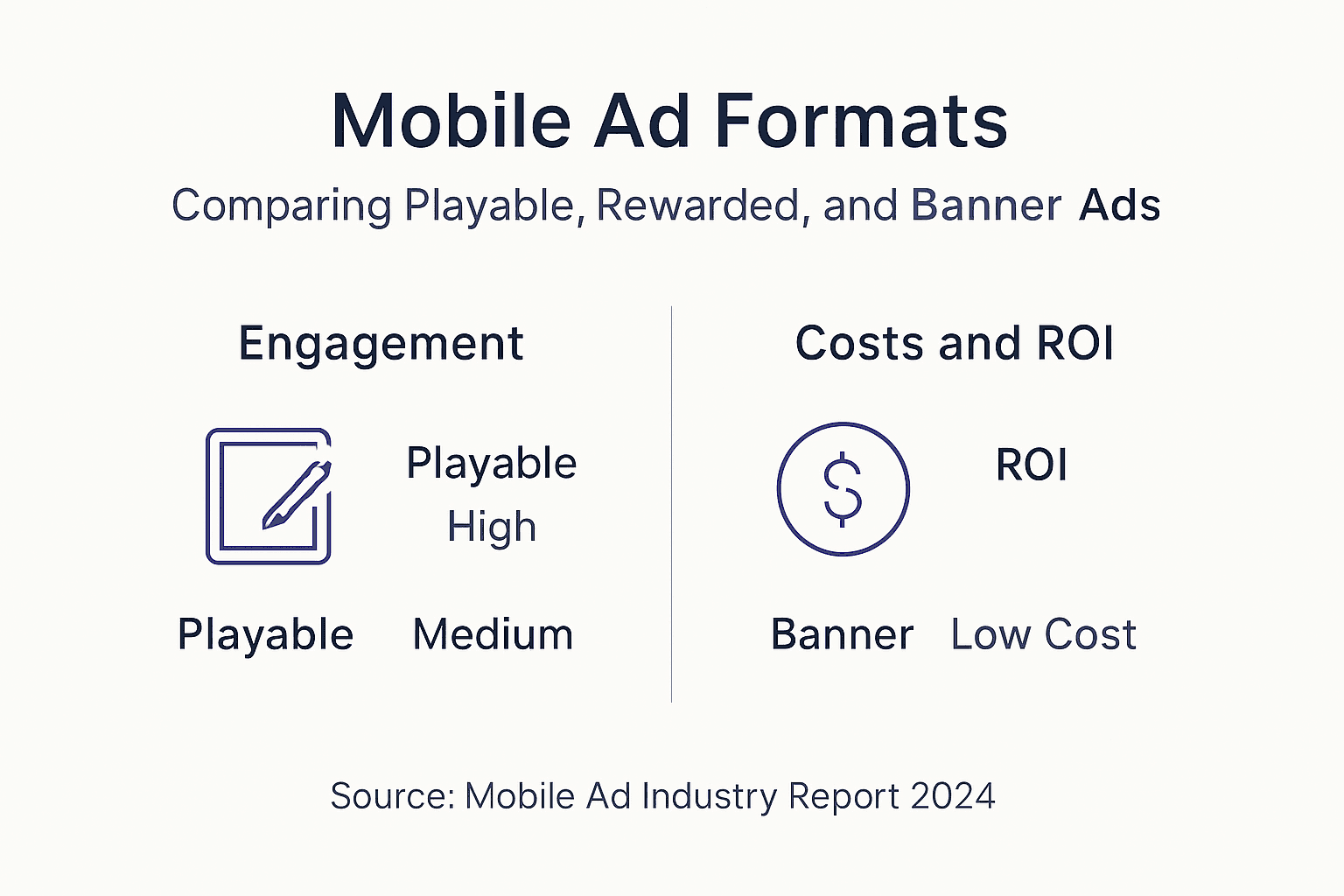
Mobile gaming campaigns utilize multiple ad formats, each offering distinct advantages for specific goals. Understanding format differences helps you allocate budget effectively and match creative approaches to campaign objectives.
| Format | User Experience | Engagement Level | Typical Cost | Best Use Case |
|---|---|---|---|---|
| Banner Ads | Small ads at screen top/bottom, minimally intrusive | Low, often ignored | Lowest CPM ($1-$3) | Brand awareness, steady background visibility |
| Interstitial Ads | Full-screen static or video ads between game levels | Medium, brief attention | Medium CPM ($5-$10) | Install campaigns with broad reach goals |
| Rewarded Video | Users opt in to watch 15-30 second video for in-game rewards | High, opt-in rates exceed 70% | Medium to High CPI | Engaged users, monetization, tutorial prompts |
| Playable Ads | Interactive 30-60 second gameplay demos | Highest, active participation 30-90 seconds | Higher CPI initially, best LTV | Quality user acquisition, showcasing unique mechanics |
Key considerations when selecting formats:
- Engagement vs. Reach Tradeoff: Banner ads reach many users cheaply but generate minimal engagement. Playable ads reach fewer users but create meaningful interactions that drive quality installs.
- User Experience Impact: Interruptive formats like interstitials can frustrate users if poorly timed. Rewarded videos and playable ads provide value exchange, making interruptions welcome.
- Campaign Stage Alignment: Use broad-reach formats like banners and interstitials for awareness phases. Deploy playable ads and rewarded videos for conversion-focused stages targeting users ready to install.
- Creative Resource Requirements: Static formats need basic graphics. Video requires production capabilities. Playable ads traditionally demanded developers but no-code tools now make them accessible.
Rewarded video’s high opt-in rate stems from the value exchange: users willingly watch ads to gain game currency, lives, or power-ups. This voluntary engagement translates to better brand recall and more favorable attitudes toward advertisers.
Playable ads command higher initial costs but deliver superior ROI through improved retention and user quality. When users self-select after trying gameplay, you acquire players genuinely interested in your game mechanics, reducing wasted spend on poor-fit installs.
For detailed format analysis and selection guidance, review this mobile ad formats comparison to match your campaign goals with optimal creative approaches.
Common Misconceptions about Playable Ads
Despite proven effectiveness, playable ads face persistent myths that discourage marketers from adopting them. Clarifying these misconceptions opens opportunities for teams to leverage powerful interactive formats affordably.
-
Myth: Playable ads always require expensive developers. Reality: No-code platforms enable non-technical marketers to create playable ads independently. Production costs have dropped from $5,000+ to under $500, with no ongoing developer fees.
-
Myth: Playable ads only work for specific game genres. Reality: Playable formats adapt to virtually any genre. Puzzle, strategy, RPG, and casual games all benefit from interactive previews showcasing unique mechanics.
-
Myth: Creating playable ads takes too long for fast-moving campaigns. Reality: No-code tools reduce production time by 70%. Teams now build and launch playable ads in 3 to 5 days versus 3 to 4 weeks with traditional development.
-
Myth: Playable ads only work for big-budget studios. Reality: Democratized creation tools and lower production costs make playable ads accessible to indie developers and small marketing teams with limited resources.
-
Myth: Users won’t engage with playable ads on mobile devices. Reality: Data proves the opposite. Users spend 30 to 90 seconds actively playing, and campaigns achieve up to 20% better retention than static formats.
-
Myth: Playable ads don’t scale effectively. Reality: Once created, playable ads distribute across networks like any other format. No-code platforms let you quickly produce multiple variants for testing and scaling winning creatives.
These myths often stem from outdated information or experiences with early playable ad technology that was indeed expensive and technical. The no-code revolution fundamentally changed the economics and accessibility of interactive advertising.
Pro Tip: Start small with no-code platforms offering free trials or low-cost starter plans. Build one playable ad, test it on a modest budget, and measure retention improvements firsthand before scaling investment.
Addressing specific concerns about complexity, explore detailed myth-busting at playable ads misconceptions to gain confidence in implementing these powerful formats.
Practical Steps to Implement Playable Ads in Mobile Game User Acquisition
Successfully deploying playable ads requires strategic planning, smart tool selection, and data-driven optimization. Follow these actionable steps to launch campaigns that drive quality installs and improve retention.
-
Design Intuitive User Journeys: Map the 30 to 60 second playable experience focusing on your game’s core mechanic. Include a clear tutorial moment, an achievement or win state, and an obvious call-to-action. Users should understand gameplay instantly without confusion.
-
Select the Right No-Code Platform: Evaluate platforms based on your needs. Prioritize drag-and-drop interfaces, genre-specific templates, analytics integration, and export options compatible with your ad networks. Test free trials before committing.
-
Build Your Playable Creative: Use platform templates as starting points. Customize visual assets, adjust difficulty to ensure most users can complete the experience, and polish transitions between tutorial, gameplay, and install prompt. Keep file sizes under 5MB for fast loading.
-
Set Campaign Budgets and Timelines: Allocate 10% to 20% of user acquisition budget initially for testing. Plan 2 to 3 week test periods to gather statistically significant data on retention and LTV before scaling spend.
-
Choose Ad Networks and Targeting: Deploy playable ads on networks supporting the format like Facebook, Google, Unity, and ironSource. Target lookalike audiences based on your best existing users to maximize relevance and conversion rates.
-
Track Critical Metrics: Monitor engagement rate, completion rate, install conversion, 7-day retention, and CPI. Compare these metrics against your standard video or static ad benchmarks to quantify playable ad lift.
-
Iterate Based on Performance Data: Analyze where users drop off within the playable experience. Simplify confusing moments, adjust difficulty, or test different calls-to-action. Launch A/B tests comparing creative variations.
-
Scale Winning Creatives: Once you identify playable ads delivering 15% to 20% better retention at acceptable CPI, increase budget allocation. Create additional variants targeting different user segments or showcasing alternative gameplay modes.
Pro Tip: Iterate based on data and user feedback to refine ads quickly. No-code tools make updates fast and cheap, so test boldly and optimize continuously rather than seeking perfection before launch.
For implementation guidance tailored to mobile gaming, review effective playable ad techniques and practical tips for making engaging game ads that convert.
Conclusion: Leveraging Mobile Advertising Knowledge for Better User Acquisition
Mastering mobile advertising terminology, formats, and tools transforms how you approach user acquisition in mobile gaming. Understanding CPI, LTV, ROAS, and other metrics lets you make data-driven decisions that optimize spending and maximize returns. This knowledge base turns abstract campaign reports into actionable insights.
Playable ads represent a significant opportunity for marketers willing to embrace interactive formats. The combination of higher engagement, improved retention, and better user quality makes them powerful tools for competitive markets. When created with no-code platforms, these once-exclusive formats become accessible to teams of any size and budget.
The democratization of playable ad creation reduces your dependency on developers and external agencies. You gain creative control, faster iteration cycles, and lower production costs. This independence means you can test more ideas, respond quickly to market changes, and maintain campaign momentum without technical bottlenecks.
As mobile advertising continues evolving with new formats, targeting capabilities, and measurement tools, your commitment to continuous learning determines long-term success. Experiment with the strategies covered here, measure results rigorously, and refine your approach based on what works for your specific games and audiences.
The mobile gaming market rewards marketers who combine strategic knowledge with practical execution. You now have the vocabulary, format understanding, and implementation roadmap to drive better user acquisition outcomes. Apply these insights confidently, start small if needed, and scale what delivers results.
Explore PlayableMaker: Simplify Your Playable Ads Today
Ready to create engaging playable ads without the technical hassle or big budgets? PlayableMaker’s no-code platform empowers marketing teams to build interactive ad experiences in days instead of weeks. You’ll slash production costs while maintaining the quality and engagement that drives quality installs and retention.
Our drag-and-drop interface, genre-specific templates, and built-in analytics make creating playable ads as simple as designing a presentation. Whether you’re testing playable ads for the first time or scaling successful campaigns, PlayableMaker provides the speed and flexibility you need. Discover how interactive formats work at playable ads explained, explore the advantages at benefits of playable ads, and learn to build interactive ads easily with step-by-step guidance.
FAQ
What is a playable ad in mobile gaming?
Playable ads are interactive ad formats offering users a hands-on gameplay preview directly within the ad. Users tap to start and immediately play a simplified 15 to 60 second version of your game, experiencing core mechanics before installing. This try-before-you-buy approach sets accurate expectations, boosting engagement and retention by attracting genuinely interested players.
How do no-code tools help create playable ads?
No-code tools provide drag-and-drop visual interfaces that eliminate coding requirements entirely. Marketing teams use pre-built templates, customize assets, and configure gameplay logic without technical skills. This approach cuts production time by 70%, reduces costs up to 50%, and empowers non-technical marketers to control creative decisions directly.
What are the main cost models in mobile game advertising?
CPI (Cost Per Install) accounts for over 60% of mobile gaming ad spend globally as of 2024, making it the dominant model where you pay only for completed installs. Other models include CPM (cost per thousand impressions) for awareness campaigns and CPC (cost per click) for traffic generation. Each model aligns payment with different campaign objectives and stages. Learn more about mobile advertising cost models to choose the right approach.
What is the retention impact of playable ads?
Playable ad campaigns show retention improvements of up to 20% over non-interactive campaigns within the first 7 days post-install. This significant lift occurs because interactive previews accurately set gameplay expectations, helping users self-select based on genuine interest. Higher quality installs mean less early churn, better LTV, and more efficient user acquisition spending. Explore detailed playable ads retention benefits to understand the mechanism behind these improvements.
Recommended
- Understanding What is eCPM in Mobile Gaming Marketing – playablemaker.com Understanding What is eCPM in Mobile Gaming Marketing
- Role of Mobile Ads: Enhancing User Acquisition Results – playablemaker.com Role of Mobile Ads: Enhancing User Acquisition Results
- Mobile Gaming Ad Formats: Boosting Global User Acquisition – playablemaker.com Mobile Gaming Ad Formats: Boosting Global User Acquisition
- What Is Ads Gaming? Complete Overview and Use Cases – playablemaker.com What Is Ads Gaming? Complete Overview and Use Cases