
TL;DR:
- Interactive creatives increase engagement, click-through rates, and install quality compared to static ads.
- No-code tools make creating interactive ads faster and more affordable for all marketing teams.
- Using interactive ads helps mobile game marketers stay competitive and improve campaign performance.
Many mobile gaming campaigns spend heavily on creative production yet still underperform. The culprit is often the same: static ad formats that ask nothing of the viewer and receive nothing in return. Interactive creatives, by contrast, invite participation and generate measurable signals of intent. The result is stronger engagement, better-quality installs, and a more efficient cost per acquisition. This article explains what interactive creatives are, how they compare to static formats, and why no-code tools have made them accessible to virtually every mobile marketing team, regardless of budget or technical resource.
Table of Contents
- What are interactive creatives and why do they matter?
- Comparing interactive creatives and static ad formats
- How interactive creatives improve user acquisition performance
- Cost, complexity, and no-code solutions: making interactive creatives easy
- Why interactive creatives are no longer just a nice-to-have
- Ready to create your own interactive creatives?
- Frequently asked questions
Key Takeaways
| Point | Details |
|---|---|
| Deeper user engagement | Interactive creatives outperform static ads because users play, engage, and remember your brand. |
| Better acquisition metrics | Playable ads drive higher click-through and retention rates in the mobile gaming funnel. |
| No-code solutions simplify everything | You can create powerful interactive ads quickly using modern no-code platforms, overcoming traditional cost and complexity barriers. |
| Competitive advantage | Teams adopting interactive creatives stand out and outpace rivals in user growth. |
What are interactive creatives and why do they matter?
An interactive creative is any ad format that requires the user to do something. Rather than watching a video or glancing at a banner, the user taps, swipes, plays, or responds. That act of participation is what separates interactive formats from everything that came before them.
The most common types relevant to mobile gaming include:
- Playable ads: A mini version of the game that lets the user experience core mechanics before installing.
- Swipe ads: Carousel or gesture-driven formats that reward exploration.
- Quizzes and polls: Short interactive sequences that personalise the ad experience.
- Rewarded interactive units: Formats that offer in-game currency or bonuses in exchange for engagement.
Each of these formats shares one defining quality: the user becomes an active participant rather than a passive observer. As interactive ads increase engagement by allowing users to participate directly, the psychological investment in the ad rises sharply. A user who has already played a level, however brief, is far more likely to install than one who merely watched a trailer.
“The shift from passive viewing to active participation is not a cosmetic change. It fundamentally alters how users process and remember an ad, which directly affects downstream conversion behaviour.”
For user acquisition specialists, this matters enormously. Engagement rate is not just a vanity metric. It is a leading indicator of install quality. Users who interact with a playable ad self-select based on genuine interest, which means your downstream retention figures improve alongside your click-through rate. You can read a fuller breakdown in this interactive ad explained resource, or explore the practical side in this guide to building interactive ad creatives.
The mobile advertising landscape has also grown considerably more competitive. Attention is scarce, and algorithms on major platforms reward creative formats that generate strong engagement signals. Interactive creatives, by their nature, produce more of those signals per impression than static alternatives. That is not an opinion. It is a structural advantage built into how these formats work.
Comparing interactive creatives and static ad formats
Now that interactive creatives are defined, it is important to see how they compare to traditional options across the metrics that matter most to mobile gaming marketers.
| Metric | Static ads | Interactive creatives |
|---|---|---|
| Engagement rate | Low to moderate | High |
| Click-through rate | Baseline | Up to 2x higher |
| Production time | Hours to days | Days (custom) or hours (no-code) |
| Production cost | Low | Moderate to low (no-code) |
| Install quality | Variable | Generally higher |
| Optimisation signal | Limited | Rich and actionable |
Static ads are not without merit. For retargeting campaigns where brand recall is already established, or for rapid A/B tests of simple visual concepts, a static format can be perfectly appropriate. Speed and low cost are genuine advantages when you need to iterate quickly on messaging.
However, for top-of-funnel user acquisition in mobile gaming, interactive creatives drive higher retention and click-through rates than static formats. The gap is not marginal. It reflects a fundamental difference in how users respond to content they can influence versus content they simply receive.
The perceived complexity of interactive creatives has historically been the main barrier. Marketers assumed that higher performance came with proportionally higher production demands. That assumption is increasingly outdated, particularly with modern no-code platforms that streamline the interactive ads workflow considerably. You can also find a range of interactive ad content ideas to accelerate your creative planning.
Pro Tip: When starting with playable ads, resist the urge to recreate the full game experience. A single, satisfying mechanic, something a user can complete in fifteen to twenty seconds, consistently outperforms longer, more complex demos. Simplicity reduces build time and improves completion rates.
How interactive creatives improve user acquisition performance
Once you understand the comparison, the impact on acquisition KPIs becomes clear. Interactive creatives do not just improve one metric in isolation. They strengthen the entire acquisition funnel from first impression through to long-term retention.

Campaigns with interactive creatives achieve 2x higher click-through rates compared to standard static or video formats. That improvement at the top of the funnel compounds as users move through the install and onboarding stages, because the users who clicked were already invested.
Here is a practical sequence for leveraging playable ads in your next user acquisition campaign:
- Define the core mechanic. Identify the single gameplay loop that best represents your game’s appeal. This becomes the foundation of your playable demo.
- Set a clear end card. Every playable ad needs a strong call to action at the conclusion of the interaction. Make the install prompt feel like a natural next step.
- Build multiple variants. Test at least two or three versions of the playable with different mechanics, difficulty levels, or visual themes to identify what resonates with your target audience.
- Measure engagement depth. Track not just click-throughs but how far users progress within the playable. Drop-off points reveal creative weaknesses.
- Feed learnings back into live game development. Playable ad data often reveals which features attract the most engaged users, which is valuable beyond the campaign itself.
The acquisition funnel benefits extend to post-install behaviour. Users acquired through playable ads tend to exhibit higher day-one and day-seven retention rates, because they arrived with accurate expectations of the game. You can explore the technical side of this in our guide on how to build interactive ads, and review ad creative processes that support efficient iteration.
Cost, complexity, and no-code solutions: making interactive creatives easy
Despite these benefits, many marketers worry interactive creatives are too expensive or complex to produce at scale. That concern was reasonable several years ago. Today, it is largely a myth.
| Creative type | Typical build time | Estimated cost range |
|---|---|---|
| Static ad | 1 to 4 hours | £200 to £800 |
| Custom-coded interactive | 2 to 6 weeks | £5,000 to £25,000+ |
| No-code interactive | 2 to 8 hours | £0 to £500 |
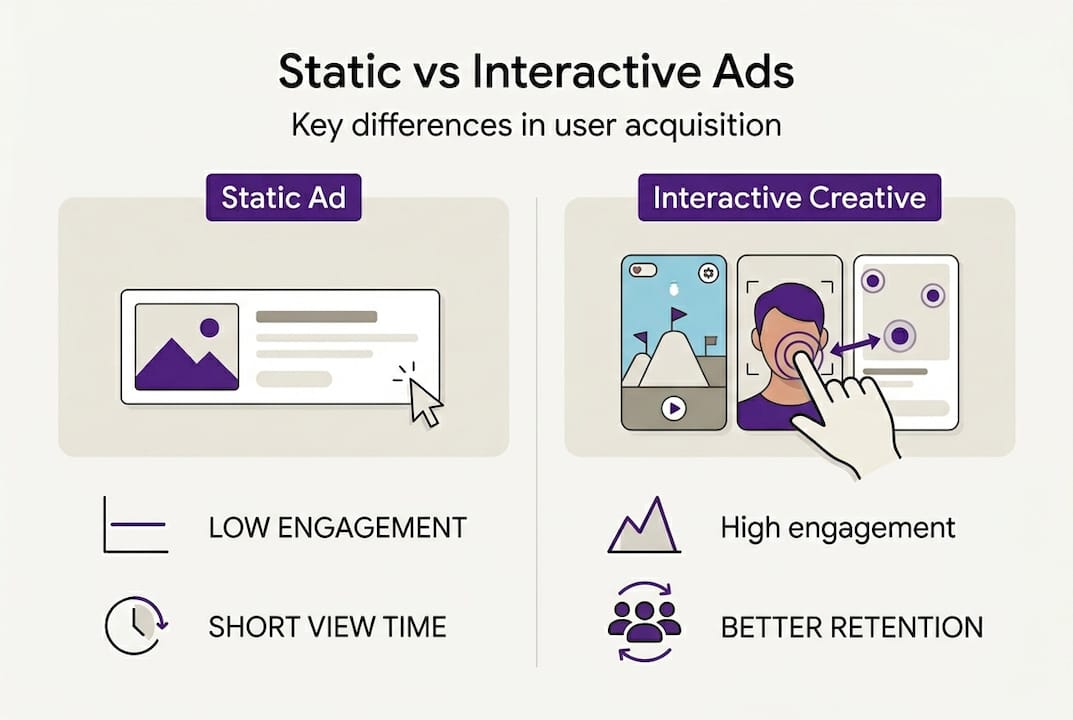
No-code solutions reduce creative build time from weeks to hours, eliminating the developer dependency that made playable ads prohibitive for smaller teams. The cost differential between custom-coded and no-code interactive creatives is substantial, often representing a saving of more than 90%.
When evaluating a no-code playable ad platform, look for the following features:
- Drag-and-drop editor that requires no programming knowledge.
- Pre-built templates tailored to common mobile game genres.
- Multi-platform export supporting major ad networks and DSPs.
- Real-time preview across device types and screen sizes.
- Analytics integration to track engagement depth and conversion events.
- Asset management that allows quick creative swaps without rebuilding from scratch.
Automation plays a meaningful role here. Modern no-code tools handle the technical rendering and compatibility requirements that previously demanded specialist developers. The marketer’s role shifts from managing production logistics to focusing on creative strategy and iterative testing. That is a more productive use of your team’s time and expertise.
You can find practical guidance on getting started in this collection of interactive ad tips, and explore the full capabilities of a playable builder with no coding required.
Why interactive creatives are no longer just a nice-to-have
There is a version of this conversation that treats interactive creatives as an advanced tactic for well-resourced teams. That framing no longer reflects reality. The mobile ad ecosystem has shifted. Users have been conditioned by years of interactive content to expect participation, not passive consumption. Static formats that once performed adequately now face a structural engagement deficit.
No-code tools have removed the last credible barrier. Cost and speed are no longer valid objections. A marketing manager with no technical background can build a compelling playable ad in an afternoon using the right platform. The creative strategy guide available from PlayableMaker outlines how this shift changes campaign planning at a strategic level.
From our perspective, the teams that continue to rely exclusively on static creatives are not just missing a performance opportunity. They are ceding ground to competitors who are generating richer engagement data, acquiring higher-quality users, and building more efficient feedback loops between their ads and their live game. The gap widens with every campaign cycle. Adopting interactive creatives now is not about chasing a trend. It is about maintaining competitive parity in a market that has already moved.
Ready to create your own interactive creatives?
If the evidence in this article has shifted your thinking, the practical next step is straightforward. PlayableMaker is built specifically for mobile gaming marketers who want to produce high-quality interactive creatives without writing a single line of code and without overspending their creative budget. Understanding why playable ads work from a psychological standpoint gives you a strategic edge, and reading about playable ads explained will help you frame the format for stakeholders. When you are ready to build, start with PlayableMaker and see how quickly an interactive creative can go from concept to live campaign.
Frequently asked questions
What is an interactive creative in mobile advertising?
An interactive creative is an ad unit that lets users actively engage, such as playing a demo or swiping to interact, rather than simply viewing. As outlined in this definition, this participation fundamentally changes how users process and respond to the ad.
Do interactive creatives really improve user acquisition results?
Yes. Interactive creatives consistently achieve higher engagement and better retention in mobile game marketing, as retention and click-through rates outperform static formats across most campaign types.
Are no-code solutions effective for building interactive creatives?
No-code tools let marketers build interactive ads quickly and at significantly lower cost, typically using drag-and-drop interfaces. No-code solutions reduce time and technical barriers that previously made playable ad production inaccessible for smaller teams.
What types of interactive creatives work best for mobile games?
Playable demos and short engagement formats such as quizzes or mini-levels are the most effective for mobile game ads. Types of playables vary by genre, but the principle of a single, satisfying mechanic holds across most categories.
Recommended
- Boost mobile game growth with interactive ads in 2026 – playablemaker.com Boost mobile game growth with interactive ads in 2026
- Interactive Ad Tips for 2025: No-Code Success Guide – playablemaker.com Interactive Ad Tips for 2025: No-Code Success Guide
- 7 Key Advantages of Interactive Ads for Mobile Games – playablemaker.com 7 Key Advantages of Interactive Ads for Mobile Games
- Mastering Interactive Ads Workflow for Mobile Games – playablemaker.com Mastering Interactive Ads Workflow for Mobile Games