
Over 80 percent of successful advertising campaigns are built on a strong creative strategy that connects brand vision to real customer needs. In the crowded british advertising world, understanding what sets effective campaigns apart can make all the difference for marketers who want lasting results. By revealing how a thoughtful creative strategy shapes everything from visuals to messaging, this guide shows how brands can turn complex goals into advertising people remember.
Table of Contents
- Defining Creative Strategy In Advertising
- Types Of Creative Strategies In Marketing
- Key Elements Of Creative Ad Approaches
- Step-By-Step Creative Strategy Process
- Common Mistakes And How To Avoid Them
Key Takeaways
| Point | Details |
|---|---|
| Creative Strategy Definition | A creative strategy is essential for guiding the creation of effective advertising campaigns that align with business objectives and resonate with target audiences. |
| Key Components | Effective strategies include clear marketing objectives, precise audience segmentation, and strong messaging frameworks that evoke emotional and rational responses. |
| Step-By-Step Process | Developing a creative strategy involves systematic steps including problem identification, objective definition, and audience analysis, ensuring targeted communication. |
| Common Mistakes | Marketers should avoid chasing trends without context, neglecting audience insights, and complicating messages, which can lead to ineffective advertising outcomes. |
Defining Creative Strategy in Advertising
A creative strategy represents the foundational blueprint that guides the development and execution of advertising campaigns, transforming abstract marketing objectives into compelling visual and narrative experiences. According to research from Universiti Teknologi MARA, the creative strategy development process is critical in designing effective advertising campaigns that resonate with target audiences.
At its core, a creative strategy articulates the fundamental approach to communicating a brand’s message, identifying the core benefits, target audience, and persuasive rationale that will capture consumer attention. As outlined by University of Florida Extension, an effective creative strategy must explain the product’s benefit, precisely define the target audience, and clearly communicate why the audience should believe the advertised message.
Key components of a robust creative strategy typically include:
- Clear definition of marketing objectives
- Precise audience segmentation and profiling
- Unique value proposition identification
- Emotional and rational messaging frameworks
- Strategic positioning relative to competitors
Successful creative strategies transcend mere promotional tactics, functioning as sophisticated communication blueprints that transform abstract business goals into memorable, impactful advertising experiences that connect deeply with intended audiences.
Types of Creative Strategies in Marketing
Creative strategies in marketing encompass diverse approaches designed to capture audience attention and communicate brand messages effectively. According to Vaia, these strategies prioritise originality, relevance, precise execution, and remarkable adaptability in reaching target audiences.
Marketing professionals typically employ several distinctive creative strategy types, each tailored to specific communication objectives. MBA Skool highlights a comprehensive seven-step procedure for developing these strategies, which involves identifying core communication challenges, defining precise objectives, and crafting a compelling creative statement.
Primary types of creative strategies include:
- Emotional Connection Strategy: Focuses on creating deep psychological resonance with audiences
- Rational Persuasion Strategy: Emphasises logical arguments and evidence-based messaging
- Storytelling Strategy: Develops narrative-driven campaigns that engage audiences through compelling storytelling
- Problem-Solution Strategy: Demonstrates how a product or service resolves specific consumer challenges
- Comparative Strategy: Highlights unique brand advantages by contrasting with competitor offerings
Each creative strategy represents a nuanced approach to bridging communication gaps, transforming abstract marketing goals into memorable, impactful audience experiences that drive engagement and inspire action.

Key Elements of Creative Ad Approaches
Creative advertising approaches require a sophisticated blend of strategic thinking, artistic expression, and deep audience understanding. Birch emphasises that effective creative strategies must seamlessly combine creativity with profound audience insights and clear business objectives, ensuring advertisements are both relevant and authentically aligned with the brand’s unique style.
The fundamental elements of creative ad approaches encompass a multifaceted framework that transforms marketing communication from mere promotional messaging to compelling storytelling. These elements work synergistically to capture audience attention, evoke emotional responses, and drive meaningful engagement with the brand’s core message.
Key elements of creative ad approaches include:
- Audience Persona Development: Creating detailed, nuanced representations of target demographic segments
- Emotional Resonance: Designing messaging that connects at a psychological and emotional level
- Unique Value Proposition: Clearly articulating the distinctive benefits that set the brand apart
- Visual and Narrative Coherence: Ensuring consistent storytelling across different media platforms
- Strategic Messaging Framework: Developing a structured approach to communication that balances creativity with strategic intent
Successful creative ad approaches transcend traditional marketing paradigms, transforming communication into an art form that speaks directly to the audience’s aspirations, challenges, and fundamental human experiences.
Step-By-Step Creative Strategy Process
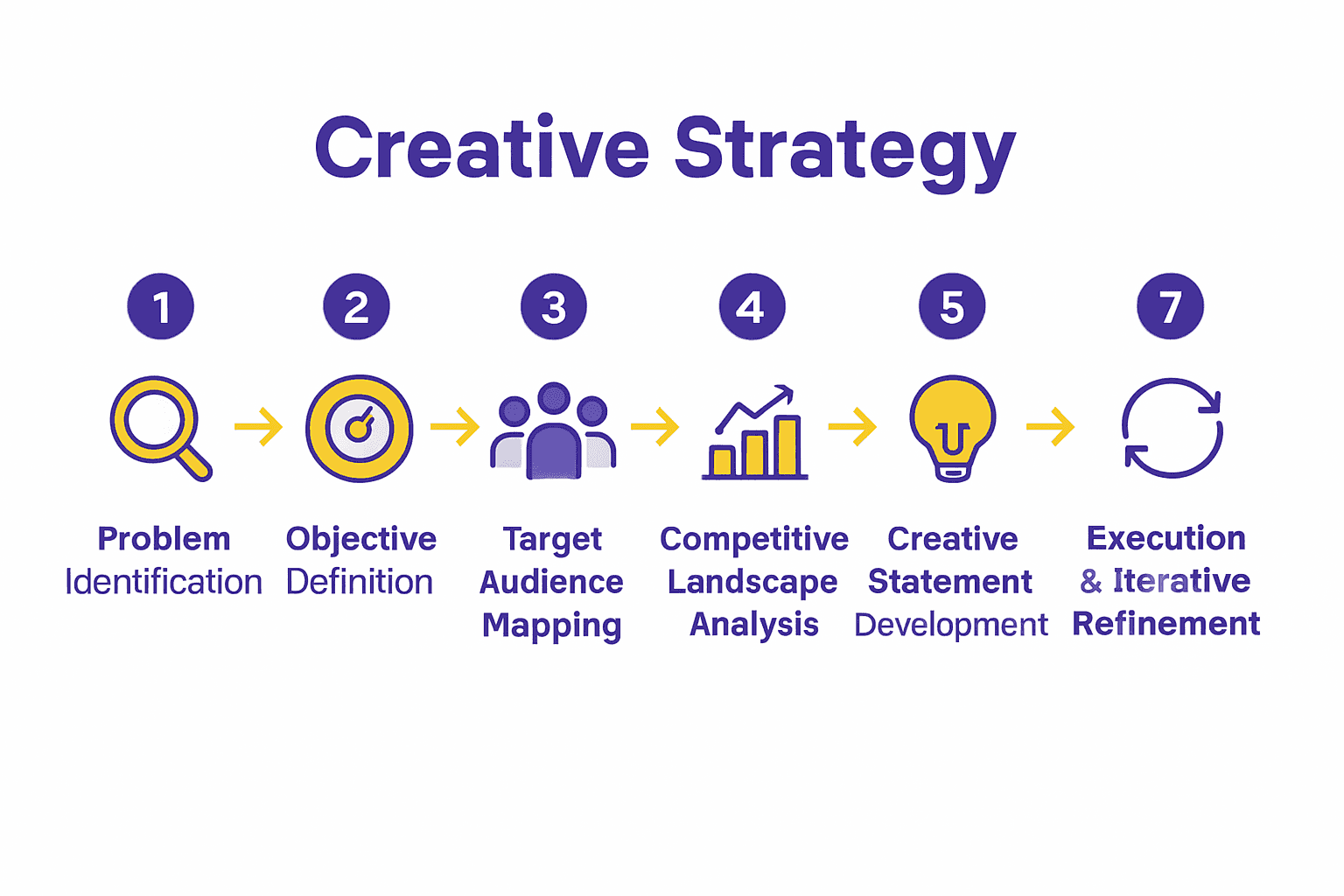
MBA Skool provides a comprehensive seven-step procedure for developing an effective creative strategy, offering marketing professionals a structured approach to transforming abstract business goals into compelling communication experiences. This methodical framework ensures that every creative initiative is purposeful, targeted, and strategically aligned with organisational objectives.
According to University of Florida Extension, the creative strategy process fundamentally revolves around three critical dimensions: defining clear product benefits, precisely identifying target audiences, and establishing message credibility. These dimensions form the foundational scaffolding upon which successful advertising campaigns are constructed.
The comprehensive step-by-step creative strategy process involves:
- Problem Identification: Thoroughly analyse existing communication challenges and market gaps
- Objective Definition: Establish precise, measurable marketing communication goals
- Target Audience Mapping: Develop detailed audience personas and segmentation strategies
- Competitive Landscape Analysis: Evaluate existing market positioning and competitor communication approaches
- Creative Statement Development: Craft a unique narrative that encapsulates brand essence
- Messaging Framework Construction: Design communication strategies aligned with audience insights
- Execution and Iterative Refinement: Implement, measure, and continuously optimise creative approaches
Successful creative strategy development demands a delicate balance between analytical rigour and creative imagination, transforming strategic insights into resonant, impactful communication experiences that genuinely connect with target audiences.
Common Mistakes and How To Avoid Them
Creative strategies in advertising are fraught with potential pitfalls that can significantly undermine marketing effectiveness. Birch highlights a critical observation that many marketers fall into the trap of launching trend-driven advertisements without carefully aligning them with core brand identity and audience expectations, which can lead to disconnected and ineffective communication.
The most prevalent mistakes often stem from a fundamental misunderstanding of strategic creativity, where professionals prioritise style over substance or chase ephemeral trends at the expense of genuine audience connection. These missteps can result in campaigns that look impressive superficially but fail to resonate with the intended demographic or achieve meaningful business objectives.
Common creative strategy mistakes include:
- Trend Chasing Without Context: Adopting popular styles without understanding their relevance to your brand
- Neglecting Audience Insights: Developing creative concepts in isolation from genuine audience understanding
- Inconsistent Brand Messaging: Creating disjointed communication that undermines brand coherence
- Overcomplicating Communication: Developing complex narratives that obscure the core message
- Ignoring Measurable Outcomes: Prioritising creativity without establishing clear performance metrics
Successful creative strategies demand a nuanced approach that balances artistic innovation with strategic precision, ensuring that every creative decision is purposefully aligned with both brand identity and audience expectations.
Unlock Your Advertising Potential with Easy Playable Ads Creation
The article highlights that developing a creative strategy is crucial yet often hindered by complex production demands and high costs. Many advertisers struggle to balance strategic precision with creative innovation while managing limited resources and tight budgets. If you have faced challenges with slow development times or costly processes that dilute the impact of your campaign’s emotional and rational messaging, it is time for a smarter solution.
At PlayableMaker, we understand these pain points and have designed a no-code platform to make playable ad creation fast, easy and budget friendly. Our solution helps you stay true to your unique creative statement and audience insights without overwhelming your resources. Whether you want to integrate storytelling or problem-solution approaches effectively, our tool supports you every step of the way. Discover detailed tips and guidance in our Help Archives – playablemaker.com and streamline ad publication through our Publishing Archives – playablemaker.com.
Don’t let complex production slow down your creative strategy. Experience firsthand how effortless it is to build interactive ads that connect deeply with your target audience by visiting https://app.playablemaker.com now and start creating with confidence.
Frequently Asked Questions
What is a creative strategy in advertising?
A creative strategy in advertising is a foundational blueprint that guides the development and execution of campaigns. It translates marketing objectives into compelling visual and narrative experiences while defining the core audience, product benefits, and persuasive elements to engage consumers effectively.
What are the key components of a creative strategy?
Key components of a creative strategy include clear marketing objectives, precise audience segmentation, identification of the unique value proposition, emotional and rational messaging frameworks, and strategic positioning relative to competitors.
What types of creative strategies can be used in marketing?
Types of creative strategies in marketing include emotional connection strategy, rational persuasion strategy, storytelling strategy, problem-solution strategy, and comparative strategy, each designed to address specific communication objectives and engage audiences effectively.
What common mistakes should be avoided when developing a creative strategy?
Common mistakes include trend chasing without context, neglecting audience insights, inconsistent brand messaging, overcomplicating communication, and ignoring measurable outcomes, all of which can undermine the effectiveness of a creative strategy.
Recommended
- Concept of Creativity in Advertising Explained – playablemaker.com Concept of Creativity in Advertising Explained
- Complete Guide to Creativity in Advertising – playablemaker.com Complete Guide to Creativity in Advertising
- Concept of Creativity in Advertising: Complete Guide – playablemaker.com Concept of Creativity in Advertising: Complete Guide
- Concept of Creativity in Advertising Explained – playablemaker.com Concept of Creativity in Advertising Explained
- Stratégie Vidéo Entreprises : Guide Complet 2024