Every mobile gaming team faces the challenge of capturing attention in a crowded market, where standard advertisements often result in low user engagement. Interactive ads stand out by turning viewers into active participants, a shift that not only deepens brand connections but also elevates recall and comprehension. This guide explores how interactive ad experiences offer creative managers and user acquisition specialists practical, no-code avenues to create engaging, cost-effective campaigns without heavy technical demands.
Table of Contents
- What Makes An Interactive Ad Unique
- Main Types Of Interactive Ad Formats
- How Interactive Ads Drive User Engagement
- No-Code Solutions And Production Workflow
- Comparing Costs: Interactive Vs. Traditional Ads
Key Takeaways
| Point | Details |
|---|---|
| Interactive Ads Enhance Engagement | Interactive advertisements transform passive viewers into active participants, leading to improved user engagement. |
| Diverse Ad Formats for User Interaction | Various interactive ad formats, such as Playable Advertisements and Augmented Reality Ads, provide unique user experiences and engagement strategies. |
| No-Code Solutions Streamline Production | No-code platforms allow for rapid development of interactive ads, making it easier for marketers to create without extensive technical skills. |
| Long-Term Value Over Initial Costs | While initial investment in interactive ads can be higher, they often deliver superior long-term returns through better engagement metrics. |
What Makes An Interactive Ad Unique
Interactive advertisements fundamentally transform digital marketing by enabling user participation beyond passive content consumption. Unlike traditional static advertisements, these dynamic experiences allow users to actively engage with advertising content, creating a unique and memorable interaction.
The core distinction of interactive ads lies in their ability to convert viewers from passive observers into active participants. These advertisements leverage digital technology to create immersive experiences that demand user interaction through:
- Mini-game elements
- Clickable interfaces
- Personalised content pathways
- Real-time response mechanisms
- Gamified user experiences
Research demonstrates that this participatory approach significantly enhances consumer engagement. Two-way communication paradigms allow users to influence advertisement content, transforming advertising from a unidirectional communication model to a collaborative experience.
Pro tip: Craft interactive ads that provide genuine value and entertainment, not just mechanical interactions, to maximise user engagement and retention.
Main Types Of Interactive Ad Formats
Interactive advertising has evolved dramatically, offering marketers a diverse range of engagement strategies that transform user experience. Innovative ad formats leverage cutting-edge technologies to create immersive, personalised interactions that go far beyond traditional marketing approaches.
The primary interactive ad formats in mobile gaming and digital marketing include:
- Playable Advertisements: Mini-game experiences that allow users to test game mechanics before downloading
- Augmented Reality (AR) Ads: Interactive experiences that overlay digital content onto real-world environments
- Interactive Video Ads: Clickable, branching narratives where user choices impact the storyline
- Gamified Brand Experiences: Challenges and mini-games that integrate brand messaging
- Poll and Quiz Advertisements: Real-time interactive content encouraging immediate user participation
Interactive advertising strategies extend beyond mere entertainment, providing utility and engagement that traditional advertising cannot match. These formats create deeper connections by offering users genuine value, whether through entertainment, education, or interactive experiences that feel more like play than advertisement.
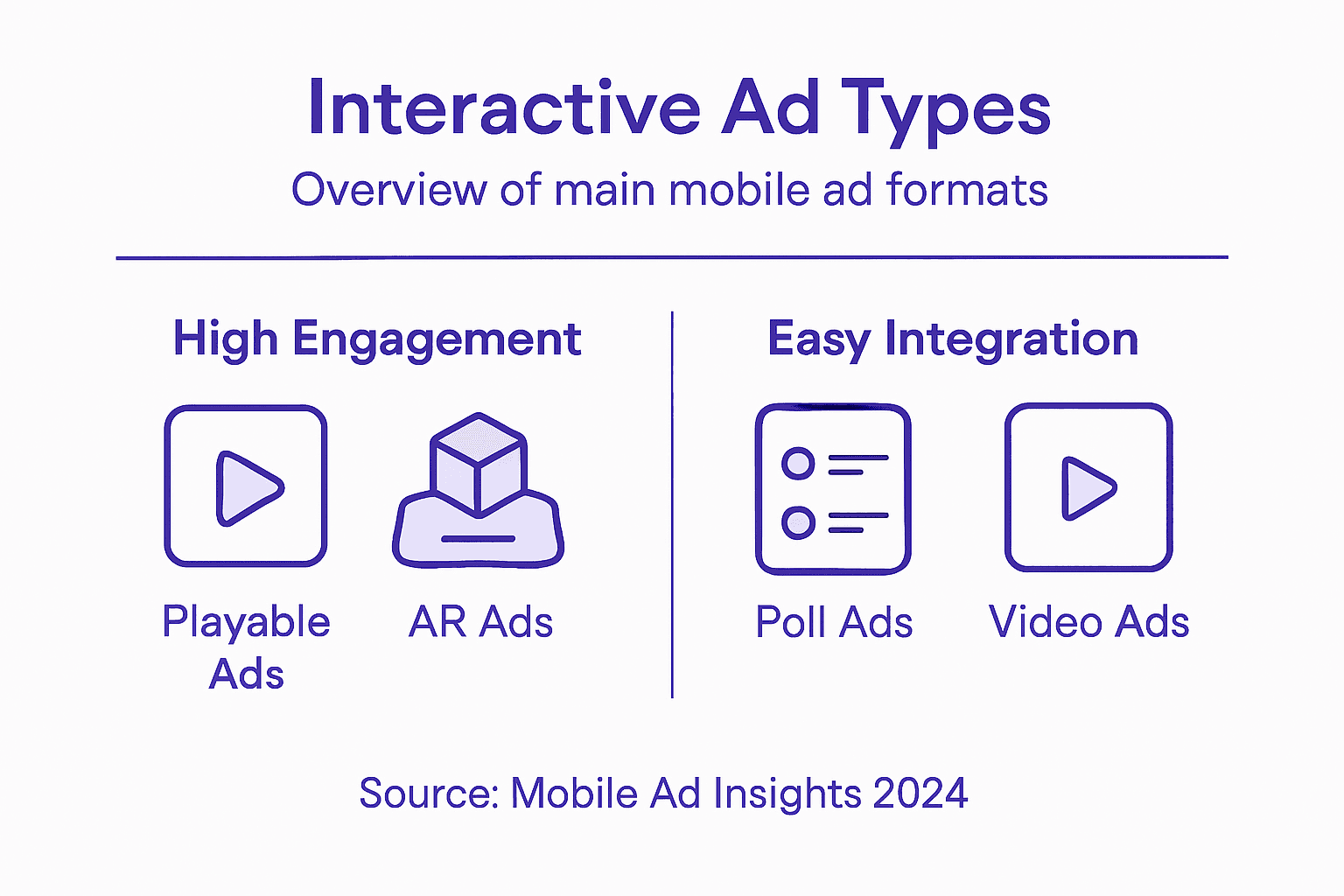
Here’s how the main interactive ad formats compare in terms of experience and marketing application:
| Ad Format | User Involvement | Common Application |
|---|---|---|
| Playable Advertisements | High, game-like | Mobile app promotion |
| Augmented Reality Ads | Immersive, physical | Retail, fashion, automotive |
| Interactive Video Ads | Choice-driven | Brand storytelling |
| Gamified Brand Experiences | Competitive, fun | Loyalty campaigns |
| Poll & Quiz Advertisements | Quick feedback | Opinion gathering, research |
Pro tip: Design interactive ad formats that align closely with your target audience’s interests and gaming preferences to maximise engagement and conversion rates.
How Interactive Ads Drive User Engagement
Psychological mechanisms of engagement transform mobile advertising by converting passive viewers into active participants. Interactive advertisements create a unique cognitive experience that goes beyond traditional marketing approaches, encouraging users to invest personal effort and attention into the advertising content.
Key psychological drivers of user engagement in interactive ads include:
- Personalisation: Tailoring content to individual user preferences
- User Control: Allowing viewers to make choices within the ad experience
- Intrinsic Motivation: Creating enjoyable, game-like interactions
- Immediate Feedback: Providing real-time responses to user actions
- Sense of Achievement: Offering rewards or progress indicators
Interactive ads convert passive viewers by demanding cognitive involvement through actions like clicking, answering questions, or playing mini-games. This active participation increases emotional connection, dramatically improving brand recall and message retention compared to traditional advertising methods.

Pro tip: Design interactive ad experiences that feel more like entertainment than advertising, focusing on user enjoyment and genuine value rather than pure promotional messaging.
No-Code Solutions And Production Workflow
No-code platforms are revolutionising interactive advertising by eliminating complex technical barriers, enabling marketers and creative teams to develop sophisticated ad experiences without extensive programming knowledge. These innovative solutions transform the traditional production workflow, making interactive ad creation accessible, rapid, and cost-effective.
Key advantages of no-code solutions in interactive ad production include:
- Rapid Prototyping: Quick design and testing of ad concepts
- Drag-and-Drop Interfaces: Intuitive visual design tools
- Template Customisation: Pre-built frameworks for faster development
- Real-Time Performance Tracking: Immediate insights and analytics
- Cross-Platform Compatibility: Seamless deployment across multiple channels
The production workflow for interactive ads using no-code solutions typically follows a streamlined process. Creative teams can now move from conceptualisation to deployment with significantly reduced development time, allowing for more agile marketing strategies and faster iteration of ad designs.
Pro tip: Select no-code platforms that offer comprehensive analytics and flexible design options to maximise your interactive ad performance and creative potential.
Comparing Costs: Interactive Vs. Traditional Ads
Interactive advertising economics reveal a nuanced cost landscape that extends beyond simple production expenses. While traditional advertisements appear more budget-friendly initially, interactive ads deliver superior long-term value through enhanced engagement and measurable performance metrics.
Key cost considerations between interactive and traditional ad formats include:
- Production Expenses
- Traditional Ads: Lower upfront costs
- Interactive Ads: Higher initial development investment
- User Engagement
- Traditional Ads: Passive interaction
- Interactive Ads: Active participation and deeper connection
- Conversion Rates
- Traditional Ads: Standard conversion percentages
- Interactive Ads: Significantly higher conversion potential
- Long-Term ROI
- Traditional Ads: Limited performance tracking
- Interactive Ads: Comprehensive analytics and performance insights
Comparative advertising strategies demonstrate that interactive advertisements, despite higher initial costs, generate substantially better returns through improved user experience and data collection capabilities. The additional investment translates into more precise targeting, enhanced user understanding, and ultimately more efficient marketing spend.
Below is a summary of cost factors influencing interactive and traditional ad campaigns:
| Cost Factor | Interactive Ads | Traditional Ads |
|---|---|---|
| Upfront Investment | Higher development spend | Lower creative costs |
| Engagement Quality | Deep, personalised | Surface-level, generic |
| Data Collection | Robust, real-time | Limited, less immediate |
| Long-Term Value | High with analytics | Restricted measurement |
Pro tip: Calculate your interactive ad’s potential return by comparing expected engagement rates and conversion improvements against the initial production investment.
Unlock the Power of Interactive Ads with PlayableMaker
The article highlights the challenge of creating engaging playable advertisements that boost mobile game ROI without draining developer resources or budgets. Many marketers struggle with the high production costs and technical complexity of traditional playable ads. Key goals include rapid prototyping, no-code solutions, and maximising user engagement through personalised, game-like experiences.
PlayableMaker directly addresses these pain points by offering a fast and budget-friendly platform designed for marketers and creative teams to build playable ads effortlessly. Our no-code drag-and-drop interface ensures you can create immersive interactive ads that adopt concepts like gamification and immediate user feedback without the need for developers. Explore best practices and production workflows in our Publishing Archives to streamline your campaign execution.
Ready to enhance your mobile game marketing with interactive ads that convert? Discover how easy it is to create playable ads that captivate players and increase ROI today at PlayableMaker. For helpful tips and support as you get started, visit our Help Archives. Take the step now to revolutionise your advertising strategy and unlock superior engagement with minimal effort.
Frequently Asked Questions
What are interactive ads and how do they differ from traditional ads?
Interactive ads are dynamic advertisements that engage users by allowing them to actively participate through mini-games, clickable interfaces, and personalised content pathways. Unlike traditional static ads that only provide passive viewing experiences, interactive ads foster user engagement and create memorable interactions.
How do interactive ads enhance user engagement in mobile games?
Interactive ads enhance user engagement by utilising psychological mechanisms such as personalisation, user control, and gamification. They transform passive viewers into active participants, leading to increased emotional connections, brand recall, and message retention compared to traditional advertising methods.
What are the main types of interactive ad formats for mobile marketing?
The main types of interactive ad formats include playable advertisements, augmented reality (AR) ads, interactive video ads, gamified brand experiences, and poll and quiz advertisements. Each format leverages technology to create immersive experiences that encourage user participation and deeper connections with the brand.
How do no-code solutions assist in the production of interactive ads?
No-code solutions streamline the production of interactive ads by allowing marketers to create sophisticated ad experiences without extensive programming knowledge. They offer rapid prototyping, drag-and-drop interfaces, and template customisation, making the development process quicker, more accessible, and cost-effective.
Recommended
- 8 Key Ad Performance Metrics for Mobile Gaming Success – playablemaker.com 8 Key Ad Performance Metrics for Mobile Gaming Success
- 7 Benefits of Interactive Marketing for Mobile Game Growth – playablemaker.com 7 Benefits of Interactive Marketing for Mobile Game Growth
- Google Ad Performance: Maximising Mobile Game ROI – playablemaker.com Google Ad Performance: Maximising Mobile Game ROI
- Conversions Advertising: Maximising Mobile Game Installs – playablemaker.com Conversions Advertising: Maximising Mobile Game Installs
- Master TikTok Engagement Workflow for Maximum Growth
- Agile Marketing Explained: Boosting Team Efficiency | Gammatica
- How to Improve the Conversion Rate of Your Landing Pages – Najumi