Every creative manager at a mobile gaming studio knows the headache of building interactive ads that do more than just show off gameplay. Moving from static trailers to bidirectional communication means overcoming myths about complexity, cost, and technical barriers. The lines between traditional and interactive ads are clearer than ever, with research highlighting how participatory formats can reshape both user experience and real-time measurement. Here, you will find what truly defines interactive ads—and practical strategies to make them affordable and effective for your campaigns.
Table of Contents
- Defining Interactive Ads And Common Misconceptions
- Key Categories Of Interactive Ad Formats
- Technical And Creative Hurdles For Teams
- Budget, Resource, And Time Constraints
- Solutions For Faster, Affordable Interactive Ad Creation
Key Takeaways
| Point | Details |
|---|---|
| Interactive Ads Foster Engagement | Unlike traditional ads, interactive ads allow users to engage directly with content, leading to enhanced user experiences and better data on user behaviour. |
| Misconceptions Need to be Addressed | Not all interactive elements guarantee higher engagement; understanding the right format is crucial for effectiveness. |
| Budget and Time Constraints are Significant | Creating interactive ads often costs significantly more and takes longer than traditional ads, necessitating careful resource planning. |
| No-Code Platforms Can Streamline Production | Utilizing no-code solutions can drastically reduce production time and costs, enabling teams to produce high-quality interactive ads efficiently. |
Defining Interactive Ads And Common Misconceptions
Interactive ads are fundamentally different from traditional static advertisements. They allow users to engage directly with the ad content rather than passively consume it. This bidirectional communication transforms how brands connect with audiences.
What makes interactive ads distinct?
- Users can click, tap, swipe, or manipulate ad elements
- Ads respond in real-time to user actions
- Engagement data flows back to the advertiser instantly
- Creative experiences replace simple image-and-text layouts
Research on interactive advertising frameworks identifies this as a distinct research paradigm, emphasising the shift from linear messaging to participatory experiences.
Common misconception number one: “Interactive ads work the same way as traditional ads, just with more buttons.” Reality check—they fundamentally change how your audience processes information. A user who taps to reveal product details is actively learning, not passively viewing.
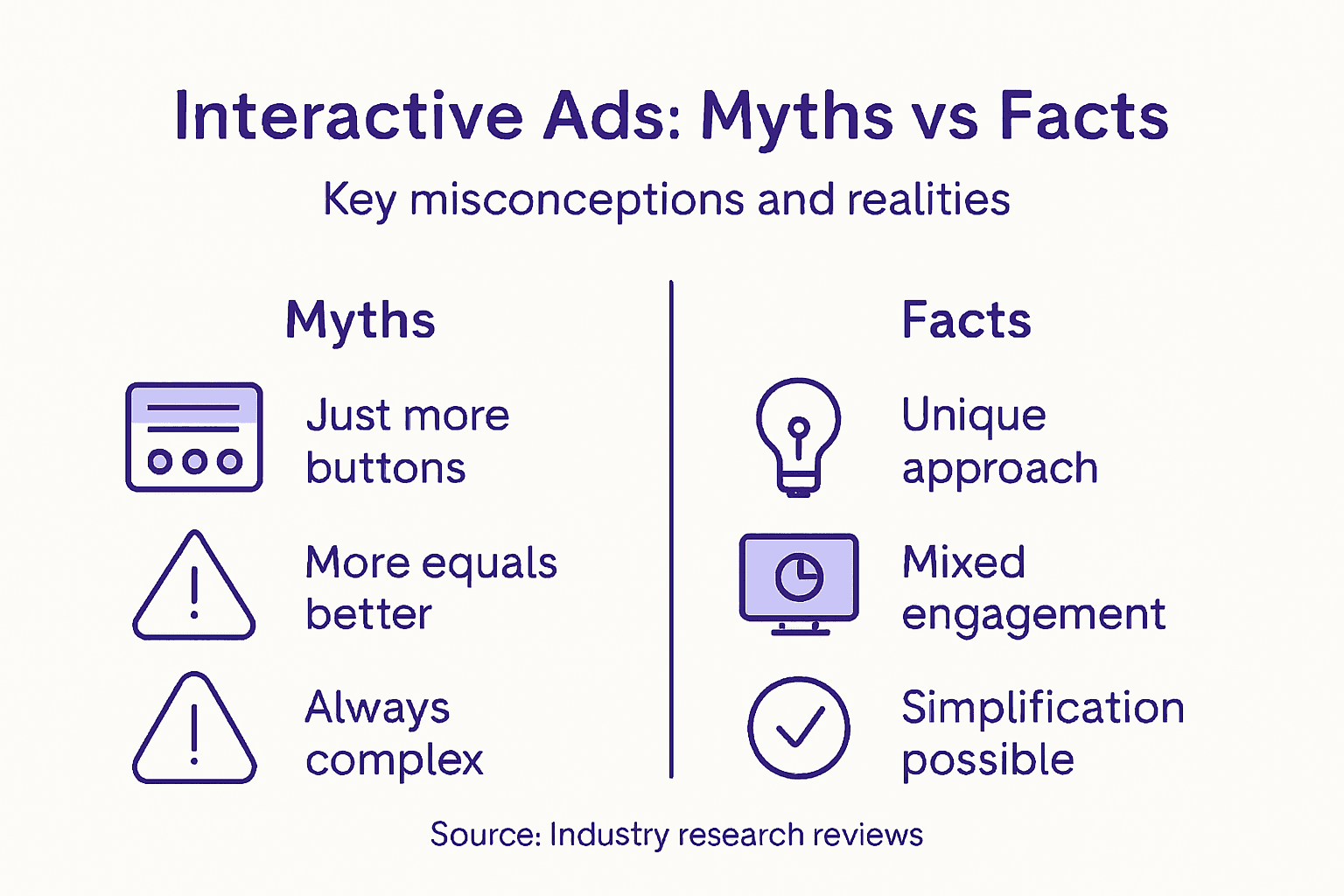
Misconception number two: “More interactivity always equals better engagement.” Study findings show mixed evidence on whether increased interactivity improves consumer comprehension, depending on ad format and design.
Misconception number three: “Interactive ads are too complex to create.” Many user acquisition specialists assume building playable experiences requires entire development teams and substantial budgets. This isn’t accurate anymore. No-code solutions now enable rapid creation without sacrificing quality or draining resources.
Misconception number four: “Interactivity works equally across all ad types.” Banner ads, pop-ups, advergames, and social network ads each respond differently to interactive elements. Your creative manager needs to understand which interaction types suit your specific campaign format.
Here’s what separates interactive ads from everything else:
- User controls the experience, not the advertiser
- Data flows both directions—you learn about user behaviour in real-time
- Creative possibilities expand dramatically beyond traditional display formats
- Measurement becomes more granular and accurate
Interactive ads aren’t just about adding animations or buttons—they’re about shifting control to the user whilst capturing genuine engagement signals.
For mobile gaming companies specifically, interactive ads represent your best opportunity to showcase game mechanics before users download. A playable ad lets potential users experience your core gameplay loop directly within the advertisement itself.
This matters because traditional ad creatives only show trailers or static images. Your best players often make download decisions based on mechanics they can actually try, not descriptions they read.
Pro tip: Start by defining what interaction means for your specific game—focus on one core mechanic rather than cramming multiple features into your first interactive ad.
Key Categories Of Interactive Ad Formats
Interactive ad formats vary dramatically in complexity, cost, and engagement potential. Understanding each category helps you choose what works for your specific user acquisition goals without overspending on unnecessary features.
Playable ads represent the most powerful category for mobile gaming. These allow users to play a simplified version of your game directly within the advertisement. A player can try your core mechanic, experience your game feel, and decide whether to download—all within 15-30 seconds.
Key playable ad advantages:
- Reduce install friction by letting players test gameplay first
- Capture genuine interest signals through player behaviour
- Generate significantly higher install conversion rates than static creatives
- Require no additional app download to experience
Advergames take gameplay further by building entire branded experiences around your product. Unlike playable ads, which showcase your actual game, advergames create standalone mini-games that tell your brand story. A puzzle game branded with your product name, or a runner game featuring your character—these drive engagement through entertaining mechanics rather than direct gameplay.
Interactive videos allow users to click, tap, or swipe within video content to reveal product information, make choices, or explore different storylines. Research into distinct interactive advertising models shows how these formats foster personalised consumer engagement through active control and synchronised messaging.
Augmented reality try-ons represent an emerging category gaining traction in global markets. Users can visualise your product in their own environment before purchasing or downloading. For gaming, AR ads might let players see how your game character appears overlaid in their space.
Interactive banners and pop-ups round out the spectrum. These interactive banner ad formats offer lower production costs than full playable experiences whilst still engaging users through clickable elements, animations, and immediate feedback.
Here’s how these categories compare:
Below is a summary comparing the main categories of interactive ad formats and their ideal use cases:
| Ad Format | Ideal Use Case | Production Complexity | Typical Engagement Level |
|---|---|---|---|
| Playable ads | Game downloads | Moderate | Very high |
| Advergames | Brand storytelling | High | High |
| Interactive videos | Explaining features | Medium | Medium to high |
| AR experiences | Product visualisation | Very high | High |
| Interactive banners | Quick launches | Low | Low to medium |
- Playable ads—highest engagement, best for game downloads, moderate production complexity
- Advergames—entertaining storytelling, good for brand awareness, higher production investment
- Interactive videos—flexible format, excellent for narrative explanation, medium complexity
- AR experiences—cutting-edge engagement, best for premium brands, significant technical requirements
- Interactive banners—lowest barrier to entry, quick to launch, limited engagement depth
Your choice of format directly affects both your production timeline and your budget. Simpler formats launch faster but capture less detailed engagement data.
For user acquisition specialists at gaming studios, playable ads deliver the best return on investment because they directly demonstrate gameplay. Your audience sees immediately whether your game mechanic appeals to them.
The research on interactive advertising evolution emphasises that format selection depends on your campaign objectives, platform availability, and budget constraints.
Pro tip: Start with playable ads to test your core mechanic’s appeal, then expand to advergames or interactive videos once you’ve validated your audience’s interest and established successful creatives.
Technical And Creative Hurdles For Teams
Building interactive ads exposes a painful reality: your team likely lacks the specialised skills needed. A mobile gaming studio excels at game development, not ad creation. These require completely different skill sets working in tension.
Your developers face immediate technical obstacles. Building playable ads means creating lightweight game experiences that run flawlessly across thousands of device combinations. Android fragmentation alone creates headaches—your ad must function on devices from 2018 and 2024 simultaneously.
Key technical challenges your team encounters:
- Cross-device compatibility consuming weeks of testing
- Performance optimisation to stay under strict ad network size limits
- Real-time data processing for personalised ad experiences
- Integration with multiple ad networks using different specifications
- API compatibility issues across platform updates
Creative teams face equally demanding obstacles. Designing interactive experiences requires balancing artistic vision with technical constraints. An animator’s perfect 60-frame animation may exceed file size limits. A designer’s intricate visual effects might crash on budget devices.
The research on technical demands in interactive advertising highlights how balancing creativity with technical feasibility remains one of the industry’s most persistent challenges, particularly when optimising user experience across diverse platforms.
Cost escalation compounds these problems. Hiring specialised interactive ad creators, running extended QA cycles across device types, and managing revisions through approval workflows drains budgets rapidly. Many studios spend £8,000-£25,000 per playable ad—before factoring in creative iteration or platform-specific builds.

Approval workflows create another bottleneck. Getting stakeholder sign-off on interactive creatives requires managing approval processes across product teams, marketing, and leadership. Each round of feedback means rebuilding and retesting.
Data privacy adds complexity. Managing privacy concerns in interactive advertising requires complying with regulations like GDPR whilst collecting engagement signals. Your technical infrastructure must process personal data securely whilst respecting user autonomy.
Common team friction points:
- Developers resenting creative requests that ignore technical constraints
- Designers frustrated by performance limitations restricting their vision
- Project managers caught between unrealistic timelines and quality standards
- Finance questioning why interactive ads cost 5x more than standard creatives
Without proper processes and tools, interactive ad teams operate in constant crisis mode, delivering late work that satisfies no one.
The reality: traditional game development processes don’t translate to ad creation. Your team needs different workflows, tools, and skill combinations working together smoothly.
Pro tip: Invest in no-code platforms specifically designed for interactive ads—they eliminate technical barriers, reduce approval cycles, and let your creative team ship faster without depending on custom developer work.
Budget, Resource, And Time Constraints
Interactive ad production devours budgets faster than traditional creatives. Most studios underestimate costs because they treat interactive ads like standard display work. They’re fundamentally different beasts requiring dedicated resources, extended timelines, and specialist expertise.
A single playable ad typically costs between £8,000 and £25,000 to produce. That covers design, development, testing across devices, and revisions. Scale this across multiple game titles, regions, or seasonal campaigns, and budgets balloon quickly.
Where costs accumulate:
- Developer salaries for specialised interactive ad expertise
- Extended QA cycles testing across hundreds of device combinations
- Third-party tool licences and integration fees
- Creative iteration and stakeholder approval rounds
- Platform-specific builds and optimisations
- Data infrastructure for tracking engagement and compliance
Time constraints create equal pressure. Building a single interactive ad takes 4-8 weeks from concept to launch. That timeline assumes smooth approval processes and minimal revisions. In reality, most studios experience delays because teams juggle interactive ads alongside regular game development work.
Your team faces a resource allocation dilemma. Do you pull developers away from your core game to build ads? Do you hire external specialists and lose control over quality? Do you sacrifice ad frequency and creative variety to stay within budget?
Research on budget allocation strategies in digital marketing emphasises the need for resilient decision frameworks when managing limited resources across channels with volatile costs. Interactive advertising sits at the centre of this challenge, competing for funding with production, UA, and operations.
The timing problem compounds budget issues. Ad networks require fresh creatives every 4-6 weeks to avoid audience fatigue. Sustainable interactive ad production means maintaining a pipeline of content. Few studios can sustain this without dedicated teams or external production partners.
Reallocating spend across channels becomes critical. Implementing budget pacing algorithms helps optimise resource deployment, ensuring timely delivery whilst maintaining cost efficiency. Smart budget management means knowing which ad formats generate sufficient ROI to justify their production costs.
Common budget realities:
- Interactive ads cost 3-5x more than static creatives per asset
- Timelines stretch when teams lack specialised skills
- Small studios cannot justify dedicated teams
- Testing and optimisation consume 30-40% of production budgets
- Approval workflows add weeks to launch schedules
The painful truth: most studios cannot sustainably produce quality interactive ads using existing internal resources and timelines.
This constraint forces difficult choices. Do you reduce creative frequency? Simplify interactive experiences? Cut testing cycles? Each option reduces campaign effectiveness.
Pro tip: Use no-code platforms to collapse production timelines from 6-8 weeks to 1-2 weeks, freeing budget for creative diversity rather than specialist salaries, and let smaller teams produce gallery-quality interactive ads without hiring expensive developers.
Solutions For Faster, Affordable Interactive Ad Creation
The traditional approach to interactive ad production is broken. Hiring specialists, waiting 6-8 weeks, spending £15,000+ per asset—this doesn’t scale for most studios. Better solutions exist. They centre on removing barriers between your creative vision and finished product.
No-code platforms eliminate the developer bottleneck entirely. These tools let your creative team build interactive ads directly without writing a single line of code. Your designer clicks, drags, and configures rather than waiting for a developer to translate their vision into reality.
What no-code platforms provide:
- Drag-and-drop interfaces requiring no programming knowledge
- Pre-built interactive templates saving weeks of work
- Real-time preview across device types
- One-click publishing to major ad networks
- Built-in analytics and performance tracking
- Version control and approval workflows
AI-assisted creative generation accelerates the process further. Research demonstrates AI generative methods create ad visuals rapidly and affordably, allowing creators to produce engaging content without specialist skills. Your team generates multiple creative variations in hours instead of weeks.
Simplified interactive formats reduce complexity dramatically. Rather than building full game experiences, newer approaches use branded task-based interactions reducing production costs significantly. A simple quiz, memory game, or spin-the-wheel mechanic engages users whilst staying within tight budgets.
Template-based workflows streamline approval cycles. Predefined templates mean your team works within proven frameworks. Approval rounds become faster because stakeholders review familiar structures rather than novel designs each time.
Collaborative tools eliminate communication friction. Your designers, developers, and product managers work within the same platform. Comments, suggestions, and approvals happen in real-time rather than through email chains and meetings.
Cost and time improvements break down like this:
The table below contrasts traditional versus modern approaches for creating interactive ads:
| Approach | Typical Cost per Asset | Average Timeline | Main Limitation |
|---|---|---|---|
| Traditional (in-house) | £15,000–£25,000 | 6–8 weeks | Requires specialist staff |
| No-code platform | £2,000–£5,000 | 1–2 weeks | May restrict custom features |
| AI-assisted templates | £500–£1,500 | 2–3 days | Best for simple ad formats |
- Traditional approach: 6-8 weeks, £15,000-£25,000 per asset
- No-code platform: 1-2 weeks, £2,000-£5,000 per asset
- AI-assisted with templates: 2-3 days, £500-£1,500 per asset
The bottleneck shifts from “Can we build this?” to “How quickly can we test multiple variations?” This changes everything about your strategy.
Small studios now compete with larger ones because speed and affordability matter more than headcount. A two-person creative team using no-code tools outproduces a traditional team of five spending months on single assets.
The practical advantage: sustainable creative pipelines. With timelines compressed from weeks to days, you maintain fresh ad rotation continuously. This directly improves campaign performance because audiences see new creative before fatigue sets in.
Pro tip: Start with simple interactive ad formats for mobile gaming using no-code platforms to validate your approach, then scale to more complex experiences once your team masters the workflow and sees proven ROI.
Overcome Costly And Complex Interactive Ad Challenges Today
The article highlights the struggle gaming studios face with soaring costs, long production timelines, and technical hurdles when creating interactive ads. If you find your team overwhelmed by complex approvals or stretched budgets due to the demand for playable ads that require specialised developer time and extensive testing, you are not alone. The key pain points include high production costs, the need for dedicated resources, and slow creative iteration cycles — all of which threaten your ability to scale campaigns effectively.
At PlayableMaker, we understand these challenges intimately. Our no-code platform empowers your creative and marketing teams to build engaging interactive ads quickly without draining dev resources or breaking the budget. You do not need to wait weeks or spend thousands to launch high-performing playable ads. Our solution enables you to reduce complexity, accelerate production timelines, and maintain cost control while producing quality content that grabs user attention. Discover more about how we make playable ad creation easy by visiting https://app.playablemaker.com. Start transforming your ad strategy now with PlayableMaker and experience faster results with greater creative freedom than ever before.
Frequently Asked Questions
What are the main challenges in creating interactive ads?
Creating interactive ads involves multiple challenges including high production costs, technical obstacles such as cross-device compatibility, and the need for specialised skills that may not exist within a game development team.
How can costs be reduced when producing interactive ads?
Using no-code platforms can significantly reduce costs by eliminating the need for developers and allowing creative teams to build ads directly, making the process more efficient and affordable.
What types of interactive ads are most cost-effective to produce?
No-code platforms and AI-assisted templates are among the most cost-effective options for producing interactive ads, allowing for quicker turnaround times and lower production costs compared to traditional methods.
How does the timeline for producing interactive ads compare to traditional ads?
The timeline for interactive ads can be compressed significantly with no-code tools; whereas traditional ads may take 6-8 weeks, no-code platforms can bring the timeline down to 1-2 weeks, and AI-assisted templates can even shorten it to 2-3 days.
Recommended
- Mastering Interactive Ads Workflow for Mobile Games – playablemaker.com Mastering Interactive Ads Workflow for Mobile Games
- Interactive Ad Tips for 2025: No-Code Success Guide – playablemaker.com Interactive Ad Tips for 2025: No-Code Success Guide
- Interactive Ad Explained: Boosting Mobile Game ROI – playablemaker.com Interactive Ad Explained: Boosting Mobile Game ROI
- What is an Interactive Ad? Understanding Its Impact – playablemaker.com What is an Interactive Ad? Understanding Its Impact
- Author Website Design That Converts: 5 Steps to More Newsletter Signups – The Digital Fair Blog | The Digital Fair