
Most gaming marketers assume playable ad performance is fixed once the creative goes live. Yet optimising creatives reduces CPI by 20-40% and boosts retention by 30%, proving that strategic iteration transforms campaign economics. Small, systematic tweaks to mechanics, visuals, and calls-to-action unlock significant cost savings whilst attracting higher-quality users. This article reveals why creative optimisation matters for playable formats, which variables drive results, and how to implement proven methodologies that balance short-term performance with long-term user value.
Table of Contents
- What does creative optimisation mean for playable ads?
- The tangible impact: costs, retention and user quality
- Optimisation methodologies: from A/B tests to audience segmentation
- Key creative elements: what matters most in playables
- Common pitfalls and expert insights for sustained success
- Unlock the full value of optimised playable creatives
- Frequently asked questions
Key Takeaways
| Point | Details |
|---|---|
| Optimise for better ROI | Regular creative tweaks reduce costs and increase retention for playable ads. |
| Test methodically | Structured A/B tests and audience segmentation maximise results and learning. |
| Focus on quality | Prioritising engaged users yields higher lifetime value and marketing efficiency. |
| Balance metrics wisely | Don’t chase only short-term wins—long-term retention matters as much as IPM. |
What does creative optimisation mean for playable ads?
Creative optimisation is the systematic process of refining ad elements to improve core key performance indicators such as cost per install, installs per mille, and retention rates. For playable ads, this process takes on unique importance because interactivity allows users to self-qualify before installing, filtering out low-intent traffic and delivering engaged players who understand the game mechanics.
Playable ads differ fundamentally from static banners or video formats. The interactive layer creates a natural selection mechanism where only genuinely interested users complete the playable sequence and proceed to install. This self-qualification process means that optimising playables drives high-value installs more effectively than passive formats.
Several creative variables influence playable ad performance:
- Core mechanics: The gameplay loop presented in the ad must be intuitive, rewarding, and representative of the actual game experience.
- Visual design: Art style, colour palette, and UI clarity directly affect user comprehension and emotional engagement.
- Intro video: The lead-in sequence sets expectations and primes users for interaction.
- Call-to-action placement: Timing and positioning of install prompts influence conversion rates without disrupting the interactive flow.
- End cards: The final screen reinforces value proposition and provides a clear path to installation.
- Difficulty curve: Balancing challenge and accessibility ensures users feel competent whilst remaining engaged.
Unlike video or banner optimisation, where the focus centres on visual appeal and messaging clarity, playable ad optimisation prioritises intent and engagement. The interactive element transforms passive viewers into active participants, creating behavioural data that reveals genuine interest rather than accidental clicks.
“Playable ads should be prioritised for gaming user acquisition because the self-qualifying interaction naturally boosts traffic quality, filtering users by demonstrated interest rather than passive exposure.”
This distinction matters because it shifts optimisation strategy from broad reach to qualified engagement. When you refine a playable creative, you’re not just improving click-through rates but enhancing the quality of every user who enters your acquisition funnel. The result is lower downstream churn and higher lifetime value, making expert retention strategies more effective from the first interaction.
The tangible impact: costs, retention and user quality
The financial and behavioural benefits of creative optimisation extend beyond theoretical advantages. Real-world data demonstrates measurable improvements across multiple dimensions of campaign performance.
Consider the following performance comparison based on industry benchmarks:
| Metric | Unoptimised Playable | Optimised Playable | Improvement |
|---|---|---|---|
| Cost per Install | £2.40 | £1.55 | 35% reduction |
| Day 1 Retention | 42% | 55% | 31% increase |
| Engagement Rate | 18% | 29% | 61% increase |
| Install Conversion | 12% | 19% | 58% increase |
These improvements stem from the self-qualification process inherent to playable formats. Users who interact with a playable ad invest cognitive effort and time, creating a psychological commitment that passive ad formats cannot replicate. This investment filters out accidental clicks and disinterested users, leaving a pool of genuinely engaged prospects.
The optimisation process reduces CPI by 20-40% whilst boosting retention by 30%, directly impacting return on ad spend. For games with longer lifetime value curves, this quality improvement compounds over weeks and months as retained users progress through monetisation funnels.

Critical insight: A 35% reduction in cost per install combined with 31% higher retention means you’re acquiring better users for less money. This dual benefit transforms unit economics, allowing you to scale campaigns profitably whilst competitors struggle with rising acquisition costs.
Quality consistently outperforms quantity in gaming user acquisition. Acquiring 1,000 users at £1.55 each with 55% day-one retention delivers far superior lifetime value compared to 1,500 users at £2.40 each with 42% retention. The optimised approach yields 550 retained users versus 630, but the lower acquisition cost and higher engagement quality create better long-term economics.
Understanding interactive ad benefits helps contextualise why these improvements occur. The interactive layer provides immediate feedback about user preferences, allowing rapid iteration based on behavioural signals rather than demographic assumptions. This data-driven approach to refinement accelerates the path to optimal creative performance whilst reducing wasted spend on underperforming variants.
The benefits for marketers extend beyond immediate campaign metrics. Optimised playables build brand recognition through positive user experiences, create word-of-mouth momentum from satisfied early adopters, and establish a foundation for sustainable growth as you refine targeting and creative strategies based on proven engagement patterns.
Optimisation methodologies: from A/B tests to audience segmentation
Achieving consistent optimisation results requires a structured approach that balances rigorous testing with practical constraints. The following process has proven effective across gaming verticals:
- Establish baseline performance: Run your initial creative for sufficient time to gather statistically significant data, typically 5,000 to 10,000 impressions minimum.
- Isolate single variables: Test one element at a time, whether that’s intro video length, CTA button colour, or difficulty level, to clearly attribute performance changes.
- Ensure adequate sample sizes: Each variant needs enough exposure to produce reliable results, avoiding premature conclusions from small data sets.
- Implement weekly iterations: Regular testing cycles maintain momentum whilst allowing time for performance patterns to emerge clearly.
- Validate with retention cohorts: Confirm that improvements in installs per mille translate to genuine retention gains, not just higher click-through rates.
Audience segmentation adds another dimension to optimisation. Different user groups respond distinctively to creative elements, making geographic, device, and demographic segmentation essential for maximising performance.
Segmenting by geography reveals cultural preferences in visual style, gameplay complexity, and reward structures. A playable that performs brilliantly in Western markets may require significant adjustment for Asian audiences, where different game genres and art styles dominate.
Device segmentation matters because screen size, processing power, and input methods affect user experience. A playable optimised for tablets may feel cramped on smartphones, whilst complex interactions that work smoothly on newer devices might frustrate users with older hardware.
Core metrics guide optimisation decisions:
- Installs per mille (IPM): Measures how many installs you generate per thousand impressions, indicating creative appeal and conversion efficiency.
- Engagement rate: Tracks the percentage of users who interact with the playable element, revealing whether your creative successfully invites participation.
- Time to engage: Monitors how quickly users begin interacting, highlighting whether your intro sequence effectively primes engagement or creates friction.
Pro Tip: Resist the temptation to rush iterations. Stability in your testing environment produces results you can trust and replicate. Changing multiple variables simultaneously or switching creatives too frequently creates noise that obscures genuine performance signals.
Balancing short-term and long-term metrics prevents optimisation myopia. An increase in installs per mille means little if those users churn within 24 hours. Track retention through day 7 and day 30 to ensure your optimisations attract users who remain engaged beyond the initial install.
Artificial intelligence and no-code tools now enable faster, more affordable optimisation cycles. These platforms allow you to test creative variations without developer resources, reducing iteration time from weeks to days. However, technology accelerates execution but doesn’t replace strategic thinking about which variables matter most for your specific game and audience.
Exploring different ad experience types helps identify which formats resonate with your target players. Some games benefit from puzzle-based playables, whilst others perform better with action-oriented or simulation formats. Testing across experience types reveals unexpected opportunities for engagement.
Leveraging no-code ad tips streamlines the technical aspects of iteration, allowing marketing teams to maintain testing velocity without constant developer involvement. This independence accelerates learning cycles and reduces the organisational friction that often slows optimisation programmes.
Key creative elements: what matters most in playables
Successful playable creatives follow a three-part structure that guides users from awareness through engagement to conversion. Each section serves distinct purposes and requires specific optimisation attention.
The lead-in video establishes context and primes users for interaction. This brief sequence, typically 3 to 5 seconds, showcases appealing visuals, hints at gameplay mechanics, and creates anticipation. Optimisation variables include video length, visual style, music choice, and the transition to interactive elements.
The interactive sequence forms the core experience where users engage with simplified gameplay. This section must be intuitive enough for immediate comprehension yet engaging enough to sustain interest through completion. Key variables include mechanic complexity, difficulty progression, visual feedback, and session length.
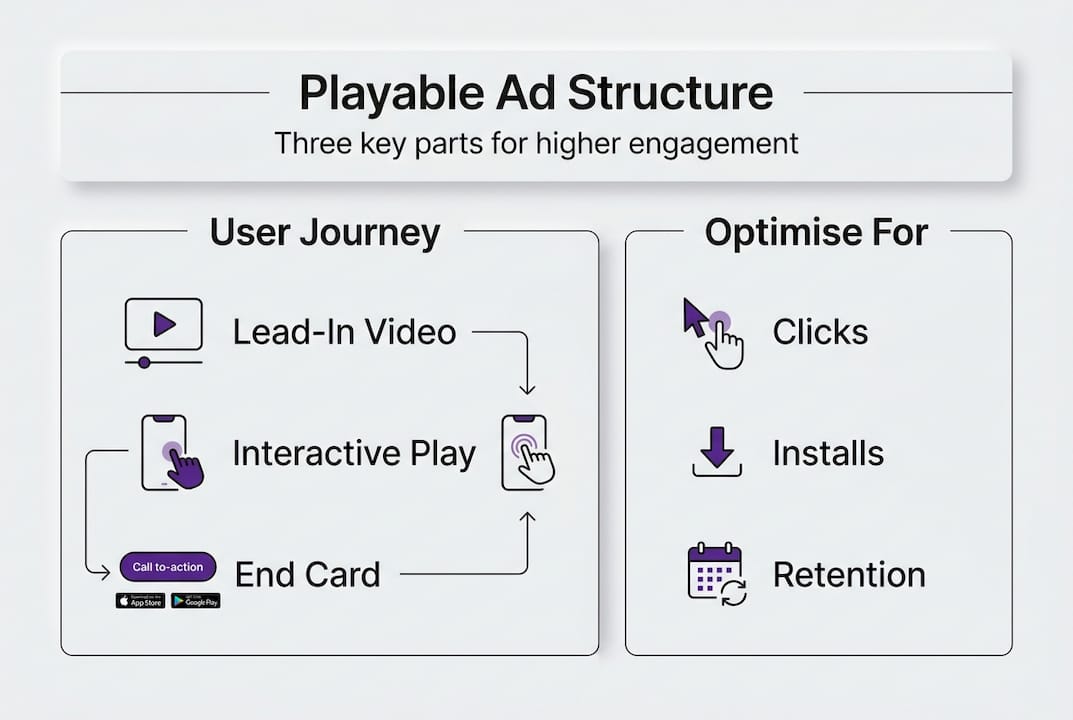
The end card and call-to-action convert engaged users into installs. This final screen reinforces the value proposition, displays app store ratings or social proof, and provides a clear installation path. Optimisation focuses on messaging clarity, visual hierarchy, and CTA button design.
The following comparison illustrates how different elements affect results:
| Creative Element | Ease of Iteration | Impact on IPM | Impact on Retention | Priority |
|---|---|---|---|---|
| Lead-in video | High | Medium | Low | Test early |
| Core mechanic | Low | High | High | Validate thoroughly |
| Visual style | Medium | Medium | Medium | Iterate regularly |
| Difficulty curve | Medium | Low | High | Balance carefully |
| End card design | High | High | Low | Test frequently |
| CTA placement | High | High | Low | Optimise continuously |
Make-or-break features for each section:
Lead-in video essentials:
- Immediate visual appeal that stops scrolling behaviour
- Clear indication that interaction is possible and rewarding
- Smooth transition that invites rather than demands engagement
Interactive sequence requirements:
- Intuitive controls requiring no written instructions
- Satisfying feedback for successful actions
- Achievable challenge that builds confidence
- Representative gameplay matching the actual game experience
End card necessities:
- Compelling value proposition reinforcing why users should install
- Social proof elements like ratings or download counts
- Prominent, accessible call-to-action button
- Visual consistency with the interactive experience
Even minor adjustments to timing, art direction, or instructional cues significantly alter user behaviour. A two-second reduction in lead-in video length might increase engagement rates by 15%, whilst adjusting difficulty from moderately challenging to easily achievable could boost completion rates by 25% but reduce retention by 10%.
Prioritising features to test first depends on your specific constraints and goals. If you need rapid improvements in installs per mille, focus on end card design and CTA placement, which offer high impact with easy iteration. For long-term retention gains, invest time in validating core mechanics and difficulty curves, accepting slower iteration cycles for more meaningful results.
Reviewing effective ad examples provides inspiration for creative approaches whilst highlighting common patterns in successful playables. These examples demonstrate how leading games balance entertainment value with conversion efficiency.
Comparing playable versus static ads clarifies why the interactive format justifies additional optimisation effort. The engagement depth and self-qualification benefits create performance advantages that compound through systematic refinement.
Common pitfalls and expert insights for sustained success
Even experienced marketers encounter predictable obstacles when optimising playable creatives. Recognising these patterns helps you avoid costly mistakes:
- Over-indexing on installs per mille: Chasing high IPM without monitoring retention creates a pipeline of low-quality users who install but quickly churn, wasting acquisition budget on users who never monetise.
- Ignoring retention drops: Focusing exclusively on top-of-funnel metrics whilst day-seven retention declines signals a disconnect between ad promise and game delivery, eroding long-term campaign viability.
- Recycling tired formats: Reusing successful creative patterns beyond their effective lifespan leads to creative fatigue, where audiences become desensitised to familiar formats and engagement rates decline.
- Poor segment analysis: Treating all users identically despite geographic, demographic, or behavioural differences leaves performance gains on the table by missing segment-specific optimisation opportunities.
- Premature scaling: Expanding budget on creatives that haven’t been thoroughly validated across retention cohorts amplifies any underlying quality issues, multiplying wasted spend.
Pro Tip: Use artificial intelligence tools for rapid early-stage iteration to identify promising creative directions quickly, but always validate results with deep retention cohorts before committing significant budget. Technology accelerates discovery but human judgement ensures sustainable performance.
The temptation to chase short-term wins proves particularly dangerous in gaming user acquisition. A creative that generates impressive install numbers but delivers poor retention creates a false sense of success whilst actually damaging unit economics. Balancing short-term IPM with long-term retention requires discipline to prioritise sustainable growth over vanity metrics.
Mastering creative optimisation for playable ads delivers enduring competitive advantages. As acquisition costs rise across the industry, your ability to extract maximum value from each creative investment becomes increasingly valuable. The skills and processes you develop through systematic optimisation compound over time, creating organisational capabilities that competitors cannot easily replicate.
Following user acquisition best practises provides broader context for how creative optimisation fits within comprehensive growth strategies. Playable ads represent one component of effective user acquisition, but their unique characteristics make them particularly responsive to systematic refinement.
Unlock the full value of optimised playable creatives
With proven frameworks for creative optimisation in hand, the next step involves accessing tools and resources that accelerate your implementation. Platforms like PlayableMaker enable gaming marketers to build, test, and refine playable ads without developer dependencies, reducing iteration cycles from weeks to days whilst maintaining creative quality.
The Playable Builder offers drag-and-drop functionality that empowers marketing teams to execute optimisation strategies independently, testing creative variations rapidly and cost-effectively. This autonomy transforms optimisation from a resource-constrained bottleneck into a continuous improvement process.
Exploring Playable Ads Explained deepens your understanding of how interactive formats revolutionise digital engagement, whilst examining the psychology behind playables reveals why these formats generate superior user quality compared to passive alternatives.
Case studies and practical examples demonstrate how gaming companies across verticals have implemented these optimisation principles to achieve measurable improvements in acquisition efficiency and user quality. Learning from real-world applications helps you adapt proven strategies to your specific game genre, target audience, and business objectives.
Frequently asked questions
How often should I optimise my playable ad creatives?
Aim for weekly iterations and tests, adjusting variables according to sample size and performance trends. Consistent testing maintains momentum whilst allowing sufficient time for reliable data patterns to emerge.
What metrics matter most when optimising for gaming user acquisition?
Focus on cost per install, installs per mille, engagement rate, and retention for meaningful results. Balancing immediate conversion metrics with longer-term retention ensures sustainable campaign performance.
Can artificial intelligence and no-code tools replace manual optimisation?
AI and no-code tools reduce costs and boost iteration speed, but expert oversight ensures optimisations translate to long-term retention gains. Technology accelerates execution whilst human judgement maintains strategic direction.
Why are playable ads more effective in gaming than video ads?
Playables create self-qualifying interaction that filters users by demonstrated interest, driving higher-value acquisition for games than passive video formats. The interactive layer reveals genuine intent rather than passive exposure.
What is the three-part structure for playable creatives?
Successful playables include a lead-in video, playable segment, and end card that guide users from awareness through engagement to conversion. Each section requires specific optimisation attention to maximise overall performance.
Recommended
- Game Ad Engagement Techniques for Playable Ad Success – playablemaker.com Game Ad Engagement Techniques for Playable Ad Success
- Why playable ads convert better: user acquisition guide 2026 – playablemaker.com Why playable ads convert better: user acquisition guide 2026
- 7 Smart Mobile Gaming Ad Ideas for Faster User Growth – playablemaker.com 7 Smart Mobile Gaming Ad Ideas for Faster User Growth
- 7 Creative Ad Formats List Every Mobile Marketer Needs – playablemaker.com 7 Creative Ad Formats List Every Mobile Marketer Needs