
TL;DR:
- Demo ads serve as interactive filters that pre-qualify highly interested players before a game download occurs. They improve retention, reduce costs, and generate valuable behavioral data by engaging users with simplified gameplay impressions. Modern no-code tools enable marketers to create budget-friendly demo ads, shifting their strategic role from entertainment to essential user qualification.
Most marketers treat demo ads as a novelty: a mini-game that sits at the end of a video, designed to entertain briefly before a user taps “install.” That framing significantly undersells what demo ads actually do. In reality, these interactive formats function as precision filters in your user acquisition funnel, separating genuinely interested players from passive scrollers before a single download occurs. This article covers what demo ads are, why they matter strategically, how to measure their impact, and how to build them without exhausting your budget or your development team.
Table of Contents
- What are demo ads and why do they matter?
- The strategic purpose of demo ads in mobile game marketing
- Benefits and challenges of using demo ads for engagement
- How to create effective and budget-friendly demo ads
- Why the purpose of demo ads is often misunderstood
- Take your demo ads further with PlayableMaker
- Frequently asked questions
Key Takeaways
| Point | Details |
|---|---|
| Demo ads drive engagement | Interactive demo ads achieve higher user engagement than static or video ads in mobile gaming. |
| Purpose extends beyond previews | Demo ads act as user qualification tools that improve retention and acquisition quality. |
| Balance benefits and costs | While demo ads offer strategic advantages, creation can be resource-intensive without the right tools. |
| Leverage new ad tech | No-code and AI tools lower barriers for cost-effective, high-impact demo ad creation. |
What are demo ads and why do they matter?
Demo ads are interactive ad formats that let potential players experience a slice of actual game mechanics before they commit to installing. A user sees an ad, taps into it, and briefly plays a simplified version of the game. If they enjoy the experience, they download. If they don’t, they move on. That self-selection process is precisely the point.
This format is fundamentally different from what what makes an ad interactive in traditional terms. Static banners display information. Video ads show gameplay. Demo ads require participation. The user must make choices, respond to prompts, and engage with game logic. That shift from passive viewing to active engagement changes everything about how the brain processes and responds to the message.
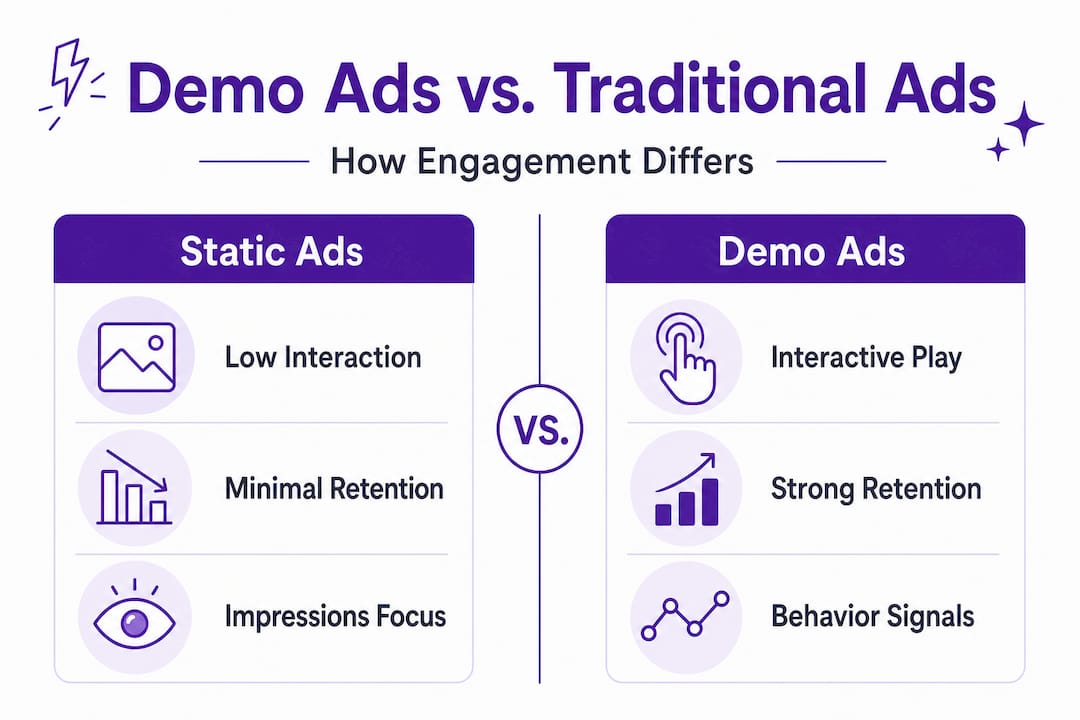
Demo ads offer a more immersive experience than static or video formats, leading to greater user engagement. The psychological basis for this is well-established: when people act on something, rather than observe it, their sense of ownership and investment increases. In mobile gaming, that translates directly into higher-quality installs.
Consider the core advantages at a glance:
- Higher intent signals: Users who complete a demo interaction have already expressed a preference. They are self-qualifying leads.
- Better retention post-install: Because players know what to expect, the drop-off rates in the first 24 hours after install are lower.
- More efficient ad spend: Fewer wasted installs from users who would have churned immediately means a lower effective cost per retained user.
- Creative intelligence: Every tap, swipe, and interaction inside a demo ad generates behavioural data that informs future creative decisions.
“The most powerful thing a demo ad does is not showcase your game. It filters your audience for you.”
Here is a quick comparison of ad format performance across key indicators:
| Format | User participation | Engagement depth | Retention signal |
|---|---|---|---|
| Static banner | None | Very low | None |
| Video ad | Passive | Low to moderate | Weak |
| Demo (playable) ad | Active | High | Strong |
Pro Tip: Keep your demo experience to between 15 and 45 seconds. Long enough to communicate the core mechanic, short enough that the user reaches the call-to-action before frustration sets in.
The strategic purpose of demo ads in mobile game marketing
With a clear understanding of what demo ads are, it’s crucial to examine their deeper purpose and strategic function in modern mobile game marketing.
Demo ads are, at their core, a lead qualification tool. That framing might feel unusual in a creative context, but it is the most accurate way to describe what they do. A user who completes your demo interaction and then taps install is categorically different from a user who watched your video and tapped install on impulse. The former has demonstrated behavioural intent. The latter has demonstrated curiosity at best.
Playable ads can increase user retention rates due to interactive engagement. That retention benefit flows directly from the qualification function. When players arrive at your game already familiar with the mechanic, onboarding friction drops, session lengths increase, and monetisation events happen earlier in the player lifecycle.
Consider how demo ads slot into the acquisition funnel:
- Awareness: Traditional formats (video, banner, social) generate initial exposure.
- Interest: The user encounters a demo ad and chooses to interact.
- Evaluation: During the demo, the user assesses whether the mechanic appeals to them.
- Conversion: Engaged users tap install, having already passed a self-assessment filter.
- Retention: Players who install based on demo engagement retain at meaningfully higher rates.
This funnel position explains why how interactive ads boost ROI is such a widely discussed topic: demo ads compress the evaluation stage directly into the ad unit itself. In traditional advertising, evaluation happens after install, which means you pay for discovery, acquisition, and then lose a large proportion of users during the first session. Demo ads shift evaluation before the install event, reducing that early-stage churn substantially.
Statistic callout: Campaigns using playable/demo ad formats consistently report lower cost-per-install figures and higher day-7 retention rates compared to video-only campaigns, according to multiple network performance reviews across 2024 and 2025.
A comparison of ad format performance against campaign goals:
| Campaign goal | Video ad suitability | Demo ad suitability |
|---|---|---|
| Brand awareness | High | Moderate |
| Qualified installs | Moderate | Very high |
| Retention improvement | Low | High |
| LTV optimisation | Low | High |
| Creative data collection | Low | Very high |
Effective user engagement strategies built around demo ads tend to treat each interaction as a data point rather than just a creative moment. The best user acquisition teams use demo ad engagement metrics to refine both their ad creative and their in-game onboarding sequences simultaneously.
Pro Tip: A/B test the core mechanic you feature in your demo, not just the visual design. Two versions of the same game with different featured mechanics can produce significantly different CPI and retention outcomes.
Benefits and challenges of using demo ads for engagement
Understanding the strategic value is key, but let’s also consider the tangible benefits and challenges marketers face when deploying demo ads.

The benefits of demo ads are well-documented and measurable. Engagement rates are typically far higher than standard video formats because the user is actively controlling the experience. Conversion rates from demo engagement to install tend to be stronger because intent is higher. Post-install retention improves because there is less expectation mismatch between the ad and the actual game.
That said, demo ads provide higher engagement but their development can be resource-intensive. The traditional path to building a demo ad involves pulling development resources away from the core game, commissioning bespoke interactive creative, running extensive quality assurance across device types, and managing file size constraints imposed by ad networks. Each of those stages takes time and money.
The specific challenges break down as follows:
- Development cost: Custom-built demo ads can cost several thousand pounds per unit when developer time is factored in.
- Technical complexity: Demo ads must function across a wide range of device specifications and operating system versions.
- File size limitations: Most networks cap playable ad file sizes between 2MB and 5MB, requiring careful optimisation.
- Creative iteration speed: Making changes to a custom-built demo ad often requires returning to the development pipeline, slowing down testing cycles.
- Measurement complexity: Tracking engagement quality within a demo ad requires instrumentation that goes beyond standard click and impression metrics.
“The biggest barrier to demo ad adoption is not scepticism about their effectiveness. It is the perception that building them requires specialist skills and significant budget.”
The good news is that this barrier is falling rapidly. Modern no-code platforms and template-based tools allow marketing teams to build, test, and iterate demo ads without writing a single line of code. This changes the economics significantly and puts creative control back with the people who understand the campaign goals rather than the people who understand the codebase.
To measure playable ad results effectively, go beyond click-through rate. Track completion rate within the demo, interaction depth (how far through the mechanic users progress), and the post-install retention rate specifically for users who arrived via demo engagement. These metrics together give you a much more accurate picture of demo ad performance than surface-level click data.
Looking at examples of successful demo ads consistently reveals a pattern: the most effective executions feature a single, clearly communicable mechanic rather than trying to represent the full complexity of the game. Simplicity in the demo does not mean the game is simple. It means the ad is focused.
Pro Tip: Aim for a demo completion rate above 60%. If users are dropping out of the demo before reaching the call-to-action, the mechanic is either too complex or too slow to reward the player. Adjust accordingly.
How to create effective and budget-friendly demo ads
Having examined both the opportunities and obstacles, we now turn to the practical side: crafting demo ads effectively without breaking the bank.
No-code tools and AI-driven solutions lower the complexity and cost of making demo ads substantially. What previously required a team of developers and a multi-week build cycle can now be achieved by a single marketing professional in a matter of days using template-based editors with drag-and-drop functionality.
Here is a practical step-by-step approach to creating effective demo ads on a realistic budget:
-
Define your core mechanic clearly. Before building anything, identify the single mechanic that best represents your game’s appeal. Is it the puzzle-solving logic? The timing-based combat? The resource management loop? One clear mechanic makes a far more effective demo than a confused sample of several.
-
Select a format that fits your distribution channels. Different networks support different playable ad specifications. Confirm file size limits, supported technologies (HTML5 is most widely accepted), and aspect ratio requirements before you build.
-
Use a no-code platform to build your first version. Template-based tools allow rapid assembly of interactive mechanics without development resources. This is where making demo ads on a budget becomes genuinely achievable for teams of all sizes.
-
Test across devices before launching. Render your demo on multiple device types and screen sizes. Performance inconsistencies are a common reason for poor demo engagement, and they are entirely avoidable with thorough pre-launch testing.
-
Launch with two or three creative variants. Never go to market with a single version of a demo ad. Test different mechanic presentations, different visual styles, or different call-to-action timings simultaneously to generate comparative data.
-
Iterate based on engagement metrics, not instinct. Use completion rate, interaction depth, and post-install retention to determine which variant wins. Then use those findings to inform your next build cycle.
A guide to the most important production decisions:
| Decision point | Low-budget approach | Impact on quality |
|---|---|---|
| Build method | No-code platform | Minimal reduction |
| Creative iteration | Template variants | Negligible reduction |
| Device testing | Emulators and key devices | Low reduction |
| Asset production | Repurpose existing game assets | Minimal reduction |
| Measurement | Network analytics plus UTM tracking | Full accuracy |
Efficient streamlining of creative processes is often the most overlooked aspect of demo ad production. Teams that establish a repeatable build workflow, with clear asset requirements, a defined mechanic selection process, and a structured testing protocol, produce higher quality output at a fraction of the cost of teams that approach each ad as a bespoke project.
Pro Tip: Repurpose your existing game assets directly into your demo ad build. Most no-code platforms accept standard image and sprite formats. This cuts asset production time significantly and ensures visual consistency between the ad and the actual game.
Why the purpose of demo ads is often misunderstood
Stepping back from the technical details, there is a broader issue worth addressing directly. Many marketing teams approach demo ads primarily as a creative showcase. They focus almost entirely on how impressive the demo looks and how faithfully it represents the game’s visual identity. That instinct is understandable, but it misses the deeper function entirely.
Demo ads are qualification tools first and creative experiences second. A visually spectacular demo that attracts users who then churn immediately has failed its primary objective. A simpler, perhaps less polished demo that consistently delivers players who stay engaged for 30 days has succeeded, regardless of how it looks.
The industry pattern we observe repeatedly is this: teams invest heavily in the visual production of their demo ads and invest almost nothing in the data architecture that would allow them to learn from those ads. They know their click-through rate. They rarely know their demo completion rate, their mechanic interaction depth, or the long-term retention profile of users who arrived via demo engagement. Without that data, the creative iteration cycle is essentially guesswork dressed up as optimisation.
The deeper purpose of a demo ad is to create a behavioural signal before the install event. Every tap, every retry, every moment a user spends inside your demo is telling you something about their fit with your game. The teams that treat engagement techniques for demo ads as a data collection exercise, not just a creative one, consistently outperform those that do not.
There is also an ethical dimension worth acknowledging. Demo ads that deliberately misrepresent the actual gameplay, featuring mechanics that do not appear in the real game, do attract installs. But the retention data is damaging, and user trust, once lost, is difficult to recover. The most effective demo ads are honest ones. They attract fewer installs from the wrong audience and more from the right one.
Take your demo ads further with PlayableMaker
For marketers aiming to put these insights into practice, the right tools make all the difference. Understanding the strategic purpose of demo ads is one thing. Having a platform that lets you act on that understanding quickly and affordably is another entirely.
PlayableMaker is built specifically for user acquisition managers and marketing teams who need to create, test, and iterate playable ads that genuinely drive engagement without pulling developers off the core product. The no-code editor allows you to build interactive demo ads from existing game assets, launch multiple creative variants simultaneously, and collect the engagement data you need to iterate intelligently. The psychology behind playable ad success is built into the platform’s design logic. If your goal is to reduce CPI, improve retention, and move faster than your competitors, PlayableMaker gives your team the means to do exactly that.
Frequently asked questions
How do demo ads improve user acquisition quality?
Demo ads qualify players by letting only genuinely interested users engage with the mechanic before installing, which means higher retention and better-quality installs compared to passive formats. The self-selection process removes low-intent users from your acquisition funnel before you pay for their install.
Are demo ads more expensive to build than traditional ad formats?
They can require more initial effort than static banners, but no-code platforms are reducing costs and complexity significantly, making demo ad creation accessible to teams without dedicated development resource. Template-based workflows have dramatically narrowed the cost gap.
What metrics should I track to evaluate demo ad effectiveness?
Focus on engagement rate, completion rate within the demo, and post-install retention rate, since key demo ad metrics including CPI alone do not capture the quality of users being acquired. Retention data is particularly telling.
Where do demo ads fit within the mobile gaming marketing funnel?
Demo ads are most effective at the acquisition stage, acting as a filter that qualifies users early in the funnel before the install event occurs, reducing post-install churn and improving the overall efficiency of your acquisition spend.
Recommended
- Engagement in ads: 25% higher CTR and 15% better retention – playablemaker.com Engagement in ads: 25% higher CTR and 15% better retention
- 7 Best Examples of Interactive Ads for Mobile Gaming – playablemaker.com 7 Best Examples of Interactive Ads for Mobile Gaming
- 7 Best Examples of Mobile Game Ads and Why They Work – playablemaker.com 7 Best Examples of Mobile Game Ads and Why They Work
- Mobile ad SDKs explained: streamline monetisation for game marketers – playablemaker.com Mobile ad SDKs explained: streamline monetisation for game marketers