
TL;DR:
- Playable ads significantly enhance impression-to-install rates and user engagement in mobile gaming UA campaigns. They leverage interactivity and micro-commitments to filter motivated users and improve retention, lowering overall acquisition costs. Modern no-code platforms empower even small teams to rapidly create impactful playables, democratizing high-performance advertising.
Playable ads are not simply another format in your creative rotation. They are fundamentally changing the benchmark for what a well-performing user acquisition campaign looks like in mobile gaming. Liftoff’s 2025 Mobile Ad Creative Index confirms that playable creatives can materially improve impression-to-install rates versus non-playable formats. This guide examines precisely why they work, how they reshape your UA funnel at every stage, and why the old assumption that these ads are complex and expensive no longer holds.
Table of Contents
- Why playable creatives outperform traditional ads
- How playable creatives impact user acquisition efficiency
- Cost-effective and no-code approaches to playable ad creation
- Maximising engagement and LTV with playable creatives
- The overlooked truth: Playables are a growth leveller for all studios
- Accelerate your playable creative journey
- Frequently asked questions
Key Takeaways
| Point | Details |
|---|---|
| Massive conversion uplift | Playable creatives can drive up to 16 times higher impression-to-install rates than traditional ads. |
| Quality user acquisition | Playables help attract users who are genuinely interested, boosting long-term value and retention. |
| No-code creation accessible | Modern tools make it easy and affordable for any studio to launch impactful playables without developers. |
| Focus on ITI metric | Impression-to-install rate is the best KPI for measuring playable ad campaign success. |
Why playable creatives outperform traditional ads
With the scene set on their dramatic performance advantages, let’s look at what actually makes playable creatives so effective.
A playable creative is an interactive ad unit that invites users to engage with a short, functional version of a game before tapping to install. It is distinctly different from static banner ads, which deliver a single image and a call to action. It also differs from video ads, which are passive experiences, and interstitial ads, which interrupt the user experience without offering genuine interaction. Playable ads place control directly in the user’s hands.
The psychology of playable ads is built on several well-understood cognitive principles. Interactivity creates a sense of agency. Agency generates investment. Investment drives commitment. When a user taps through a puzzle mechanic or completes a short in-ad level, they have made a micro-commitment to the product. That commitment dramatically increases the likelihood of a full install.
| Ad format | Typical CTR range | Impression-to-install rate | User intent at click |
|---|---|---|---|
| Static banner | 0.1% to 0.3% | Very low | Low |
| Video (non-interactive) | 0.5% to 1.5% | Low to moderate | Moderate |
| Interstitial | 1% to 3% | Moderate | Mixed |
| Playable | 3% to 8%+ | High to very high | High |
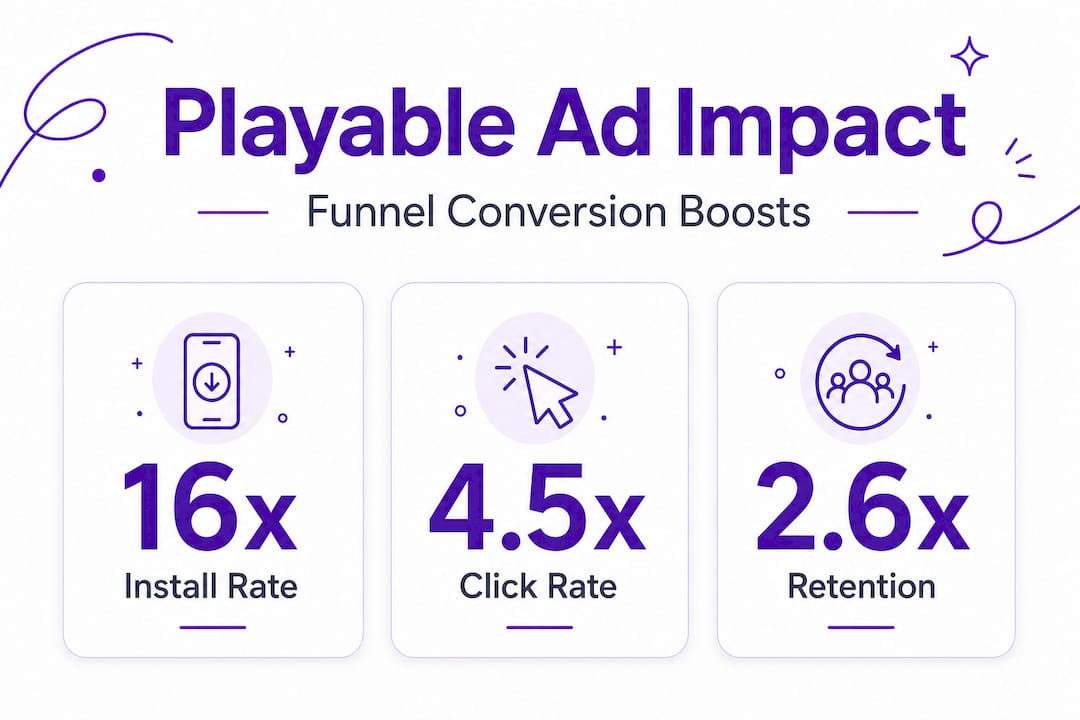
The numbers tell a clear story. Impression-to-install rates were 8x higher for playable ads than non-playable formats for top spenders, and 16x higher for other game advertisers, according to Liftoff’s 2025 data. That is not a marginal improvement. It is a structural shift in performance.
“The most powerful thing a playable ad does is remove uncertainty. The user already knows they enjoy the game. They are installing a product they have already experienced.” This is the principle that separates playables from every other format.
The benefits of playable ads extend well beyond raw install numbers. Consider what drives this engagement uplift:
- Interactivity: Users make choices rather than passively watching, triggering deeper cognitive engagement.
- Self-qualification: Low-intent users exit the ad early, filtering out audiences unlikely to retain or monetise.
- Taste-before-try: Users understand the core loop before committing, which aligns expectations and reduces early churn.
- Completion incentive: The mini-game structure creates a natural pull to finish the experience and find out what comes next.
Understanding why playable ads convert at such a higher rate is not complicated once you accept that mobile users are busy, sceptical, and overwhelmed with options. Playables respect their time by letting them decide quickly whether the product is for them.
How playable creatives impact user acquisition efficiency
Knowing why playables succeed, it is vital to see how they reshape every step of your user acquisition performance.

The mobile UA funnel moves from impression to click, click to install, install to registration, and registration to meaningful in-game action such as a first purchase or session completion. Most advertising spend is wasted between impression and install. Playables directly address this gap by raising the quality of every click.
| Funnel stage | Before playables | After playables | Change |
|---|---|---|---|
| Impression to click | 0.8% | 3.5% | +338% |
| Click to install | 22% | 58% | +164% |
| Install to Day 1 retention | 28% | 41% | +46% |
| Day 7 retention | 14% | 22% | +57% |
These figures illustrate a consistent pattern: playables improve performance not just at the top of the funnel, but all the way through to retention. The self-qualification effect means that the users who install are fundamentally more aligned with the product.
Mobile game installs conversion strategies that rely on passive formats often achieve high click volumes but suffer from poor downstream metrics. Playables reverse this by trading raw click volume for intent quality. The result is lower effective cost per loyal user, which matters far more than cost per install in mature UA programmes.
There are multiple ad experience types available in the market today. Choosing the right one for your specific funnel goals is critical. If your primary challenge is poor Day 7 retention, playables are likely your most effective lever. If your challenge is pure reach at the top of the funnel, a mixed format strategy may serve better. Understanding which stage of your funnel is leaking helps you deploy the right creative accordingly.
You can track these improvements effectively with tools such as marketing analytics for playables that measure interaction depth, exit points within the ad, and downstream conversion behaviour. This data allows you to iterate your playable design with precision rather than guesswork.
Here is a practical framework for benchmarking your playable performance against existing formats:
- Establish your baseline: Record your current impression-to-install rate, Day 1 retention, and Day 7 retention across active ad formats.
- Launch a controlled playable test: Run the playable against the same audiences and budgets as your control creative.
- Measure ITI as your north star: Track the impression-to-install rate weekly, segmented by network and audience.
- Analyse retention delta: Compare Day 1 and Day 7 retention between playable-acquired users and non-playable-acquired users.
- Calculate blended CPA: Divide total spend by the number of retained users, not simply installs, to get a true cost picture.
- Iterate based on exit data: Identify where users are dropping out of the playable experience and adjust the mini-game flow accordingly.
Pro Tip: Treat impression-to-install rate as your primary performance indicator for playable creatives. Because playables self-qualify users before the install step, ITI is the most honest signal of how well your creative is filtering and converting motivated audiences.
Cost-effective and no-code approaches to playable ad creation
Efficiency is only as valuable as the tools allow. Now, see how modern no-code creation eliminates traditional roadblocks.
For years, the prevailing view was that playable ads required dedicated development resource: engineers to build interactive experiences in HTML5, designers to create mobile-optimised interfaces, and QA teams to test across devices and operating systems. This made playables the exclusive territory of studios with substantial budgets. That view is now outdated.
The rise of no-code creation platforms has fundamentally changed the economics of playable advertising. UGC-led and no-code ad creation are emerging as key differentiators in top-performing campaigns, according to Liftoff’s 2025 research. This shift is not a trend. It is a structural change in how high-performing teams approach creative production.
Modern no-code platforms for optimising creatives for playables typically offer the following capabilities:
- Drag-and-drop interface: Build interactive ad experiences without writing a single line of code.
- Pre-built game templates: Start from a functional mini-game and customise the visuals, mechanics, and branding to match your product.
- Built-in analytics: Track interaction rates, completion rates, and exit behaviour directly within the platform.
- Multi-network export: Generate ad files formatted for major mobile advertising networks without additional technical effort.
- Rapid variant creation: Produce multiple creative versions from a single base template in a fraction of the time it would take a development team.
- Asset reuse: Apply existing game assets such as characters, backgrounds, and sound effects to populate templates quickly.
The cost savings are significant. A traditionally developed playable ad can require 40 to 80 hours of developer time plus design iterations, representing thousands of pounds in overhead per creative. A no-code equivalent can be produced in a few hours by a marketing specialist with no engineering background. The speed-to-market advantage is equally important. In a competitive UA environment, the ability to respond to audience signals with a new creative within days rather than weeks is a meaningful edge.
Understanding no-code ad development also changes how teams think about creative testing. Rather than investing heavily in a single polished playable and hoping it performs, teams can now produce five or six short variants quickly, run them simultaneously, identify the best performer, and scale it. This approach mirrors how top performance marketers already handle video and static creative testing.
Pro Tip: Launch shorter, simpler playable variants first. A 15-second mini-experience with a clear reward hook will often outperform a highly polished 45-second experience because it respects the user’s time and removes unnecessary friction from the journey to install.
Maximising engagement and LTV with playable creatives
Having tackled the creation and efficiency angles, let’s look at the deeper value: how playables foster genuine engagement and boost long-term user value (LTV).
The install is not the goal. Retention and monetisation are. This distinction matters enormously when evaluating ad format performance. Playables do not just drive more installs. They attract a qualitatively different user: one who already understands the core game loop, has demonstrated a willingness to engage, and has made a micro-commitment before the download even begins.
This self-qualification mechanism has a direct and measurable effect on lifetime value. Users who discover a game through interactive ads for engagement consistently show higher Day 7 and Day 30 retention rates. They also convert to paying users at higher rates because they arrived with realistic expectations about the product.
“A user who installs after completing a playable is not discovering what the game is. They are returning to something they already enjoyed.”
This framing changes how you should think about LTV attribution. The value of a playable creative is not captured fully in the install cost. It is captured in the entire downstream revenue that retained, engaged user generates over months of play.
Here are four engagement tactics to build into your playable creative design:
- Showcase the core game loop: Use the most satisfying and representative mechanic as the centrepiece of the mini-experience. Do not use a simplified or unrelated mini-game that does not reflect the actual product.
- Build a reward structure: Give users a small win or progression moment within the playable. This creates a positive emotional association before the install and primes the user for in-game reward loops.
- Create seamless progression: Design the ad so that the transition from the playable to the install store page feels like a natural continuation. Abrupt interruptions reduce conversion.
- Signal the full product value: Use the final frame of the playable to hint at deeper content, more complex mechanics, or progression milestones the user has not yet reached. Curiosity is a powerful install driver.
Reviewing examples of mobile game ads that perform well consistently reveals these patterns. The best-performing playables do not try to showcase everything. They showcase one thing brilliantly, create desire for more, and then remove every barrier between that desire and the download.
The connection between engagement quality and long-term monetisation is direct. High-LTV users begin with genuine interest. Playables are the most reliable mechanism currently available in mobile advertising for ensuring that the users entering your funnel have that genuine interest from the very first interaction.
The overlooked truth: Playables are a growth leveller for all studios
With all the mechanics explored, it is time to question the assumptions holding most teams back from real creative impact.
The mobile gaming industry has a tendency to treat production quality as a proxy for performance quality. Teams spend weeks polishing a playable, refining animations, adding sound design, and stress-testing edge cases, only to find that a simpler version built in a day outperforms their flagship creative. This pattern is more common than most studios care to admit.
The truth is that effectiveness in playable advertising is driven by clarity of hook, relevance of mechanic, and speed of self-qualification. It is not driven by visual complexity. A brightly lit 3D environment with particle effects does not convert better than a clean 2D puzzle if the puzzle is more representative of the actual game experience.
This insight matters most to small and mid-sized studios. Larger studios have conditioned the industry to believe that high production values are the baseline requirement for competitive playables. They are not. The history of playable ads shows that the format’s effectiveness has always come from its interactive nature, not its graphical fidelity.
No-code tools and the growing availability of UGC-style creative frameworks have effectively democratised access to this format. A two-person indie studio can now launch a playable campaign that competes directly with a format once reserved for teams with eight-figure marketing budgets. First-mover advantage in any creative format goes to those who act quickly, test intelligently, and adapt based on data. It does not go to those who spend the most time building.
Pro Tip: Build your first playable in a day, launch it, and use the interaction data to inform your second version. The fastest learning cycles produce the most competitive creatives, not the most carefully engineered ones.
Accelerate your playable creative journey
Having shared both evidence and perspective, here is how you can take the next step and put these insights to work in your own campaigns.
At PlayableMaker, we built our platform specifically for UA managers and marketing specialists who understand the value of playable creatives but have historically been blocked by cost, complexity, or dependency on development teams. Understanding why playable ads work is the first step. Having a practical, accessible way to build and launch them is what turns that understanding into results. Our no-code tools let you go from brief to live creative without writing a line of code, without waiting for developer availability, and without overspending your creative budget. If you are ready to start, our ad creation on a budget guide is the right next step for building your first playable efficiently.
Frequently asked questions
What exactly is a playable creative in mobile gaming advertising?
A playable creative is an interactive ad that lets users experience a mini version of a game before downloading it. This meaningful interaction before install is what separates playables from all passive ad formats.
How much can playable creatives increase conversion rates?
Playable creatives have been shown to increase impression-to-install rates up to 16x compared to non-playable formats for some game advertisers, representing one of the largest performance uplifts documented in mobile UA research.
Are playable creatives difficult or expensive to produce?
No. Modern no-code and template-based tools make it possible to create impactful playable ads quickly and affordably, and UGC and no-code creation are now recognised as key differentiators in top-performing campaigns.
Do playable creatives improve user quality or just install volume?
They improve both: playables self-qualify users before the install step, meaning those who download are more likely to retain, engage deeply, and ultimately generate stronger lifetime value.
Which key metric should I focus on when using playable creatives?
Focus on the impression-to-install rate (ITI), as treating ITI as a primary KPI gives you the clearest picture of how effectively your playable is converting motivated, qualified users from first impression to download.
Recommended
- Why Creatives Matter for Mobile Game Ad Success – playablemaker.com Why Creatives Matter for Mobile Game Ad Success
- Mobile creatives: a practical guide for marketers – playablemaker.com Mobile creatives: a practical guide for marketers
- 2025 SocialPeta & Newsbreak Mobile Game Report: 9M+ Monthly Advertisers & the Rise of Weekly Creative Iteration – playablemaker.com 2025 SocialPeta & Newsbreak Mobile Game Report: 9M+ Monthly Advertisers & the Rise of Weekly Creative Iteration
- Why test creatives for mobile gaming user acquisition – playablemaker.com Why test creatives for mobile gaming user acquisition