Creative testing transforms mobile gaming user acquisition campaigns by improving click-through rates by up to 35% whilst slashing costs. Most marketers struggle to identify which ad creatives genuinely drive installs and retention, wasting budgets on underperforming formats. Testing diverse creatives across playable, video, and static ads reveals what resonates with your target audience, enabling data-driven optimisation. No-code platforms now accelerate this process, letting you iterate rapidly without developer resources or inflated production costs.
Table of Contents
- Why Testing Creatives Matters In Mobile Gaming User Acquisition
- Impact Of Different Ad Formats On Creative Testing
- Common Misconceptions In Creative Testing
- Frameworks For Effective Creative Testing
- Practical Benefits Of No-Code Creative Testing Tools
- Maximise Your Mobile Gaming User Acquisition With PlayableMaker
- FAQ
Key takeaways
| Point | Details |
|---|---|
| Creative testing boosts engagement | Testing diverse ad formats improves click-through rates and reduces cost-per-install significantly. |
| Different formats require tailored approaches | Playable, video, and static ads each demand unique testing strategies to maximise performance. |
| Continuous testing sustains results | Regular creative optimisation adapts campaigns to market shifts and maintains long-term success. |
| No-code tools accelerate iterations | Platforms like PlayableMaker enable rapid testing without technical overhead or budget strain. |
Why testing creatives matters in mobile gaming user acquisition
User acquisition professionals face relentless pressure to optimise every pound spent on mobile gaming campaigns. Testing creatives addresses this challenge head-on by revealing which ad variations genuinely convert audiences into loyal players. Mobile ad campaign performance data demonstrates that systematic testing can reduce cost-per-install by 20-30% whilst simultaneously lifting engagement metrics.
Playable ads particularly shine in retention metrics, keeping users engaged far beyond the initial install. Top mobile gaming studios recognise this value, allocating 20-30% of their UA budgets specifically to creative testing initiatives. This investment pays dividends by identifying high-performing variations early, eliminating wasted spend on underperforming creatives.
Testing prevents costly mistakes that plague campaigns relying on gut instinct alone. Without structured experimentation, you’re essentially gambling with your marketing budget. Smart testing reveals surprising insights about audience preferences, often contradicting assumptions about what should work.
The most successful campaigns track key ad performance metrics beyond simple click-through rates. Combining CTR with retention, lifetime value, and engagement depth creates a complete picture of creative effectiveness. This holistic view separates genuinely valuable users from those who install and immediately churn.
Pro Tip: Start with small budget allocations across multiple creative variants rather than betting heavily on a single concept. This approach minimises risk whilst maximising learning opportunities.
Key benefits of systematic creative testing
- Identifies winning creative concepts before scaling spend
- Reduces wasted budget on underperforming ad variations
- Reveals audience preferences through data rather than guesswork
- Enables rapid iteration based on performance signals
- Improves both acquisition cost and post-install user quality
Impact of different ad formats on creative testing
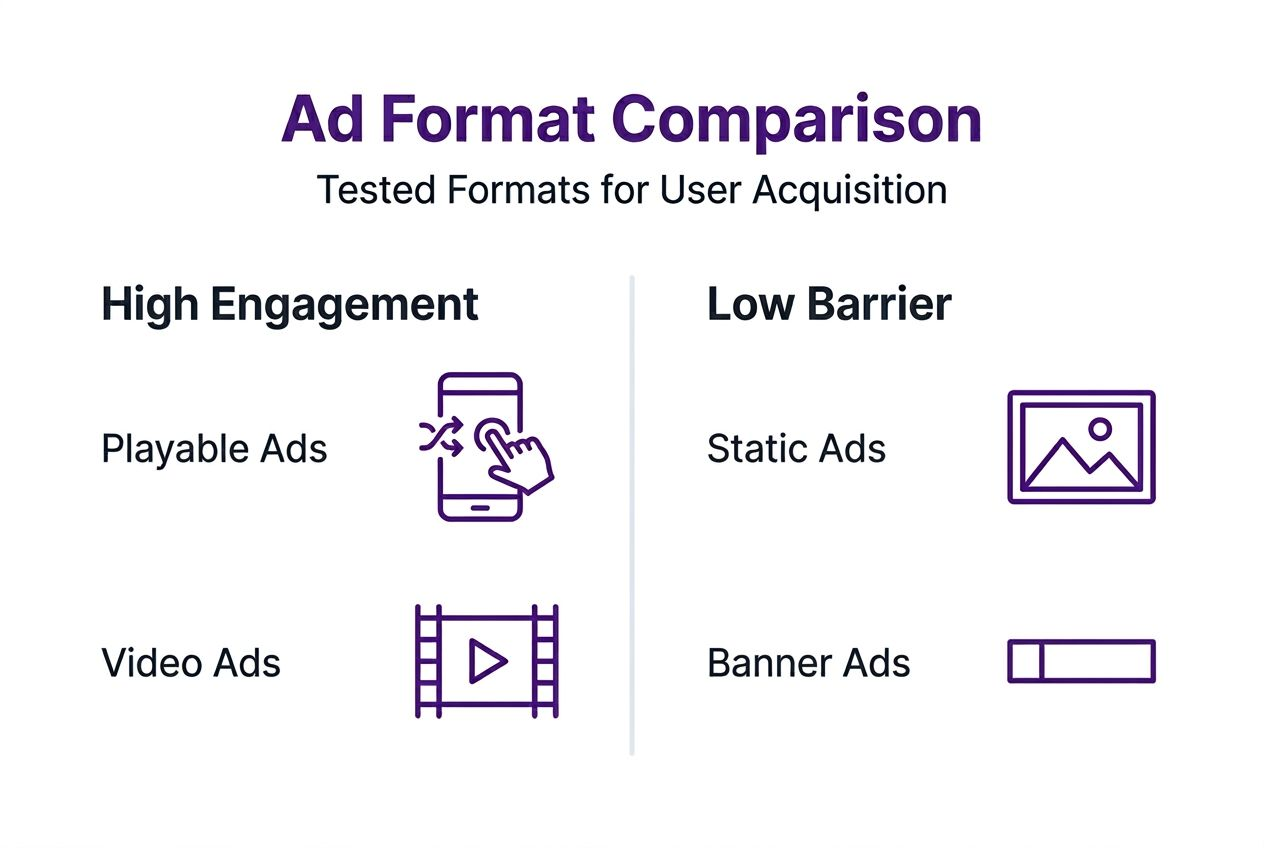
Ad format selection dramatically influences creative testing outcomes and strategy. Each format serves distinct purposes, requiring tailored testing approaches to maximise effectiveness. Understanding these differences prevents the 25% install loss that occurs when marketers apply one-size-fits-all testing methodologies.
Playable ads consistently deliver the highest retention and engagement metrics among all formats. Research shows playable ads yield 54% higher retention compared to static or video alternatives. This advantage stems from interactive experiences that let potential players sample gameplay before installing. Even more impressive, multi-hook playable ads outperform single-hook versions by 30% in conversion rates, demonstrating the value of diverse interaction points.
Video ads excel at narrative storytelling and emotional connection but lack the interactivity that drives deeper engagement. They work brilliantly for brand building and showcasing game features but often struggle to match playable ads in retention metrics. Testing video creatives requires focus on hook timing, visual storytelling clarity, and call-to-action placement.

Static ads represent the most cost-effective format for testing broad concepts quickly. Whilst they typically generate lower engagement than interactive formats, their production speed and budget friendliness make them ideal for initial hypothesis testing. Successful static ads then inform more resource-intensive playable or video creative development.
Pro Tip: Test playable ads effectively by creating variations with different gameplay mechanics, difficulty curves, and reward structures to identify what resonates most with your target audience.
Ad format comparison for creative testing
| Format | Engagement Level | Production Cost | Retention Impact | Best Use Case |
|---|---|---|---|---|
| Playable | Highest | Medium-High | 54% higher retention | Quality user acquisition |
| Video | Medium-High | Medium | Moderate | Storytelling and brand building |
| Static | Low-Medium | Lowest | Lower | Rapid concept testing |
Common misconceptions in creative testing
Many marketers sabotage their creative testing efforts by clinging to outdated assumptions. The most damaging misconception treats CTR as the ultimate success metric. Click-through rates reveal initial interest but tell you nothing about user quality, retention, or lifetime value. Focusing solely on CTR optimises for clicks rather than valuable players.
Another prevalent myth suggests testing only becomes necessary when campaign performance declines. This reactive approach misses continuous optimisation opportunities that compound over time. Studies indicate continuous creative testing improves campaign LTV by 15-25% compared to one-time testing efforts. Waiting for problems before testing leaves money on the table.
Shockingly, 70% of mobile gaming campaigns neglect post-install user quality metrics when evaluating creative performance. This oversight leads to inflated install counts filled with users who churn within days. Quality-focused testing prioritises retention and engagement over vanity metrics.
Some teams believe single-format testing suffices for comprehensive insights. Ignoring multi-format approaches misses significant engagement gains available through playable ads and interactive experiences. Different formats attract different user segments, requiring diverse creative testing strategies.
“The biggest mistake in creative testing isn’t testing poorly, it’s not testing continuously. Markets shift, audiences evolve, and yesterday’s winning creative becomes tomorrow’s underperformer.”
Myths that undermine testing effectiveness
- Assuming high CTR automatically indicates successful creatives
- Testing only when campaigns underperform instead of continuously
- Ignoring retention and lifetime value in favour of install volume
- Believing one winning creative works indefinitely without iteration
- Thinking developer resources are essential for effective testing
Recognising these misconceptions helps you build a creative testing guide grounded in data rather than assumptions.
Frameworks for effective creative testing
Structured frameworks transform chaotic creative testing into systematic optimisation engines. Start by defining success metrics beyond simple click-through rates. Track install rate, day-1 retention, day-7 retention, and 30-day lifetime value to build a complete performance picture. These metrics reveal whether creatives attract genuinely valuable users or just drive empty installs.
Create multiple creative variants spanning different concepts, visual styles, and messaging angles. Diversity in your test pool increases the likelihood of discovering unexpected winners. Testing minor variations of the same concept limits learning potential and wastes opportunities.
Implement structured testing cycles combining both A/B testing and multivariate approaches. A/B tests isolate individual variable impacts, whilst multivariate testing reveals interaction effects between creative elements. Your ad A/B testing guide should outline clear hypothesis formulation, sample size requirements, and statistical significance thresholds.
Analyse both quantitative metrics and qualitative feedback to understand why certain creatives succeed. Numbers reveal what performs, but user feedback explains the underlying reasons. This combination enables you to replicate success factors in future creative iterations.
Iterate rapidly using no-code platforms to compress feedback loops. Traditional creative production often requires weeks or months, by which time market conditions may have shifted. Modern tools enable same-day iterations, letting you capitalise on insights whilst they remain relevant.
Pro Tip: Follow these essential steps for mobile ad A/B tests to ensure statistical rigour and actionable insights from every testing cycle.
Testing framework implementation steps
- Define comprehensive KPIs spanning acquisition, engagement, and monetisation
- Create diverse creative variants across multiple formats and concepts
- Establish control groups and testing parameters with adequate sample sizes
- Run tests for sufficient duration to capture meaningful behaviour patterns
- Analyse results through both quantitative metrics and qualitative insights
- Document learnings and apply winning elements to scaled campaigns
- Iterate continuously rather than treating testing as a one-time exercise
Recommended testing metrics by campaign stage
| Campaign Stage | Primary Metrics | Secondary Metrics |
|---|---|---|
| Initial Testing | CTR, Install Rate | Creative Engagement Time |
| Validation | Day-1 Retention, Day-7 Retention | Cost per Install |
| Scaling | Lifetime Value, ROAS | Retention Curve Shape |
Practical benefits of no-code creative testing tools
No-code platforms revolutionise creative testing by eliminating technical bottlenecks that traditionally slowed iteration cycles. These tools cut playable ad production time by 70%, transforming processes that once required weeks into same-day turnarounds. Speed matters enormously in competitive mobile gaming markets where audience preferences shift rapidly.
Faster iterations enable quicker campaign optimisations, letting you capitalise on winning creatives before market conditions change. Traditional development cycles created lag between insight and implementation, often rendering learnings obsolete by deployment. No-code tools compress this timeline dramatically.
Budget constraints frequently limit creative testing scope, particularly for smaller studios or new titles. No-code solutions reduce production costs substantially, democratising sophisticated testing approaches previously reserved for major publishers. Marketing teams gain autonomy to test ideas without competing for scarce developer resources.
This independence accelerates experimentation frequency, enabling continuous testing at scale without technical overhead. You can validate hypotheses immediately rather than waiting for development sprints to accommodate creative requests. The result is more tests, more learning, and better-optimised campaigns.
Empowering marketers to own the creative testing process removes dependencies that create organisational friction. Teams move faster, learn quicker, and optimise more effectively when they control their testing tools directly.
Pro Tip: Use no-code playable ad creation to test wild creative concepts without risking developer time, then invest engineering resources only in proven winners.
Advantages of no-code creative testing
- Eliminates developer bottlenecks that slow testing cycles
- Reduces production costs by 60-80% compared to custom development
- Enables same-day creative iterations based on performance data
- Empowers marketing teams to own their optimisation processes
- Scales testing volume without proportional resource increases
Maximise your mobile gaming user acquisition with PlayableMaker
PlayableMaker delivers the no-code solution serious user acquisition professionals need to test creatives effectively without budget overruns or technical delays. Our intuitive platform lets you build interactive playable ads in hours rather than weeks, enabling rapid iteration based on real performance data. Testing diverse formats becomes straightforward, helping you discover what genuinely resonates with your target audience.
Reducing production time and costs frees resources for broader testing scope and higher-frequency optimisation. We’ve built PlayableMaker specifically for mobile game marketers who understand why playable ads are so effective but lack the technical resources to capitalise on their potential. Our drag-and-drop playable builder requires zero coding skills, letting you focus on creative strategy rather than technical implementation. Start testing smarter today and watch your engagement and install metrics climb.
FAQ
What key metrics should I track when testing creatives?
Track CTR, install rate, retention, and lifetime value for balanced insights into both acquisition efficiency and user quality. Focusing on key ad performance metrics beyond clicks reveals whether creatives attract genuinely valuable players or just drive empty installs. Post-install metrics matter more than initial engagement for long-term campaign success.
How often should I test and optimise my creatives?
Test continuously rather than only when performance declines, as continuous creative testing improves campaign LTV by 15-25% compared to one-time efforts. Regular testing adapts campaigns to evolving market conditions and audience preferences. Waiting for problems wastes optimisation opportunities that compound over time.
What are the advantages of using no-code tools for creative testing?
No-code tools enable faster ad production, cutting timelines by 70% whilst reducing reliance on scarce developer resources. No-code playable ad creation slashes costs and empowers marketing teams to iterate rapidly based on performance data. More frequent testing leads to better-optimised campaigns and superior user acquisition outcomes.
Should I test different ad formats simultaneously?
Yes, testing playable, video, and static formats simultaneously reveals which format type resonates best with your specific audience. Different formats attract different user segments and serve distinct purposes in the acquisition funnel. Multi-format testing maximises learning and prevents the 25% install loss from format mismatches.
How large should my test sample sizes be?
Aim for minimum sample sizes of 1,000-2,000 conversions per variant to achieve statistical significance, though exact requirements depend on your baseline conversion rates. Larger samples reduce noise and increase confidence in results. Running tests too short or with inadequate sample sizes produces unreliable insights that lead to poor scaling decisions.
Recommended
- Creative Testing for Mobile Games: Step-by-Step Success – playablemaker.com Creative Testing for Mobile Games: Step-by-Step Success
- Why Creatives Matter for Mobile Game Ad Success – playablemaker.com Why Creatives Matter for Mobile Game Ad Success
- Step-by-Step Guide to A/B Testing Ads for Mobile Games – playablemaker.com Step-by-Step Guide to A/B Testing Ads for Mobile Games
- How to Repurpose Ad Creatives for Mobile Gaming Success – playablemaker.com How to Repurpose Ad Creatives for Mobile Gaming Success