
TL;DR:
- Playable ads help filter out unqualified users early, reducing wasted ad spend.
- Monitoring all funnel metrics ensures effective optimization from awareness to loyalty stages.
- Building quality-focused, iterative creative testing leads to long-term user value and sustainable ROAS.
Ad budgets in mobile gaming disappear faster than most teams realise. A poorly structured funnel lets unqualified users slip through at every stage, inflating your cost per install whilst delivering players who churn within 24 hours. The result is wasted spend, frustrated stakeholders, and creative teams running on empty. Playable ads change this equation meaningfully. By putting an interactive experience in front of users early, you filter out low-intent traffic before it ever reaches your install flow. This guide walks through each stage of the mobile ad funnel, with practical strategies, key performance indicators, and tool guidance to help you build a leaner, higher-performing acquisition engine.
Table of Contents
- Understanding the mobile ad funnel and why it matters
- Preparation: Setting up for effective playable ad integration
- Execution: Step-by-step process to optimise each funnel stage
- Verification and scaling: Measuring success and tackling common pitfalls
- What most guides miss: Building a funnel for both quality and scale
- Next steps: Building your high-performance mobile ad funnel
- Frequently asked questions
Key Takeaways
| Point | Details |
|---|---|
| Funnel stages matter | Optimising each step improves overall user acquisition efficiency and ROI. |
| Playables filter users | Playable ads boost quality by engaging and pre-qualifying users before install. |
| Track the right KPIs | Use play rate, D1/D7 retention, and ROAS to verify and scale what works. |
| Iterate for success | Rapid testing and tweaks deliver the highest gains in funnel performance. |
Understanding the mobile ad funnel and why it matters
For anyone working in user acquisition for mobile games, understanding marketing funnels is not optional. The funnel maps the entire journey from a user’s first impression of your ad through to their long-term spend and loyalty within your game. Each stage has distinct objectives, different creative requirements, and specific metrics that signal whether things are working.
The funnel stages for gaming break down as follows:
| Funnel stage | Primary goal | Key KPIs |
|---|---|---|
| Awareness | Reach target audiences | CPM, Impressions, CTR |
| Consideration | Drive interest and intent | Play Rate, Store Visits |
| Conversion | Secure installs | Install Rate, Activation Rate |
| Engagement | Build habits | D1, D7 Retention |
| Monetisation | Generate revenue | ARPU, ROAS |
| Loyalty | Sustain and grow | Referrals, LTV |
Each stage feeds the next. A weak awareness campaign means fewer users enter consideration. A poorly optimised conversion stage means qualified users never install. The compounding effect of gaps at each level is significant.
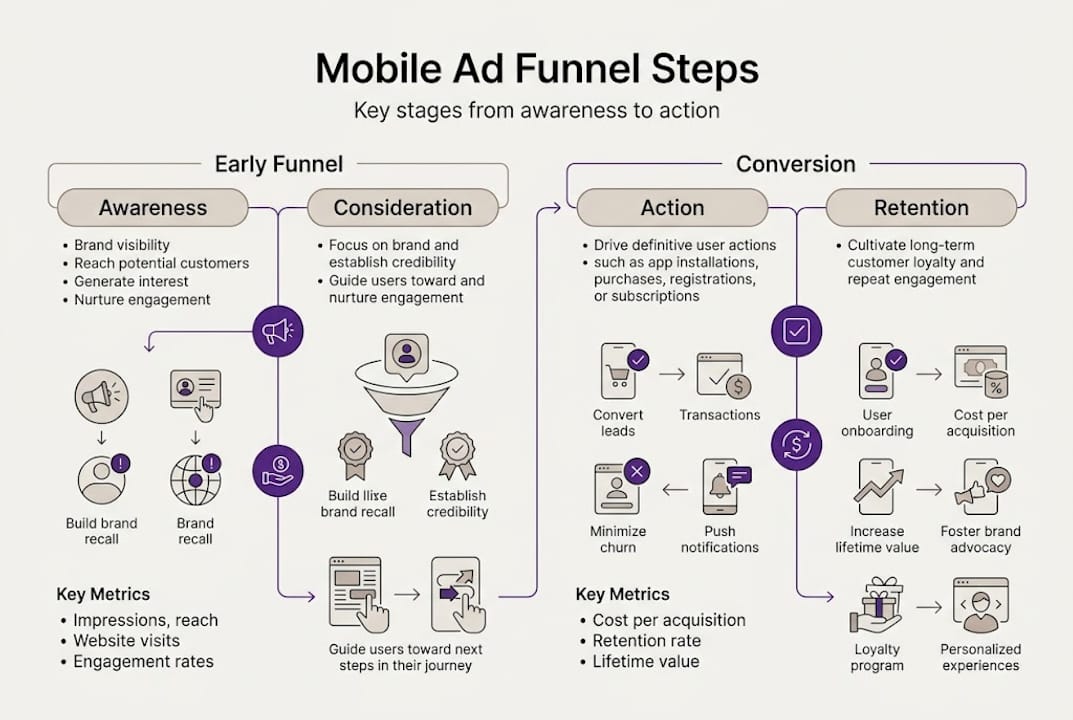
Tracking key ad performance metrics at every stage gives your team the data it needs to pinpoint exactly where budget is leaking. Without this visibility, optimisation becomes guesswork.
Here are the core metrics to monitor across the funnel:
- Awareness: CPM and CTR to gauge creative resonance with your target segment
- Consideration: Play rate to measure interactive ad engagement and quality of traffic
- Conversion: Install rate and activation rate for post-click efficiency
- Retention: D1, D7, and D30 retention rates to assess onboarding quality
- Monetisation: ARPU and ROAS to validate profitability of acquired users
- Loyalty: Referral rates and lifetime value (LTV) for long-term returns
Missing even one of these metrics at its respective stage leaves you partially blind. Many teams track installs obsessively whilst ignoring D7 retention, only to discover their ROAS is negative weeks later. A full-funnel view prevents this.
Preparation: Setting up for effective playable ad integration
Now that we understand what each funnel stage entails, here is how to prepare for seamless playable ad integration. Effective deployment begins well before any creative goes live. The teams, assets, and knowledge you assemble at this stage directly determine your results.

One of the most important decisions you will make is choosing the right creation tool. In-house development is capable but expensive, often tying up engineering resources that could be better spent on your core product. No-code builders offer a practical alternative.
| Tool type | Speed | Cost | Flexibility | Technical skill needed |
|---|---|---|---|---|
| In-house developers | Slow | High | Very high | Expert |
| No-code builders | Fast | Low to medium | Medium to high | Minimal |
| Drag-and-drop platforms | Very fast | Low | Medium | None |
| Agency outsourcing | Medium | High | High | None |
For most UA teams, a no-code or drag-and-drop platform offers the best balance of speed and cost. Using playable ad benefits data to justify this choice internally is straightforward: teams using playables in awareness and consideration stages have seen D1 retention improve by 35% and measurable ROAS uplift compared to static formats.
Before you build anything, work through this preparation checklist:
- Define your target audience segments for each funnel stage separately
- Gather your top-performing gameplay clips, art assets, and core loop mechanics
- Establish baseline KPIs from your current static or video ad campaigns
- Confirm platform creative specifications for each network you intend to use
- Set up event tracking in your mobile measurement partner (MMP) for every key action
- Agree on a testing budget that allows at least three creative variants per stage
Pro Tip: Limit your first playable to a 15 to 30 second interaction loop. Longer experiences lose users before conversion, and shorter ones often fail to communicate your game’s core appeal. This balance tends to optimise both play rate and install rate simultaneously, helping you keep UA costs under control during the testing phase.
Execution: Step-by-step process to optimise each funnel stage
Preparation complete, let us move to the step-by-step process for practical deployment. The sequence in which you introduce playables across the funnel matters. Starting everywhere at once disperses your testing budget and makes attribution harder.
-
Deploy at awareness first. Launch your playable ad against broad audience segments to generate impression volume. Measure CTR against your existing creative benchmarks to confirm the format is outperforming.
-
Introduce at consideration next. Once your awareness playable is generating acceptable CTR, bring a tailored version into the consideration stage to target users who have already shown category interest. Track play rate closely here.
-
Align conversion creatives with your store page. The transition from playable ad to store listing should feel seamless. Inconsistency between the two causes drop-off. Study mobile game ad examples to see how leading studios handle this handoff.
-
Use post-install data to inform creative iteration. Once your first cohort installs, examine D1 and D7 retention. If retention drops sharply, your playable may be misrepresenting gameplay. Adjust the interactive experience to align with actual onboarding.
-
Test hybrid formats at scale. Blend playable mechanics with rewarded video to reach users who engage differently. This is particularly effective on networks where pure playables have limited inventory.
Playable ads generate higher engagement and improved ROAS precisely because they filter out passive viewers. Users who complete a play interaction have already demonstrated intent. That self-selection is enormously valuable.
Pro Tip: Run A/B tests with at least two distinct interactive mechanics before scaling. The psychology of playable ads shows that perceived control and immediate feedback loops drive completion rates upward. Testing which mechanic resonates with your specific audience is worth the extra creative effort.
For social channels, monitor Facebook ad performance separately from other networks. Playable benchmarks vary significantly between platforms, so consolidating results across channels can obscure meaningful signals.
Verification and scaling: Measuring success and tackling common pitfalls
After launching your improved funnel, it is time to check results and address any stumbling blocks. A structured verification process prevents teams from scaling under-performing creatives and missing the compounding returns of genuine optimisation.
Compare your pre- and post-playable KPIs using a structured results table:
| Metric | Pre-playable baseline | Post-playable result | Target improvement |
|---|---|---|---|
| CTR | 1.2% | 2.1% | +75% |
| Play rate | N/A | 38% | New metric |
| Install rate | 18% | 26% | +44% |
| D1 retention | 28% | 38% | +35% |
| D7 retention | 14% | 19% | +36% |
| ROAS (Day 30) | 0.8x | 1.3x | Positive |
You should monitor play rate, install rate, D1/D7 retention, ARPU, and ROAS consistently to validate funnel performance at every stage. These metrics together give you a complete picture rather than a partial one.
“Chasing installs without tracking retention is like filling a bucket with a hole in it. Volume alone tells you nothing about the quality of what you have acquired.”
Common pitfalls to address during this phase:
- Creative fatigue: Rotating playables every two to three weeks prevents frequency-driven performance decay
- Ignoring cohort analysis: Always segment results by install date and traffic source to isolate true creative impact
- Skipping mid-funnel validation: Many teams jump straight from awareness metrics to ROAS without checking consideration and conversion stage health
- Over-indexing on one platform: Diversify across networks; playable inventory behaves differently on Meta, Google, and DSP channels
For teams working on boosting conversion rates, the iteration framework is straightforward: test one variable at a time, measure for at least seven days per variant, then apply learnings before scaling spend. This methodical approach compounds over time. Exploring different types of ad experiences alongside playables also helps you identify which formats perform best at each specific funnel stage.
What most guides miss: Building a funnel for both quality and scale
With data in hand, it is worth stepping back to reconsider what genuine funnel mastery actually means. Most guides stop at install volume. They celebrate cost-per-install reductions and call it success. But the teams consistently generating strong long-term ROAS are doing something different.
They are building for quality first, and scale second. Playable ads are uniquely positioned to help here because they self-qualify users before the install happens. A user who completes your interactive ad has already demonstrated patience, curiosity, and genuine interest in your game’s mechanics. That is a fundamentally different kind of user than someone who tapped a banner by accident.
The mistake most teams make is pausing their creative testing too soon. One winning playable is not a system. It is a data point. The compounding returns come from optimising playable ad creatives iteratively, learning from each variant, and refining your understanding of what truly resonates with your highest-value user segments. Short-term install spikes are satisfying, but long-view creative learning is what separates sustainable programmes from campaigns that plateau. Treat each iteration as an investment in organisational knowledge, not just a quick performance fix.
Next steps: Building your high-performance mobile ad funnel
Ready to put your new strategies into practice? PlayableMaker is built specifically for UA teams who need to create, test, and iterate on playable ads without draining development budgets or waiting weeks for engineering support. The platform’s no-code environment means your marketing team can build interactive ad experiences directly, informed by the psychology behind effective playables, and launch them fast. Whether you are new to playable ads or looking to scale an existing programme, PlayableMaker gives you the tools to move from concept to live creative in a fraction of the usual time and cost. Explore the platform today and start building the funnel your game deserves.
Frequently asked questions
What is the most important KPI for mobile ad funnel success?
ROAS and D1/D7 retention rates are the strongest indicators of funnel health, as confirmed by KPI frameworks tracking awareness through loyalty. Together, they reflect both short-term acquisition efficiency and long-term user quality.
How do playable ads improve user quality in the ad funnel?
Playable ads self-select engaged users through interaction, filtering low-quality traffic and boosting D1 retention by up to 35%. Users who complete the experience have already demonstrated genuine interest before the install.
What tools are needed to create effective playable ads?
No-code platforms and drag-and-drop builders allow marketing teams to produce and iterate on playable ad creatives quickly, without requiring dedicated developer time or significant production budgets.
What is a common mistake to avoid in mobile ad funnels?
Neglecting post-install engagement metrics is one of the most common errors. Teams that ignore D1/D7 retention and ROAS often scale budgets against creatives that appear to work but actually acquire low-value users.
How soon should I expect results after adding playables to my funnel?
With correct placement and a well-structured interactive experience, most teams observe measurable improvements in retention and conversion KPIs within the first seven days of the initial cohort.
Recommended
- How to Make Engaging Game Ads for Mobile Success – playablemaker.com How to Make Engaging Game Ads for Mobile Success
- 7 Essential Ad Design Tips for Mobile Games in 2025 – playablemaker.com 7 Essential Ad Design Tips for Mobile Games in 2025
- Master Effective Playable Ad Techniques for Mobile Gaming – playablemaker.com Master Effective Playable Ad Techniques for Mobile Gaming
- What Is Playable Ad Funnel? 40% Higher CTR & Lower CPI – playablemaker.com What Is Playable Ad Funnel? 40% Higher CTR & Lower CPI