Mobile game user acquisition specialists face a persistent challenge: how to engage potential players without exhausting budgets. Playable ads deliver a compelling answer, achieving 30–40% higher click-through rates compared to video ads in casual game genres. Understanding the playable ad funnel transforms your approach from passive impressions to active engagement, guiding users from curiosity to install through interactive mini-games. This strategic sequence leverages behavioral psychology and smart design to lower cost per install while boosting retention.
Table of Contents
- Introduction To The Playable Ad Funnel
- Key Stages And Mechanics Of A Playable Ad Funnel
- Psychological Principles Behind Playable Ads Effectiveness
- Playable Ad Creative Development: Trends And Tools
- Genre Suitability And Customizing Playable Ads For Mobile Games
- Common Misconceptions And Practical Solutions
- Measuring Success And Optimizing Your Playable Ad Funnel
- Conclusion: Bridging Playable Ad Funnel Understanding To Practical Application
- Explore Advanced Playable Ad Solutions For Mobile Gaming
- Frequently Asked Questions About Playable Ad Funnels
Key Takeaways
| Point | Details |
|---|---|
| Higher engagement | Playable ads achieve 30–40% higher CTR than video ads through interactive gameplay experiences. |
| Four-stage funnel | Attention capture, tutorial, early success moment, and persistent install CTA guide users from awareness to conversion. |
| Behavioral psychology | Active participation and reward anticipation drive stronger install motivation and post-install retention. |
| No-code acceleration | No-code platforms reduce developer time by up to 70%, enabling faster, cheaper playable ad production. |
| Genre suitability | Match-3, Merge, Puzzle, and Idle games perform best due to simple, intuitive core mechanics. |
Introduction to the Playable Ad Funnel
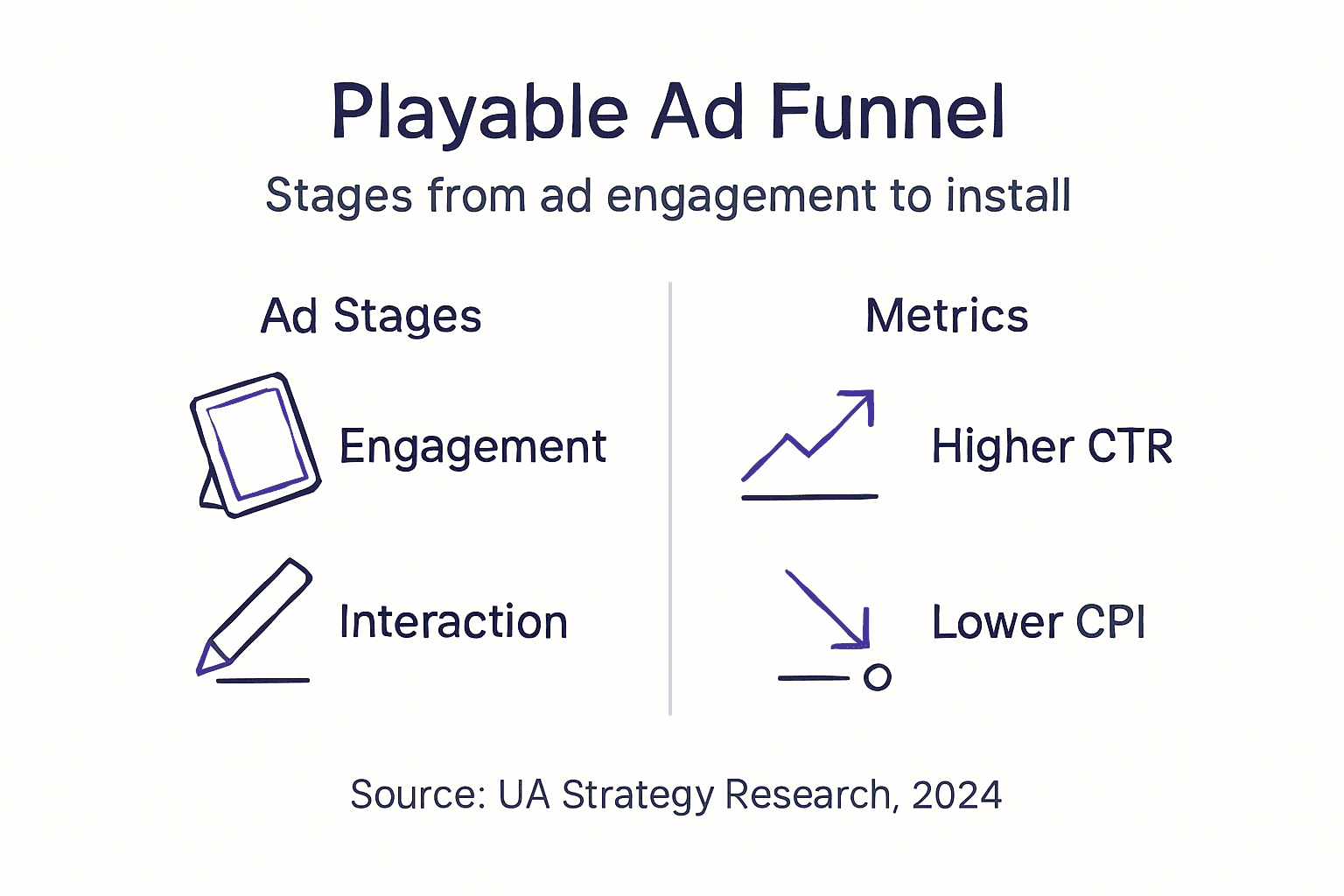
A playable ad funnel is the user journey from initial ad engagement to app install, structured around interactive mini-games that let potential players experience core gameplay before downloading. Unlike static banners or passive video ads, playables put control in the user’s hands within seconds.
The market has responded enthusiastically. Over 30,000 playable ad creatives launched daily in 2024, with more than 7% of mobile game advertisers integrating playables into their UA mix. This rapid adoption stems from measurable performance advantages: higher engagement rates, stronger click-through performance, and lower cost per install compared to traditional formats.
For casual and mid-core mobile games, playables have become essential. They combine genuine gameplay samples with direct calls to action, creating a seamless path from curiosity to commitment. When users interact with your game mechanics before installing, they arrive with clearer expectations and stronger intent.
Key benefits include:
- Enhanced engagement: Interactive elements keep users actively involved rather than passively watching
- Qualified installs: Players who complete playable challenges demonstrate genuine interest in your game mechanics
- Cost efficiency: Higher conversion rates translate to lower acquisition costs per quality user
- Rapid testing: Digital format enables quick iteration cycles to optimize funnel performance
Understanding marketing funnel basics helps frame how playables fit into broader UA strategy. Unlike awareness-stage content, playables operate at consideration and decision stages, accelerating users toward conversion. The examples of effective playable ads demonstrate how top-performing games leverage interactive experiences to stand out in crowded ad spaces.
The funnel concept matters because each stage serves a specific purpose. You’re not just creating a mini-game; you’re architecting a conversion path that addresses user psychology, technical constraints, and business objectives simultaneously. Getting this architecture right determines whether your playable becomes a UA asset or a wasted creative effort.
Key Stages and Mechanics of a Playable Ad Funnel
Every high-performing playable ad funnel follows a proven four-stage sequence designed to maximize engagement and conversion within seconds.
-
Attention capture: The playable must deliver instant interactivity, achieving time-to-fun under 10 seconds. Users should tap, swipe, or drag immediately without confusion. Visual clarity and compelling motion draw the eye and hand simultaneously.
-
Tutorial phase: A brief, intuitive introduction shows users how to interact without lengthy instructions. The best playables teach through doing rather than telling, using visual cues like arrows, highlighted objects, or simple animation to guide first actions.
-
Early success moment: This critical stage triggers reward anticipation by letting users achieve a small win quickly. Whether matching three gems, merging two objects, or solving a simple puzzle, that first success creates momentum and emotional investment.
-
Persistent install CTA: The call-to-action remains visible throughout the experience, typically as a button overlay that doesn’t interrupt gameplay but stays accessible. Smart placement ensures users can convert the moment motivation peaks.
Behavioral triggers embedded in these stages significantly boost conversion rates. Quick wins activate dopamine responses, making users want more of that feeling. Easy interaction reduces friction that might cause abandonment. Clear progression signals that success is achievable, lowering perceived risk of downloading.
Rapid iteration drives optimization. Leading advertisers test dozens of creative variations monthly, refining mechanics, visual styles, and CTA placement based on performance data. Engaging playable ads design tips emphasize starting simple and adding complexity only where data justifies it.

Pro Tip: Focus on one core mechanic per playable rather than cramming multiple features. A perfectly executed single interaction outperforms a complex experience that confuses users. Test your playable on actual devices to ensure load speed and responsiveness meet the under-10-second standard.
Technical performance cannot be overlooked. Slow load times or laggy interactions destroy the funnel before it begins. Optimize file sizes, compress assets, and test across device types and network conditions. Understanding ad format types helps you choose platforms and specifications that balance quality with performance.
The funnel’s power lies in its psychological sophistication disguised as simple fun. Each stage serves conversion goals while feeling natural to users. Master this balance and your playables become acquisition engines rather than experimental creative exercises.
Psychological Principles Behind Playable Ads Effectiveness
Playable ads leverage behavioral psychology principles that passive formats cannot access. Understanding these mechanisms explains why interactive ads consistently outperform video and static alternatives.
The “try before you buy” effect fundamentally changes user relationships with advertised games. When you let potential players interact with actual mechanics, you transform marketing from promise to proof. Users who succeed or nearly succeed in playable ads convert at higher rates because they’ve invested effort and experienced competence, triggering anticipation of continued reward.
Active participation creates stronger neural connections than passive observation. Your brain processes interactive experiences differently, encoding them more deeply in memory. This cognitive engagement means users remember your game better and develop preferences based on direct experience rather than abstract claims.
Key psychological drivers include:
- Effort justification: Users rationalize their invested time and energy by valuing the game more highly, increasing install likelihood
- Reward anticipation: Early success moments activate anticipation circuits, making users eager to continue the experience
- Autonomy and control: Letting users make choices, even simple ones, satisfies psychological needs for agency and competence
- Curiosity loops: Well-designed playables create questions that only the full game can answer, driving installation motivation
Emotional engagement strengthens brand connections before installation occurs. When users feel satisfaction, curiosity, or mild frustration followed by triumph during your playable, they form emotional associations with your game. These feelings transfer to the full product, improving retention metrics compared to users acquired through passive ads.
The psychology behind playable ads reveals deeper patterns. Cognitive biases favor active participation over passive reception. Social proof becomes irrelevant when users can evaluate quality themselves. The endowment effect kicks in as users begin to feel ownership over their playable progress, making abandonment psychologically costly.
Pro Tip: Design your playable to create a “cliffhanger” moment where users achieve something meaningful but can clearly see additional rewards or challenges ahead. This open loop compels installation to resolve the narrative tension you’ve created.
Retention benefits extend beyond initial conversion. Users who install after playable engagement arrive with accurate expectations and demonstrated interest in core mechanics. This qualification reduces early churn compared to users acquired through misleading or vague creative. You’re not just getting installs; you’re getting players predisposed to enjoy what you’ve built.
Playable Ad Creative Development: Trends and Tools
Creative production trends have transformed playable ads from expensive custom development projects to scalable, budget-friendly UA tools accessible to teams of all sizes.
Rapid iteration dominates the landscape. 64.8% of playable ads released monthly are new creatives, reflecting the testing velocity required for optimization. Top performers don’t perfect a single playable; they systematically test variations to discover what resonates with specific audience segments.
Reusable templates based on proven mechanics have emerged as efficiency multipliers. Rather than building each playable from scratch, smart teams start with templates for match-3, merge, puzzle, or idle mechanics, then customize visuals and difficulty curves. This approach slashes development time while ensuring core interactions already work.
No-code platforms represent the most significant shift. These solutions reduce developer time by up to 70%, democratizing playable creation for creative managers without technical backgrounds. You can now prototype, test, and deploy playables in days rather than weeks, dramatically improving time-to-market and testing capacity.
Key development trends include:
- Component libraries: Pre-built game mechanics, UI elements, and animations that snap together like building blocks
- Visual editors: Drag-and-drop interfaces that eliminate coding requirements for creative iteration
- Asset optimization: Automated compression and formatting tools that ensure fast load times across devices
- Version control: Systems for managing multiple creative variations and tracking performance by version
Cost and speed comparisons reveal the magnitude of these improvements:
| Approach | Average Production Time | Typical Cost | Iteration Speed |
|---|---|---|---|
| Traditional development | 2-4 weeks | $5,000-$15,000 | Slow (requires dev resources) |
| No-code platforms | 2-5 days | $500-$2,000 | Fast (creative team can iterate) |
| Template reuse | 1-3 days | $200-$800 | Very fast (mainly customization) |
These efficiency gains enable testing strategies previously available only to advertisers with massive budgets. You can now run systematic A/B tests across mechanics, visual styles, difficulty levels, and CTA placements without breaking your budget or overwhelming your development team.
The no-code playable ad creation approach shifts bottlenecks from technical implementation to creative strategy. Your constraint becomes imagination and testing discipline rather than engineering capacity. Playable ad templates provide starting points that let you focus energy on differentiation and audience fit.
This democratization matters for competitive positioning. When every advertiser can deploy playables quickly and affordably, creative quality and strategic testing separate winners from losers. The tools have leveled the playing field; your creativity and data discipline determine outcomes.
Genre Suitability and Customizing Playable Ads for Mobile Games
Not all game genres benefit equally from playable ads. Understanding which mechanics translate well to short interactive experiences helps you allocate budget effectively and design funnels that convert.
Match-3, Merge, Puzzle, and Idle games show better playable ad funnel performance because their core mechanics are instantly understandable and satisfying in short sessions. These genres feature simple tap or drag interactions that users grasp within seconds, meeting the critical time-to-fun requirement.
Complex genres like RPG, strategy, or narrative-driven games face different challenges. You cannot compress deep systems into 15-second playables without losing what makes the game compelling. Instead, focus on isolated mechanics or key gameplay moments that showcase unique features. A battle sequence, character customization screen, or territory expansion moment can represent larger systems effectively.
Customization amplifies funnel performance by aligning playable mechanics with your specific game’s appeal:
- Visual style matching: Ensure playable art direction mirrors your game’s aesthetic so users recognize continuity
- Difficulty calibration: Set challenge levels that create early success without feeling trivially easy
- Core mechanic spotlighting: Highlight the interaction that best represents why players enjoy your game
- Progression teasing: Show advancement systems or collection mechanics that motivate continued play
Choosing the right mechanic requires understanding your audience and game positioning. If your match-3 game differentiates through power-up combinations, feature those in your playable. If your merge game’s appeal is satisfying object evolution, make that transformation central to the ad experience.
Pro Tip: Test simplified versions of your actual game levels as playables rather than creating entirely separate experiences. This ensures authentic representation while maintaining the time-to-fun standard. Extract one puzzle, one merge chain, or one combat encounter that encapsulates your game’s feel.
The playables tailored by genre demonstrate adaptation strategies. Casual games can often use core mechanics directly, while mid-core titles benefit from focusing on a single satisfying loop within larger systems. Hard-core games might showcase competitive elements or skill expressions that appeal to their target demographic.
Genre suitability also affects creative volume requirements. Simple genres may need fewer variations because core appeal is universal, while complex games might require multiple playables highlighting different aspects to reach diverse player motivations. Budget your creative resources accordingly.
Common Misconceptions and Practical Solutions
Several persistent myths prevent UA teams from adopting playable ads effectively. Addressing these misconceptions enables realistic expectations and smart implementation strategies.
Myth: Playable ads require expensive developer resources
Reality: No-code platforms and reusable templates have eliminated this barrier. Creative managers can now build, test, and deploy playables without involving engineering teams for every iteration. While custom development remains an option for complex executions, the no-code tools for playable ads deliver professional results at a fraction of traditional costs.
Myth: Playable ads are niche experimental formats
Reality: Mainstream adoption is well-established. With over 7% of mobile game advertisers integrating playables and more than 30,000 daily creatives launching globally, this format has moved from experimental to essential. Leading games across casual, mid-core, and increasingly hard-core genres rely on playables as core UA channels.
Myth: All game genres perform equally in playable formats
Reality: Genre suitability significantly impacts results. Games with simple, intuitive core mechanics consistently outperform complex titles unless the latter carefully isolate specific gameplay moments. Understanding your genre’s fit helps set realistic performance expectations and guides creative strategy.
Myth: One great playable is enough
Reality: Continuous creative refresh and testing drive sustainable success. The 64.8% monthly new creative rate exists because performance decays over time and audience segments respond to different approaches. Plan for ongoing production rather than one-time creation.
Practical solutions flow from these realities:
- Start with templates: Use proven mechanics as foundations, customizing visuals and difficulty rather than building from scratch
- Embrace no-code tools: Shift creative control from engineering to UA and creative teams for faster iteration
- Match genre to format: Be honest about whether your game mechanics suit short interactive experiences or require adapted approaches
- Build testing pipelines: Establish processes for systematic creative variation and performance analysis rather than ad hoc efforts
These misconceptions often stem from outdated information or limited exposure to modern playable ad ecosystems. The technology, costs, and best practices have evolved dramatically, making playables accessible to teams at every budget level. Your barrier is knowledge and process adoption rather than resources or technical capability.
Measuring Success and Optimizing Your Playable Ad Funnel
Data-driven optimization separates successful playable strategies from disappointing experiments. Track the right metrics and iterate systematically to maximize return on ad spend.
Core performance indicators include:
- Click-through rate: Measures initial engagement and creative appeal
- Install rate: Tracks conversion from click to download
- Day-1 retention: Reveals quality of acquired users
- Cost per install: Determines economic efficiency
Playable ads consistently outperform video formats across these dimensions. Lower CPI, higher CTR, and better retention result from qualified user acquisition and ad network preferential treatment of engaging formats.
Performance comparison:
| Metric | Video Ads | Playable Ads | Improvement |
|---|---|---|---|
| Click-through rate | 1.5-2.5% | 3.0-4.5% | +100-125% |
| Install conversion | 15-25% | 30-45% | +60-100% |
| Day-1 retention | 35-45% | 45-60% | +22-43% |
| Cost per install | Baseline | 20-40% lower | 20-40% savings |
Rapid A/B testing accelerates optimization. Rather than waiting weeks for statistical significance, test multiple variations simultaneously across audience segments. Creative refresh cycles should run monthly at minimum, with high performers testing weekly.
Ad networks reward engaging playables with better placement and lower costs. When users interact longer and convert at higher rates, algorithms prioritize your ads, creating a virtuous cycle. This algorithmic favorability compounds cost advantages over time.
Optimization workflow:
- Analyze baseline performance: Establish current metrics across CTR, install rate, retention, and CPI for existing creatives
- Generate variations: Create 3-5 playable versions testing different mechanics, visual styles, or difficulty levels
- Deploy systematically: Run variations simultaneously with controlled budgets to gather comparable data quickly
- Evaluate and iterate: Identify winners, understand why they succeeded, and create next-generation variations building on insights
- Refresh regularly: Replace underperformers with new tests while scaling winners until performance decays
The optimizing playable ads approach emphasizes continuous improvement over perfection. Your first playable will not be your best, but systematic testing reveals what resonates with your specific audience.
Data granularity matters. Segment performance by traffic source, device type, geography, and audience demographic. A playable that crushes on iOS premium inventory might flop on Android rewarded placements. Tailor creative strategy to where you’re buying traffic.
Success measurement extends beyond immediate conversion. Track cohort lifetime value for users acquired through different playables to understand long-term quality differences. Higher day-1 retention often predicts better LTV, justifying premium CPIs for superior creatives.
Conclusion: Bridging Playable Ad Funnel Understanding to Practical Application
Playable ad funnels represent a proven path to enhanced user engagement and cost-efficient installs when executed with strategic discipline. The 30-40% CTR advantage and measurably lower CPI stem from psychological principles and smart funnel design working together.
No-code platforms and reusable templates have democratized access, enabling UA specialists and creative managers to scale playable production without proportional budget or team expansion. The 70% reduction in developer time translates directly to faster testing cycles and lower costs.
Continuous creative optimization drives long-term success. With 64.8% of monthly playables representing new creatives, market leaders understand that iteration and refresh separate sustainable strategies from one-hit wonders. Build testing and production pipelines that support ongoing improvement.
Genre fit, behavioral psychology, and technical execution must align for maximum impact. Understanding which mechanics suit short interactive experiences, how to trigger install motivation, and what technical standards ensure smooth experiences gives you the framework for strategic decisions.
The competitive advantage lies not in understanding these principles but in applying them systematically. Transform insights into action through disciplined testing, data analysis, and creative iteration. Your playable ad funnel becomes an acquisition engine when strategy, execution, and optimization work together.
Explore Advanced Playable Ad Solutions for Mobile Gaming
Ready to transform your UA strategy with high-performing playable ads? Our no-code platform empowers creative teams to build, test, and deploy engaging playables in days rather than weeks, slashing costs while boosting conversion rates. Reusable templates based on proven mechanics let you start strong, while intuitive editors enable rapid customization without developer involvement.
Explore deeper insights on playable ads psychology to refine your funnel strategy, or discover how playable ads revolutionize digital engagement across channels. Our no-code playable ad tools put professional-grade creation capabilities in your hands, enabling the testing velocity and cost efficiency that drive sustainable growth. Start building playables that convert today.
Frequently Asked Questions about Playable Ad Funnels
What is the ideal length for playable ads in a funnel?
Playable ads should run 15-30 seconds for optimal performance, with time-to-fun under 10 seconds being critical. Shorter experiences maintain attention while longer formats risk user drop-off before reaching the install CTA. Focus on delivering one satisfying interaction loop rather than cramming multiple features into extended playtime.
How do no-code tools specifically speed up playable ad creation?
No-code platforms eliminate coding requirements through visual editors and pre-built component libraries, reducing production from weeks to days. Creative teams can iterate independently without waiting for developer availability, while automated optimization handles technical requirements like asset compression and cross-device compatibility. This shifts the bottleneck from technical implementation to creative strategy.
Which game genres gain the highest ROI from playable ad funnels?
Match-3, Merge, Puzzle, and Idle games consistently deliver the strongest playable ad ROI due to instantly understandable mechanics and satisfying short-session gameplay. These genres naturally fit the 15-30 second format while showcasing core appeal. Complex genres like RPG or strategy can succeed by isolating specific mechanics rather than representing full systems.
How often should playable ads be refreshed for best results?
Refresh playable creatives monthly at minimum, with high-performing campaigns testing new variations weekly. Performance typically decays after 30-45 days as audiences encounter the same creative repeatedly and ad network algorithms optimize toward newer inventory. The 64.8% monthly new creative rate among top advertisers reflects this refresh necessity.
Can playable ads be integrated across different ad networks easily?
Most modern playable ad platforms support standard formats compatible with major networks including Google, Facebook, Unity Ads, and AppLovin. Technical specifications vary by network, but professional creation tools handle format requirements automatically. Test performance across networks as audience composition and algorithmic preferences affect results significantly. Learn more about building interactive ads for multi-network deployment.
Recommended
- The Benefits of Playable Ads for Mobile Marketers – playablemaker.com The Benefits of Playable Ads for Mobile Marketers
- Why Test Playable Ads: Boost Mobile Game UA – playablemaker.com Why Test Playable Ads: Boost Mobile Game UA
- Why Use Playable Ads: Boost Game UA Efficiency – playablemaker.com Why Use Playable Ads: Boost Game UA Efficiency
- From Zero to Wow: The Power of Playable Ad Templates to Skyrocket Engagement – playablemaker.com From Zero to Wow: The Power of Playable Ad Templates to Skyrocket Engagement