Nearly every british mobile gaming company is searching for ways to fine-tune Google Ads results without driving up technical expenses. Achieving real growth depends on understanding which core metrics matter most for player acquisition and how your campaigns compare globally. With nearly 90 percent of advertising budgets wasted on suboptimal strategies, this guide shows user acquisition specialists how to reduce spending, track meaningful metrics, and simplify workflows through no-code solutions.
Table of Contents
- Core Google Ads Metrics Explained
- Types Of Performance Metrics For Mobile Gaming
- How Metrics Shape User Acquisition Strategies
- Financial Implications For Ad Budgets
- Mistakes To Avoid With Ad Measurement
Key Takeaways
| Point | Details |
|---|---|
| Monitor Core Metrics | Focus on CTR, CPC, conversion rate, and impressions for campaign optimisation. |
| Utilise Advanced Insights | Leverage CPA and ROAS for deeper financial analysis of advertising effectiveness. |
| Adopt Data-Driven Strategies | Implement real-time tracking and adaptive techniques for user acquisition. |
| Avoid Measurement Mistakes | Regularly review metrics to ensure relevance and avoid reliance on superficial indicators. |
Core Google Ads metrics explained
Understanding Google Ads performance metrics is crucial for mobile gaming user acquisition specialists seeking to optimise advertising spend and campaign effectiveness. These quantitative indicators provide deep insights into ad performance, revealing how potential players interact with marketing campaigns. Performance metrics in Google Ads encompass several key measurements that help marketers track and improve their advertising strategies.
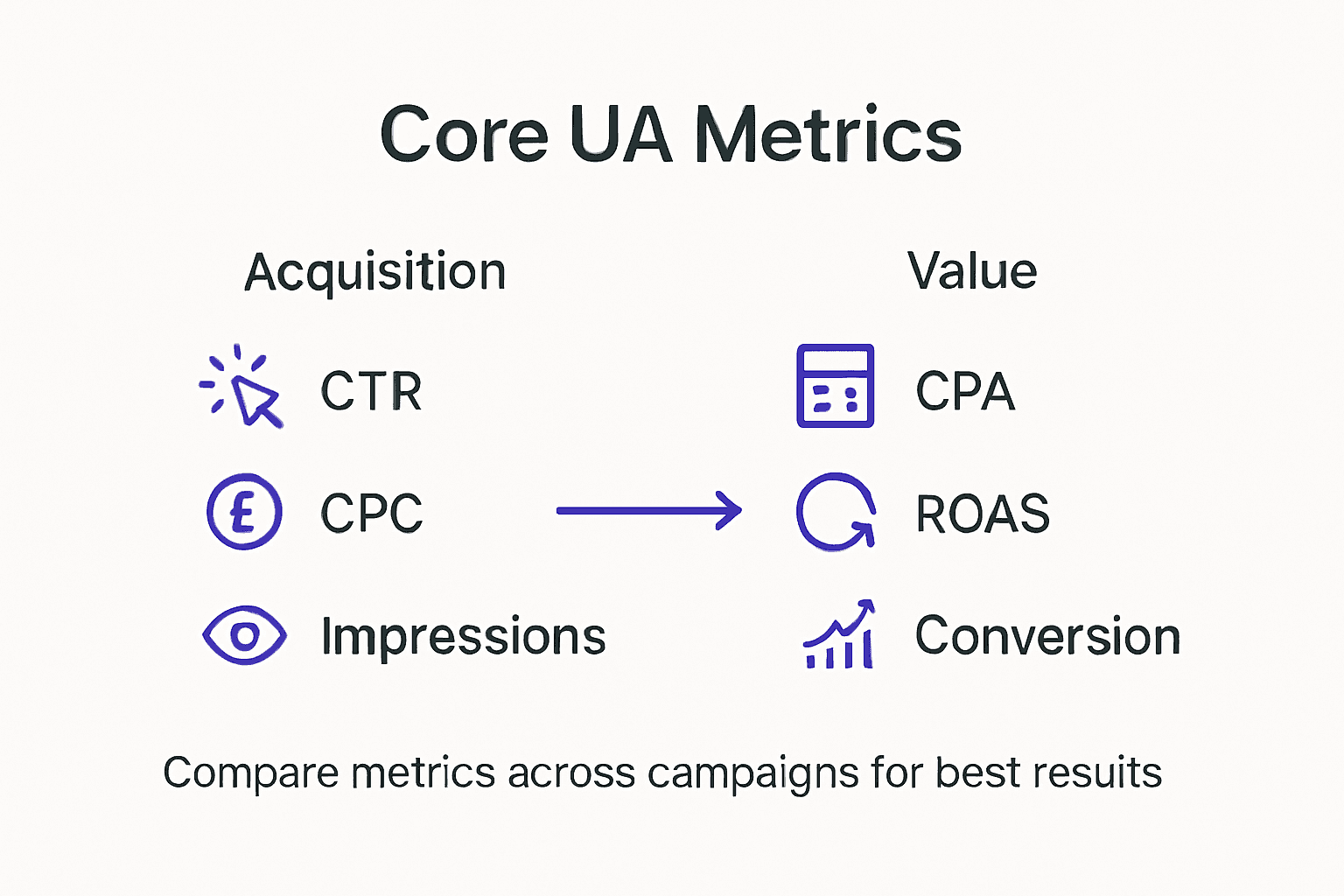
The core Google Ads metrics mobile gaming professionals should monitor include click-through rate (CTR), cost per click (CPC), conversion rate, and impressions. CTR demonstrates the percentage of users who click an advertisement after viewing it, indicating how compelling your ad creative appears. Cost per click measures the financial investment required to generate each individual click, directly impacting user acquisition budgets. Conversion rate tracks how many clicks transform into actual game installations or desired player actions, providing a clear picture of campaign effectiveness.
Additionally, advanced metrics like cost per acquisition (CPA) and return on ad spend (ROAS) offer deeper strategic insights. CPA calculates the precise cost of acquiring a new player, while ROAS reveals the revenue generated relative to advertising expenditure. Mobile gaming marketers can leverage these metrics to make data-driven decisions about campaign optimisation, budget allocation, and targeting strategies. By carefully analysing these performance indicators, user acquisition teams can refine their approach, reduce unnecessary spending, and improve overall marketing efficiency.
Here is a summary comparing key Google Ads metrics for mobile gaming user acquisition:
| Metric | What it Measures | Business Impact |
|---|---|---|
| Click-through Rate | Percentage of ad viewers who click | Indicates creative effectiveness |
| Cost per Click | Average cost for each click | Determines cost efficiency of ad spend |
| Conversion Rate | Proportion of clicks leading to action | Reflects success in acquiring engaged users |
| Cost per Acquisition | Cost of gaining a new player | Assesses total spend required for each new user |
| Return on Ad Spend | Revenue per pound spent on ads | Evaluates overall financial return from campaigns |
Pro tip: Regularly compare your Google Ads metrics across different campaigns and creative variations to identify the most cost-effective strategies for user acquisition.
Types of performance metrics for mobile gaming
Mobile gaming user acquisition professionals require a comprehensive understanding of performance metrics that extend beyond basic advertising indicators. Performance evaluation methods offer nuanced insights into player engagement, revealing critical behavioural patterns that influence marketing strategies. These metrics range from technical measurements to complex behavioural analytics, providing a holistic view of campaign effectiveness.

Key performance metrics for mobile gaming can be categorised into several distinct groups. Acquisition metrics track how players discover and download games, including source tracking, referral channels, and initial conversion rates. Engagement metrics measure player interactions, such as session length, retention rates, and in-game actions. Monetisation metrics analyse revenue generation, examining average revenue per user (ARPU), lifetime value (LTV), and conversion from free-to-play to paying users. Gameplay performance metrics evaluate player skill levels, including actions per minute, strategic decision-making, and win/loss ratios.
Advanced performance tracking goes beyond traditional metrics by incorporating sophisticated analytical frameworks. Player performance indices can provide granular insights into player behaviour, measuring complex attributes like aggression, survivability, and tactical proficiency. These sophisticated metrics enable user acquisition specialists to develop highly targeted marketing strategies, identifying and attracting players most likely to engage deeply with a mobile game. By understanding these nuanced performance indicators, marketing teams can optimise their user acquisition approaches, reducing customer acquisition costs and improving overall campaign efficiency.
The following table categorises mobile gaming performance metrics and their main areas of focus:
| Category | Primary Focus | Typical Use Case |
|---|---|---|
| Acquisition Metrics | User downloads and sources | Track origin of new installs |
| Engagement Metrics | Player interaction levels | Identify retention and time spent in-game |
| Monetisation Metrics | Revenue per user | Assess in-app purchase success |
| Gameplay Performance | Player skill analytics | Tailor marketing to highly engaged player types |
Pro tip: Develop a comprehensive dashboard that combines multiple performance metrics to gain a holistic understanding of your mobile game’s user acquisition and engagement strategies.
How metrics shape user acquisition strategies
User acquisition strategies in mobile gaming have transformed into sophisticated, data-driven approaches that leverage precise performance metrics to drive growth. Data-driven growth strategies now rely on continuous monitoring and instant adjustments based on real-time performance indicators. This dynamic approach allows marketing teams to optimise campaigns with unprecedented precision, ensuring maximum efficiency in attracting and retaining high-quality players.
The key metrics that fundamentally shape user acquisition strategies include critical performance indicators such as cost per install (CPI), lifetime value (LTV), retention rates, and engagement levels. These metrics provide granular insights into campaign effectiveness, enabling marketers to identify the most productive channels and targeting strategies. By analysing these indicators, user acquisition specialists can make informed decisions about budget allocation, creative design, and audience segmentation, ultimately reducing acquisition costs while improving overall player quality.
User acquisition techniques have evolved to become highly adaptive, with real-time data enabling instant campaign modifications. Advanced analytics now allow marketers to track performance across multiple dimensions, comparing different acquisition channels, creative variations, and audience segments. This approach transforms user acquisition from a static marketing function into a dynamic, responsive strategy that continuously learns and improves. Sophisticated machine learning algorithms can now predict player potential, helping marketers focus their efforts on segments most likely to generate long-term value and engagement.
Pro tip: Create a comprehensive dashboard that tracks multiple user acquisition metrics simultaneously, allowing for quick identification of high-performing strategies and rapid iteration.
Financial implications for ad budgets
Mobile gaming user acquisition professionals must develop sophisticated financial strategies that balance precise budget allocation with maximum return on investment. Budget management principles reveal that successful advertising expenditure requires a nuanced approach balancing mandatory baseline costs and flexible campaign spending. Understanding the intricate financial dynamics of Google Ads allows marketers to create more targeted and cost-effective user acquisition strategies.
The core financial considerations in mobile gaming advertising revolve around key metrics such as cost per install (CPI), lifetime user value, and return on ad spend (ROAS). These financial indicators help user acquisition specialists make data-driven decisions about budget allocation, ensuring that each advertising dollar generates maximum player acquisition potential. Sophisticated marketers develop predictive models that estimate potential player value against acquisition costs, enabling more strategic and precise budget management.
Government budget projection techniques offer valuable insights into optimising advertising expenditures. By adopting rigorous forecasting methods, mobile gaming marketing teams can create more accurate budget predictions, identifying potential cost overruns and implementing proactive financial controls. Advanced financial strategies involve continuous monitoring of campaign performance, dynamic budget reallocation, and sophisticated risk management techniques that minimise unnecessary spending while maximising user acquisition efficiency.
Pro tip: Implement a weekly budget review process that tracks key financial metrics, allowing for rapid adjustments and preventing potential overspending.
Mistakes to avoid with ad measurement
Mobile gaming user acquisition specialists must navigate a complex landscape of potential measurement errors that can significantly distort advertising performance insights. Common ad measurement mistakes often stem from overreliance on incomplete tracking data, inadequate understanding of user privacy restrictions, and overlooking critical cross-device attribution challenges. These fundamental errors can lead to misguided marketing decisions that inflate user acquisition costs and reduce overall campaign effectiveness.
The most critical measurement mistakes in Google Ads typically involve misinterpreting performance metrics and focusing on superficial indicators. Vanity metrics such as total impressions or click-through rates can create a false sense of success when they do not directly correlate with meaningful user acquisition outcomes. Sophisticated marketers understand that true performance measurement requires a holistic approach that connects advertising spend directly to player lifetime value, retention rates, and actual game engagement.
Audience measurement strategies reveal that many user acquisition professionals fail to adapt their measurement techniques as campaigns evolve. Successful measurement requires continuous refinement of tracking methodologies, incorporating advanced attribution models that account for complex user journeys across multiple platforms and devices. Key pitfalls include rigidly adhering to outdated measurement frameworks, neglecting to integrate machine learning insights, and failing to establish clear, measurable objectives that align with broader business goals.
Pro tip: Implement a quarterly review of your ad measurement methodology, critically examining each metric’s relevance and updating your tracking approach to reflect emerging technological capabilities and privacy standards.
Optimise Your Google Ads with Faster Playable Ads
Understanding complex Google Ads metrics such as cost per acquisition and return on ad spend can be overwhelming, especially when creating playable ads involves heavy resource investment and delays. This often drives up your user acquisition costs and makes it difficult to respond swiftly to campaign performance insights. If reducing cost per click while improving conversion rate feels like a constant challenge, it is time to rethink your playable ad strategy.
At PlayableMaker, we provide a no-code platform to build interactive ads quickly and affordably, giving you the power to experiment and optimise your campaigns in real time. Our solution helps you stay agile by cutting development time and budget, enabling you to focus on refining your ad creatives to boost click-through rate and maximise return on ad spend. Explore expert tips and support in our Help Archives to make the most of your advertising spend. Begin transforming your user acquisition approach today by visiting playablemaker.com and see how easy creating effective playable ads can be.
Don’t let traditional ad creation slow down your growth. Discover smarter, quicker playables by browsing our Uncategorized Archives and start lowering your cost per acquisition immediately.
Frequently Asked Questions
What are the core Google Ads performance metrics to monitor for user acquisition?
The core metrics include click-through rate (CTR), cost per click (CPC), conversion rate, impressions, cost per acquisition (CPA), and return on ad spend (ROAS). These metrics help evaluate ad effectiveness and optimise advertising strategies.
How do I calculate the cost per acquisition (CPA) in Google Ads?
CPA is calculated by dividing the total cost of the campaign by the number of conversions. This metric provides insights into the total spend required to acquire a new player.
Why is monitoring retention rates important in mobile gaming marketing?
Monitoring retention rates is crucial because it reflects how well the game engages players over time. Higher retention rates indicate that a game successfully retains players, leading to increased lifetime value and revenue.
What common mistakes should I avoid when measuring Google Ads performance?
Common mistakes include overreliance on vanity metrics like total impressions or click-through rates, neglecting cross-device attribution, and not continuously refining tracking methodologies. It’s essential to connect metrics directly to player lifetime value to get accurate insights.
Recommended
- Google Ad Performance: Maximising Mobile Game ROI – playablemaker.com Google Ad Performance: Maximising Mobile Game ROI
- Complete Guide to FB Ad Metrics for Mobile Gaming – playablemaker.com Complete Guide to FB Ad Metrics for Mobile Gaming
- Advertising Performance Metrics: Complete Guide – playablemaker.com Advertising Performance Metrics: Complete Guide
- Facebook Ads KPIs: The Essential Guide – playablemaker.com Facebook Ads KPIs: The Essential Guide