
TL;DR:
- Creative quality and format choice directly influence CPI by affecting user engagement and intent.
- Systematic testing with clear hypotheses and controlled variables helps reduce CPI through continuous learning.
- Interactive ad formats like playables often yield the lowest CPI by attracting more qualified users.
How creatives influence CPI in mobile gaming campaigns
Most user acquisition teams understand, at least in principle, that creative assets shape campaign performance. Yet 89% of marketers recognise creative importance while fewer than 4% optimise their creatives systematically. That gap between recognition and action is where CPI (cost-per-install, the amount you pay each time a user installs your game) either stays high or drops dramatically. This guide explains precisely why creative assets affect CPI in mobile gaming, how the mechanics work, and what disciplined optimisation looks like in practice. Whether you manage a modest indie title or a major studio’s UA budget, the principles here apply directly to your campaigns.
Table of Contents
- What is CPI and how do creatives fit in?
- The mechanics: Why creative quality changes CPI
- Volume vs. discipline: Testing creatives to optimise CPI
- Real-world strategies: Using creative formats to drive CPI success
- Why creative discipline outperforms luck — our view
- Take your UA creatives—and CPI—further
- Frequently asked questions
Key Takeaways
| Point | Details |
|---|---|
| Creative quality drives installs | High-quality, relevant ads consistently lead to lower CPI through better engagement. |
| Systematic testing beats random volume | Disciplined, hypothesis-driven creative testing outperforms ad hoc production in optimising CPI. |
| Measure what matters | Don’t rely on CTR alone; prioritise install rates and D7+ ROAS for meaningful results. |
| Format can impact CPI | Playable and interactive creatives deliver better CPI versus standard static ad types. |
What is CPI and how do creatives fit in?
CPI stands for cost-per-install. It is the standard benchmark for measuring how efficiently a user acquisition campaign converts ad spend into actual game installs. A lower CPI means you are acquiring players more cost-effectively, which stretches your budget further and improves profitability, especially when combined with strong retention and monetisation.
Creative assets are the visual and interactive elements that users see before they decide to install. These include static banner images, short-form video ads, full-screen interstitials, and playable ads, which are mini, interactive demos of your game. Each format communicates your game’s value proposition in a different way, and each carries a different potential impact on your CPI.
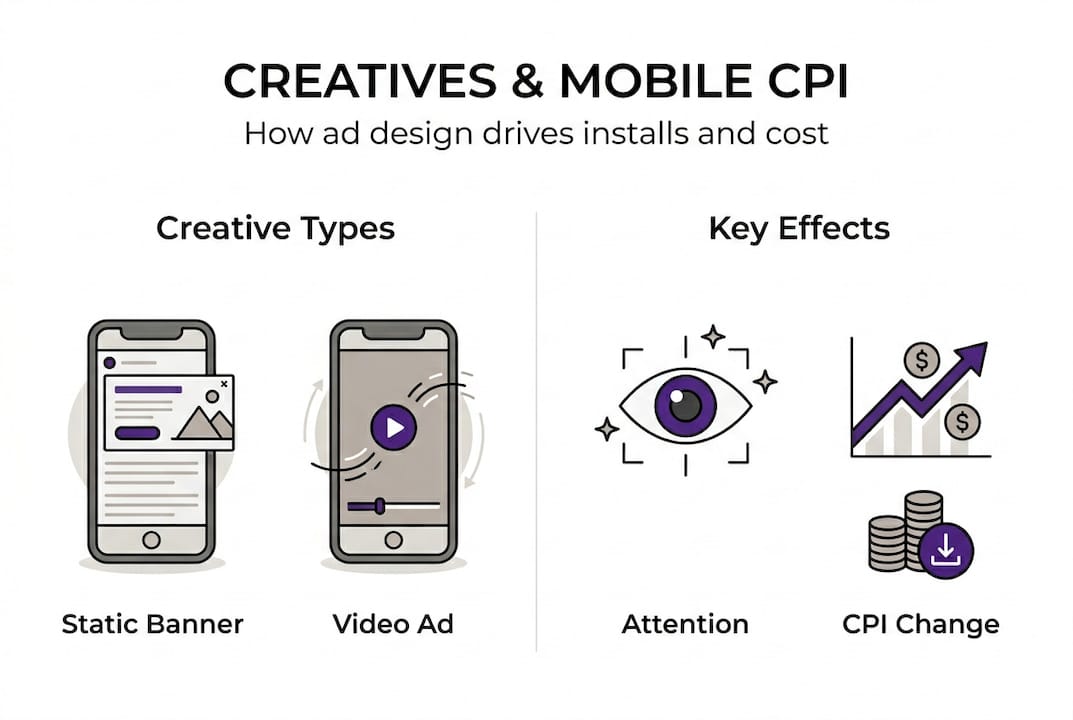
The relationship between creatives and CPI is direct. When a creative captures attention, communicates clearly, and resonates with the right audience, more users click and more users install. Because ad platforms charge based on impressions or clicks, a higher install rate relative to spend translates to a lower CPI. The inverse is equally true: weak creatives drain budget without generating proportional installs, which pushes CPI up.
Understanding the impact of ad creatives on your campaigns means looking beyond surface metrics. A useful way to frame this is by comparing typical CPI performance across different creative formats:
| Creative format | Typical CTR range | CPI impact | Best used for |
|---|---|---|---|
| Static banner | Low to moderate | Often highest CPI | Brand awareness, retargeting |
| Short-form video | Moderate to high | Moderate CPI | Broad audience acquisition |
| Interstitial (full-screen) | Moderate | Moderate CPI | Mid-funnel engagement |
| Playable / interactive | Very high | Can be lowest CPI | High-intent installs, quality users |
One important nuance here: a very high click-through rate (CTR) does not automatically mean a low CPI. On platforms such as AppLovin, CTR above 90% is sometimes driven by the mechanical nature of interactive formats rather than genuine creative quality. When users tap a playable ad simply to interact with it, that tap registers as a click whether or not the user intended to install.
This is why experienced UA teams measure performance using IPM (installs per mille, meaning installs per thousand impressions) and ROAS (return on ad spend, the revenue generated relative to what was spent on the ad). These metrics cut through the noise of inflated CTR and show you what is actually happening at the install and monetisation level. Prioritising testing creatives for UA with these downstream metrics in mind is what separates efficient campaigns from expensive ones.
Key points to carry forward:
- CPI is your efficiency barometer. It tells you how much each player costs to acquire.
- Creative format shapes user intent. Not all clicks carry equal weight.
- Measure IPM and ROAS, not just CTR, to understand true creative performance.
The mechanics: Why creative quality changes CPI
With CPI’s relevance established, we can now look at why the quality of your ad creative directly shapes these numbers. The process follows a clear sequence: a user sees your ad, they engage with it, they click, and they install. Each step in that chain is influenced by how well your creative performs.

At the first stage, attention capture, a creative must stand out in a feed or break through during an interstitial placement. Mobile users scroll and skip quickly. Creatives with strong visual contrast, motion, and a clear focal point hold attention longer. The longer a user engages, even by a fraction of a second, the more likely they are to process your game’s value.
At the second stage, engagement and interaction, the creative must communicate why this game is worth installing. This is where format differences become significant. A video ad can show gameplay, narrative, and excitement in fifteen seconds. A playable ad lets the user actually feel the core mechanic before they commit, which is a far more convincing pitch than any tagline.
At the third stage, the click, intent matters enormously. A user who clicks because they genuinely want to install behaves very differently from one who tapped accidentally or reflexively. High-impact ad creative tips consistently emphasise that the goal is not maximising clicks but maximising qualified clicks from users who are genuinely interested in your game.
At the final stage, the install, the quality of the experience the creative promised must match what the app store page and the game itself deliver. Creative-to-install rate (the proportion of clicks that result in installs) drops sharply when there is a mismatch between what the ad showed and what the user finds.
Three measurable effects of strong creative quality on campaign outcomes:
- Higher IPM. More installs per thousand impressions reduces wasted spend and brings CPI down directly.
- Lower cost-per-click. Platforms reward engaging creatives with better ad auction performance, meaning you pay less for each click.
- Better user quality. Users attracted by accurate, compelling creatives tend to retain longer and monetise better, which improves ROAS over time.
“The distinction between CTR and install-level metrics is fundamental. A creative generating 90% CTR on AppLovin is often achieving that mechanically through format interactivity. The real signal is whether those clicks convert to installs and whether those users spend. Teams that optimise for CTR alone are chasing a proxy metric that can actively mislead campaign decisions.” — AppLovin gaming creative analysis
Pro Tip: When reviewing creative performance in your creative testing for mobile games workflow, always pull D7 ROAS (return on ad spend measured seven days after install) alongside IPM. These two metrics together give you a clear picture of both acquisition efficiency and user quality from each creative variant.
Volume vs. discipline: Testing creatives to optimise CPI
Understanding the mechanics is only half the battle. How you deploy your creative strategy ultimately shifts your CPI. There is a commonly held view in mobile UA circles that producing more creatives increases the probability of finding a winner. That is partially true. More creative variants do give you more chances to identify high performers. But volume without structure is often counterproductive.
Fewer than 4% of marketers optimise their creatives systematically, even though nearly all of them acknowledge that creatives are important. What does the other 96% do? They produce assets based on instinct, replicate what looks like industry trends, and run everything simultaneously without clear hypotheses. When a creative underperforms, they cannot explain why. When one overperforms, they cannot reliably replicate it. This is the cost of undisciplined creative production.
Systematic creative testing is built on three pillars:
- Clear hypotheses. Before producing a creative, define what you are testing and what outcome you expect. For example: “A playable ad showing the first level mechanic will generate a higher IPM than a video montage of gameplay highlights because it gives users direct experience of the core loop.”
- Controlled variables. Change one element at a time, such as the call-to-action wording, the opening visual, or the gameplay scenario shown. Changing multiple elements simultaneously makes it impossible to isolate what caused performance differences.
- Documented outcomes. Record what you tested, what you measured, and what you learned. This learning log becomes a permanent asset that informs every future creative decision and gradually reduces your average CPI across campaigns.
Comparing undisciplined and systematic approaches makes the difference vivid:
| Dimension | Undisciplined testing | Systematic testing |
|---|---|---|
| Creative production | Based on instinct or trends | Based on documented hypotheses |
| Variables per test | Multiple, mixed | One at a time, controlled |
| Metrics tracked | CTR, sometimes CPI | IPM, D7 ROAS, install rate |
| Learnings retained | Rarely documented | Recorded and reused |
| CPI trajectory | Unpredictable | Consistently improving |
| Budget efficiency | Wasteful | Compounding returns |
The compounding effect of systematic testing is significant. Each test adds a data point to your understanding of what works for your specific audience, platform, and game genre. Over time, you develop creative frameworks that are proven rather than assumed, and your CPI decreases as a result of accumulated knowledge rather than lucky guesses. Your creative testing framework becomes a genuine competitive advantage.
Pro Tip: Create a simple shared document as your learning agenda. Before each test, record the hypothesis, the variable, and the expected outcome. After the test, record the actual result and a one-line conclusion. Even a basic spreadsheet built this way will transform your team’s ability to learn and improve systematically.
Real-world strategies: Using creative formats to drive CPI success
Once you have embraced systematic testing, the next step is applying creative innovation and format choice directly to your campaigns. Different formats suit different objectives, and the smartest UA teams cycle through them deliberately rather than defaulting to one approach.
Video ads remain the workhorses of mobile UA. They perform consistently across platforms, scale well, and can communicate complex gameplay in a short window. However, their effectiveness depends heavily on the first three seconds, where you must establish the game’s genre, visual style, and an element of excitement or curiosity. Videos that bury the hook lose viewers before the message lands.
Playable and interactive ads represent the most significant opportunity for CPI reduction in competitive gaming categories. Because users interact directly with a simplified version of the game mechanic, those who proceed to install are pre-qualified. They have already experienced something of the game and made a conscious choice to continue. The benefits of interactive creatives consistently show stronger install intent and better downstream retention metrics compared to passive formats.
Interstitials, full-screen ads that appear at natural breaks, work well for retargeting and mid-funnel users who have already shown some interest. Their high visibility compensates for lower novelty compared to playables.
Three creative experiments worth running in your next UA cycle:
- Playable vs. video head-to-head. Run the same campaign with a playable variant and a video variant, matched for audience and budget. Measure IPM and D7 ROAS. The results will tell you which format your audience responds to and at what cost.
- First-three-seconds test. Create two versions of the same video ad with different opening scenes. One shows a character in action, the other shows a gameplay challenge. Measure completion rate and IPM to find which hook engages your specific audience.
- Call-to-action copy variation. Test “Play now” versus “Install free” versus a genre-specific phrase such as “Start your adventure.” Small copy differences can shift install intent meaningfully.
On measurement: D7 ROAS as a metric is increasingly the standard for evaluating gaming creative success because it captures user quality, not just acquisition volume. A creative that drives a flood of low-value installs looks strong on CPI but weak on ROAS. The goal is to identify creatives that bring in users who engage, retain, and monetise. Exploring interactive ad content ideas that align with your game’s core loop gives you a practical starting point for generating those high-quality installs.
Why creative discipline outperforms luck — our view
Having explored what works in practice, here is our take on what separates top-performing user acquisition teams from the rest. The conventional wisdom in mobile UA encourages high creative volume: produce more, test more, and eventually you will find a winner. There is truth in that logic. But it misses something more important.
The teams with consistently low CPI are rarely the ones who produced the most creatives. They are the ones who learned the most from every creative they produced. There is a compounding effect to disciplined iteration that random volume cannot replicate. Each systematic test narrows the uncertainty about what works. Each documented outcome becomes institutional knowledge. Over six months, a team running structured experiments with thirty creatives will outperform a team that produced three hundred creatives without a clear framework.
Putting process before production is not a slow or cautious approach. It is the most efficient path to sustainable CPI reduction. The value of creative iteration is not in the individual tests but in the accumulation of learning those tests generate. Creative discipline is not glamorous, but it is what builds durable, compounding UA performance.
Take your UA creatives—and CPI—further
The insights in this article point clearly towards one practical conclusion: creative quality, format selection, and systematic testing are the levers that move CPI. To put these insights into practice and drive measurable results in your campaigns, the right creative toolkit matters. PlayableMaker is built specifically to help UA teams produce effective playable ads quickly and affordably, without requiring developer time or a large production budget. You can explore the full range of creative ad formats available to mobile marketers and find the combination that fits your game and your acquisition goals. Building better creatives, faster, is exactly where lower CPI begins.
Frequently asked questions
How do creatives lower cost-per-install (CPI) in mobile games?
Strong ad creatives improve user engagement and clearly communicate a game’s value, which increases the proportion of viewers who go on to install, raising install rate and reducing the effective cost per install.
Why is CTR not enough when measuring creative impact on CPI?
CTR can be artificially high on interactive formats due to format mechanics rather than genuine intent, meaning high CTR on AppLovin does not reliably predict lower CPI. Metrics like IPM and ROAS measure actual acquisition efficiency and user quality far more accurately.
What is systematic creative testing and why does it matter?
Systematic creative testing means running structured experiments with clear hypotheses and documented outcomes, which fewer than 4% of marketers currently practise. This approach consistently reduces CPI by accumulating actionable knowledge rather than relying on random production.
Which creative formats usually have the lowest CPI in mobile UA?
Playable and interactive ad formats typically generate the lowest CPI because users self-select before installing, meaning those who proceed are genuinely interested and far more likely to engage with the game after download.
Recommended
- Why Creatives Matter for Mobile Game Ad Success – playablemaker.com Why Creatives Matter for Mobile Game Ad Success
- Creative advertising trends for mobile gaming in 2026 – playablemaker.com Creative advertising trends for mobile gaming in 2026
- 2025 SocialPeta & Newsbreak Mobile Game Report: 9M+ Monthly Advertisers & the Rise of Weekly Creative Iteration – playablemaker.com 2025 SocialPeta & Newsbreak Mobile Game Report: 9M+ Monthly Advertisers & the Rise of Weekly Creative Iteration
- Why test creatives for mobile gaming user acquisition – playablemaker.com Why test creatives for mobile gaming user acquisition