
Most advice about mobile game creative testing skips one crucial detail: defining clear objectives and tracking the right metrics. In a competitive market where british and European developers are launching thousands of new titles yearly, understanding what truly drives ad engagement sets your game apart. This guide reveals how to set actionable KPIs and navigate each stage of creative testing, helping you make data driven decisions that boost results from the start.
Table of Contents
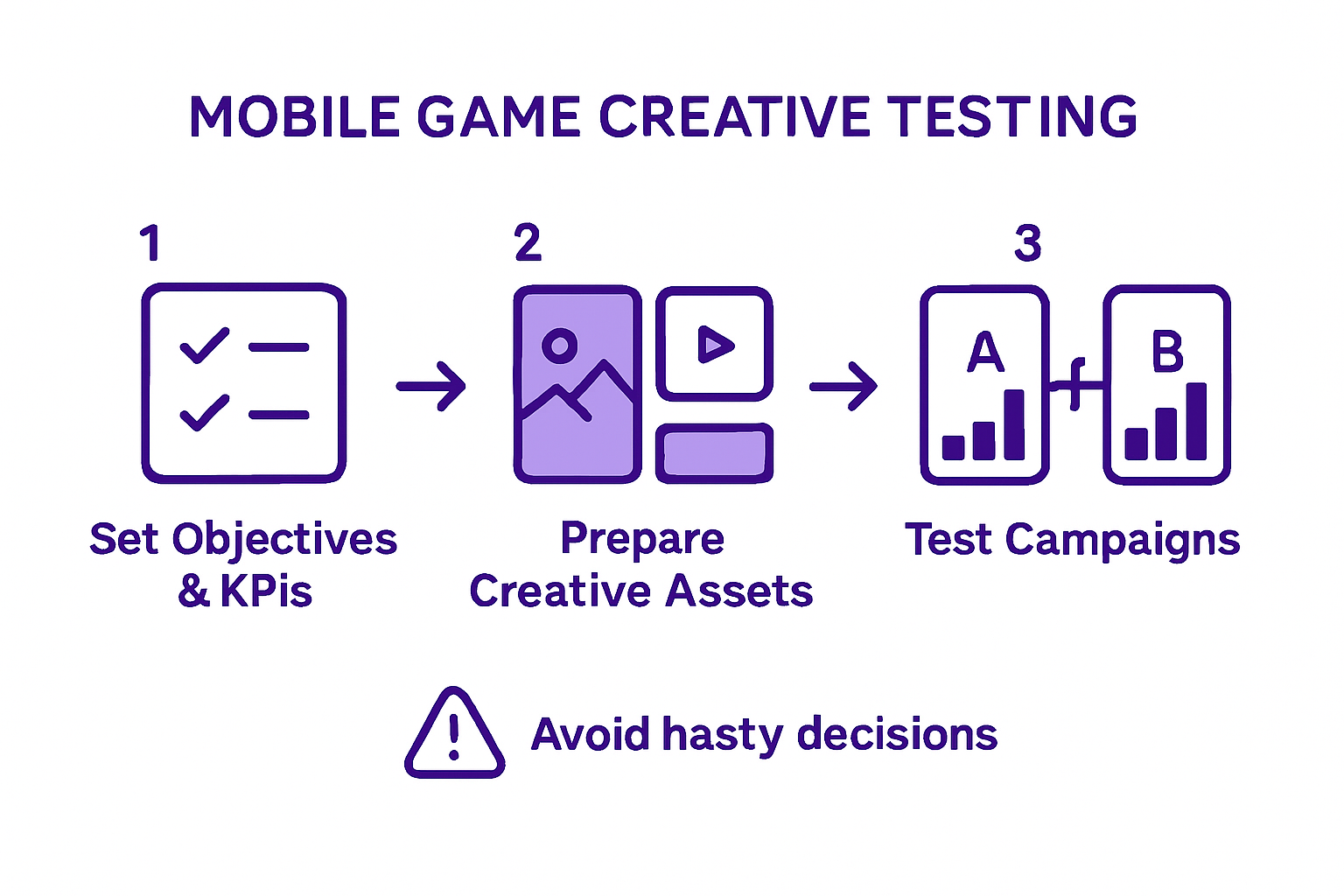
- Stage 1: Define Creative Testing Objectives And KPIs
- Stage 2: Select And Prepare Mobile Game Creative Assets
- Stage 3: Set Up Scalable Test Campaigns
- Stage 4: Launch And Monitor Initial Ad Tests
- Stage 5: Analyse Results And Identify Winning Creatives
- Stage 6: Optimise And Iterate Based On Performance Insights
Quick Summary
| Key Point | Explanation |
|---|---|
| 1. Establish clear objectives and KPIs | Define 2-3 core KPIs that align with marketing strategies to measure creative performance effectively. |
| 2. Select targeted creative assets | Choose visual elements that resonate with your audience and convey your game’s essence quickly and effectively. |
| 3. Set up structured test campaigns | Implement a systematic testing framework to compare variations while maintaining statistical significance in results. |
| 4. Monitor performance in real-time | Use tracking systems to gather key metrics, allowing for prompt adjustments based on test results. |
| 5. Iteratively optimise based on insights | Continuously refine your creative strategies by analysing data patterns and improving ad elements for better engagement. |
Stage 1: Define creative testing objectives and KPIs
Successful creative testing for mobile games starts with clarity about your testing goals and measurable performance indicators. Your first step involves establishing precise objectives that align with broader marketing and game growth strategies.
Begin by identifying specific metrics that genuinely reflect your game’s creative performance. Performance metrics can include key indicators like average watch time, click through rate, and return on ad spend. Consider which measurements will provide meaningful insights into your creative variations. For mobile game advertising, typical objectives might involve reducing cost per acquisition, improving user engagement rates, or increasing conversion percentages from ad view to game download.
When defining your KPIs, focus on metrics that directly connect creative elements to user behaviour. This means moving beyond surface level measurements and drilling into how specific creative choices influence player interactions. Are users watching more of your ad when you change the character design? Does a different narrative approach increase download probability? Your KPIs should answer these strategic questions.
Warning: Avoid setting too many competing objectives simultaneously. Prioritise 2-3 core KPIs that can provide clear, actionable insights about your mobile game’s creative performance. This targeted approach ensures more reliable and interpretable test results.
With your objectives and KPIs established, you are now prepared to move into the actual creative testing phase where these carefully defined metrics will guide your experimental strategy.
Stage 2: Select and prepare mobile game creative assets
Creative asset selection represents a critical phase in mobile game advertising where your visual storytelling begins. This stage requires strategic thinking about how your game’s unique characteristics can be effectively communicated through compelling visual elements.
Start by understanding your target demographic and the core visual language of your game. Intelligent approaches to generating graphical game assets involve systematic research and targeted content generation that resonates with your potential players. Consider exploring multiple creative variations that highlight different aspects of gameplay such as character design, action sequences, or unique game mechanics. Each creative asset should serve as a miniature narrative that instantly communicates the excitement and engagement your mobile game offers.
When preparing your assets, focus on technical and aesthetic considerations specific to mobile platforms. This means creating visuals that are crisp, easily comprehensible at smaller screen sizes, and optimised for quick loading. Pay attention to resolution, colour contrast, and visual complexity to ensure your creative assets look stunning across various mobile devices.

Warning: Avoid cluttered or overly complicated visuals that might confuse potential players. Your creative assets should communicate your game’s core experience within seconds of viewing.
With your carefully selected and prepared creative assets, you are now ready to move forward to the next stage of creative testing and implementation.
Stage 3: Set up scalable test campaigns
Setting up scalable test campaigns requires a strategic approach that allows you to efficiently evaluate multiple creative variations while maintaining precise control over your experimental parameters. This stage transforms your carefully selected creative assets into a robust testing framework that can generate meaningful insights about player engagement.
Effective in game advertising requires defining clear objectives and leveraging appropriate testing methodologies that support comprehensive audience understanding. Begin by establishing a structured testing environment where you can systematically compare different creative assets across multiple audience segments. This means configuring your advertising platforms to distribute your creative variations randomly and evenly, ensuring statistically significant results that reflect genuine player preferences.
Consider implementing a phased testing approach that gradually expands your campaign reach. Start with smaller audience segments to validate initial hypotheses, then progressively increase your sample size as you gain confidence in your creative performance. Pay close attention to key metrics such as click through rates, conversion percentages, and user retention to understand how different creative elements influence player behaviour.
Warning: Avoid the temptation to make hasty decisions based on limited data. Scalable testing requires patience and a methodical approach that allows sufficient time and audience exposure to generate reliable insights.
With your scalable test campaigns now established, you are prepared to analyse and interpret the rich performance data that will guide your future creative strategies.
Stage 4: Launch and monitor initial ad tests
Launching your initial ad tests marks a critical moment in your creative testing strategy where theoretical planning transforms into actionable insights. This stage requires meticulous attention to detail and a systematic approach to understanding how your creative assets perform in real world advertising environments.
Monitoring key performance indicators becomes essential for evaluating the effectiveness of your mobile game advertising campaigns. Begin by establishing a comprehensive tracking system that captures nuanced metrics such as average watch time, click through rates, cost per acquisition, and return on ad spend. These indicators will provide a holistic view of how different creative variations resonate with your target audience.
Implement a real time monitoring approach that allows you to quickly identify trends and anomalies in your test results. Set up automated reporting dashboards that provide immediate visibility into your campaign performance, enabling you to make rapid adjustments as needed. Pay special attention to how different creative elements impact user engagement metrics such as view duration, interaction rates, and conversion probabilities.
Warning: Resist the impulse to prematurely terminate tests based on initial impressions. Statistical significance requires sufficient data volume and consistent performance across multiple audience segments.
With your initial ad tests now launched and carefully monitored, you are positioned to gather the empirical evidence needed to refine your mobile game advertising strategy.
Stage 5: Analyse results and identify winning creatives
Analysing your ad test results represents a pivotal moment in your creative testing strategy where data transforms into actionable marketing intelligence. This stage requires a systematic and nuanced approach to understanding which creative variations genuinely resonate with your target audience.
Effective ad performance analysis demands rigorous testing and learning across different audience segments. Begin by conducting a comprehensive statistical evaluation of your creative variations. Look beyond surface level metrics and dive deep into performance indicators such as engagement rates, conversion probabilities, and user retention. Compare each creative variant across multiple dimensions to understand not just which creative performs best, but why it succeeds.
Establish a structured analysis framework that accounts for statistical significance and eliminates potential bias. Use advanced statistical techniques like confidence interval calculations and hypothesis testing to ensure your conclusions are robust. Pay particular attention to how different creative elements such as colour schemes, character designs, and narrative approaches impact overall performance across various audience segments.
Warning: Statistical validity requires patience. Avoid making premature conclusions based on limited data or short term performance fluctuations. Ensure your sample size is sufficiently large and diverse to generate meaningful insights.
With your creative performance thoroughly analysed, you are now prepared to distil your findings into a strategic roadmap for future mobile game advertising efforts.
Stage 6: Optimise and iterate based on performance insights
Optimising your mobile game advertising strategy requires a dynamic and responsive approach that transforms raw performance data into strategic creative refinements. This stage is about intelligently translating your analytical findings into actionable creative improvements.
Effective ad campaign optimization demands continuous testing and learning across diverse audience segments. Begin by identifying the most significant performance variations among your creative assets. Look for consistent patterns that reveal which visual elements, narrative approaches, or design strategies generate the most compelling user engagement. This might involve examining how specific character designs, colour palettes, or gameplay snippets correlate with higher conversion rates and user retention.
Develop an iterative optimization framework that systematically incorporates your performance insights. Create a structured process where each creative test informs subsequent iterations, gradually refining your advertising approach. This means not just replicating successful elements but understanding the underlying psychological and design principles that make certain creative variations more effective.
Warning: Optimization is an ongoing process. Avoid becoming overly attached to any single creative strategy. The mobile gaming market evolves rapidly, and what works today might become less effective tomorrow.
With your optimisation strategy now established, you are prepared to continually adapt and improve your mobile game advertising creative approach.
Accelerate Your Mobile Game Creative Testing with No-Code Playable Ads
The article highlights the challenges of defining clear testing objectives, preparing compelling creative assets, and setting up scalable campaigns to truly optimise ad performance for mobile games. Many developers face obstacles such as lengthy development times, high costs, and complex technical demands when trying to implement effective playable ads as part of their creative testing strategy. These pain points directly affect your ability to iterate fast, analyse meaningful KPIs, and confidently identify winning creatives.
At PlayableMaker, we understand that creative testing should be fast, budget-friendly, and accessible to all teams without relying heavily on your developers’ time or company resources. Our no-code solution allows you to build playable, interactive ads quickly so you can focus on refining your creative approach based on real user behaviour insights. Whether you are launching initial ad tests or looking to optimise continuously, our platform supports every stage of your creative testing process with ease.
Explore our resources in the Uncategorized Archives for insights on creative strategies and take advantage of detailed guidance in the Help Archives to get started smoothly. Ready to transform how you create and test mobile game ads Today? Visit PlayableMaker to begin building high-impact playable ads fastest with no coding required.
Frequently Asked Questions
What are the key objectives for creative testing in mobile games?
To achieve effective creative testing in mobile games, focus on specific objectives such as reducing cost per acquisition, improving user engagement rates, or increasing conversion percentages. Define 2-3 core key performance indicators (KPIs) that can provide actionable insights, allowing you to prioritise your testing efforts effectively.
How can I select the right creative assets for mobile game advertising?
Start by understanding your target demographic and the unique aspects of your game that should be highlighted. Create multiple creative variations that showcase different gameplay elements and ensure that they are visually appealing and optimised for mobile platforms, so they deliver clear messages immediately.
What steps should I take to set up scalable test campaigns for my mobile game?
Begin by establishing a structured environment to compare different creative assets across various audience segments. Use random and even distribution of your creative variations across a manageable sample size, gradually increasing it as confidence in your data grows to ensure statistically valid results.
How do I monitor the performance of my initial ad tests?
Implement a comprehensive tracking system to capture key performance indicators like average watch time and click-through rates. Set up real-time monitoring reports to quickly identify trends and make adjustments as necessary to improve overall campaign performance.
What should I focus on when analysing the results of my ad tests?
Conduct a thorough statistical evaluation of your creative variations, paying close attention to engagement rates and user retention metrics. Establish an analysis framework that eliminates bias and allows for statistically significant conclusions based on a sufficiently large sample size from various audience segments.
How can I optimise my mobile game advertising based on performance insights?
Identify the creative elements that consistently drive user engagement and develop an iterative optimisation process. Actively refine your advertising strategies based on data-driven insights, ensuring that you adapt your approach regularly to stay relevant in the constantly evolving mobile gaming market.
Recommended
- 7 Essential Steps for Effective Mobile Ad A/B Tests – playablemaker.com 7 Essential Steps for Effective Mobile Ad A/B Tests
- What Is AB Testing? Complete Guide for Mobile Gaming – playablemaker.com What Is AB Testing? Complete Guide for Mobile Gaming
- What Is an AB Test? Complete Guide for Mobile Marketing – playablemaker.com What Is an AB Test? Complete Guide for Mobile Marketing
- Ad A/B Testing Guide for Higher Mobile Game ROI – playablemaker.com Ad A/B Testing Guide for Higher Mobile Game ROI