
Global gaming UA spend hit $25B in 2025, and creative output has scaled alongside it at a pace few teams anticipated. Yet rising volume alone does not guarantee rising results. Many user acquisition specialists are finding that more creatives can actually accelerate audience fatigue rather than cure it. This guide examines the most significant creative advertising trends shaping mobile gaming in 2026, from AI-driven production cycles to format selection and refresh strategies. You will leave with a clear framework for building playable ads that genuinely engage users, without burning through your budget or your team’s bandwidth.
Table of Contents
- Current creative advertising landscape in mobile gaming
- The AI effect: Opportunities and risks for creative teams
- Creative refresh strategies: What works in 2026
- Choosing the right format: Playables vs video and beyond
- Practical playbook: Cost-effective, high-impact creative strategies
- Why chasing creative volume misses the mark
- Take your next step with smarter playable ads
- Frequently asked questions
Key Takeaways
| Point | Details |
|---|---|
| Creative output isn’t everything | High volume doesn’t guarantee results—focus on relevance and freshness for real impact. |
| AI can accelerate, but not replace | Efficiency from AI is best paired with human-led design to maintain engagement and avoid fatigue. |
| Frequent refreshing boosts results | Structured creative cycles and rapid testing improve both stability and performance in UA campaigns. |
| Choose formats by goal | Playables lead in user acquisition, but mixing formats like video enhances overall ROI. |
| Action beats volume | Leverage tactical strategies, not just more creatives, for cost-effective and sustainable growth. |
Current creative advertising landscape in mobile gaming
The numbers are striking. Top advertisers now produce between 2,400 and 2,600 creatives per quarter, a figure that would have seemed implausible just three years ago. Understanding the history of UA and playable ads helps contextualise just how dramatically the landscape has shifted. What was once a deliberate, resource-intensive process has become a high-velocity production challenge.
“Volume without strategy is just noise. The marketers winning in 2026 are those who treat creative output as a system, not a sprint.”
The table below illustrates how creative production benchmarks have evolved:
| Metric | 2023 benchmark | 2026 benchmark |
|---|---|---|
| Creatives per quarter (top advertisers) | ~800 | 2,400 to 2,600 |
| Monthly new creative share | ~43% | 58% |
| YoY growth in creative output | ~8% | 14.6% |
| UA spend (global gaming) | ~$18B | $25B |
Several forces are driving this shift:
- AI-assisted production tools have lowered the technical barrier to generating new ad variants
- Platform algorithm changes reward fresh creatives with lower CPMs, incentivising rapid cycling
- Audience fragmentation means a single creative rarely performs uniformly across segments
- Competitive pressure pushes teams to outpace rivals through sheer output
The challenge is that scaling output without scaling strategy leads to diminishing returns. Exploring the full range of creative ad formats available to mobile marketers reveals that format diversity, not just volume, is a key driver of sustained performance. Teams that treat every new creative as an experiment, rather than a deliverable, tend to extract far more value from their spend.
The AI effect: Opportunities and risks for creative teams
Artificial intelligence has fundamentally changed the economics of creative production. Tasks that once required a designer, a developer, and several days of iteration can now be prototyped in hours. This acceleration is genuinely useful, but it carries a significant caveat: AI accelerates production but increases creative fatigue, with weekly refreshes now recommended to maintain performance.
Understanding AI’s role in creative ideation for mobile campaigns reveals both the opportunity and the risk. AI excels at generating variations, resizing assets, and testing copy permutations at scale. It struggles with emotional nuance, cultural context, and the kind of interactive logic that makes a playable ad genuinely satisfying to engage with.
| Dimension | AI-generated creatives | Human-directed creatives |
|---|---|---|
| Production speed | Very fast | Slower |
| Cost per variant | Low | Higher |
| Emotional resonance | Variable | Stronger |
| Playable logic quality | Inconsistent | More reliable |
| Fatigue risk | Higher | Lower |
| Best use case | Volume testing | Hero creatives |
The practical implication is clear. AI is best deployed for rapid prototyping and variant generation, while human judgement should guide the final creative direction, particularly for playable ads where the interactive experience must feel intentional and rewarding.

Pro Tip: Use AI to generate five to ten rough variants quickly, then apply human review to select and refine the two or three with genuine engagement potential. This hybrid approach reduces wasted spend and keeps refresh cycles sustainable.
Teams that lean entirely on AI risk producing creatives that look superficially different but feel functionally identical to users. Knowing how to repurpose ad creatives intelligently, rather than simply regenerating them, is a skill that separates high-performing teams from those chasing volume for its own sake.
Creative refresh strategies: What works in 2026
Refresh cadence has become one of the most debated topics in mobile UA. The data is fairly clear: 58% of creatives are new each month, representing a 14.6% year-on-year increase, and structured refresh cycles can improve performance stability by up to 30%. That is a meaningful gain for teams managing significant ad budgets.
But frequency alone is not the answer. Unstructured refreshing, where new creatives are pushed out reactively rather than systematically, tends to create volatility rather than stability. A structured test-and-learn cycle is far more effective.
Here is a practical approach to building one:
- Establish a baseline. Identify your current top-performing creatives and document what makes them work: hook style, mechanic, visual language, or call to action.
- Define your refresh trigger. Set a clear performance threshold, such as a drop in CTR or IPM, that signals when a creative needs replacing rather than waiting for it to fail completely.
- Build modular assets. Design creatives with interchangeable components: backgrounds, characters, UI elements, and end cards. This allows rapid recombination without starting from scratch.
- Run structured A/B tests. Test one variable at a time to isolate what is actually driving performance change.
- Review and retire systematically. Schedule weekly reviews to retire underperformers and promote winners to broader spend.
Understanding why testing playable ads rigorously matters becomes obvious when you see how quickly audience response can shift. A creative that performs well in week one may plateau by week three, not because the ad is poor, but because the audience has already seen it.
Pro Tip: Build modular creative assets from the outset. A library of interchangeable visual and interactive components dramatically reduces the time and cost of each refresh cycle.
Choosing the right format: Playables vs video and beyond
Format selection is one of the highest-leverage decisions a UA team makes. The evidence is fairly consistent: playables drive installs most effectively, while video can perform better for D30 ROAS in certain verticals, particularly mid-core and strategy genres where longer narrative hooks build stronger intent.
“The question is not which format is best. It is which format is best for your specific goal, your genre, and your current funnel stage.”
A direct comparison helps clarify the decision:
| Format | Best for | Typical strength | Typical weakness |
|---|---|---|---|
| Playable ads | Installs, engagement | High interaction, low fraud | Higher production cost |
| Video (rewarded) | Retention, ROAS | Broad reach, narrative | Passive, higher skip rates |
| Static/banner | Retargeting | Low cost, fast to produce | Low engagement |
| Hybrid (video + playable) | Awareness to install | Best of both | Complex to produce |
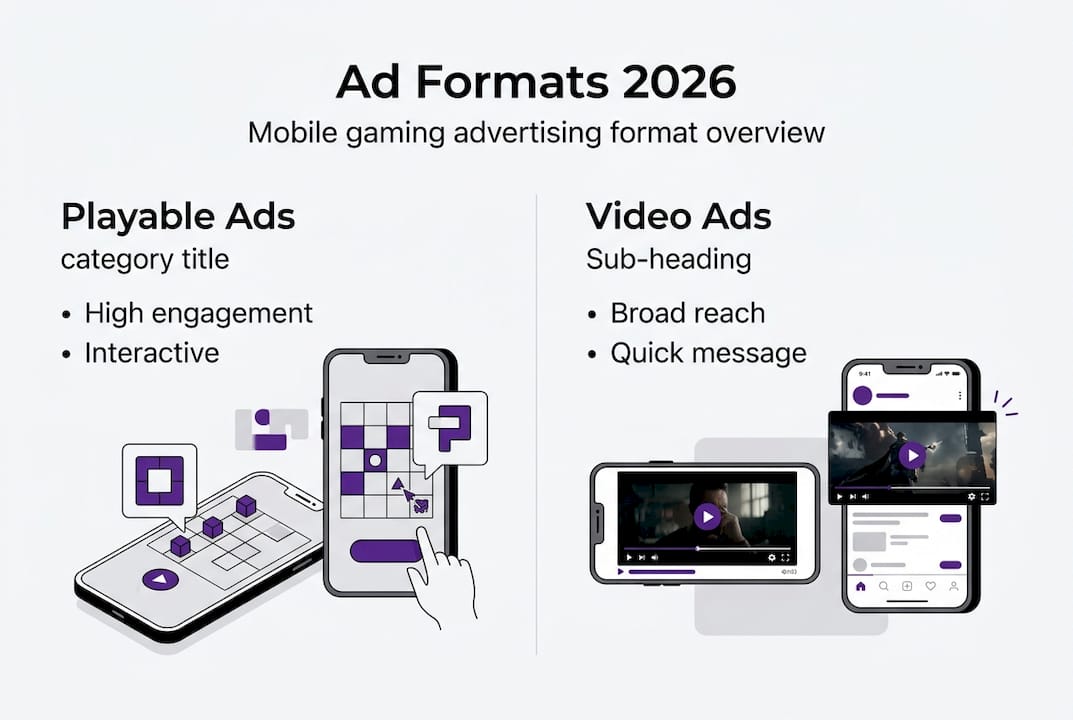
Exploring the differences between video and playable ads in depth reveals that the two formats are often more complementary than competitive. The benefits of playable ads for acquisition are well-documented, but they do not replace video for every objective.
Key considerations when selecting your format mix:
- Installs as primary KPI: Prioritise playables, particularly for casual and hyper-casual genres
- ROAS or LTV focus: Test rewarded video alongside playables, especially for mid-core titles
- Retargeting campaigns: Static and short-form video are often more cost-efficient
- New market entry: Hybrid formats can build awareness while driving direct action
Understanding the full spectrum of types of ad experiences available helps teams avoid defaulting to a single format out of habit rather than evidence.
Practical playbook: Cost-effective, high-impact creative strategies
Knowing the trends is one thing. Translating them into action within a real budget is another. Structured refresh and data-driven cycles help marketers outperform peers on stability by up to 30%, but only when applied consistently rather than sporadically.
Here are three strategies that consistently deliver results without requiring enterprise-level resources:
- Modular creative architecture. Design your playable and video assets as systems of interchangeable parts. A single core mechanic can yield dozens of testable variants by swapping visual themes, characters, or end-card copy. This approach dramatically reduces per-variant cost while maintaining creative diversity.
- Performance-gated budget allocation. Rather than distributing spend evenly across all active creatives, concentrate budget on proven performers and use a small reserve, around 15 to 20% of total spend, for testing new variants. This protects revenue while enabling continuous experimentation.
- Fatigue monitoring as a standard process. Track frequency metrics and engagement decay curves for every active creative. Set automated alerts when a creative crosses your defined fatigue threshold so you can act before performance drops significantly.
Pro Tip: Use performance data to retire underperformers quickly and redeploy that budget to fresh variants. Holding onto a declining creative out of sunk-cost thinking is one of the most common and costly mistakes in mobile UA.
Measuring playable ad effectiveness with precision is essential to this process. Without clear metrics tied to specific creative decisions, it is impossible to know whether a refresh improved performance or whether external factors were responsible.
Why chasing creative volume misses the mark
There is a persistent assumption in mobile UA that more creatives equal better results. The logic seems sound: more variants mean more chances to find a winner. But this framing misses something important. Users are not passive recipients of advertising. They develop recognition, and then resistance, quickly.
Campaigns anchored in authentic interactivity and agile testing consistently outperform brute-force creative pushes. The reason is straightforward. A genuinely engaging playable ad, one where the mechanic feels satisfying and the experience feels honest about the game it represents, builds a different kind of user intent than a video ad that simply looks appealing.
The uncomfortable truth is that the psychology behind playable ad effectiveness is often underutilised. Teams invest in volume and refresh cadence but neglect the quality of the interactive experience itself. A poorly designed playable refreshed weekly will still underperform a well-designed one refreshed monthly.
Focus on clarity of mechanic, honesty in representation, and tight feedback loops between creative performance and design decisions. Volume is a tool, not a strategy.
Take your next step with smarter playable ads
The trends are clear, and the strategies are within reach. What separates teams that act on this knowledge from those that do not is usually access to the right tools and resources. Understanding what makes playable ads effective is the foundation, but execution is where results are made.
PlayableMaker is built specifically for UA teams and mobile marketers who need to produce high-quality playable ads without the development overhead. The Playable Builder tool lets you create interactive ad experiences using a drag-and-drop interface, no coding required. If you are ready to move from insight to execution, start building with PlayableMaker and see how quickly a smarter creative process takes shape.
Frequently asked questions
How frequently should I refresh mobile gaming ad creatives?
Aim for weekly or monthly refreshes based on performance signals. 58% of creatives are new monthly, with structured cycles improving stability by up to 30%, making cadence a critical lever rather than an afterthought.
Are AI-generated ad creatives as effective as human-designed ones?
AI speeds up production significantly but raises the risk of creative fatigue. AI accelerates output but increases fatigue, so combining AI-generated volume with human creative direction delivers the strongest results.
Should I prioritise playable ads or video for user acquisition?
Playables typically drive stronger install rates, while video may yield better D30 ROAS in certain genres. Playables best serve install goals, whereas video suits retention-focused objectives, making a mixed-format strategy the most reliable approach.
What are the biggest pitfalls in creative advertising for gaming?
The main risks are creative fatigue from over-reliance on AI, unstructured refresh cycles, and neglecting the quality of the interactive experience. Structured refresh cycles boost stability by up to 30%, underscoring the value of systematic rather than reactive creative management.
Recommended
- 2025 SocialPeta & Newsbreak Mobile Game Report: 9M+ Monthly Advertisers & the Rise of Weekly Creative Iteration – playablemaker.com 2025 SocialPeta & Newsbreak Mobile Game Report: 9M+ Monthly Advertisers & the Rise of Weekly Creative Iteration
- Ad tech trends 2026: create playable ads fast and affordably – playablemaker.com Ad tech trends 2026: create playable ads fast and affordably
- Master Mobile Ad Trend Analysis 2025 for Playable Ads Success – playablemaker.com Master Mobile Ad Trend Analysis 2025 for Playable Ads Success
- 7 Essential Mobile Game Ad Trends to Know for 2025 – playablemaker.com 7 Essential Mobile Game Ad Trends to Know for 2025
- How to Master Immersive Tech Innovation 2026: 5 Surprising Secrets – Amlogy AR|VR