
TL;DR:
- Playable ad ROI depends on creative quality, strategic alignment, and user lifetime value.
- Effective playables showcase core mechanics to reduce churn and attract high-LTV users.
- Success requires ongoing testing, creative iteration, and honest reflection of the game experience.
Playable ads have earned a reputation as a high-performing format in mobile game marketing, but that reputation comes with an important caveat. Not every playable ad delivers strong returns. The reality is that ROI depends heavily on creative quality, strategic alignment, and how well the ad reflects the actual game experience. Many user acquisition teams adopt playables because competitors are doing so, only to find results fall short of expectations. This guide breaks down what ROI truly means for playable ads, which metrics matter most, where campaigns commonly fail, and what actionable steps you can take to improve performance.
Table of Contents
- Understanding playable ad ROI: definitions and metrics
- The mechanics behind playable ads: how they impact user quality and retention
- Pitfalls and challenges: when playable ad ROI fails
- Proven strategies to maximise your playable ad ROI
- Why experts still get playable ad ROI wrong
- Ready to improve your playable ad ROI?
- Frequently asked questions
Key Takeaways
| Point | Details |
|---|---|
| Focus on user quality | Playable ads excel when attracting self-selected, high-value users who retain longer in your game. |
| ROI needs strategic alignment | A playable ad must match your game’s core experience to produce true ROI, not just installs. |
| Optimisation beats trend adoption | Manually optimising and iterating your creatives drives better results than simply following the latest UA trends. |
| Beware of hidden costs | Production complexity and misaligned playables can erode your ROI if not properly managed from the start. |
| Leverage modern tools | AI and no-code platforms can streamline creative iteration, helping you keep pace with top-performing competitors. |
Understanding playable ad ROI: definitions and metrics
ROI in the context of playable ads is not simply about the number of installs generated. It is the relationship between the lifetime value (LTV) of acquired users and the total cost of running the campaign, including ad spend and creative production. A campaign that drives thousands of installs from low-intent users can still produce a negative return if those users churn within days.
The metrics that matter most for evaluating playable ad ROI include:
- Cost per install (CPI): The direct cost of acquiring each new user.
- Lifetime value (LTV): The projected revenue a user generates over their time in the game.
- Retention rate: The percentage of users still active at day 1, day 7, and day 30.
- Engagement rate: How long users interact with the playable ad before converting.
- Ad spend efficiency: The ratio of total revenue generated to total campaign cost.
To illustrate, consider a simplified calculation. If your campaign spends £10,000 and acquires 2,000 users at a CPI of £5, but those users have an average LTV of £8, your gross return is £16,000. After deducting the £10,000 ad spend, you have a positive return of £6,000. However, if creative production cost an additional £4,000, your actual net ROI narrows considerably.
| Metric | Value |
|---|---|
| Total ad spend | £10,000 |
| Creative production cost | £4,000 |
| Users acquired | 2,000 |
| Average LTV per user | £8 |
| Gross revenue | £16,000 |
| Net ROI | £2,000 |
One of the most valuable properties of playable ads is what industry professionals call self-selection. Users who complete the interactive experience and then choose to install are demonstrating genuine intent. This self-selection mechanism boosts LTV and retention over volume, meaning fewer but better users. For a deeper look at how to track these outcomes, measuring playable ad effectiveness is a useful starting point.
Pro Tip: If you are measuring playable ad ROI by installs alone, you are missing the point entirely. A lower install volume with higher LTV users almost always outperforms a high-volume, low-quality campaign over a 30-day window. Shift your reporting to LTV-weighted ROI as your primary benchmark.
With the basics outlined, it is crucial to see how playable ads truly function in mobile game marketing and the challenges that affect ROI.
The mechanics behind playable ads: how they impact user quality and retention
Playable ads function as a pre-qualification tool within the user acquisition funnel. Before a user ever installs your game, they have already experienced a condensed version of its core mechanics. This is fundamentally different from video ads or static banners, where the user has no hands-on context before committing to a download.

The play-before-you-install approach directly reduces post-install churn. When users arrive already familiar with the gameplay loop, they are less likely to be surprised or disappointed by what they find. This translates into measurably better day-1 and day-7 retention rates, which are critical signals for algorithmic optimisation on most ad networks.
Here is how playable ads typically fit within the broader UA funnel:
- Awareness: A user encounters the playable ad within a host app or network placement.
- Engagement: The user interacts with the mini-game, experiencing the core loop firsthand.
- Self-selection: Only users who enjoy the experience proceed to the install call-to-action.
- Conversion: The motivated user installs and is more likely to engage deeply from day one.
- Retention: Higher baseline familiarity reduces early churn, improving LTV signals.
As noted in The Playable Bible, playable ads can be integrated with video funnels and enhanced through accelerated iteration with AI or no-code tools. This hybrid approach, pairing a short video hook with an interactive end-card, has become a standard tactic for studios seeking to balance reach with quality.
“Playable ROI optimisation prioritises quality users via self-selection, boosting LTV and retention.” This principle should sit at the centre of every playable ad brief your team writes.
For teams looking to go further, maximising retention with playables covers expert-level tactics, and why playables convert better explains the psychological mechanisms at work.
Pro Tip: Balance creative ambition with baseline engagement. An overly complex mini-game may impress internally but confuse users within the five-second window you typically have. Prioritise clarity and instant fun over technical sophistication.
Now, having grasped the mechanics and user impact of playables, let us address the risks and challenges that even seasoned marketers overlook.
Pitfalls and challenges: when playable ad ROI fails
Playable ads are not immune to failure. In fact, several specific conditions reliably produce poor ROI, and understanding them is just as important as knowing best practices.
The most common pitfalls include:
- Production cost overruns: Complex creatives that require significant developer time can erode margins before the campaign even launches.
- Creative misalignment: Ads that showcase mechanics not present in the actual game mislead users and increase post-install churn.
- Poor UA strategy integration: Running playables in isolation, without connecting them to broader funnel data, limits optimisation opportunities.
- Scaling difficulties: Networks such as Unity and ironSource have specific technical requirements and audience dynamics that affect how playables perform at scale.
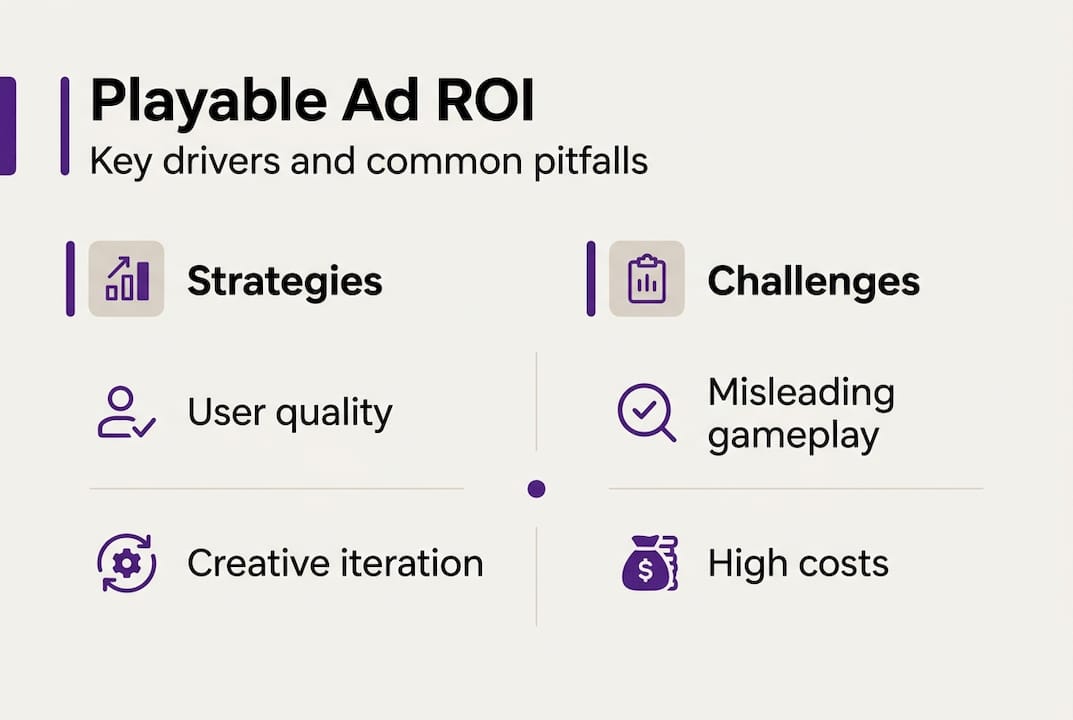
Misleading gameplay is a particularly damaging issue. When the ad experience does not match the installed product, users feel deceived. This damages brand trust and produces negative reviews, both of which compound over time. High production costs for complex creatives, misleading gameplay, and scaling issues on major networks are well-documented edge cases that teams frequently underestimate.
| Scenario | Risk level | Primary impact |
|---|---|---|
| Misleading gameplay | High | Churn, negative reviews |
| Overproduced creative | Medium | Budget overrun |
| Poor network fit | Medium | Low delivery, wasted spend |
| No core-loop alignment | High | Low LTV, poor retention |
| No iteration process | Medium | Stagnant performance |
There is also a cultural dimension worth acknowledging. Some developers are sceptical of playable ads when they are pushed by account managers without genuine core-loop alignment. This scepticism is often justified. The format works best when it emerges from a clear creative strategy, not from network recommendations alone.
For teams looking to address these issues proactively, optimising playable ad creatives and budgeting for playable ads in 2026 offer practical frameworks.
Having covered what can go wrong, the next focus is practical strategies and tools for overcoming these obstacles and improving playable ad ROI.
Proven strategies to maximise your playable ad ROI
Improving ROI from playable ads requires a structured approach to both creative development and campaign management. Here is a step-by-step framework that works in practice.
- Audit your core loop first. Before building any playable, identify the single mechanic that makes your game enjoyable. The ad should showcase that mechanic, nothing else.
- Build multiple creative variants. Do not launch with one version. Produce three to five variants that differ in difficulty, visual style, or call-to-action placement.
- Run structured A/B tests. Test one variable at a time. Changing multiple elements simultaneously makes it impossible to identify what is driving performance differences.
- Integrate with your video funnel. Use short video hooks to drive awareness, then use the playable as an interactive end-card. This hybrid format consistently outperforms standalone playables in engagement metrics.
- Iterate rapidly using no-code tools. AI and no-code platforms reduce iteration time and help scale effective creatives without requiring developer involvement at every stage.
- Monitor LTV-weighted ROI weekly. Do not wait for a campaign to end before evaluating performance. Early LTV signals at day 3 and day 7 are strong predictors of long-term returns.
Critically, manual optimisation is vital for ROI. Playables are not a plug-and-play solution. Teams that treat them as a set-and-forget format consistently underperform compared to those who actively manage creative rotation and audience segmentation.
Pro Tip: Before launching your next playable ad, ask these questions. Does this ad reflect the actual game experience? Have we tested at least three creative variants? Do we have a plan to iterate within the first two weeks? If the answer to any of these is no, pause and address it first.
For broader context on how playables fit within a full acquisition strategy, UA ad strategies for mobile games and repurposing ad creatives are worth exploring.
Why experts still get playable ad ROI wrong
There is an uncomfortable pattern in mobile game marketing. When a format performs well for hypercasual titles, the entire industry rushes to adopt it, regardless of genre fit. Playable ads are no exception. Market pressure and a degree of FOMO push studios to invest in playables even when their game’s core loop does not translate naturally into a short interactive format.
The contrasting reality is that playables are essential for hypercasual scaling but their effectiveness depends entirely on manual optimisation and genuine core-loop alignment. Studios that see strong ROI from playables are not simply using the format. They are investing in iteration, testing rigorously, and ensuring the ad experience honestly represents the product.
ROI boosts attributed to playable ads are almost always the result of strategic deployment, not trend adoption. The format itself is neutral. What drives returns is the discipline behind the creative process. Honest A/B testing, willingness to discard underperforming variants, and a commitment to alignment over novelty are what separate high-ROI campaigns from disappointing ones. For inspiration on creative direction, creative playable ad concepts offers a useful reference point.
Ready to improve your playable ad ROI?
If this guide has clarified what it actually takes to generate strong returns from playable ads, the logical next step is building and testing creatives that reflect these principles. PlayableMaker is designed specifically for user acquisition teams who want to move fast without draining development resources. Our no-code platform lets you create, iterate, and launch playable ads at a fraction of the traditional cost and timeline.
Start by reading our explainer on playable ads to ground your strategy in fundamentals, then explore why playables are effective to understand the psychological drivers behind the format. Both resources will sharpen your approach before you invest in production.
Frequently asked questions
How do you calculate ROI for playable ads?
ROI is calculated by comparing the LTV of users acquired through playable ads against the combined total of ad spend and production costs. A positive return requires LTV to exceed both cost components across your acquired user base.
What factors most affect playable ad ROI?
User quality, alignment with the game’s core loop, creative iteration speed, and production costs are the most decisive factors. High production costs and misaligned creatives are among the most commonly cited causes of underperformance.
How are AI and no-code tools changing playable ad ROI?
AI and no-code platforms accelerate creative testing and iteration, reducing the time and cost required to identify high-performing variants. This makes frequent optimisation accessible to teams without large development budgets.
Should non-gaming apps use playable ads for user acquisition?
Non-gaming apps can benefit from the format, but the interactive mechanic must align closely with the app’s core user action. Non-gaming apps face specific pitfalls when the creative does not reflect genuine product value.
Are playable ads a plug-and-play solution?
No. Manual optimisation is vital for achieving strong ROI. Teams that treat playable ads as a passive format consistently see weaker results than those who actively manage creative rotation and performance data.
Recommended
- Why playable ads convert better: user acquisition guide 2026 – playablemaker.com Why playable ads convert better: user acquisition guide 2026
- 7 Smart Mobile Gaming Ad Ideas for Faster User Growth – playablemaker.com 7 Smart Mobile Gaming Ad Ideas for Faster User Growth
- Ad campaign breakdown: mastering playable ads in 2026 – playablemaker.com Ad campaign breakdown: mastering playable ads in 2026
- 7 Types of Ad Experiences for Better User Acquisition Results – playablemaker.com 7 Types of Ad Experiences for Better User Acquisition Results
- Google Ads Management | ChitChat For Google Ads Services