Over 60 percent of mobile gaming advertisers are shifting to contextual ads as privacy standards tighten across British and European markets. For user acquisition specialists, creating engaging ads without deep technical resources poses real challenges. This article highlights how no-code solutions can help you craft cost-effective, context-aware campaigns that deliver higher engagement while respecting privacy and budget constraints.
Table of Contents
- What Are Contextual Ads And How They Work
- Key Types Of Contextual Advertising Formats
- Contextual Vs Behavioural Targeting Methods
- Applications In Mobile Gaming User Acquisition
- Risks, Costs, And Common Challenges
Key Takeaways
| Point | Details |
|---|---|
| Contextual Advertising Effectiveness | Contextual advertising enhances user engagement by displaying relevant ads based on webpage content without tracking individual user behaviour. |
| Ad Format Variability | Utilising diverse ad formats—text, display, native, and video—maximises the impact of advertisements tailored for various audiences. |
| Ethical Considerations | Addressing algorithmic bias and privacy concerns is crucial for maintaining user trust and ensuring responsible advertising practices. |
| Strategic Implementation | Effective contextual advertising strategies involve precise ad placements and timing to integrate seamlessly into user experiences, especially in mobile gaming. |
What Are Contextual Ads And How They Work
Contextual advertising represents a sophisticated digital marketing approach that strategically matches advertisements to specific web page content. Contextual advertising systems utilise sophisticated linguistic algorithms to analyse page content and deliver highly relevant advertisements that seamlessly integrate with user experience.
At its core, contextual advertising operates through automated platforms that scan webpage text, keywords, and overall thematic context to determine the most appropriate advertisements. These systems employ advanced natural language processing techniques to understand nuanced content meanings, ensuring that ads feel organic rather than intrusive. For mobile gaming platforms, this means potentially displaying game-related advertisements on pages discussing gaming strategies, reviews, or related entertainment content.
The mechanism behind contextual advertising involves multiple sophisticated steps. First, web crawlers analyse page content, breaking down text into meaningful keywords and themes. Then, advertising networks cross-reference these keywords with available advertisement inventory, selecting ads with the closest thematic match. This dynamic process happens instantaneously, creating a personalised advertising experience that respects user interests while maintaining privacy standards.
Expert Pro Tip: When implementing contextual advertising, prioritise content relevance and user experience over pure click-through rates to build long-term audience trust and engagement.
Key Types Of Contextual Advertising Formats
Contextual advertising encompasses several dynamic formats that strategically deliver targeted messages across digital platforms. Advertising formats range from text-based advertisements to sophisticated multimedia experiences, each designed to seamlessly integrate with specific content environments.
The primary contextual advertising formats include text ads, display ads, native ads, and video advertisements. Text advertisements appear as simple, keyword-matched textual content alongside relevant webpage content. Display ads utilise graphical elements to capture user attention, dynamically adjusting visual design to match webpage themes. Native advertisements represent a more nuanced approach, blending almost imperceptibly with surrounding content to minimise user disruption. Video advertisements offer immersive storytelling experiences, particularly powerful in mobile gaming contexts where narrative and visual engagement are paramount.

Mobile gaming platforms particularly benefit from contextual advertising’s granular targeting capabilities. By analysing user behaviour, game genre, and in-app content, advertisers can deploy highly relevant ad formats that feel less like interruptions and more like natural extensions of the user’s interactive experience. These sophisticated targeting mechanisms ensure that a strategy game player might see ads for similar tactical games, while a casual puzzle game enthusiast receives recommendations aligned with their preferences.
Expert Pro Tip: Experiment with multiple contextual ad formats and track performance metrics to understand which resonates most effectively with your specific audience segment.
Contextual Vs Behavioural Targeting Methods
Contextual and behavioural targeting methods represent two fundamentally different approaches to digital advertising, each with unique mechanisms for delivering personalised ad experiences. While they share the ultimate goal of connecting advertisers with relevant audiences, their underlying strategies diverge significantly in data utilisation and user privacy considerations.
Contextual targeting operates by analysing the immediate content surrounding an advertisement placement. This approach examines webpage keywords, topics, and thematic elements to match advertisements that naturally align with the current user context. For instance, a mobile gaming website might display ads for gaming peripherals or new game releases. The key distinguishing feature is that contextual targeting makes decisions based on the current page content, without tracking individual user history or personal data.
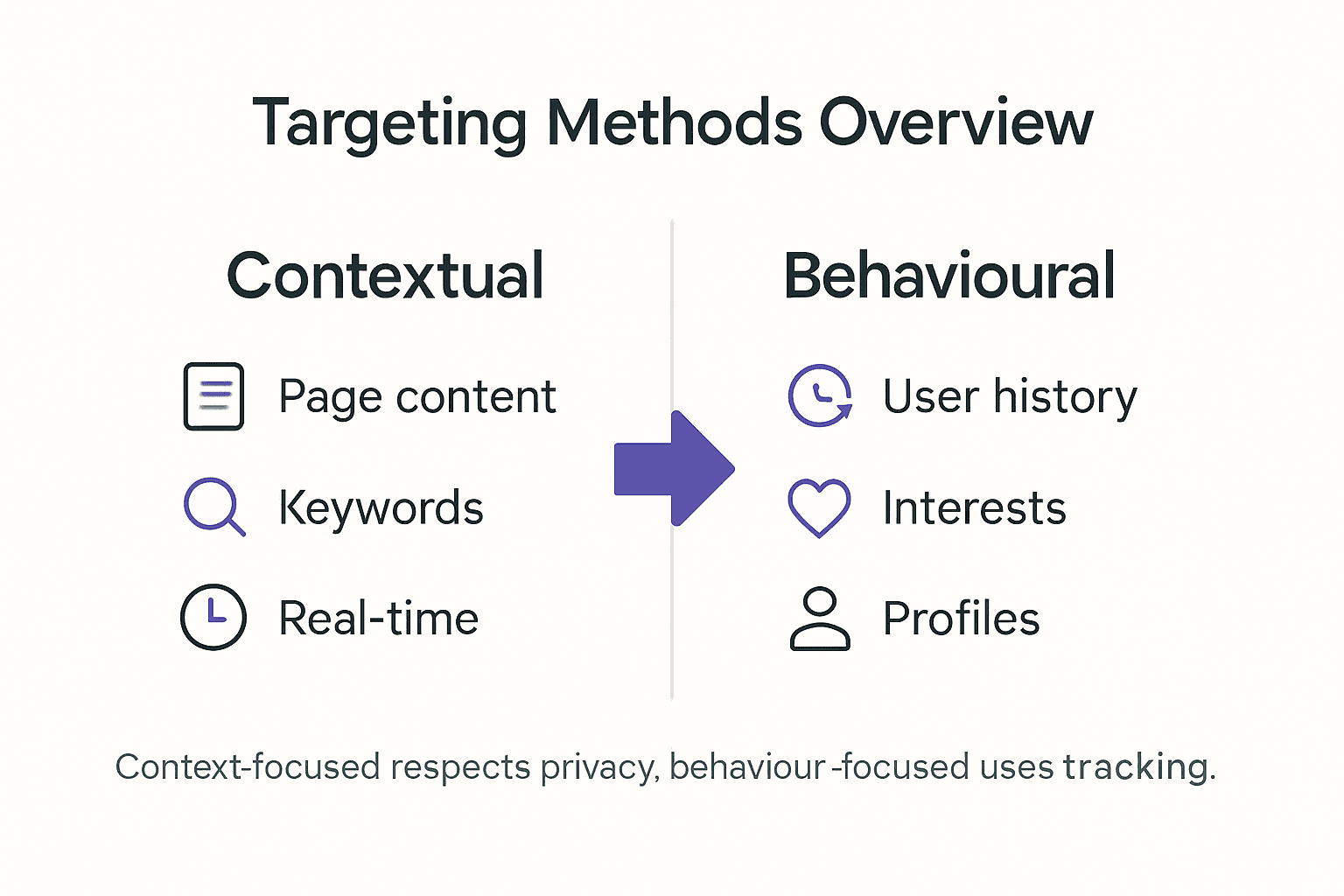
Behavioural targeting, conversely, builds comprehensive user profiles by tracking browsing histories, click patterns, and long-term online behaviours. This method creates detailed user segments, allowing advertisers to serve highly personalised advertisements across different platforms. However, this approach raises significant privacy concerns, as it relies on extensive personal data collection. Mobile gaming platforms, in particular, must carefully balance the desire for precise targeting with increasing user sensitivity about data privacy and consent.
Here’s a comparison of contextual and behavioural targeting approaches:
| Aspect | Contextual Targeting | Behavioural Targeting |
|---|---|---|
| Data Basis | Webpage content and keywords | User history and behaviour patterns |
| Privacy Implications | Low; does not track users | High; involves tracking and profiling |
| Relevance Mechanism | Matches ads to immediate context | Personalises ads by user profile |
| Regulation Impact | Less affected by privacy laws | Increasing restrictions and scrutiny |
Expert Pro Tip: Prioritise contextual targeting strategies that respect user privacy while maintaining high relevance, as emerging data protection regulations continue to challenge traditional behavioural tracking methods.
Applications In Mobile Gaming User Acquisition
Contextual advertising has emerged as a powerful strategy for user acquisition in mobile gaming, offering sophisticated approaches to engaging potential players. Mobile gaming ad integration strategies leverage precise ad placement techniques that maximise user attention and minimise gameplay disruption.
Strategic ad placement is crucial in mobile gaming user acquisition. Eye-tracking studies reveal that advertisements positioned in task-relevant zones can significantly enhance brand recall and user engagement. For mobile game developers, this means carefully selecting ad locations that feel natural within the game environment. Contextual ads can be seamlessly integrated into loading screens, between game levels, or as reward-based interactions that provide tangible value to the player experience.
The most effective contextual advertising approaches in mobile gaming focus on relevance and timing. By analysing game genre, player demographics, and in-game behaviour, developers can create highly targeted ad experiences that feel less like interruptions and more like organic extensions of the gameplay. For instance, a strategy game player might receive ads for similar tactical games, while a casual puzzle game enthusiast would see recommendations aligned with their specific gaming preferences. This nuanced approach ensures that advertisements become a value-added component of the gaming experience rather than a disruptive element.
Expert Pro Tip: Implement contextual ads that offer genuine value to players, such as rewards or game-related content, to transform advertising from an interruption into an engaging game mechanic.
Risks, Costs, And Common Challenges
AI-driven contextual advertising technologies represent a complex landscape of opportunities and significant potential risks for digital marketers. The sophisticated algorithms powering these systems introduce multifaceted challenges that require careful navigation and strategic implementation.
Infrastructure and development costs represent a substantial investment for organisations seeking to implement advanced contextual advertising solutions. Technical requirements include developing robust semantic analysis capabilities, creating sophisticated machine learning models capable of understanding nuanced content contexts, and building infrastructure that can process vast amounts of data in real-time. These technical demands necessitate significant computational resources, specialised personnel, and ongoing maintenance expenses that can strain smaller marketing budgets.
Beyond financial considerations, contextual advertising confronts critical ethical challenges. The potential for algorithmic bias, unintentional discriminatory ad targeting, and privacy violations creates a delicate balance between technological innovation and responsible marketing practices. Marketers must implement rigorous oversight mechanisms to ensure advertisements are distributed fairly, transparently, and without inadvertently perpetuating harmful stereotypes or manipulating user perceptions. This requires continuous monitoring, periodic algorithmic audits, and a commitment to maintaining user trust through responsible data handling.
The following table summarises key infrastructure and ethical challenges in contextual advertising:
| Challenge | Business Impact | Mitigation Strategies |
|---|---|---|
| Infrastructure Costs | High technical and staff expenses | Invest in scalable solutions |
| Algorithmic Bias | Risk of unfair ad targeting | Regular audits and adjustments |
| Privacy Concerns | Potential user distrust | Transparent data handling |
Expert Pro Tip: Develop a comprehensive risk management framework that includes regular ethical audits of your contextual advertising algorithms, focusing on transparency, fairness, and user consent to mitigate potential legal and reputational risks.
Elevate Your Contextual Ad Strategy with Easy Playable Ads
The article highlights a key challenge faced by advertisers aiming for privacy-first contextual advertising while maintaining ad relevance and user engagement. Creating impactful ads that feel natural and respectful to user privacy often demands extensive development resources, complex infrastructure, and a hefty budget. This is where PlayableMaker offers a compelling solution by enabling you to build playable and interactive ads quickly without code or overspending. Our platform empowers you to deliver engaging ads seamlessly integrated with your content context, perfectly matching the privacy-conscious approach discussed.
Discover how easy it is to create budget-friendly, immersive ads that enhance user experience and avoid common pitfalls like intrusive or irrelevant advertising. Explore our Publishing Archives to learn more about optimising ad delivery and visit our Help Archives for guidance on launching your first campaign. Ready to transform how you engage users with contextual ads? Start building today at PlayableMaker and experience hassle-free, privacy-friendly playable advertising that aligns perfectly with the future of user acquisition.
Frequently Asked Questions
What are contextual ads?
Contextual ads are advertisements that are strategically matched to the content of a web page using advanced algorithms and natural language processing. They aim to deliver relevant ads based on the immediate context of the content being viewed.
How do contextual ads differ from behavioural targeting?
Contextual ads focus on the content of the web page to match ads, while behavioural targeting relies on user profiles and past behaviours. This makes contextual advertising less intrusive and more respectful of user privacy.
What are the main types of contextual advertising formats?
The primary formats include text ads, display ads, native ads, and video advertisements. Each format is designed to integrate seamlessly with the surrounding content, enhancing user engagement without being disruptive.
How can contextual ads benefit mobile gaming user acquisition?
Contextual ads can enhance user acquisition in mobile gaming by strategically placing relevant ads within gameplay. By ensuring that advertisements match player interests and are displayed at appropriate times, they can feel like a natural part of the gaming experience.
Recommended
- What Are Personalized Ads? Complete Guide for 2024 – playablemaker.com What Are Personalized Ads? Complete Guide for 2024
- Personalised Ads – Impact on Mobile Game Marketing – playablemaker.com Personalised Ads – Impact on Mobile Game Marketing
- Facebook Ads: Why Precise Targeting Transforms Mobile Game UA – playablemaker.com Facebook Ads: Why Precise Targeting Transforms Mobile Game UA
- Facebook Behavioural Targeting: Boost Mobile Game ROI – playablemaker.com Facebook Behavioural Targeting: Boost Mobile Game ROI