Personalised ads in mobile gaming can increase engagement by up to 300 percent when tailored to player habits, yet many british and European studios still struggle to deploy these strategies without hefty coding investments. In a world flooded with generic banners and irrelevant offers, understanding how to dynamically match ads to users’ real motivations is game-changing. This guide breaks down the latest methods for delivering relevant, cost-effective personalised ad experiences that drive real results across global markets.
Table of Contents
- Personalised Ads in Mobile Gaming Defined
- Types and Methods of Ad Personalisation
- How Personalised Ads Function in Games
- Legal Framework and Data Protection Rules
- Risks, Challenges, and Cost Implications
Key Takeaways
| Point | Details |
|---|---|
| Personalised Ads Enhance Engagement | Personalised ads leverage player data to create tailored advertising experiences, significantly improving engagement and user acquisition metrics. |
| Three Core Dimensions | Key dimensions of personalised ads include content adaptation, timing optimisation, and contextual relevance, which ensure seamless integration into gameplay. |
| Privacy Compliance is Crucial | Adherence to data protection regulations, such as GDPR, is essential to build user trust and avoid legal penalties related to data privacy. |
| Balance Between Personalisation and Privacy | Developers must navigate the challenges of personalised targeting without alienating users, maintaining a strong focus on consent and privacy controls. |
Personalised Ads in Mobile Gaming Defined
Personalised ads in mobile gaming represent a sophisticated targeting strategy that dynamically adapts advertising content to individual player characteristics, preferences, and behavioural patterns. These advanced advertisements go far beyond traditional static marketing approaches, transforming in-game advertising through AI-driven personalisation techniques that maximise player engagement.
Personalisation involves intricate data analysis that allows game developers and marketers to craft advertising experiences uniquely tailored to specific user segments. By leveraging player data such as gaming history, engagement levels, spending patterns, and demographic information, mobile game advertisers can create hyper-relevant ad experiences that feel less intrusive and more contextually appropriate. These targeted approaches significantly improve user acquisition metrics by presenting advertisements that resonate with individual player motivations and interests.
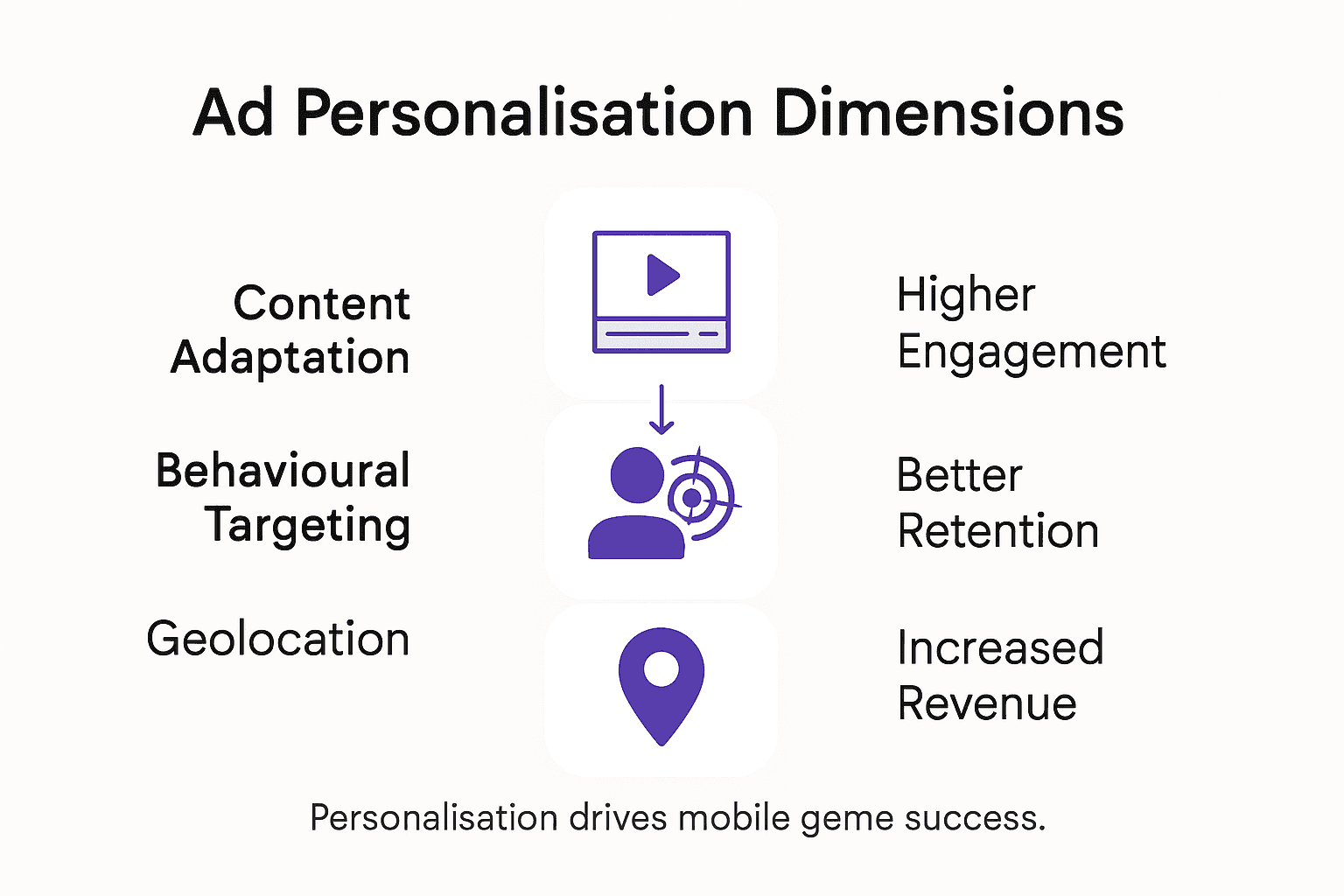
The core mechanics of personalised ads in mobile gaming centre around three primary dimensions: content adaptation, timing optimization, and contextual relevance. Content adaptation means modifying ad visuals, messaging, and promotional offers to match player preferences. Timing optimization determines the precise moment during gameplay when an advertisement will have maximum receptivity. Contextual relevance ensures that ads feel integrated with the gaming experience rather than disruptive external interruptions. Comprehensive research indicates these personalization strategies can dramatically enhance player engagement and monetization potential, creating a win-win scenario for both game developers and players.
The following table summarises the core dimensions of personalised ads and their effects on business outcomes:
| Dimension | Description | Business Impact |
|---|---|---|
| Content Adaptation | Customises ads to player interests | Increases relevance, boosts engagement |
| Timing Optimisation | Delivers ads at ideal gameplay moments | Maximises user receptivity |
| Contextual Relevance | Integrates ads seamlessly into game environment | Reduces disruption, raises acceptance |
Pro Tip: Implement gradual personalisation by starting with basic demographic segmentation and progressively refining targeting strategies based on real-time player behaviour and feedback data.
Types and Methods of Ad Personalisation
Personalised ad strategies in mobile gaming encompass several sophisticated targeting methods designed to create highly tailored advertising experiences. Mobile game advertisers leverage multiple techniques for crafting personalised ad approaches, each focusing on distinct data points and user characteristics to maximise engagement and conversion potential.
Behavioural Targeting represents the primary method of ad personalisation, analysing individual player interactions, gameplay patterns, and historical engagement metrics. This approach involves tracking in-game actions, time spent on specific game modes, purchase histories, and skill progression to generate hyper-specific ad content. Marketers can segment players into nuanced categories based on their demonstrated preferences, enabling them to design advertisements that resonate deeply with specific player archetypes.

Additional personalisation methods include geolocation-based targeting, which adapts ad content according to a player’s geographical region, and social media data integration, which incorporates cross-platform user information to create more comprehensive player profiles. These techniques allow advertisers to construct multi-dimensional targeting strategies that transcend traditional demographic segmentation. By combining behavioural insights with geographical and social data, mobile game marketers can create advertising experiences that feel intimately connected to individual player contexts and motivations.
Below is a comparison of personalisation methods used in mobile gaming advertising:
| Method | Main Data Leveraged | Typical Outcome |
|---|---|---|
| Behavioural Targeting | Player actions and habits | Highly tailored messaging |
| Geolocation Targeting | Player’s location info | Region-specific offers |
| Social Data Integration | Social media activity | Cross-platform alignment |
Pro Tip: Implement a progressive personalisation strategy by starting with basic behavioural targeting and gradually incorporating more advanced data integration techniques to refine your advertising precision.
How Personalised Ads Function in Games
Personalised ads within mobile gaming environments operate through a sophisticated technological ecosystem that enables dynamic, real-time advertisement delivery. The comprehensive process involves intricate data collection and analysis techniques that transform player interactions into targeted advertising opportunities, creating a seamless and intelligent ad experience.
User Profiling represents the foundational mechanism driving personalised ad functionality. This complex process begins with comprehensive data aggregation, capturing multiple dimensions of player behaviour including gameplay patterns, interaction frequencies, in-game purchase histories, and device-specific characteristics. Advanced algorithmic systems continuously analyse these data points, creating dynamic user profiles that evolve with each player interaction. These profiles enable advertisers to segment players into highly specific categories, allowing for precision targeting that goes beyond traditional demographic segmentation.
The technical implementation of personalised ads involves multiple sophisticated components, including real-time programmatic ad delivery, dynamic creative optimization, and contextual placement algorithms. These systems work collaboratively to ensure that advertisements appear at optimal moments within the gaming experience, matching ad content precisely to individual player preferences and current gameplay contexts. By integrating machine learning techniques, mobile game advertisers can predict and respond to player receptiveness, adjusting ad characteristics such as visual design, messaging, and promotional offers in microseconds.
Pro Tip: Develop a granular data collection strategy that captures nuanced player interactions, enabling more sophisticated and responsive personalisation techniques.
Legal Framework and Data Protection Rules
Personalised mobile game advertising operates within a complex global regulatory landscape that demands rigorous compliance with data protection standards. The European Parliament’s comprehensive review of targeted advertising regulations provides critical guidance for navigating the intricate legal requirements surrounding user data processing694680_EN.pdf), establishing fundamental principles for responsible data management.
Consent Management emerges as a cornerstone of legal compliance in personalised advertising. Mobile game developers must implement transparent, granular consent mechanisms that allow users to understand exactly what data is being collected, how it will be used, and provide clear opt-out options. This involves developing user interfaces that clearly explain data collection practices, using plain language that avoids technical jargon, and ensuring that consent is freely given, specific, informed, and unambiguous. Critically, consent cannot be bundled with other terms of service and must be as easy to withdraw as it is to provide.
The regulatory framework surrounding personalised ads encompasses multiple critical dimensions, including data minimisation, purpose limitation, and user privacy protection. International standards like the General Data Protection Regulation (GDPR) mandate that game developers collect only necessary data directly relevant to the intended advertising purpose, maintain strict data security protocols, and provide users with comprehensive rights to access, rectify, and request deletion of their personal information. These regulations fundamentally transform how mobile game advertisers approach user data, shifting from unrestricted collection to a more ethical, user-centric model of data management that prioritises individual privacy and consent.
Pro Tip: Implement a robust consent management platform that provides clear, granular privacy controls and maintains detailed documentation of user consent interactions to ensure ongoing regulatory compliance.
Risks, Challenges, and Cost Implications
Personalized mobile game advertising presents a complex landscape of psychological and financial challenges that demand sophisticated strategic navigation. The pursuit of hyper-targeted advertising creates a delicate balance between potential engagement gains and substantial operational risks, requiring nuanced understanding of user perception and technical implementation.
Privacy Risks emerge as the most significant challenge in personalised advertising ecosystems. Mobile game developers must contend with intricate psychological dynamics where increased ad relevance can simultaneously attract and alienate users. Research indicates that overly precise targeting can trigger user discomfort, creating a paradoxical situation where advanced personalization techniques might actually reduce engagement. The potential for user re-identification, data leakage, and privacy intrusion represents substantial legal and reputational risks that can dramatically undermine user trust and potentially result in significant financial penalties.
The financial implications of personalised advertising extend far beyond direct implementation costs. Comprehensive surveys reveal substantial operational challenges, including increased compliance expenditures, potential user attrition, and the complex balancing act between personalization depth and privacy preservation. Game developers must invest in sophisticated consent management systems, robust data protection infrastructures, and continuous monitoring mechanisms. These requirements translate into significant technical and human resource investments, potentially offsetting the anticipated revenue gains from targeted advertising strategies.
Pro Tip: Develop a progressive personalization approach that prioritises user consent, implements granular privacy controls, and maintains transparent communication about data usage to mitigate potential user resistance and regulatory risks.
Unlock Seamless Personalised Ads with PlayableMaker
The challenge of creating highly personalised ads that truly engage mobile gamers without draining your resources is real. The article highlights how traditional playable ads can be costly and time-consuming to develop while also emphasising the need for dynamic content adaptation and precise timing to maximise user acquisition. With personalised ads requiring continuous optimisation to match player preferences and uphold data compliance, your solution must be both flexible and efficient.
PlayableMaker offers a no-code platform designed to solve these exact pain points. Build interactive playable ads fast and budget friendly while maintaining the power of tailored content that resonates with your audience. Whether you want to swiftly test behavioural targeting or adapt creatives for better contextual relevance, our easy-to-use solution frees up your devs and marketing team to focus on what matters most. Learn practical strategies about publishing successful mobile ads on our Publishing Archives or get expert guidance through our Help Archives.
Ready to experience how effortless and cost effective creating personalised mobile gaming ads can be Take control of your ad acquisition strategy today at PlayableMaker and transform your advertising approach for measurable impact.
Frequently Asked Questions
What are personalised ads in mobile gaming?
Personalised ads in mobile gaming are targeted advertising strategies that adapt content based on individual player characteristics, preferences, and behaviours, enhancing engagement and relevance.
How do personalised ads improve user engagement in games?
By tailoring ad content to reflect player interests and timing advertisements to appear during optimal gameplay moments, personalised ads increase the likelihood of player receptivity and engagement.
What methods are used for personalising ads in mobile games?
Methods include behavioural targeting, geolocation-based targeting, and social media data integration. These techniques allow advertisers to create highly tailored advertising experiences based on player data and interactions.
What are the legal considerations for personalised game advertisements?
Legal considerations include data protection regulations that mandate obtaining user consent for data collection, ensuring transparency in data usage, and implementing measures to protect user privacy, such as those outlined in the GDPR.
Recommended
- Personalised Ads – Impact on Mobile Game Marketing – playablemaker.com Personalised Ads – Impact on Mobile Game Marketing
- What Are Personalized Ads? Complete Guide for 2024 – playablemaker.com What Are Personalized Ads? Complete Guide for 2024
- 7-Step User Acquisition Checklist for Mobile Gaming Success – playablemaker.com 7-Step User Acquisition Checklist for Mobile Gaming Success
- Master User Acquisition Ad Strategies for Mobile Games – playablemaker.com Master User Acquisition Ad Strategies for Mobile Games