British mobile game companies are finding that Facebook behavioural targeting can identify user interests with over 90 percent accuracy, reshaping how user acquisition campaigns perform. For specialists and marketing managers, understanding these methods is crucial as the gap between ad spend and genuine engagement keeps growing worldwide. This guide breaks down Facebook’s behavioural targeting options, offering cost-effective and no-code strategies that help you reach the right players without wasting resources.
Table of Contents
- Defining Facebook Behavioural Targeting Methods
- Targeting Types For Mobile Game Marketers
- How Facebook Targeting Powers Playable Ads
- Costs, Limitations, And Mistakes To Avoid
- Privacy, Transparency, And Compliance Essentials
Key Takeaways
| Point | Details |
|---|---|
| Behavioural Targeting Precision | Facebook’s behavioural targeting enables mobile game marketers to reach highly specific user segments by analysing intricate online behaviours and interactions. |
| Combining Targeting Strategies | Implementing a combination of targeting approaches enhances user acquisition efficiency and reduces ad spend wastage. |
| Continuous Performance Monitoring | Regularly reviewing and adjusting targeting parameters based on campaign data is essential for maintaining relevance and optimising engagement. |
| Privacy Compliance Importance | Adherence to data protection regulations is critical, necessitating transparent data collection practices and robust user consent mechanisms. |
Defining Facebook Behavioural Targeting Methods
Facebook behavioural targeting represents a sophisticated digital marketing approach that allows advertisers to segment and reach potential users based on their intricate online behaviours, interactions, and specific demographic characteristics. Quantitative research demonstrates that the platform can uniquely identify individual user interests with remarkable precision, enabling hyper-targeted advertising strategies for mobile game marketers.
The core mechanics of Facebook behavioural targeting revolve around several sophisticated tracking mechanisms. These include monitoring user engagement patterns, analysing past interactions with digital content, examining app usage history, and evaluating specific in-platform behaviours such as likes, shares, comments, and click-through rates. By aggregating these granular data points, Facebook creates comprehensive user profiles that allow advertisers to construct highly nuanced audience segments tailored to specific mobile game marketing objectives.
Mobile game developers can leverage these targeting methods through multiple strategic approaches. Key targeting dimensions include:
- Demographic targeting (age, gender, location)
- Interest-based targeting
- Behavioural targeting specific to gaming interactions
- Custom audience creation
- Lookalike audience generation
Pro tip: Precision Targeting Strategy: Combine multiple targeting layers to create ultra-specific audience segments, reducing ad spend wastage and improving conversion rates for mobile game user acquisition campaigns.
Pro tip: Data Refinement Technique: Continuously monitor and update your targeting parameters based on real-time campaign performance metrics to maintain optimal audience relevance and engagement.
Targeting Types for Mobile Game Marketers
Mobile game marketers can leverage multiple sophisticated targeting approaches within Facebook’s advertising ecosystem to optimise user acquisition and engagement. Cross-country research demonstrates that strategic ad targeting can significantly enhance marketing effectiveness, particularly in the competitive mobile gaming landscape.
The primary targeting types for mobile game marketers include custom audience targeting, which enables advertisers to reach existing users or similar potential players. This method involves creating audiences based on specific characteristics such as in-game behaviour, previous interaction history, and demographic profiles. Personalised ad research indicates that carefully crafted audience segments can dramatically improve consumer attitudes and behavioural responses.
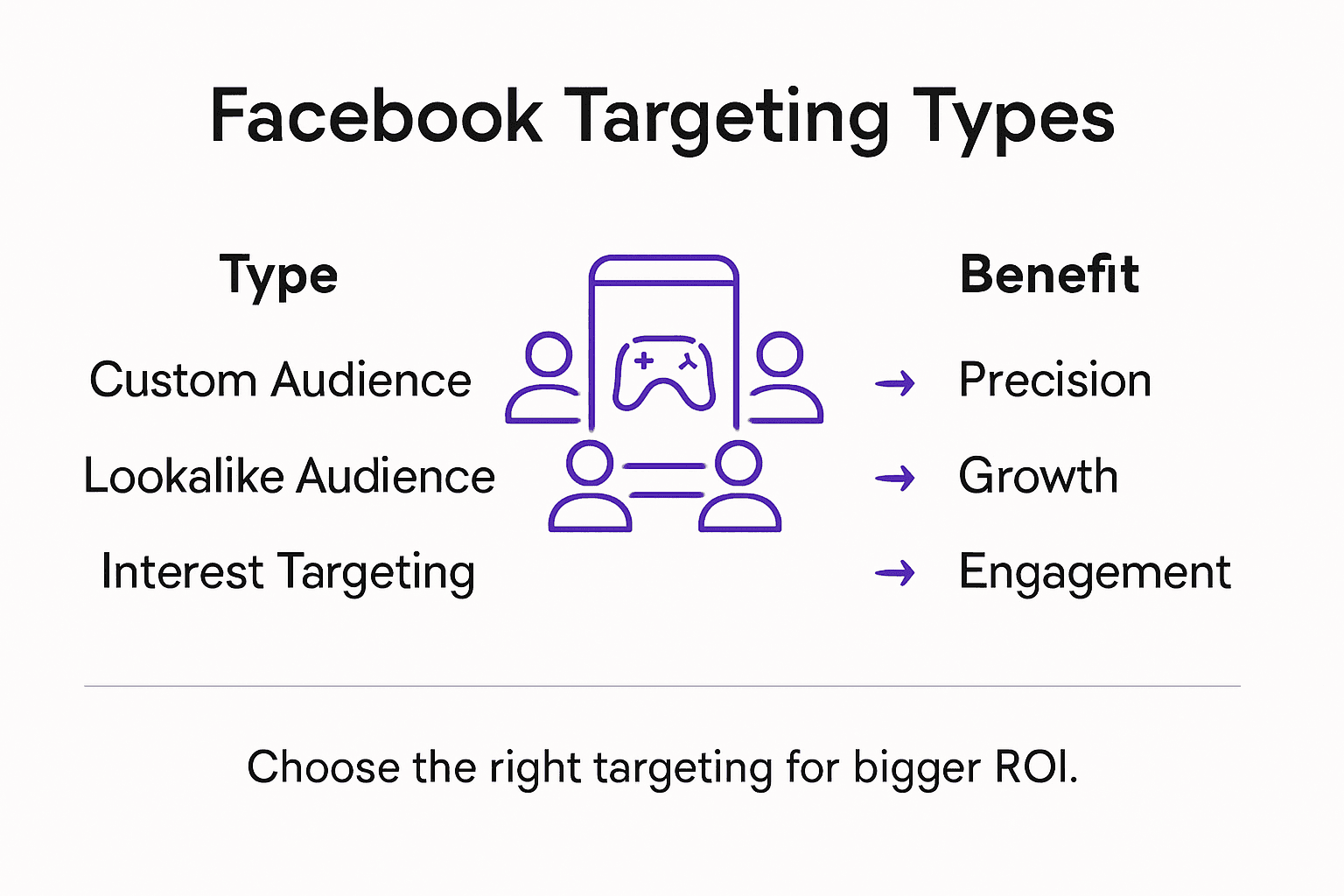
Mobile game marketers can utilise several strategic targeting approaches:
Here’s how key Facebook targeting types impact mobile game marketing strategies:
| Targeting Type | Primary Objective | Business Impact |
|---|---|---|
| Custom Audiences | Engage existing or previous users | Boosts retention and reactivation rates |
| Lookalike Audiences | Find new, high-potential players | Expands reach to quality user segments |
| Interest-Based Targeting | Reach players by gaming preferences | Increases ad relevance and engagement |
| Behavioural Targeting | Segment by in-app behaviours | Optimises spend towards active users |
| Demographic Targeting | Filter by age, gender, or location | Aligns ads with target market profiles |
| Retargeting | Re-engage former leads or players | Improves conversion and lowers acquisition costs |
- Lookalike Audience Targeting: Identifying new users similar to existing high-value players
- Interest-Based Targeting: Reaching potential players based on gaming preferences and related interests
- Behavioural Targeting: Segmenting audiences by in-app interactions, purchase history, and engagement levels
- Demographic Targeting: Filtering audiences by age, gender, location, and other key characteristics
- Retargeting: Re-engaging users who have previously interacted with the game or shown interest
Pro tip: Audience Refinement Strategy: Continuously experiment with different targeting combinations and use Facebook’s detailed analytics to progressively narrow and optimise your audience segments for maximum user acquisition efficiency.
Pro tip: Performance Tracking Technique: Implement regular A/B testing across different targeting parameters to identify the most cost-effective audience configurations for your specific mobile game.
How Facebook Targeting Powers Playable Ads
Facebook’s sophisticated targeting mechanisms play a critical role in transforming playable ads from simple interactive experiences into highly precise user acquisition tools. Psychological research on behavioural targeting reveals that strategic audience segmentation can significantly enhance user engagement and interaction rates with interactive ad formats.

The power of Facebook targeting for playable ads lies in its ability to create hyper-personalised ad experiences that resonate with specific user segments. Targeting parameters enable mobile game marketers to design interactive ad experiences that match precise user preferences, including gaming interests, behaviour patterns, and demographic characteristics. Engagement studies demonstrate that carefully curated targeting can reduce selection bias and improve overall user acquisition performance.
Key targeting strategies that power playable ads include:
- Demographic Precision: Matching ad experiences to specific age groups and locations
- Interest Alignment: Designing interactive ads that reflect users’ gaming preferences
- Behavioural Matching: Creating ad experiences based on previous gaming interactions
- Lookalike Audience Expansion: Reaching new potential players with similar characteristics to existing high-value users
- Retargeting Optimization: Re-engaging users who have shown previous interest in similar game genres
Pro tip: Contextual Customisation: Continuously refine your playable ad targeting by analysing user interaction data and adjusting audience segments to improve relevance and conversion rates.
Pro tip: Performance Calibration: Implement granular tracking of playable ad interactions to understand how different targeting parameters influence user engagement and game installation rates.
Costs, Limitations, and Mistakes To Avoid
Facebook behavioural targeting for mobile games presents complex challenges that require strategic navigation. Algorithmic research reveals that ad delivery mechanisms can inadvertently create unexpected demographic skews, potentially undermining marketing objectives and increasing overall campaign costs.
The primary limitations of Facebook targeting stem from inherent algorithmic biases and sophisticated selection processes. Targeting complexity means mobile game marketers must remain vigilant about potential pitfalls. Comparative algorithm studies demonstrate that removing demographic features does not automatically eliminate biased outcomes, necessitating a nuanced approach to audience segmentation.
Key mistakes mobile game marketers should avoid include:
The following table contrasts common Facebook targeting mistakes with recommended solutions:
| Common Mistake | Consequence | Recommended Solution |
|---|---|---|
| Over-narrowing audiences | Severely limits user reach | Broaden targeting criteria slightly |
| Ignoring algorithmic bias | Leads to unbalanced user acquisition | Regularly audit and adjust parameters |
| Neglecting performance | Results in wasted ad spend | Continually monitor and refine campaigns |
| Static targeting | Misses new opportunities | Update segments based on recent data |
| Poor budget allocation | Reduces ROI and campaign efficiency | Test and shift spend to top segments |
- Over-Narrowing Audiences: Creating segments so specific that potential user reach becomes dramatically limited
- Ignoring Algorithmic Bias: Failing to audit and adjust targeting parameters that might produce unintended demographic distortions
- Neglecting Performance Metrics: Not continuously monitoring campaign performance and audience engagement
- Static Targeting: Using the same audience segments without regular refinement
- Budget Misallocation: Investing heavily in poorly constructed targeting strategies
Pro tip: Bias Mitigation Strategy: Regularly cross-reference your targeting parameters with actual campaign performance data to identify and correct potential algorithmic biases before they significantly impact user acquisition.
Pro tip: Audience Diversification Technique: Implement multiple targeting approaches simultaneously and comparatively analyse their performance to develop more robust, balanced user acquisition strategies.
Privacy, Transparency, and Compliance Essentials
Navigating the complex landscape of privacy and data protection is crucial for mobile game marketers leveraging Facebook’s behavioural targeting capabilities. Legal research on personal data processing highlights the critical importance of understanding and adhering to data protection regulations, particularly within the European Union’s stringent legal framework.
The fundamental challenge lies in balancing effective targeting strategies with robust user privacy protections. Compliance requirements demand that mobile game marketers maintain transparent data collection practices and provide clear mechanisms for user consent. Critical case studies demonstrate how targeted advertising infrastructures can potentially be misused, underscoring the need for rigorous ethical and legal safeguards in digital marketing approaches.
Key privacy and compliance considerations include:
- User Consent Management: Implementing clear, granular consent mechanisms
- Data Minimisation: Collecting only essential user information for targeting
- Transparent Targeting Practices: Clearly communicating how user data influences ad delivery
- Regular Compliance Audits: Continuously reviewing targeting strategies against evolving privacy regulations
- Cross-Border Data Protection: Understanding variations in international privacy laws
Pro tip: Consent Clarity Strategy: Develop user-friendly consent interfaces that explicitly explain data usage, providing granular options for users to control their personal information sharing preferences.
Pro tip: Regulatory Tracking Technique: Establish a dedicated compliance monitoring system that tracks changes in global privacy regulations to ensure ongoing adherence to the most current legal standards.
Amplify Your Mobile Game Success with Effortless Playable Ads
Mastering Facebook behavioural targeting is essential for maximising your mobile game ROI but building interactive playable ads can be costly and time-consuming. The challenge lies in creating engaging ad experiences that align perfectly with sophisticated targeting parameters such as demographic precision, behavioural matching and lookalike audience expansion while managing budget constraints and development resources.
At PlayableMaker, we understand these pain points and offer a no-code solution that empowers you to build playable ads fast without draining your budget or overloading your team. Our platform is designed with mobile game marketers in mind who want to rapidly capitalise on Facebook’s advanced targeting strategies to drive user acquisition and retention efficiently.
Discover how you can simplify playable ad creation while fully leveraging Facebook’s targeting methods by exploring our Uncategorized Archives for insights and practical tips. Ready to take your mobile game marketing to the next level? Start building budget-friendly, high-converting playable ads today at PlayableMaker and learn how our Publishing tools can streamline your campaign launch via the Publishing Archives. Don’t let complexity stall your growth act now to create engaging interactive ads that deliver results.
Frequently Asked Questions
What is Facebook behavioural targeting for mobile games?
Facebook behavioural targeting for mobile games is a digital marketing strategy that allows advertisers to reach users based on their online behaviours, interactions, and demographic characteristics. By analysing data such as user engagement patterns, app usage, and in-platform actions, Facebook creates detailed user profiles for hyper-targeted advertising.
How can I improve my mobile game marketing using Facebook targeting?
To enhance your mobile game marketing, you can use various targeting methods such as custom audiences, lookalike audiences, interest-based targeting, and behavioural targeting. Combining multiple targeting layers creates ultra-specific audience segments, helping to reduce ad spend wastage and improve conversion rates.
What are the key advantages of using Facebook for playable ads?
The main advantages of using Facebook for playable ads include the ability to create personalised experiences that resonate with specific user segments. This targeting allows for improved user engagement and higher interaction rates, ultimately leading to better user acquisition for mobile games.
What should I consider regarding privacy when using Facebook behavioural targeting?
When employing Facebook behavioural targeting, it’s crucial to adhere to privacy regulations and ensure transparency in data collection practices. This includes managing user consent effectively, minimising data collection, and conducting regular compliance audits to align your strategies with legal requirements.
Recommended
- Facebook Ads: Why Precise Targeting Transforms Mobile Game UA – playablemaker.com Facebook Ads: Why Precise Targeting Transforms Mobile Game UA
- Understanding Facebook Targeted Ads for Mobile Gaming – playablemaker.com Understanding Facebook Targeted Ads for Mobile Gaming
- Detailed Targeting Facebook Ads: Essential Guide – playablemaker.com Detailed Targeting Facebook Ads: Essential Guide
- Facebook Interest Targeting: Complete Guide for 2024 – playablemaker.com Facebook Interest Targeting: Complete Guide for 2024