
TL;DR:
- Understanding retention benchmarks reveals the importance of targeting top-quartile cohorts to improve user lifetime value. Engaging viewers early through optimized ad hooks and honest creative alignment significantly enhances retention rates and campaign efficiency. Using lifecycle data and interactive ad formats like playable ads ensures consistent messaging and reduces early churn, leading to sustained long-term engagement.
Mobile game user acquisition professionals know the pain well: you drive installs at scale, the numbers look promising, and then Day 7 arrives and half your cohort has already gone. Applying the right user retention tactics for ads is not simply about spending more or testing different colours. It is about understanding why users leave, aligning your creative with what the game actually delivers, and building a systematic approach that keeps acquisition cost and retention working in the same direction. This guide covers exactly that, with practical, budget-friendly methods grounded in how mobile gaming audiences actually behave.
Table of Contents
- Understand retention challenges and benchmarks in mobile game ads
- Prepare your ads by mastering the critical retention curve
- Execute interactive and honest ad creatives for better user alignment
- Verify and optimise your retention strategy using lifecycle and behavioural data
- Rethinking user retention: why ad promise delivery trumps gimmicks
- Explore PlayableMaker tools to enhance user retention through interactive ads
- Frequently asked questions
Understand retention challenges and benchmarks in mobile game ads
To improve user retention, you first need to understand typical retention rates and how your ads contribute to these results.
Retention benchmarks give you the performance targets your campaigns should be calibrated against. Without them, you are optimising in the dark. Average retention benchmarks across categories sit around 24% on Day 1, 12% on Day 7, and 5% on Day 30, with gaming figures varying by sub-vertical and channel choice shifting retention by 20 to 40%. Hypercasual games often land below these averages, while mid-core RPGs and strategy titles frequently exceed Day 30 figures when UA and product are tightly aligned.
What is retention in digital marketing, specifically in this context? It refers to the percentage of users who return to your app on a given day after first install. For mobile games, this metric is the single clearest indicator of whether your acquired users have genuine intent. Poor ad targeting or misleading creative produces installs from users who were never going to stay, and no amount of in-app onboarding rescues that.
The distinction between average and top-quartile performance matters enormously. Targeting average benchmarks caps your upside. Professionals using customer acquisition and retention strategies that aim for top-quartile cohorts routinely achieve Day 7 rates above 20%, which dramatically improves lifetime value calculations and ROAS.
Key retention benchmark reference points:
- Day 1 average: ~24% across mobile categories
- Day 7 average: ~12%, with gaming sub-verticals showing wide variance
- Day 30 average: ~5%, heavily influenced by genre and monetisation model
- Channel choice alone can move these figures by 20 to 40%
- Top-quartile performers consistently outpace averages by 50 to 80% on Day 7
| Retention day | Industry average | Top-quartile target | Impact of channel choice |
|---|---|---|---|
| Day 1 | 24% | 36% to 40% | Up to 20% variance |
| Day 7 | 12% | 18% to 22% | Up to 30% variance |
| Day 30 | 5% | 9% to 12% | Up to 40% variance |
Reviewing proven retention strategies from adjacent sectors reinforces a consistent principle: the quality of the acquisition moment shapes everything that follows. A user who installs because the ad accurately represented the game is fundamentally more valuable than one who installed on a misleading promise.
Prepare your ads by mastering the critical retention curve
Having grasped retention benchmarks, next focus on preparing your ads by optimising the viewer retention curve.
Ad retention curves track how many viewers remain watching your ad second by second. Most platforms provide this data natively, yet a surprising number of UA teams never look at it beyond completion rate. The curve reveals precisely where audience attention breaks down, and that information is more actionable than almost any other creative metric you have access to.

Steep early drop-off within the first three seconds is almost always caused by a weak hook. Optimising these initial seconds yields disproportionately large retention improvements across the entire ad view. A cliff-drop curve, where 40 to 60% of viewers leave in the first three seconds, signals that the opening frame is failing to communicate relevance fast enough. The fix is rarely a complete creative rebuild. It is usually a tighter opening, a stronger visual signal, or a more direct value statement in the first moment.
Understanding improving user engagement through these small mechanical adjustments is one of the most efficient ways to improve overall ad performance without increasing spend. A one to two second improvement in average watch time across a high-volume campaign compounds significantly.
Practical steps for analysing and improving your ad retention curve:
- Export second-by-second view data from your platform dashboard at least weekly
- Identify the single largest drop-off point. Focus all editing energy there first
- If the biggest drop is between seconds 0 and 3, recut the opening before changing anything else
- Test two hook variations before introducing changes elsewhere in the creative
- Use the retention curve data from playing retention with playable ads as a secondary diagnostic signal alongside your in-app Day 1 retention numbers
Pro Tip: If your ad retention curve shows a second major drop-off around the 8 to 12 second mark, you likely have a pacing problem in the body of the ad rather than a hook failure. Address each drop-off point separately and in sequence.
Execute interactive and honest ad creatives for better user alignment
With a clear focus on creating effective hooks, the next step is executing interactive and honest creatives that align user expectations from ad to onboarding.
This is where ad retention strategies genuinely diverge from generic digital marketing advice. In mobile gaming, the gap between what an ad shows and what the game actually delivers is one of the most measurable and damaging sources of churn. Playable ads can cut CPI by 20 to 40% and improve early retention by providing honest gameplay previews, avoiding clickbait that damages retention and lifetime value. Users who interact with a playable ad and still install are self-selecting for genuine interest. That changes the entire retention profile of the cohort.
Why does this matter so much? Because retention fails when the experience after install does not match the ad creative or store page. Connecting playable creatives to onboarding variants protects Day 7 retention specifically by reinforcing the visual and mechanical language a user already encountered in the ad. When the first ten minutes of gameplay mirror the ad experience, the user feels a sense of continuity rather than betrayal.
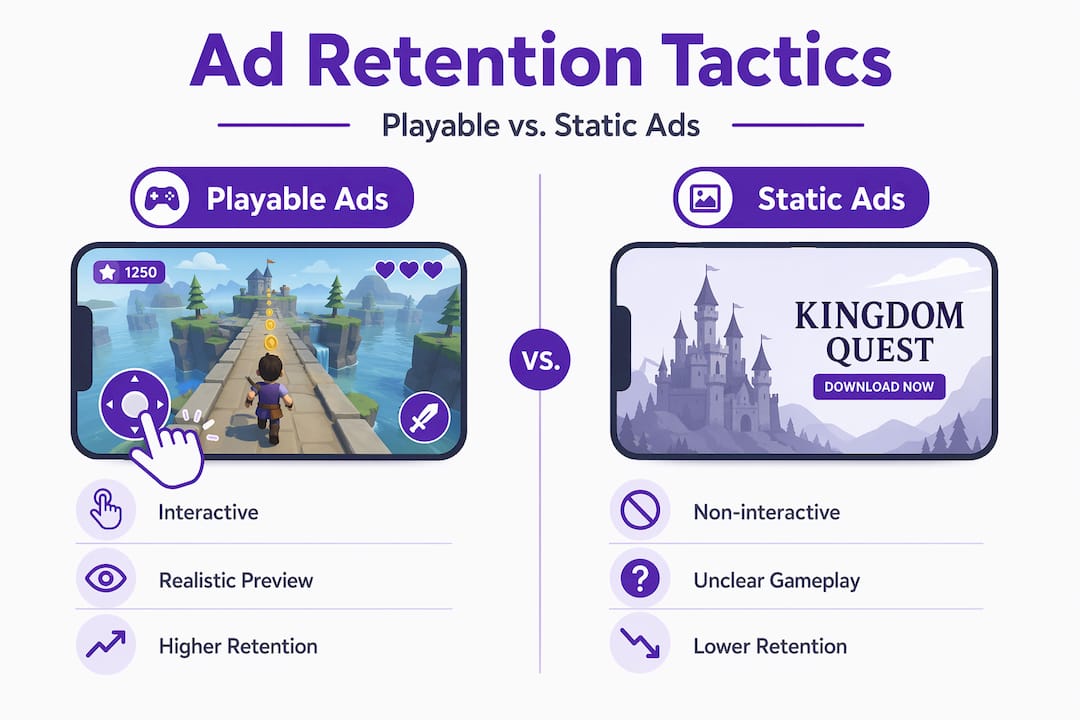
Understanding why playable ads convert better than static alternatives is not just about novelty. It is about the psychology of informed consent: users who have touched the mechanic know what they are signing up for.
How to execute honest, interactive ad creatives that retain users:
- Build the ad around a real gameplay loop, not an aspirational or simplified version. If the core loop involves merging objects, show merging objects, not a cinematic.
- Match the visual language of the ad directly to the onboarding screen design. Same colour palette, same UI elements, same character presentation where possible.
- Limit interactive elements to what the game actually offers. An ad that promises complexity the game does not deliver is worse than a simple honest creative.
- Connect ad variant data to onboarding A/B tests. Users acquired through a specific ad creative should receive an onboarding flow that references what they saw.
- Review creative against store page monthly. As games update, ads frequently become misaligned with the current product. Audit and refresh accordingly.
The comparison of playable ads versus static ads consistently shows that interactivity improves retention not because it is engaging in the abstract, but because it filters for users who have already demonstrated intent through action. Early retention improvements of this kind compound heavily into ROAS figures within 14 to 30 days.
Pro Tip: When building a playable ad, reproduce the exact difficulty level of the tutorial rather than making it artificially easy. Users who find the ad too easy and the game harder will churn earlier than users whose ad experience accurately reflected the challenge.
Verify and optimise your retention strategy using lifecycle and behavioural data
After executing your ad creatives, verify and optimise your user retention through smart lifecycle and behavioural data strategies.
Effective ad retention does not stop at install. The relationship between your ad investment and actual retention outcomes is measurable throughout the user lifecycle, and that data loop is one of the most underused assets in mobile gaming UA. Retention marketing uses personalised, lifecycle-aware messaging and AI-driven behavioural data to sustain relationships beyond acquisition, preventing churn effectively. Knowing which ad creative produced a cohort and then tracking that cohort’s in-app behaviour allows you to identify warning signals before Day 7, not after.
Customer retention spans the full user lifecycle. Implementing ad-to-lifecycle feedback loops improves cohort retention by addressing underperforming segments at the moment they show early disengagement signals, rather than waiting for them to lapse entirely.
The practical mechanics of this approach involve tagging cohorts by their acquisition source and creative variant, then monitoring in-app events in the first 24 to 48 hours. Session length, level progression speed, and tutorial completion rate are stronger early indicators of Day 7 retention than almost any acquisition metric.
Core lifecycle and behavioural verification tactics:
- Tag every cohort by ad creative variant from day one. Aggregate data obscures valuable signal
- Monitor tutorial completion and first session length as proxy indicators for Day 7 retention
- Use push notification timing calibrated to cohort behaviour, not fixed schedules
- Build maximise retention with playable ads insights into your post-install messaging sequences
- Feed creative performance data from lifecycle dashboards back into your UA creative briefs
| Lifecycle signal | What it predicts | Recommended action |
|---|---|---|
| Tutorial incomplete within 24h | High Day 3 churn risk | Trigger re-engagement push at hour 20 |
| Session under 2 minutes on Day 1 | Poor onboarding fit | Test alternate onboarding flow for that cohort |
| Zero progression in first level | Ad-to-game mismatch | Review which creative drove the install |
| Day 1 return within 12 hours | Strong Day 7 predictor | Reduce interruption, reward the pattern |
Building these feedback loops between acquisition and retention strategies creates a system where every campaign teaches you something about the next one. Ways to retain users through this methodology are increasingly affordable because the data already exists inside your analytics stack. The cost is analytical discipline, not additional budget.
Rethinking user retention: why ad promise delivery trumps gimmicks
Here is the perspective that most UA playbooks skip over entirely. The mobile gaming industry has spent enormous energy chasing the next format innovation, whether that is rewarded video, interactive end cards, or AR-enabled previews. Each new format arrives with compelling case studies and early adopter advantages. And then the results normalise, because the format was never the point.
The real driver of sustainable retention is not the format of the ad. It is the accuracy of the promise it makes. Retention fails when ads do not deliver the promised experience post-install. Aligning playable ads with onboarding variants is key to protecting longer-term retention precisely because it closes the gap between what a user anticipated and what they actually encountered.
This principle sounds simple, but it demands a level of cross-functional coordination that most UA teams find genuinely difficult. The ad creative team optimises for installs. The product team optimises for in-app metrics. Neither team naturally owns the moment of transition between the two. That gap is where retention leaks.
In practice, the studios with the strongest Day 30 retention numbers are rarely those with the most technically impressive ads. They are the ones where UA and product have built a shared language around what the ad promises and how onboarding delivers on it. The experts’ views on playable ads consistently reflect this: playable formats succeed not because they are interactive, but because they force the team to interrogate what the core experience actually is before it is built into the ad.
Gimmicks generate spikes. Honest, aligned experiences generate retention curves that do not collapse before Day 7.
Explore PlayableMaker tools to enhance user retention through interactive ads
Having explored retention tactics in depth, here is how you can apply them today. PlayableMaker is built specifically for teams who need to create interactive, playable ads quickly and without burning development budget. The no-code platform lets you build and iterate on ad creatives in hours rather than weeks, which means you can test hook variations, onboarding-aligned experiences, and new interactive formats at the pace your campaign data demands. Understanding the psychology behind playable ads and how playable ads work in digital engagement is useful context, but the practical starting point is being able to build and test without developer dependency. If budget is a concern, the budget-friendly playable ads guide shows exactly how teams of all sizes can produce high-quality interactive creatives affordably.
Frequently asked questions
What is the most important moment in an ad to focus on for retention?
The first 2 to 3 seconds of an ad are critical to retain viewers and reduce early drop-off, as steep drop-off in these seconds is almost always caused by a weak hook. Fixing the opening frames typically produces the largest measurable improvement in overall view retention.
How do playable ads improve user retention?
Playable ads allow users to experience the core game mechanic before installing, which sets realistic expectations and filters for users with genuine interest. Playable formats can cut CPI by 20 to 40% while improving early retention by providing honest gameplay previews that reduce clickbait-driven churn.
Why is aligning ad creative with onboarding important for retention?
When the in-app experience mirrors the ad, users feel a sense of continuity rather than disappointment, which directly protects Day 7 retention. Retention fails when the experience after install does not match the expectation set by the ad creative and store page.
How can AI help improve retention from ad cohorts?
AI analyses behavioural signals in the first 24 to 48 hours after install to identify users at risk of churning before Day 7, allowing teams to trigger personalised re-engagement at the right moment. AI-driven retention uses these behavioural patterns to personalise outreach in ways that fixed push notification schedules cannot replicate.
Recommended
- Mobile ad formats for gaming UA: complete list 2026 – playablemaker.com Mobile ad formats for gaming UA: complete list 2026
- Combat ad fraud in mobile games: Safer UA strategies – playablemaker.com Combat ad fraud in mobile games: Safer UA strategies
- Top mobile ad platforms for gaming user acquisition – playablemaker.com Top mobile ad platforms for gaming user acquisition
- Ad CTR explained: boost mobile game ad performance – playablemaker.com Ad CTR explained: boost mobile game ad performance