
Over 85 percent of british mobile gaming companies identify customer acquisition and retention as their top business challenge. With so much at stake in the fast-growing mobile game market, understanding these strategies is crucial for anyone hoping to compete. This article breaks down how british developers can attract new players, keep them engaged, and maximise their returns while building long-lasting communities around their games.
Table of Contents
- Customer Acquisition And Retention Defined
- Key Approaches In Mobile Gaming Marketing
- Data-Driven Targeting And Segmentation Methods
- Optimising Campaign Budgets And ROI
- Common Pitfalls And How To Avoid Them
Key Takeaways
| Point | Details |
|---|---|
| Customer Acquisition Cost (CAC) | Understanding CAC is essential for evaluating the effectiveness of player acquisition strategies in mobile gaming. |
| Retention Strategies | Developing engaging gameplay and fostering community can significantly enhance player loyalty and retention. |
| Data-Driven Targeting | Utilising sophisticated segmentation techniques allows for targeted marketing that resonates with specific player behaviours and preferences. |
| Ethical Monetisation | Prioritising transparent and fair monetisation strategies can build player trust and foster long-term relationships in the gaming community. |
Customer Acquisition And Retention Defined
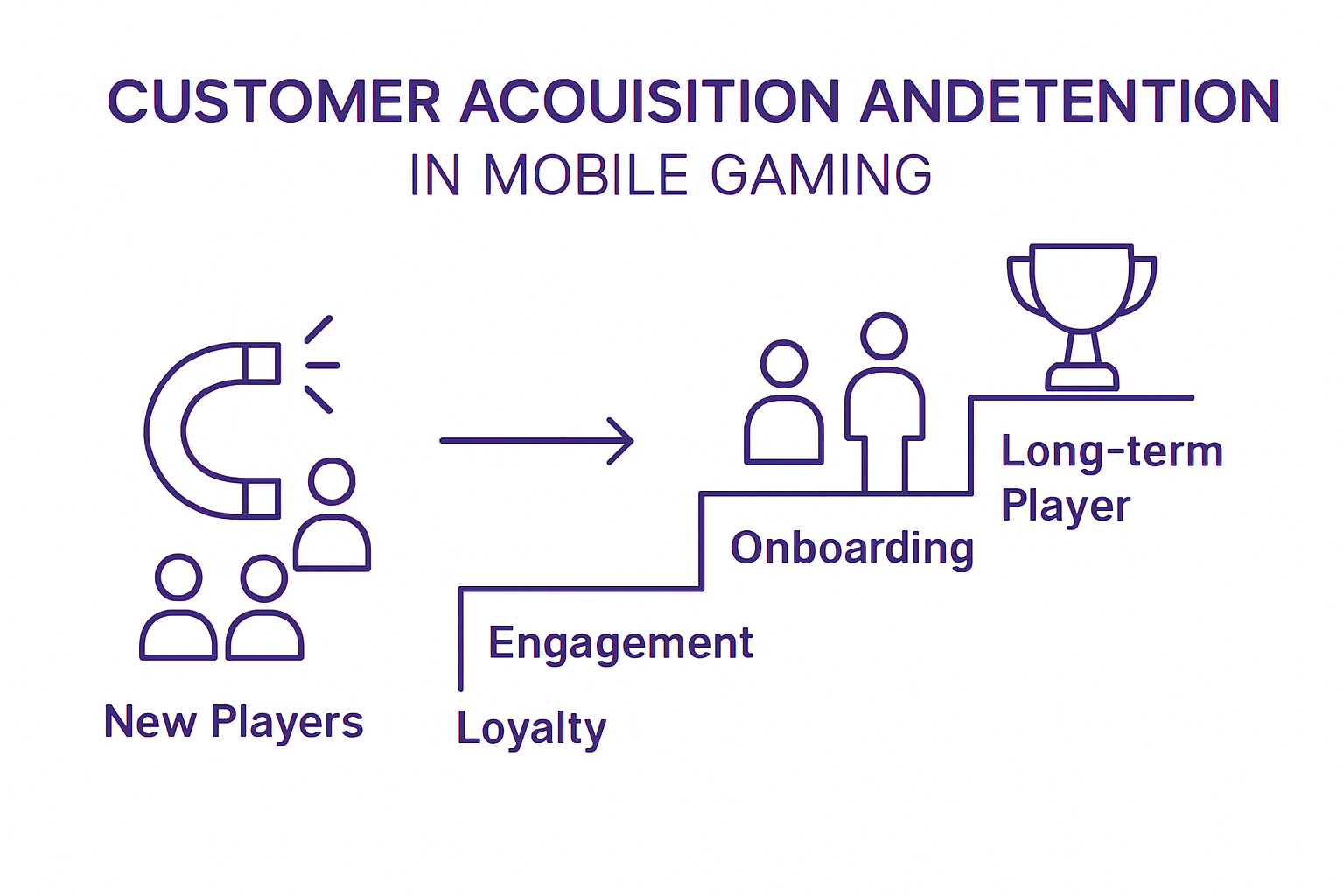
In the competitive mobile gaming industry, understanding customer acquisition and retention is paramount to sustainable growth. Customer acquisition methods represent the strategic processes game developers and marketers employ to attract new players to their mobile gaming platforms.
Customer acquisition cost (CAC) is a critical metric that quantifies the total expense incurred when gaining a new mobile game player. This includes marketing expenditures, advertising costs, promotional campaigns, and resources dedicated to attracting potential gamers. User acquisition in mobile gaming requires a nuanced approach that balances investment with potential player lifetime value.
Conversely, customer retention focuses on maintaining player engagement and preventing user churn. Retention strategies aim to create compelling gameplay experiences, introduce regular content updates, implement reward systems, and foster a sense of community. User retention techniques are essential for mobile game developers seeking to transform initial player interest into long-term player loyalty. Successful retention involves understanding player motivations, addressing gameplay friction points, and continuously evolving the gaming experience to meet player expectations.
Key strategies for effective customer acquisition and retention include:
- Developing engaging and innovative game mechanics
- Implementing personalised player experiences
- Creating robust community engagement platforms
- Offering regular content updates and challenges
- Designing intuitive and rewarding progression systems
By mastering these interconnected approaches, mobile game developers can build sustainable player ecosystems that drive both initial attraction and ongoing player commitment.
Key Approaches In Mobile Gaming Marketing
Mobile game marketing requires sophisticated strategies that go beyond traditional advertising methods. Mobile game user acquisition strategies have evolved to incorporate sophisticated techniques that target specific player demographics and behavioural patterns.

Gamification has emerged as a powerful marketing approach, integrating interactive design elements to enhance user engagement. By leveraging personalised ads, developers can create targeted experiences that resonate with specific player segments. The integration of game-like mechanics into marketing campaigns transforms passive advertising into an immersive, interactive experience that captures player attention more effectively.
The freemium model represents another critical marketing strategy in mobile gaming. This approach allows players to download and experience core game content without upfront costs, while offering optional in-game purchases. Players can enjoy basic gameplay mechanics, with monetisation strategies carefully designed to provide value without creating perceived barriers to enjoyment. Advanced freemium models incorporate nuanced design features that cater to diverse player motivations, balancing accessibility with revenue generation.
Key marketing approaches in mobile gaming include:
- Implementing targeted advertising campaigns
- Developing personalised player engagement strategies
- Creating interactive and immersive ad experiences
- Utilising data-driven player segmentation
- Designing flexible monetisation models
- Offering compelling value propositions
Successful mobile game marketing demands a holistic approach that combines technical insight, creative design, and deep understanding of player psychology. By continuously adapting strategies and embracing innovative techniques, game developers can effectively attract and retain players in an increasingly competitive digital landscape.
Data-Driven Targeting And Segmentation Methods
Data-driven targeting represents a sophisticated approach to understanding and engaging mobile game players with unprecedented precision. Audience targeting in mobile gaming has transformed from broad demographic approaches to intricate, behaviour-based segmentation strategies that unlock deeper player insights.
Clustering techniques have revolutionised player analysis, enabling developers to understand audience segmentation with remarkable depth. Advanced analytical methods now allow game marketers to categorise players based on nuanced behavioural patterns, playing styles, and engagement metrics. These sophisticated segmentation approaches go beyond traditional demographic categorisations, creating multidimensional player profiles that capture the complex motivations driving mobile game engagement.
Modern data-driven strategies leverage multiple targeting dimensions, incorporating:
- Behavioural tracking and analysis
- Engagement frequency metrics
- In-game purchase patterns
- Player skill progression
- Social interaction levels
- Motivational psychological profiling
The ultimate goal of these sophisticated targeting methods is to create hyper-personalised experiences that resonate with specific player archetypes. By understanding the unique characteristics and preferences of different player segments, mobile game developers can craft marketing strategies, game mechanics, and monetisation approaches that feel individually tailored, significantly enhancing player satisfaction and long-term retention.
Optimising Campaign Budgets And ROI
Optimising marketing budgets in mobile gaming requires a strategic, data-driven approach that balances cost-effectiveness with player acquisition potential. Advertising performance metrics play a crucial role in understanding the nuanced relationship between marketing expenditure and game player engagement.
Developers can enhance campaign efficiency through systematic experimentation and targeted approaches. A/B testing strategies for mobile game advertisements enable precise refinement of marketing messaging, helping teams identify the most compelling content that drives player conversion while minimising unnecessary spending. By implementing continuous testing and iterative improvements, mobile game marketers can progressively reduce customer acquisition costs and improve overall return on investment.
Key strategies for optimising campaign budgets and maximising ROI include:
- Implementing rigorous performance tracking
- Utilising granular audience segmentation
- Developing multi-variant testing protocols
- Creating dynamic, responsive marketing campaigns
- Continuously refining targeting parameters
- Measuring player lifetime value against acquisition costs
Successful budget optimisation demands a holistic approach that combines technical analytics with creative marketing insights. By leveraging data-driven methodologies and maintaining flexibility in campaign strategies, mobile game developers can create highly efficient marketing approaches that deliver substantial returns while minimising financial risk.
Common Pitfalls And How To Avoid Them
Mobile game marketing requires vigilance against numerous strategic and ethical challenges that can undermine player trust and campaign effectiveness. Monetisation strategies demand careful navigation, particularly when balancing revenue generation with player experience and ethical considerations.
Addressing gaming experimentation challenges involves recognising the complex dynamics of player engagement and potential exploitation risks. Developers must implement transparent approaches that respect player autonomy while maintaining sustainable business models. Ethical monetisation involves creating clear value propositions, avoiding manipulative design patterns, and providing genuine player choice in purchasing decisions.
Key pitfalls to avoid in mobile game marketing include:
- Implementing predatory in-app purchase mechanics
- Obscuring true cost structures
- Creating artificially limited gameplay experiences
- Exploiting psychological manipulation techniques
- Neglecting player feedback and community sentiment
- Designing opaque reward systems
Successful mobile game marketing transcends mere transactional interactions. By prioritising player trust, maintaining transparent communication, and designing genuinely engaging experiences, developers can build sustainable player relationships that generate long-term value and positive community reputation.
Accelerate Your Customer Acquisition and Retention with Playable Ads
Mobile game developers face the constant challenge of attracting new players while keeping them engaged over time. This article highlights essential strategies like personalised player experiences and innovative gameplay mechanics that drive retention and reduce churn. However, executing these tactics can be costly and time-consuming, especially when development resources are stretched thin or budgets are tight. Creating interactive and immersive ads quickly without overwhelming your team is critical to mastering both acquisition and retention.
At PlayableMaker, we understand these pain points and offer a no-code solution designed to help you build highly engaging playable ads fast and budget-friendly. Our platform empowers marketing teams and developers to craft captivating experiences that resonate with segmented audiences and improve conversion rates, all while preserving valuable resources. Discover how easy it is to create ads that drive measurable results by exploring our Uncategorized Archives for inspiration and best practices.
Ready to boost your mobile game’s growth with less effort and greater impact Try our platform now at https://app.playablemaker.com and transform your customer acquisition and retention strategies today.
Frequently Asked Questions
What is customer acquisition in mobile gaming?
Customer acquisition in mobile gaming refers to the strategic processes that game developers and marketers use to attract new players to their games. This includes various methods such as marketing expenditures, advertising costs, and promotional campaigns.
How is the customer acquisition cost (CAC) calculated?
Customer Acquisition Cost (CAC) is calculated by summing up all the expenses incurred in gaining a new mobile game player, which includes marketing spend, advertising costs, and resources used to attract potential players, then dividing this total by the number of new users acquired.
What are effective strategies for customer retention in mobile games?
Effective customer retention strategies include developing engaging gameplay experiences, implementing reward systems, regularly updating content, and fostering a strong sense of community among players to encourage ongoing engagement and loyalty.
How can data-driven targeting improve player engagement?
Data-driven targeting enhances player engagement by allowing developers to segment players based on behavioural patterns and preferences. This approach enables the creation of hyper-personalised experiences that resonate with specific player archetypes, significantly improving player satisfaction and retention.
Recommended
- Customer Acquisition Methods: Complete Mobile Gaming Guide – playablemaker.com Customer Acquisition Methods: Complete Mobile Gaming Guide
- What is User Retention? Understanding Its Importance – playablemaker.com What is User Retention? Understanding Its Importance
- Understanding What is User Acquisition in Mobile Gaming – playablemaker.com Understanding What is User Acquisition in Mobile Gaming
- Understanding User Acquisition Strategy for Apps – playablemaker.com Understanding User Acquisition Strategy for Apps
- Making Learning Fun: Engaging Activities for Your Kids – The Zoofamily