
Mobile game marketers face a brutal reality in 2026. Privacy regulations have stripped away over half the granular user data that once powered precise ad targeting, leaving many scrambling to maintain acquisition performance. Yet innovative user acquisition specialists are thriving by embracing no-code playable ad tools and privacy-safe targeting methods that deliver exceptional results without draining budgets or developer resources. This guide walks you through practical, actionable strategies to adapt your mobile ad targeting for the privacy-first era, leveraging behavioural segmentation, AI-driven optimisation, and interactive creatives that convert.
Table of Contents
- Understanding The Impact Of Privacy Changes On Mobile Ad Targeting
- Preparing Your Mobile Ad Targeting Strategy With No-Code Tools
- Executing Targeted Mobile Ads Using Playable No-Code Creatives
- Verifying And Optimising Your Mobile Ad Targeting Outcomes
- Discover No-Code Playable Ad Tools To Boost Your Targeting
Key takeaways
| Point | Details |
|---|---|
| Privacy shifts reshape targeting | Post-ATT privacy changes reduce granular data by over 50%, forcing reliance on aggregate insights and contextual signals. |
| Behavioural segmentation drives results | Data-driven targeting improves engagement by 30%+ and significantly boosts lifetime value across mobile gaming campaigns. |
| No-code playables cut costs | Interactive ads created with drag-and-drop tools reduce CPI by 20-40% whilst accelerating production timelines. |
| AI optimisation enhances ROAS | Value-based bidding combined with AI-powered DSPs delivers 3.4x-4x D7 ROAS through intelligent audience refinement. |
| Incrementality replaces attribution | Aggregate measurement and incrementality testing provide privacy-safe performance insights when user-level tracking fails. |
Understanding the impact of privacy changes on mobile ad targeting
Apple’s App Tracking Transparency framework fundamentally altered mobile advertising in 2021, and its ripple effects continue reshaping targeting strategies in 2026. The post-ATT privacy changes reduce granular data by over 50%, eliminating the individual user tracking that once enabled hyper-precise audience targeting. Mobile marketers can no longer rely on device-level identifiers to follow users across apps and websites, forcing a complete rethink of acquisition tactics.
This seismic shift pushed the industry towards aggregated behavioural data and contextual signals. Rather than tracking individual users, marketers now analyse patterns across user cohorts, identifying trends in app categories, gameplay preferences, and engagement behaviours. SKAdNetwork 4.0 emerged as Apple’s privacy-compliant attribution solution, providing campaign performance data without exposing individual user identities. The framework aggregates conversion events and delays reporting to prevent user fingerprinting, giving marketers enough insight to optimise whilst respecting privacy boundaries.
Modern measurement strategies now prioritise probabilistic modelling and incrementality testing over deterministic attribution. Consider these essential adaptations:
- Probabilistic models estimate user journeys by analysing statistical patterns rather than tracking individuals
- Incrementality tests measure true campaign impact by comparing exposed and control groups
- Cohort analyses replace individual user tracking to identify high-value segments
- Contextual targeting leverages app categories and content themes instead of personal data
The era of micro-targeting individual users has ended. Success in 2026 requires mastering segment-based approaches that balance privacy compliance with performance goals.
This transformation actually benefits mobile game marketers willing to adapt. Broader segment-based targeting often performs better than over-segmented micro-audiences, reducing wasted spend on tiny, unstable groups. The challenge lies in identifying meaningful behavioural segments without granular data, which is precisely where no-code tools and AI optimisation shine.
Preparing your mobile ad targeting strategy with no-code tools
Successful mobile ad targeting in the privacy-first era demands proper groundwork before launching campaigns. Start by assembling these essential components:
- Access to a demand-side platform with AI-driven optimisation capabilities
- Behavioural data sources covering genre preferences, session patterns, and engagement metrics
- No-code creative tools for rapid playable ad production and iteration
- Attribution framework supporting SKAdNetwork and probabilistic modelling
- Analytics infrastructure for cohort tracking and incrementality measurement
Once your foundation is solid, segment users based on observable behaviours rather than personal identifiers. Genre affinity provides powerful targeting signals for mobile games. Players who engage heavily with puzzle games exhibit different acquisition costs and lifetime values compared to action game enthusiasts. Layer behavioural traits like session frequency, average playtime, and in-app purchase propensity to create meaningful segments without violating privacy boundaries.
Full-funnel strategies that use value-based bidding combined with genre-specific creatives and AI DSPs drive better ROAS. Value-based bidding tells your DSP to prioritise users likely to generate high lifetime value rather than simply optimising for install volume. This approach aligns acquisition spending with revenue potential, dramatically improving campaign economics. AI-powered platforms analyse thousands of signals to predict user quality, adjusting bids in real-time based on likelihood to engage and monetise.
Creative formats must match game genres to maximise engagement. Casual puzzle games benefit from simple, immediately understandable playable ads that showcase core mechanics in seconds. Strategy games require more complex interactive experiences demonstrating depth and progression systems. Action titles need fast-paced, visually striking creatives that communicate excitement. Using a playable builder drag-and-drop creator enables rapid testing of multiple creative approaches without consuming developer resources.

Pro Tip: Begin with three to five broad user segments based on genre preference and engagement level before adding behavioural complexity. Over-segmentation fragments your audience into unstable micro-groups that prevent algorithms from optimising effectively. Master broad segments first, then refine based on performance data.
Executing targeted mobile ads using playable no-code creatives
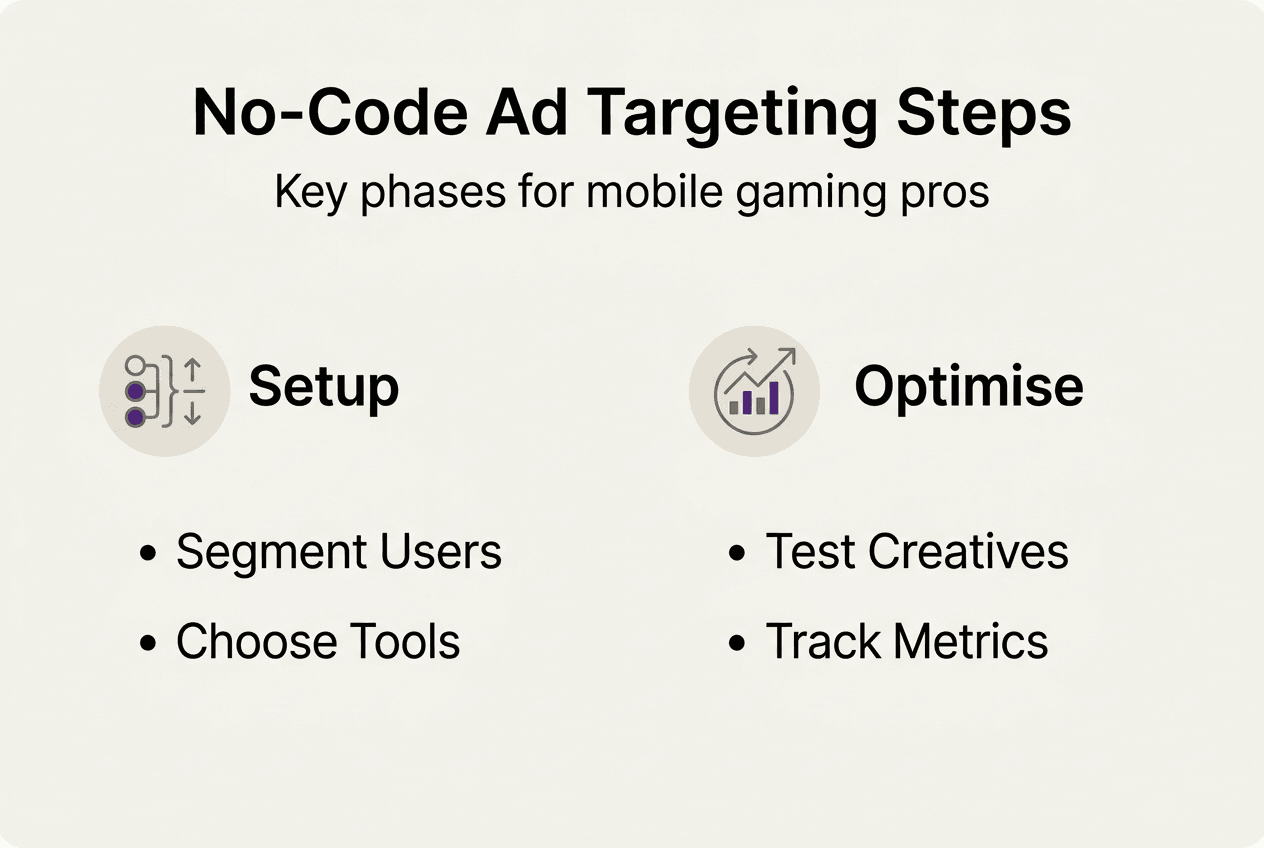
Launching effective targeted campaigns requires systematic execution that combines behavioural segmentation with engaging interactive creatives. Follow this proven implementation sequence:
- Define your core user segments using genre affinity and engagement patterns
- Create segment-specific playable ads using no-code drag-and-drop tools
- Configure value-based bidding parameters aligned with LTV projections
- Set up SKAdNetwork conversion values to track quality signals
- Launch campaigns with AI DSP optimisation enabled from day one
- Monitor initial performance and gather statistically significant data before adjusting
Behavioural and psychographic segmentation during campaign setup separates high-performers from mediocre marketers. Beyond basic demographics, consider these powerful targeting dimensions:
- Time-of-day engagement patterns revealing casual versus hardcore players
- Cross-genre affinity indicating openness to new game types
- Monetisation behaviour showing willingness to make in-app purchases
- Social engagement levels predicting viral potential and organic growth
- Device specifications indicating graphics quality expectations
Empirical benchmarks show behavioural targeting improves engagement 30%+, with playables cutting CPI by 20-40% compared to static creatives. The interactivity advantage stems from self-selection: users who engage with playable ads demonstrate genuine interest in your game mechanics before installing, resulting in higher quality acquisitions with better retention and monetisation.
Compare traditional approaches against no-code playable strategies:
| Metric | Static banner ads | Video ads | No-code playable ads |
| — | — | — |
| Average CPI | £2.80-£4.50 | £1.90-£3.20 | £1.40-£2.60 |
| Day 1 retention | 18-25% | 25-35% | 38-52% |
| Day 7 retention | 8-12% | 12-18% | 20-28% |
| Production time | 2-4 hours | 1-2 days | 3-6 hours |
| Developer resources | Minimal | Moderate | None |
These performance gaps compound over campaign lifecycles. Better retention translates to higher LTV, justifying increased acquisition spending and creating a virtuous cycle. Understanding why playable ads convert better helps optimise creative strategy for maximum impact.
Key behavioural signals and creative formats effective across mobile game categories include:
- Puzzle games: Simple mechanic demonstrations with clear win conditions
- Strategy games: Resource management previews showing progression depth
- Action games: Skill-based challenges highlighting responsive controls
- Casual games: Relaxing, low-pressure experiences emphasising fun over competition
- RPG titles: Character customisation and story hooks creating emotional investment
Pro Tip: Enable real-time AI DSP optimisation from campaign launch rather than waiting for manual analysis. Modern platforms adjust bidding and audience targeting continuously, identifying high-value user patterns faster than human marketers. This automated refinement becomes especially critical when managing multiple segments and creative variants simultaneously. Explore the advantages of interactive ads to maximise your creative strategy.
Verifying and optimising your mobile ad targeting outcomes
Monitoring campaign performance in the aggregate measurement era requires different metrics and methodologies than traditional attribution models. Focus on incremental lift rather than last-click attribution, measuring the true impact of your campaigns by comparing exposed groups against holdout controls. This incrementality approach reveals whether your targeting actually drives additional installs or simply captures users who would have converted organically.
ROAS interpretation becomes nuanced when working with delayed, aggregated data from SKAdNetwork. Rather than expecting immediate attribution, analyse cohort performance over seven, fourteen, and thirty-day windows. Persona.ly reports 3.4x-4x D7 ROAS with data-driven targeting, whilst advanced retargeting delivers +12% to +138% ROAS uplift depending on segment sophistication and creative quality.
Common troubleshooting scenarios and solutions:
- Over-segmentation fragmenting audiences: Consolidate into broader groups with sufficient scale for algorithmic optimisation
- Creative fatigue reducing engagement: Rotate playable variants weekly using no-code tools for rapid iteration
- Attribution delay masking performance: Extend evaluation windows and focus on leading indicators like engagement rate
- Budget pacing issues: Implement dayparting based on peak user activity patterns
- Cross-platform inconsistencies: Separate iOS and Android campaigns with platform-specific creative adaptations
Optimisation techniques comparison:
| Technique | Implementation complexity | Expected ROAS improvement | Time to impact |
|---|---|---|---|
| Incrementality testing | Moderate | 15-30% | 2-4 weeks |
| Value-based bidding | Low with AI DSP | 25-45% | 1-2 weeks |
| Genre-focused creatives | Low with no-code tools | 30-60% | 3-7 days |
| Behavioural segmentation | Moderate | 20-40% | 1-3 weeks |
| Cohort-based measurement | High | 10-25% | 4-6 weeks |
Best practices for ongoing campaign adjustments:
- Review segment performance weekly, adjusting budgets towards high-LTV cohorts
- Refresh playable ad creatives bi-weekly to combat engagement decay
- Test new behavioural segments monthly whilst maintaining control groups
- Analyse cross-funnel metrics from acquisition through re-engagement
- Document learnings systematically to build institutional knowledge
Balanced funnel measurement proves essential for sustainable growth. Acquisition metrics like CPI and install volume matter, but retention and monetisation determine profitability. Track the complete user journey from first impression through long-term engagement, identifying where targeting improvements deliver maximum impact. Strong acquisition targeting should produce users who not only install but remain active and generate revenue over time. Implement comprehensive customer acquisition retention strategies to optimise the entire user lifecycle.
Discover no-code playable ad tools to boost your targeting
The targeting strategies covered throughout this guide become dramatically more effective when paired with professional no-code playable ad creation tools. Rather than waiting days or weeks for developer resources, marketing teams can iterate creative concepts in hours, testing multiple approaches across different user segments simultaneously. This production speed advantage translates directly to campaign performance, enabling rapid optimisation cycles that outpace competitors stuck in traditional workflows.
No-code platforms eliminate the technical barriers that once limited playable ad adoption to large studios with dedicated development teams. Drag-and-drop interfaces make interactive ad creation accessible to marketers without coding skills, democratising a format that consistently outperforms static and video alternatives. The playable ads psychology explained reveals why interactivity drives superior engagement and conversion rates.
Explore comprehensive resources on playable ads explained to understand how this format revolutionises digital engagement. When you’re ready to create your first campaign, the playable builder drag-and-drop creator provides everything needed to launch professional interactive ads without technical expertise or excessive budgets.
FAQ
What is SKAdNetwork and why does it matter for mobile ad targeting?
SKAdNetwork 4.0 enables privacy-safe, aggregated attribution helping mobile marketers measure campaign effectiveness without revealing user identities. Apple’s framework aggregates conversion data and delays reporting to prevent individual tracking whilst providing enough signal for campaign optimisation. This matters because it represents the primary attribution mechanism for iOS campaigns in 2026, replacing device-level tracking with privacy-compliant measurement. Marketers must design campaigns around SKAdNetwork’s constraints, using conversion values strategically to capture meaningful performance signals within the aggregated data structure.
How can no-code tools improve mobile user acquisition campaigns?
No-code platforms dramatically accelerate creative production, enabling marketing teams to build and test playable ads in hours rather than weeks. This speed advantage allows rapid iteration across multiple user segments and creative concepts, identifying winning combinations faster than competitors relying on traditional development workflows. The playable builder no-code creator eliminates developer dependencies, letting marketers respond immediately to performance data and market trends. Beyond speed, no-code tools reduce costs substantially, making premium interactive formats accessible to studios of all sizes rather than only large enterprises with extensive technical resources.
What metrics should I track to verify targeting success post-privacy changes?
Tracking incrementality tests, ROAS, and engagement metrics is vital as traditional user-level attribution declines. Focus on aggregate return on ad spend measured across cohorts rather than individual user journeys, using seven, fourteen, and thirty-day windows to capture delayed conversions. Monitor engagement lift by comparing exposed groups against holdout controls to measure true incremental impact. Segment-level performance metrics reveal which behavioural groups deliver superior lifetime value, guiding budget allocation decisions. Cohort retention analyses provide early signals of user quality before monetisation fully materialises, enabling faster optimisation cycles in the aggregate measurement era.
Why do playable ads outperform static creatives for mobile game targeting?
Interactive playable ads create self-selection effects that dramatically improve user quality and retention rates. Users who engage with playable mechanics before installing demonstrate genuine interest in your game’s core loop, resulting in higher day one and day seven retention compared to users acquired through passive formats. This pre-install qualification reduces wasted spend on users likely to churn immediately, improving overall campaign economics. The hands-on experience also sets accurate expectations, reducing negative reviews from users surprised by gameplay that differs from advertised content. Playables essentially function as interactive product demonstrations, letting potential players sample your game before committing to an install.
How quickly can I expect results from implementing these targeting strategies?
Initial performance signals typically emerge within three to seven days for campaigns with sufficient daily spend, though statistical significance requires one to two weeks of data collection. Value-based bidding and AI DSP optimisation deliver fastest impact, often showing measurable ROAS improvements within the first week as algorithms identify high-value user patterns. Genre-focused creative optimisation produces results almost immediately, with engagement rate improvements visible in initial campaign days. Behavioural segmentation refinements require longer evaluation periods, typically two to four weeks, as you need adequate sample sizes across segments to draw reliable conclusions. Incrementality testing demands the longest timeframes, usually four to six weeks, to account for delayed conversions and ensure control group validity.
Recommended
- What is Ad Targeting? Understanding Its Importance and Mechanics – playablemaker.com What is Ad Targeting? Understanding Its Importance and Mechanics
- Understanding Ad Audience Targeting in Mobile Gaming – playablemaker.com Understanding Ad Audience Targeting in Mobile Gaming
- Ad tech trends 2026: create playable ads fast and affordably – playablemaker.com Ad tech trends 2026: create playable ads fast and affordably
- How to Repurpose Ad Creatives for Mobile Gaming Success – playablemaker.com How to Repurpose Ad Creatives for Mobile Gaming Success