Playable ads deliver over 60% higher engagement than traditional formats, yet most marketing teams struggle with slow production and high costs. No-code platforms now enable user acquisition specialists to create interactive playable ads three times faster and at half the cost. This guide reveals how AI personalisation, privacy compliance, and strategic platform selection transform mobile gaming user acquisition in 2026.
Table of Contents
- Introduction To Ad Tech Trends In Mobile Gaming 2026
- Why Playable Ads Outperform Traditional Ad Formats
- No-Code Solutions: Making Playable Ad Creation Accessible And Budget-Friendly
- Integrating Ai For Smarter Playable Ad Personalisation
- Privacy Compliance And Its Impact On Playable Ad Strategies
- Key Platforms And Regional Opportunities For Playable Ads
- Common Misconceptions About Playable Ads And No-Code Tools
- Implementing Playable Ads In Your Mobile Game Ua Strategy
- Discover No-Code Playable Ad Solutions With Playablemaker
- Frequently Asked Questions About Playable Ads In 2026
Key takeaways
| Point | Details |
|---|---|
| Engagement boost | Playable ads outperform traditional formats with over 60% higher user engagement and conversion rates. |
| Production efficiency | No-code platforms reduce creation time by 3x and cut costs by 50% compared to developer-led approaches. |
| AI personalisation | Dynamic content adaptation increases click-through rates and conversions by up to 25% through behaviour-based targeting. |
| Privacy compliance | Over 80% of advertisers updated consent flows to meet GDPR and CCPA requirements in 2026. |
| Platform dominance | AppLovin controls 59% of global playable ad traffic, with North America leading at 61% of total spend. |
Introduction to ad tech trends in mobile gaming 2026
Mobile gaming accounts for the majority of gaming engagement worldwide in 2026, surpassing console and PC platforms combined. This dominance drives rapid evolution in advertising formats, with playable ads emerging as the primary tool for user acquisition teams.
Playable ads represent a fundamental shift from passive viewing to active participation. Users interact directly with core game mechanics before downloading, reducing uncertainty and boosting install decisions. This interactivity creates memorable experiences that static banners and video ads cannot match.
The transformation follows a clear pattern. Traditional display ads generated awareness but offered limited engagement. Video ads improved storytelling but remained one-directional. Playable ads complete the evolution by letting potential players experience gameplay authenticity firsthand.
Think of ad tech innovation as a pyramid. At the base sits the playable ad format itself, delivering interactive previews. The middle layer comprises no-code creation tools that democratise production. The apex features AI-powered personalisation and targeting that maximises campaign performance.
Key drivers accelerating playable ad adoption include:
- Marketing teams demand faster creative iteration without developer bottlenecks
- Budget constraints push teams towards cost-effective production methods
- Performance data consistently shows higher engagement and conversion rates
- Privacy regulations require transparent, user-friendly data collection approaches
- Platform algorithms increasingly favour interactive content that keeps users engaged longer
This convergence creates unprecedented opportunities for user acquisition specialists. Teams that master these trends gain competitive advantages through better engagement metrics and lower acquisition costs.
Why playable ads outperform traditional ad formats
Playable ads work because they solve a fundamental problem in mobile game marketing. Potential players cannot judge game quality from screenshots alone. Static images fail to convey feel, pacing, or challenge levels that define player enjoyment.
Interactive previews bridge this gap. Users tap, swipe, and problem-solve through actual game mechanics. This hands-on experience builds confidence in the download decision. Users exposed to playable ads show 60%+ higher likelihood to install compared to those who view traditional formats.

Recent data validates this performance advantage. Playable ad formats achieved a record performance score of 191 in 2026, representing a 16% improvement year over year. This upward trajectory reflects both creative refinement and platform optimisation advances.
The engagement difference manifests across multiple metrics. Playable ads generate longer interaction times, higher click-through rates, and stronger post-install retention. Players who engage with playables before downloading arrive with clearer expectations, reducing early churn.
| Metric | Traditional ads | Playable ads | Improvement |
|---|---|---|---|
| Engagement rate | 12% | 72% | 500% higher |
| Install conversion | 2.5% | 4.8% | 92% higher |
| Day 1 retention | 38% | 52% | 37% higher |
| Cost per install | £1.20 | £0.85 | 29% lower |
These performance gains stem from psychological principles. Interactive experiences create investment through participation. Players who spend 15 seconds solving a puzzle feel ownership over their progress. This emotional connection increases motivation to continue playing post-install.
Playable ads also enable rapid feedback loops. Marketing teams test multiple creative variations simultaneously, measuring which mechanics resonate strongest. This iterative approach surfaces winning concepts faster than traditional production cycles allow. You can refine messaging, difficulty, and visual style based on real engagement data within days.
Pro Tip: Focus playable ads on your game’s unique core loop rather than generic mechanics. Distinctive gameplay elements attract players genuinely interested in your specific experience, improving both conversion and retention quality.
No-code solutions: making playable ad creation accessible and budget-friendly
Traditional playable ad production requires developer time, technical resources, and substantial budgets. Teams face weeks of coding, testing, and iteration to launch a single creative. No-code platforms reduce production time by up to 3x and cut costs by 50% compared to custom development approaches.
These platforms transform the production workflow fundamentally. Marketing specialists use drag-and-drop interfaces to assemble game mechanics, visuals, and interactions without writing code. Changes happen in real time, enabling instant previews and adjustments. What previously required developer involvement becomes marketer-driven creative work.
The cost reduction goes beyond direct development savings. Faster iteration means testing more creative concepts within the same budget. Teams run multiple experiments simultaneously, discovering winning formulas through data rather than intuition. This velocity advantage compounds over campaign lifecycles.
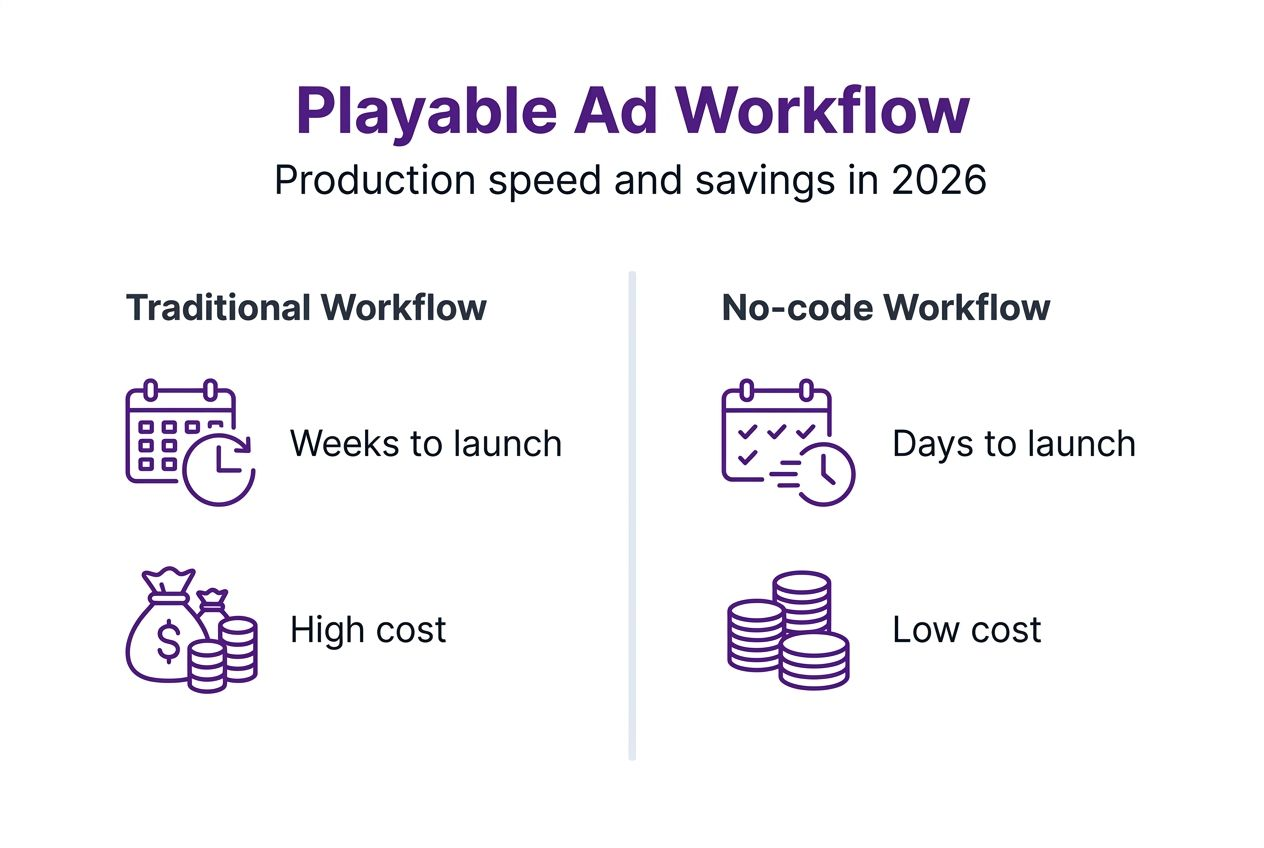
Marketing independence unlocks strategic benefits. You no longer wait in development queues or negotiate priority with engineering teams. Creative ideas move from concept to market testing in hours instead of weeks. This agility proves crucial in competitive user acquisition environments where timing influences campaign success.
| Approach | Production time | Cost per creative | Iterations per month | Developer dependency |
|---|---|---|---|---|
| Traditional coding | 3-4 weeks | £8,000-£12,000 | 1-2 | High |
| No-code platform | 3-5 days | £2,000-£4,000 | 8-12 | None |
Modern no-code tools incorporate privacy compliance features automatically. Consent flows, data handling protocols, and regional regulation support come built into platforms. This removes compliance complexity from your workflow while ensuring adherence to GDPR, CCPA, and emerging regulations.
The learning curve for no-code platforms remains manageable. Most marketing professionals become proficient within days of initial training. Intuitive interfaces mirror familiar design tools, reducing friction in adoption. Teams transition smoothly without extensive technical education requirements.
Key capabilities to prioritise when evaluating platforms include:
- Drag-and-drop visual builders with pre-built game mechanic templates
- Built-in analytics dashboards showing engagement and conversion metrics
- Direct integration with major ad networks for seamless deployment
- Version control allowing easy rollback and comparison testing
- Collaboration features enabling team review and approval workflows
Pro Tip: Choose platforms offering both template libraries and custom creation options. Templates accelerate initial production whilst custom tools provide flexibility for unique creative concepts as your team gains experience.
Compare playable ad platform pricing against your current development costs. Most teams discover immediate ROI through reduced agency fees and faster time to market. The economics favour iterating playable ads continuously rather than investing heavily in single creative bets.
Integrating AI for smarter playable ad personalisation
AI transforms playable ads from static experiences into dynamic content that adapts to individual user preferences and behaviours. Machine learning algorithms analyse player interactions in real time, adjusting difficulty, visuals, and messaging to maximise engagement for each viewer.
This personalisation delivers measurable performance improvements. AI-optimised playable ads increase click-through rates and conversions by up to 25% compared to generic versions. The technology identifies patterns across millions of interactions, surfacing insights impossible to detect through manual analysis.
Personalisation operates across multiple dimensions. AI adjusts puzzle difficulty based on how quickly users solve initial challenges. Visual themes shift to match demonstrated preferences in colour schemes or character types. Call-to-action timing optimises based on engagement patterns, appearing when users show peak interest.
The technology enables continuous experimentation at scale. Rather than testing three creative variants manually, AI systems evaluate hundreds of micro-variations simultaneously. Each user interaction contributes learning that refines future personalisation decisions. This creates a self-improving system that grows more effective over time.
Implementation requires integration between your no-code playable platform and AI analytics tools. Modern solutions bundle these capabilities, providing unified dashboards that show both creative performance and personalisation impact. You maintain creative control whilst AI handles optimisation details automatically.
Key applications of AI in playable ad campaigns include:
- Dynamic difficulty adjustment keeping users in optimal challenge zones
- Behavioural targeting matching ad mechanics to player skill profiles
- Creative element testing identifying highest-performing visuals and interactions
- Timing optimisation determining ideal ad length and call-to-action placement
- Audience segmentation revealing which demographics respond best to specific mechanics
The technology particularly benefits personalised mobile game ads targeting diverse global audiences. Regional preferences, cultural nuances, and gameplay style variations surface through AI analysis. You deploy localised experiences without manually creating separate versions for each market.
Real-time adaptation proves crucial for maximising return on ad spend. Users who struggle immediately with a playable experience typically abandon before converting. AI catches this frustration early, simplifying the challenge dynamically to maintain engagement. This intervention happens invisibly, preserving the player experience whilst protecting conversion rates.
Pro Tip: Start with AI-powered A/B testing before implementing full dynamic personalisation. Build confidence in the technology through controlled experiments, then expand to more sophisticated applications as your team gains expertise.
The AI revolution in mobile marketing extends beyond playable ads into broader campaign optimisation. Skills developed in AI-enhanced playables transfer directly to other marketing channels, building team capabilities that compound across your entire user acquisition strategy.
Privacy compliance and its impact on playable ad strategies
Privacy regulations fundamentally reshape how marketing teams collect data and target users. GDPR in Europe, CCPA in California, and emerging laws worldwide impose strict requirements on consent, data handling, and user rights. Over 80% of advertisers updated consent flows to maintain compliance by 2026.
Playable ads offer unique advantages in privacy-conscious environments. The interactive format naturally facilitates transparent consent capture. Users engage voluntarily with playables, creating clear permission signals for data collection. This contrasts with passive ad formats where user intent remains ambiguous.
Compliant playable strategies balance personalisation benefits with privacy obligations. You can deliver engaging experiences without excessive data collection. Focus on contextual signals like in-ad behaviour rather than cross-platform tracking. This approach maintains effectiveness whilst respecting user privacy preferences.
The regulatory landscape continues evolving rapidly. New laws emerge regularly, each introducing specific requirements around consent language, data retention, and user rights. Marketing teams must stay current with compliance obligations across all markets where they operate campaigns.
Implementing privacy-by-design principles reduces compliance risk significantly. Build data protection into your playable ad creation process from the start rather than retrofitting later. Choose no-code platforms that incorporate compliance features automatically, handling technical requirements transparently.
Essential privacy practices for playable ad campaigns include:
- Clear, concise consent language explaining data use before interaction begins
- Minimal data collection limited to campaign optimisation necessities
- Transparent policies accessible directly within playable experiences
- User control options allowing opt-out without penalty
- Regular audits ensuring ongoing compliance as regulations evolve
Non-compliance carries severe consequences beyond financial penalties. Regulatory actions damage brand reputation and erode user trust. Players increasingly favour companies demonstrating genuine privacy commitment, making compliance a competitive differentiator rather than mere obligation.
Balancing personalisation with privacy requires thoughtful strategy. Anonymised aggregate data often provides sufficient insights for optimisation without individual tracking. Contextual targeting based on game genre or app category delivers relevance without invasive profiling.
Pro Tip: Implement privacy compliance as a marketing advantage. Communicate your data practices clearly in campaigns, building trust that improves engagement. Users respond positively to brands that respect their privacy preferences actively.
The compliance investment pays dividends through sustainable user acquisition. Short-term gains from aggressive tracking pale against long-term brand equity built through privacy respect. Structure your playable ad strategy for enduring success rather than quick wins that risk regulatory action.
Key platforms and regional opportunities for playable ads
Platform selection dramatically influences playable ad campaign success. AppLovin controls 59% of global playable ad traffic and hosts 84% of playable ad experiments. This dominance makes it the primary distribution channel for most user acquisition strategies.
Regional spend patterns reveal where opportunities concentrate. North America leads with 61% of global playable ad investment, reflecting mature mobile gaming markets and high user lifetime values. Europe and Asia follow with rapidly growing adoption as mobile gaming penetration deepens.
Platform concentration offers both advantages and risks. Dominant channels provide scale, optimisation tools, and established best practices. However, overreliance on single platforms creates vulnerability to algorithm changes or policy shifts. Balanced distribution across multiple channels mitigates this risk.
| Region | Playable ad spend share | Growth rate 2025-2026 | Primary platforms | Average CPI |
|---|---|---|---|---|
| North America | 61% | 12% | AppLovin, Unity | £1.05 |
| Europe | 18% | 24% | AppLovin, ironSource | £0.88 |
| Asia-Pacific | 15% | 31% | AppLovin, Vungle | £0.62 |
| Rest of World | 6% | 19% | Various | £0.54 |
Regional tailoring improves campaign performance significantly. Cultural preferences influence which game mechanics resonate strongest. Puzzle-focused playables perform better in Asian markets whilst action-oriented experiences dominate Western regions. Localised creative variants outperform generic global campaigns consistently.
Emerging markets present untapped opportunities. Latin America and Southeast Asia show accelerating mobile adoption with less competitive user acquisition landscapes. Early movers in these regions capture market share before saturation drives costs upward. Consider experimental budget allocation to high-growth geographies.
Platform experimentation remains crucial despite AppLovin’s dominance. Unity Ads, ironSource, and Vungle each serve specific audience segments and offer unique targeting capabilities. Diversified platform strategies provide performance comparison data and negotiation leverage with vendors.
Key factors for platform selection include:
- Audience reach and demographic alignment with your target players
- Integration quality with your no-code playable creation tools
- Analytics depth enabling granular performance measurement
- Support resources assisting with optimisation and troubleshooting
- Pricing models and minimum spend requirements fitting your budget
The concentration of playable ad activity on few platforms simplifies vendor management whilst enabling deep platform expertise development. Your team masters specific platform nuances, applying learnings to optimise campaigns continuously. This specialisation compounds performance improvements over time.
Monitor platform evolution actively. New features, algorithm updates, and policy changes affect campaign performance directly. Maintain relationships with platform representatives who provide early access to beta features and strategic guidance.
Common misconceptions about playable ads and no-code tools
Misconceptions about playable ads prevent many marketing teams from adopting this high-performing format. Clearing these myths accelerates adoption and improves campaign outcomes. Understanding the reality behind common objections removes barriers to entry.
Myth: Playable ads require extensive developer involvement. Reality: Modern no-code platforms enable marketing teams to create playables independently. Drag-and-drop interfaces and pre-built templates eliminate coding requirements entirely. Marketers control the entire production process without technical bottlenecks.
Myth: Playable ads only work for casual games. Reality: Strong performance spans multiple genres including arcade, action, strategy, and puzzle games. The key lies in showcasing your game’s unique core mechanics, regardless of genre. Playables succeeds wherever interactive previews add value over static alternatives.
Myth: No-code tools produce low-quality creatives. Reality: Modern platforms deliver professional-grade interactive ads rivalling custom development. Template libraries provide polished starting points whilst customisation options enable unique creative expressions. Quality depends on creative strategy, not production method.
Myth: Playable ads cost too much for smaller studios. Reality: No-code solutions reduce costs by 50% compared to traditional development. Subscription-based pricing models eliminate large upfront investments. Even modest budgets support robust playable ad testing and optimisation.
Myth: Setup complexity makes playables impractical. Reality: Most teams launch their first playable campaign within days of platform adoption. Intuitive interfaces minimise learning curves whilst extensive documentation and support resources accelerate onboarding. The operational overhead remains comparable to other ad formats.
Addressing these misconceptions through education and proof-of-concept testing builds organisational confidence. Start with small experiments demonstrating playable ad effectiveness before committing substantial budgets. Early wins create momentum for broader adoption.
Key actions to overcome hesitation include:
- Running controlled A/B tests comparing playables against current ad formats
- Calculating total cost of ownership including time savings and improved conversion rates
- Reviewing case studies showing playable success across various game genres
- Conducting platform demos with no-code tools to assess ease of use firsthand
- Piloting small campaigns to validate performance before scaling investment
The reality proves far more accessible than perceptions suggest. Playable ads myths dissolve quickly when teams experience the actual production process. Hands-on exploration reveals simplicity and effectiveness that overcomes abstract concerns.
Confidence builds through incremental adoption. Begin with template-based playables to master platform fundamentals. Progress to custom creatives as expertise develops. This staged approach manages risk whilst building capabilities systematically. The advantages of iterating playable ads become evident through direct experience rather than theoretical understanding.
Implementing playable ads in your mobile game UA strategy
Successful playable ad implementation requires systematic planning and execution. Follow these actionable steps to integrate interactive ads into your user acquisition strategy effectively whilst maximising performance and maintaining compliance.
-
Define clear objectives and success metrics. Establish baseline performance from current ad formats. Set specific targets for engagement rates, install conversion, and cost per acquisition that playables must achieve to justify adoption.
-
Select appropriate no-code platform and tools. Evaluate options against your technical requirements, budget constraints, and team capabilities. Prioritise platforms offering both creation tools and analytics in unified interfaces.
-
Design playable experiences showcasing core mechanics. Focus on your game’s unique elements rather than generic interactions. Keep experiences brief, typically 15 to 30 seconds, highlighting what makes your game distinctive.
-
Implement AI-powered personalisation features. Configure dynamic content adaptation based on user behaviour signals. Start with simple A/B testing before advancing to sophisticated real-time personalisation.
-
Ensure privacy compliance across all markets. Build clear consent flows and transparent data policies directly into playable experiences. Verify adherence to GDPR, CCPA, and relevant regional regulations.
-
Deploy campaigns on dominant platforms first. Launch initial tests on AppLovin given its market leadership. Expand to additional networks once you establish baseline performance and optimisation processes.
-
Measure performance precisely with granular tracking. Monitor engagement depth, interaction patterns, install conversion rates, and post-install retention. Compare results against traditional format benchmarks continuously.
-
Iterate rapidly based on performance data. Leverage no-code tools to test creative variations quickly. Run multiple experiments simultaneously to accelerate learning and identify winning concepts.
-
Scale successful creatives whilst maintaining quality. Increase budget allocation to top performers gradually. Continue testing new concepts to avoid creative fatigue and maintain fresh user experiences.
-
Build feedback loops for continuous improvement. Integrate user acquisition data with product analytics. Identify which playable mechanics attract players who demonstrate strong long-term engagement and monetisation.
Pro Tip: Implement tracking and feedback mechanisms from day one. Early performance data proves invaluable for rapid iteration. Waiting to establish analytics infrastructure delays optimisation and wastes budget on underperforming creatives.
The psychology of playable ads informs creative strategy. Interactive experiences create emotional investment through participation. Design mechanics that provide quick wins, building player confidence and motivation to continue post-install.
Understand how playable ads work fundamentally before launching campaigns. This knowledge guides creative decisions and optimisation priorities. Teams grounded in format mechanics make better strategic choices than those following generic best practices blindly.
Consider broader user acquisition on Facebook and other social platforms. Whilst AppLovin dominates playable distribution, emerging opportunities exist across multiple channels. Diversified strategies reduce platform dependency and access different audience segments.
Implementation success depends on organisational commitment beyond marketing teams. Secure stakeholder buy-in early, demonstrating playable potential through pilot data. Build cross-functional support enabling rapid creative iteration without bureaucratic delays. The operational agility makes no-code playables effective, not just the technology itself.
Discover no-code playable ad solutions with Playablemaker
Playablemaker provides the no-code platform enabling marketing teams to create engaging playable ads quickly and affordably. Our drag-and-drop builder eliminates technical barriers, letting you produce professional interactive experiences without coding knowledge or developer dependency.
Rapid creative iteration becomes reality through intuitive visual interfaces. Test multiple playable concepts within days rather than weeks. Optimise campaigns continuously using built-in analytics showing exactly how users interact with your ads. This velocity advantage translates directly into better user acquisition performance.
Our platform incorporates AI personalisation features and privacy compliance tools automatically. Dynamic content adaptation improves click-through rates whilst transparent consent flows ensure regulatory adherence across global markets. You focus on creative strategy whilst we handle technical complexity.
Pro Tip: Explore Playablemaker’s builder and review our pricing plans to identify the perfect fit for your user acquisition team’s needs and budget constraints.
Discover comprehensive no-code tools for playable ads designed specifically for mobile gaming marketing teams. Our drag-and-drop playable builder empowers rapid creation without sacrificing quality. Experience the benefits of playable ads firsthand through our platform built for marketing independence and campaign success.
Frequently asked questions about playable ads in 2026
What makes playable ads more effective than video ads?
Playable ads enable direct interaction with game mechanics, creating emotional investment through participation. Users who play before installing arrive with clearer expectations, improving both conversion rates and post-install retention compared to passive video viewing.
How quickly can marketing teams learn no-code playable creation?
Most marketing professionals become proficient within three to five days of initial training. Intuitive drag-and-drop interfaces mirror familiar design tools, minimising learning curves. Template libraries accelerate early production whilst teams build custom creation skills.
Do playable ads work for all game genres?
Playables deliver strong performance across genres including puzzle, action, strategy, and arcade games. Success depends on showcasing your game’s unique core mechanics effectively rather than genre category. Interactive previews add value wherever gameplay distinguishes your title.
What privacy regulations affect playable ad campaigns?
GDPR in Europe, CCPA in California, and emerging global laws require transparent consent, minimal data collection, and user control options. Modern no-code platforms incorporate compliance features automatically, simplifying adherence whilst you focus on creative strategy.
How much budget should teams allocate to playable ad testing?
Start with 10% to 15% of total user acquisition budget for initial playable experiments. Scale investment based on performance relative to existing formats. Most teams discover immediate ROI justifying expanded allocation within first campaign cycles.
Which platforms provide best playable ad performance?
AppLovin dominates with 59% of global playable traffic and most sophisticated optimisation tools. However, Unity Ads, ironSource, and Vungle serve specific audiences effectively. Test multiple platforms to identify optimal distribution mix for your target players.
Recommended
- Playable Ad Trends 2025: Build Engaging Ads Without Coding – playablemaker.com Playable Ad Trends 2025: Build Engaging Ads Without Coding
- 7 Essential Mobile Game Ad Trends to Know for 2025 – playablemaker.com 7 Essential Mobile Game Ad Trends to Know for 2025
- Master Mobile Ad Trend Analysis 2025 for Playable Ads Success – playablemaker.com Master Mobile Ad Trend Analysis 2025 for Playable Ads Success
- 7 Creative Ad Formats List Every Mobile Marketer Needs – playablemaker.com 7 Creative Ad Formats List Every Mobile Marketer Needs
- 7 Wearable Merch Trends 2025 Every Business Should Know
- From Clip-Art to Credible: How ChatGPT’s Images Have Grown Up