
TL;DR:
- Mobile ad privacy involves technical controls and legal frameworks that regulate how user data and identifiers are managed during advertising. Controlling access to advertising identifiers like IDFA and GAID is essential for compliance with laws such as GDPR and Apple’s ATT. Building privacy-resilient measurement infrastructure and transparent consent flows enables effective advertising while respecting user rights.
Understanding what is mobile ad privacy is not simply a matter of switching off ads or hiding from data collectors. It is a layered technical and regulatory discipline that governs how apps collect, share, and act upon user data during advertising. For mobile gaming marketers and app developers, the stakes are high. Misread the obligations and you risk non-compliance with frameworks like GDPR and Apple’s App Tracking Transparency. Get it right, and you build campaigns that are both effective and genuinely respectful of your users.
Table of Contents
- Key takeaways
- What is mobile ad privacy: identifiers, tracking, and data protection
- Regulatory frameworks shaping mobile ad privacy
- Technical and operational challenges in implementation
- Best practices for balancing privacy and ad performance
- How to protect mobile privacy: device and in-app controls
- My perspective on mobile ad privacy’s real challenge
- How Playablemaker supports privacy-conscious ad creation
- FAQ
Key takeaways
| Point | Details |
|---|---|
| MAIDs are the core issue | Mobile advertising identifiers like IDFA and GAID enable cross-app tracking; controlling access to them is the foundation of ad privacy. |
| Regulation spans multiple frameworks | iOS ATT, GDPR, and US consumer rights laws each impose distinct compliance obligations that marketers must manage simultaneously. |
| SDK sequencing matters | Allowing SDKs to access identifiers before consent is obtained is one of the most common and costly compliance failures in mobile apps. |
| Consent denial does not remove ads | Blocking tracking reduces personalisation and measurement precision but does not eliminate ad delivery, a distinction worth communicating to users. |
| Fallback measurement is non-negotiable | Privacy-preserving attribution tools like SKAdNetwork must be part of every mobile gaming ad architecture, not treated as an afterthought. |
What is mobile ad privacy: identifiers, tracking, and data protection
Mobile ad privacy, more formally described within the industry as mobile advertising data governance, refers to the set of technical controls, legal obligations, and user rights that regulate how personal data is used to serve, measure, and optimise advertising within mobile applications. The concept revolves around mobile advertising identifiers (MAIDs), which are unique device-level codes assigned by the operating system.
On iOS devices, this identifier is the IDFA (Identifier for Advertisers). On Android, it is the GAID (Google Advertising ID). Both serve the same function: they allow ad networks, measurement providers, and attribution platforms to link user behaviour across different apps and attribute ad exposure to downstream actions like installs or in-app purchases.
Here is what these identifiers make possible in practice:
- Cross-app tracking. An ad network can recognise that a user who saw your game ad in one app later installed your game from a different network, connecting those events under a single anonymous profile.
- Frequency capping. Without an identifier, platforms cannot tell whether a user has already seen the same creative ten times, leading to overexposure and ad fatigue.
- Audience segmentation. Behavioural signals collected via MAIDs allow advertisers to build lookalike audiences based on high-value players, improving targeting precision.
- Conversion measurement. Attribution providers like AppsFlyer and Adjust rely on MAIDs to match ad clicks with app installs accurately.
The privacy concern is straightforward. When these identifiers are shared broadly across ad networks, data brokers, and analytics providers, they create detailed behavioural profiles of individual users without those users having any meaningful say in the process. Mobile ad privacy, as a discipline, exists to put user consent and data minimisation at the centre of this ecosystem rather than treating them as optional extras.
Regulatory frameworks shaping mobile ad privacy
The regulatory context for mobile advertising data governance has shifted dramatically since 2021, and it continues to evolve. Three frameworks are most directly relevant to mobile gaming marketers operating across major markets.
| Framework | Jurisdiction | Core requirement | Impact on ad targeting |
|---|---|---|---|
| iOS App Tracking Transparency (ATT) | Global (iOS devices) | Explicit user opt-in before IDFA access | Significant reduction in match rates for non-consented users |
| GDPR | European Union and UK | Lawful basis for processing, privacy by design, user rights | Requires consent before any behavioural tracking; fines for violations |
| California DROP and CCPA | United States (California) | Right to deletion and Do Not Sell or Share | Operators must honour opt-outs; data sale requires clear disclosure |
Apple’s ATT framework was the first major OS-level intervention. When a user declines the permission prompt, the app receives a zeroed IDFA, which is functionally useless for cross-app tracking. This single change reshaped how mobile gaming studios approach user acquisition measurement.

GDPR reaches further into app architecture than most developers realise. Articles 25, 28, 32, and 33 place obligations on privacy by design, processor agreements with SDK vendors, data security standards, and breach notification timelines. Consent management is only one part of the requirement.
In the United States, California’s DROP platform allows consumers to request deletion of personal data linked to their MAID, while Do Not Sell or Share mechanisms under CCPA require publishers to offer clear opt-out controls. These apply separately from any GDPR obligations and require their own implementation logic.
Pro Tip: Do not treat ATT consent prompts as your only compliance obligation. GDPR and US state laws require additional in-app consent flows, data processing agreements, and user rights mechanisms that operate entirely independently of Apple’s permission dialogue.
Technical and operational challenges in implementation
Knowing the regulations is one thing. Implementing them without breaking your ad stack is another matter entirely. Several technical challenges are consistent sources of compliance failure across the mobile gaming industry.
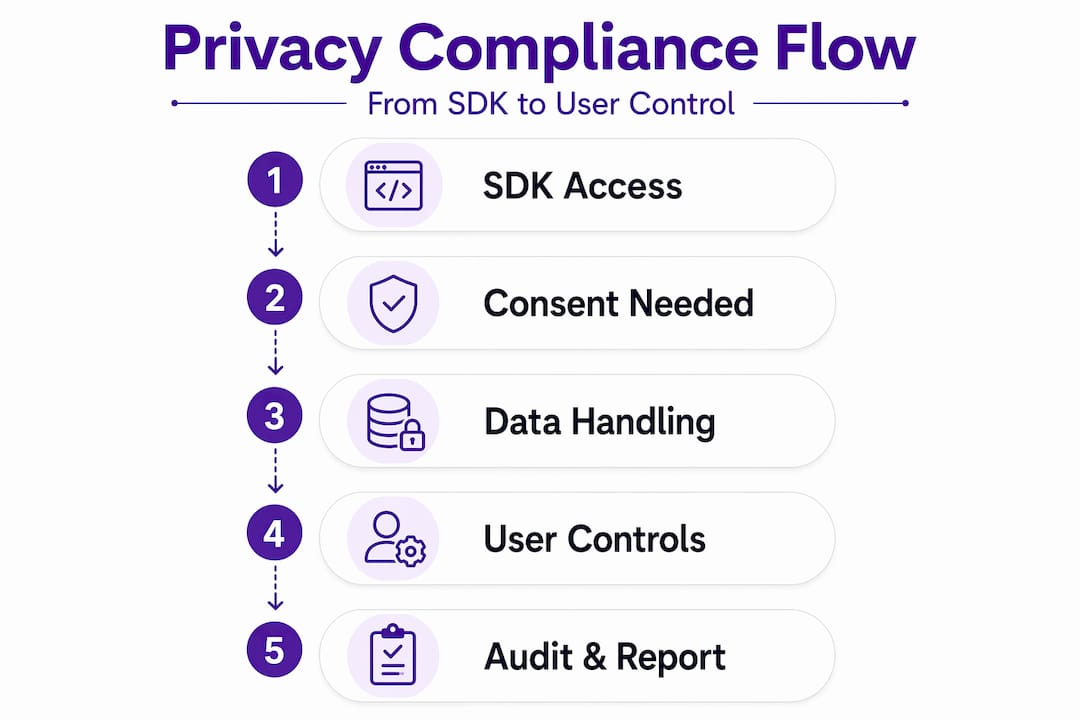
The most pervasive problem is premature SDK data collection. Many developers initialise ad and analytics SDKs at app launch before the consent flow has been shown to the user, let alone completed. The SDK begins collecting data, including device signals and possibly identifiers, in the milliseconds before any legal basis for processing exists. Auditing the runtime initialisation order of every SDK in your app is not optional; it is a compliance prerequisite.
A second technical nuance concerns Android identifier management. Resetting and deleting the advertising ID are not the same action. Resetting generates a new identifier, which breaks the link to historical behavioural data but still permits new data collection under the fresh ID. Deleting the advertising ID entirely removes it from the device, blocking interest-based advertising altogether. If your app communicates privacy controls to users, this distinction must be explained accurately.
Consent-denied measurement is a further challenge that many gaming marketers underestimate:
- Attribution gaps. When a significant proportion of iOS users decline ATT, standard last-click attribution breaks down. You need SKAdNetwork or AdAttributionKit configured as a parallel measurement path, not a fallback you activate after the problem emerges.
- Data flow audits. Every SDK in your stack has its own data sharing behaviour. Aggregating consent signals at the app level does not automatically prevent downstream SDK partners from collecting data independently.
- Consent mode parameters. Google Consent Mode v2 uses parameters including "ad_storage
,analytics_storage,ad_user_data, andad_personalization` to govern what Google’s ad and analytics systems do with non-consented users. Failing to implement these correctly disables key ad features for EU and UK users.
Pro Tip: Treat ad identifier access as an architectural dependency, not a feature. Build your measurement infrastructure to function meaningfully even when the majority of users deny consent, because in regulated markets, that is increasingly your baseline.
Best practices for balancing privacy and ad performance
The mobile gaming studios handling this best have stopped asking how to minimise the impact of privacy regulations and started asking how to build campaigns that perform within them. That shift in orientation produces better results.
-
Set realistic measurement expectations. When users deny tracking, personalisation and attribution precision decrease. This is documented and expected. Communicating this reality internally prevents organisations from misattributing performance drops to creative or budget decisions when the cause is consent denial.
-
Implement privacy-preserving attribution. SKAdNetwork on iOS and AdAttributionKit (Apple’s updated successor framework) provide aggregate, privacy-safe conversion signals without requiring IDFA access. These should be configured from the outset of any iOS campaign, not added reactively.
-
Design consent flows that are genuinely clear. Consent UI that obscures opt-out options or uses dark patterns to coerce acceptance creates legal liability and erodes user trust. Regulatory bodies across Europe have consistently penalised apps for deceptive consent interfaces. A clean, transparent consent dialogue typically achieves better long-term retention than a manipulative one.
-
Layer your consent signals. OS-level permissions like ATT and Android’s consent controls govern identifier access. Ad platform consent parameters like Google Consent Mode v2 govern data processing behaviour within specific platforms. Both layers must be implemented correctly and independently. One does not substitute for the other.
-
Audit third-party processors. GDPR Article 28 requires data processing agreements with every vendor who handles user data on your behalf, including mobile ad SDKs. Many studios have dozens of SDKs active simultaneously, each representing a potential compliance gap.
How to protect mobile privacy: device and in-app controls
Beyond compliance obligations for developers, mobile advertising privacy explained from the user’s perspective centres on a set of device-level and in-app controls that restrict how identifiers are shared. Understanding these empowers marketers to communicate privacy choices accurately and build trust with their audience.
On iOS, the primary control is the “Allow Apps to Request to Track” toggle in the device’s Privacy and Security settings. When disabled, no app can even display the ATT prompt, and all apps receive a zeroed IDFA. Users who have already granted permission to specific apps can revoke it individually within the same settings menu.
On Android, the process differs. Users can find the advertising ID within the Google Settings or Privacy menu depending on device manufacturer. From there, they have two distinct options:
- Reset the advertising ID. This creates a new identifier, severing the link between past behavioural data and the device but still permitting new interest-based ad targeting under the fresh ID.
- Delete the advertising ID. This removes the identifier entirely, and prevents interest-based advertising based on app usage data. The user will still see ads, but those ads will not be informed by cross-app behavioural profiles.
In-app controls are an additional layer. Under US law, the Do Not Sell or Share mechanism allows consumers to restrict data sale or sharing for targeted advertising purposes, though it may still permit data sharing required to deliver core app functionality. Apps serving US users must surface this option clearly within their privacy settings.
One important clarification for users and marketers alike: privacy controls limit cross-app behavioural profiling rather than ad volume. A user who deletes their advertising ID will still see ads. Those ads will simply be less precisely targeted. Managing this expectation accurately reduces friction and avoids trust damage from users who feel misled about what privacy settings actually do.
My perspective on mobile ad privacy’s real challenge
I have seen privacy compliance treated as a checklist too many times. A consent banner goes up, ATT prompts get deployed, and the team considers the problem solved. That approach misses the point entirely.
What I have found, working closely with mobile gaming marketers navigating the post-ATT environment, is that the real challenge is architectural. Privacy by design requires that measurement resilience, consent sequencing, and data minimisation are built into the product from the start. Teams that retrofit privacy into existing ad stacks consistently encounter more breakage, more gaps in attribution data, and more regulatory exposure than those who design for it upfront.
My advice is to reframe how you think about consent-denied users. In mature markets, that cohort represents a substantial and growing share of your audience. If your measurement infrastructure only functions correctly for consented users, you are flying partially blind on a significant portion of your campaign spend. Investing in aggregate measurement, modelled conversions, and privacy-preserving attribution is not a workaround. It is the strategy.
The gaming studios I respect most in this space treat user trust as a performance metric. They understand that clear consent flows, honest data practices, and transparent communication about what privacy settings actually do translate into better retention and higher lifetime value. Privacy, done well, is a growth lever.
— Ondrej
How Playablemaker supports privacy-conscious ad creation
When tracking and identifier access become constrained, the quality and engagement of your ad creative matters more than ever. Playable ads are particularly well suited to privacy-first environments because they generate first-party engagement signals directly within the ad unit, without relying on cross-app behavioural data to drive performance.
Playablemaker’s no-code platform allows marketing teams and developers to build playable ads quickly and without diverting engineering resources. In environments where targeting precision is reduced by consent limitations, a genuinely engaging interactive ad compensates with higher intrinsic performance. You can also explore how playable ad formats align with modern privacy regulations while delivering measurably stronger engagement than static or video alternatives. The platform is built for teams who need to move fast without sacrificing quality or compliance.
FAQ
What is mobile ad privacy?
Mobile ad privacy refers to the regulations, technical controls, and user rights that govern how mobile apps collect and use personal data for advertising purposes. It centres on controlling access to mobile advertising identifiers like IDFA and GAID, which enable cross-app tracking and ad targeting.
How does iOS ATT affect mobile ad campaigns?
When a user declines Apple’s ATT prompt, the app receives a zeroed IDFA, blocking cross-app tracking and standard attribution. Marketers must use privacy-preserving frameworks like SKAdNetwork or AdAttributionKit to maintain measurement in this scenario.
What is the difference between resetting and deleting an Android advertising ID?
Resetting the Android advertising ID creates a new identifier and breaks the link to past behavioural data, but still allows new interest-based targeting. Deleting it removes the identifier entirely, preventing interest-based ad targeting based on app usage.
Does blocking ad tracking remove all ads?
No. Blocking or denying ad tracking reduces personalisation and measurement accuracy but does not eliminate ad delivery. Users will still see ads; those ads will simply be less targeted based on cross-app behavioural data.
What is the biggest compliance risk for mobile gaming apps?
One of the most common failures is allowing SDKs to access device identifiers and collect data before the user has seen or responded to a consent prompt, creating non-compliance even when a consent dialogue is technically present in the app.
Recommended
- Personalised Ads: Optimising Mobile Game Acquisition – playablemaker.com Personalised Ads: Optimising Mobile Game Acquisition
- What Are Personalized Ads? Complete Guide for 2024 – playablemaker.com What Are Personalized Ads? Complete Guide for 2024
- Winning personalisation strategies for mobile gaming ads – playablemaker.com Winning personalisation strategies for mobile gaming ads
- Mobile Ad Glossary: 60% CPI Spend Drives Gaming Growth – playablemaker.com Mobile Ad Glossary: 60% CPI Spend Drives Gaming Growth