
TL;DR:
- No-code platforms enable marketers to launch high-performing in-app ads without coding skills.
- Rewarded videos and playable ads offer the best engagement for user acquisition and retention.
- Regular creative testing and strategic channel diversification drive optimal ad campaign performance.
Most mobile marketers assume that building compelling in-app ads requires a developer, a sizeable budget, and weeks of production time. That assumption is increasingly outdated. No-code platforms have matured significantly, and today’s user acquisition specialists can launch interactive, high-performing ad formats without writing a single line of code. This guide breaks down exactly what in-app advertising is, which formats deliver the strongest results, how to set up campaigns efficiently, and which performance benchmarks to track. Whether you manage a lean team or simply want to move faster, the strategies here are directly applicable.
Table of Contents
- What is in-app advertising and why does it matter?
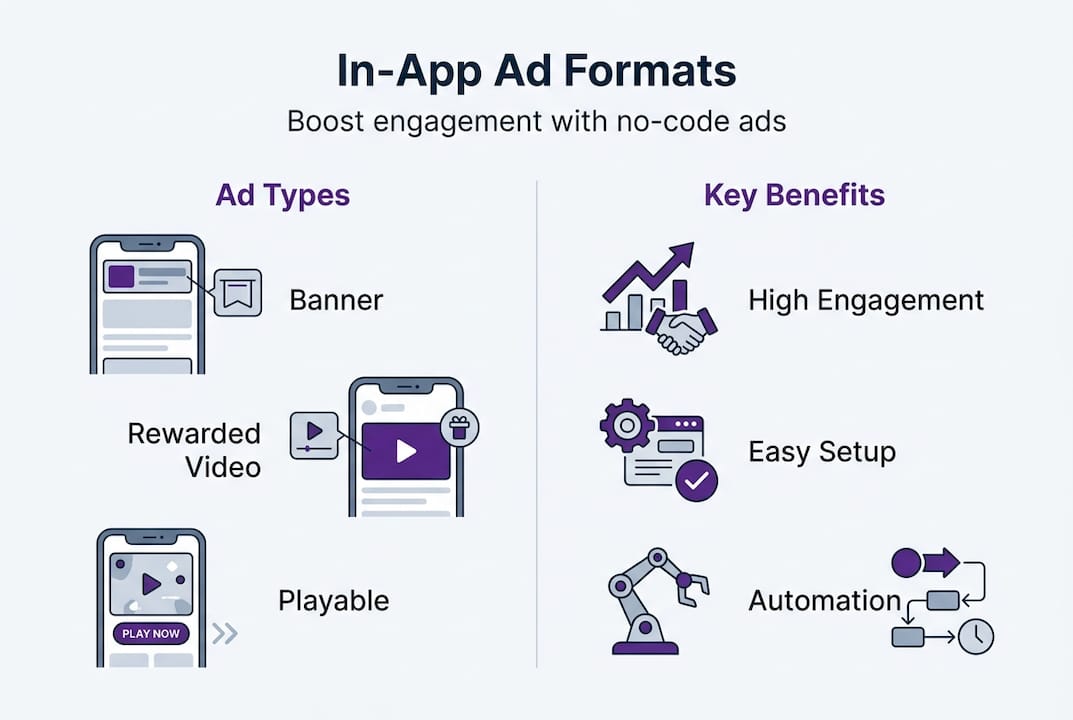
- Key in-app ad formats: from banners to playables
- Setting up in-app ads: no-code tools and automation
- Performance benchmarks and optimisation strategies
- A fresh perspective: why playables and no-code matter more than ever
- Next steps: unlock cost-effective, interactive ads
- Frequently asked questions
Key Takeaways
| Point | Details |
|---|---|
| No-code in-app ads | Modern platforms enable marketers to launch high-performing in-app ads without technical help. |
| Playable and rewarded win | Rewarded and playable formats deliver the strongest user acquisition and engagement rates for apps. |
| Optimise with benchmarks | Top-performing campaigns monitor D7 ROAS, LTV to CPI, and diversify channel mix for growth. |
| Continuous creative testing | Testing multiple ad variants and iterating quickly drives the best results over time. |
What is in-app advertising and why does it matter?
In-app advertising refers to targeted promotional content displayed within a mobile application’s user experience. Unlike mobile web ads, in-app ads appear inside apps that users have already chosen to engage with, which means the attention quality is typically higher from the outset. For user acquisition teams, this distinction matters enormously.
The scale of the opportunity is significant. Over 70% of app revenue now derives from in-app advertising, making it the dominant monetisation channel for free-to-play apps and freemium services alike. For UA specialists, this creates a dual role: in-app ads are both a revenue source and a primary channel for acquiring new users at scale.
“In-app ads now blend seamlessly with content and can be launched with no code, removing the traditional barrier between marketers and high-quality ad experiences.”
The core advantages of in-app advertising over other digital channels include:
- Higher engagement rates: Users inside an app are already in an active, focused session, making them more receptive to relevant ad content.
- Rich targeting options: In-app environments support behavioural, contextual, and demographic targeting with precision that mobile web cannot match.
- Seamless UX integration: Formats such as rewarded video and native ads fit naturally within the app flow, reducing friction and user resistance.
- Monetisation and UA alignment: The same ad infrastructure that generates revenue can also serve as a channel to acquire new users through cross-promotion.
Modern platforms have reduced the technical barrier considerably. Exploring the range of ad experiences for UA reveals just how varied and accessible the format landscape has become. For teams without dedicated engineering support, this shift represents a genuine competitive advantage.
Key in-app ad formats: from banners to playables
Not all ad formats are created equal. Each serves a different purpose within the user journey, and choosing the right one depends on your campaign goal, your audience’s session behaviour, and the level of engagement you need to drive.
The table below compares the primary formats across the metrics that matter most to UA teams:
| Format | Engagement level | Typical eCPM | User disruption | Best use case |
|---|---|---|---|---|
| Banner | Low | £0.20–£1.50 | Minimal | Brand awareness |
| Interstitial | Medium | £2–£8 | High | Re-engagement |
| Rewarded video | High | £8–£25 | Low (opt-in) | UA and retention |
| Native | Medium | £1–£6 | Very low | Content-led apps |
| Playable | Very high | £10–£30 | Low (interactive) | UA and installs |
| Video (non-rewarded) | Medium-high | £4–£15 | Medium | Awareness and UA |
Rewarded video offers the highest viewability among standard formats, while playable ads consistently generate the strongest interaction rates. For UA campaigns focused on installs and downstream retention, these two formats are the clear frontrunners.
Browsing the full range of ad format options helps clarify which creative approach suits your specific app category. Reviewing real ad examples from live campaigns also accelerates creative decision-making considerably.
When to use each format within a session:
- Banners: Persistent placement during low-intensity moments such as menu screens or loading states.
- Interstitials: Natural breaks between levels or content pages, with strict frequency caps to avoid churn.
- Rewarded video: Offer at moments of high intent, such as when a user runs out of lives or currency.
- Playables: Best placed at the end of a rewarded video or as a standalone unit during onboarding flows.
- Native: Integrated within content feeds or recommendation sections for a non-intrusive experience.
Frequency capping is essential across all formats. Overexposure to any ad unit, regardless of quality, accelerates user fatigue and increases uninstall rates.
Setting up in-app ads: no-code tools and automation
The practical setup of in-app advertising has become far more accessible in recent years. Platforms designed for marketers rather than engineers now handle the heavy lifting, from inventory connection to creative deployment and real-time reporting.

Platforms like AdMob Mediation and similar demand-side platforms enable full campaign setup via dashboards, with no coding required at any stage. This is a meaningful shift for UA teams operating without embedded developer support.
Here is a straightforward process for launching in-app ads with minimal technical input:
- Choose a no-code ad platform that supports your target formats (rewarded video, playable, interstitial). Evaluate no-code ad tools based on SDK compatibility with your app stack.
- Connect your app inventory by integrating the platform’s SDK or using a tag-based connection. Most modern platforms offer step-by-step integration guides that require no engineering expertise.
- Select and configure ad formats within the dashboard. Set frequency caps, define placement triggers, and upload or build your creatives directly in the interface.
- Define your targeting parameters using first-party data wherever possible. With privacy regulations tightening globally, first-party behavioural signals are more valuable than third-party data for bidding and segmentation.
- Monitor performance in the dashboard using real-time metrics. Most platforms surface eCPM, fill rate, and ROAS automatically, enabling rapid iteration without manual data pulls.
Automation tools within platforms like AdMob Mediation handle waterfall management and bidding optimisation, reducing the manual workload for campaign managers. Pairing these with AI ad ideation tools accelerates the creative process further, particularly for teams generating multiple variants simultaneously. Effective client acquisition strategies also reinforce why diversifying your creative portfolio matters.
Pro Tip: Test between 5 and 10 creative variants per campaign before scaling. UA teams that iterate on creative early consistently outperform those that scale a single asset prematurely.
Performance benchmarks and optimisation strategies
With campaigns live, the focus shifts to measurement and iteration. Understanding which metrics signal sustainable growth versus short-term volume is what separates effective UA from wasteful spend.
The table below outlines the key performance indicators for in-app UA campaigns and what strong performance looks like:
| Metric | Definition | Target value | Strong performance |
|---|---|---|---|
| D7 ROAS | Revenue returned by day 7 per £1 spent | >20% | >35% |
| LTV to CPI ratio | Lifetime value divided by cost per install | >3x | >5x |
| eCPM | Effective cost per thousand impressions | Varies by format | Top quartile for category |
| Retention (D1/D7) | Users returning on day 1 and day 7 | D1 >40%, D7 >15% | D1 >55%, D7 >25% |
| CTR | Click-through rate on ad unit | >1.5% | >3% |
Monitor D7 ROAS above 20% and LTV above 3x CPI for sustainable UA. Frequency caps are equally important: they balance revenue generation against user retention, and miscalibrating them is one of the most common causes of elevated churn in ad-supported apps.
Practical optimisation levers to apply once campaigns are running:
- Creative iteration: Refresh creatives every two to three weeks to combat ad fatigue, particularly for interstitials and video units.
- Channel mix diversification: Spread spend across Meta, Google, and TikTok. Aim to ensure no single channel accounts for more than 60% of total UA budget.
- Frequency cap adjustment: Start conservatively (one to two impressions per user per day) and increase incrementally based on retention data.
- Session timing: Trigger rewarded and playable ads at high-intent moments rather than at arbitrary intervals.
- Bidding versus waterfall: Use in-app bidding for efficiency at scale; waterfall setups may still suit smaller inventories with established demand partners.
For deeper guidance on placement logic, reviewing a structured ad placement strategy is worthwhile. Understanding the types of in-game ads also informs smarter sequencing decisions. Teams looking to improve marketing ROI will find that disciplined metric tracking is the single most reliable lever available.
Pro Tip: Hard paywalls generate high short-term conversion rates but can suppress long-term retention. Rewarded formats that let users earn value within the app tend to produce better LTV outcomes over a 30-day window.
A fresh perspective: why playables and no-code matter more than ever
Here is something worth saying plainly: most UA teams are still underusing playable ads, and the reason is almost always a misconception about complexity and cost. The assumption that interactive formats require significant development investment persists even as playable ads convert better than static and video equivalents across virtually every app category.
The honest lesson from watching many campaigns is that over-indexing creative spend on video, while neglecting playables, is a common and costly mistake. Video is familiar and easy to produce, so it becomes the default. But familiarity is not the same as effectiveness.
No-code tools have genuinely changed the calculus here. A medium-sized UA team using a no-code playable builder can now iterate faster than a large studio relying on traditional development pipelines. Speed of iteration, not budget size, increasingly determines who wins in performance marketing. The teams that test, learn, and adapt quickly are outpacing those with larger resources but slower creative cycles.
The window to gain an advantage from this shift is still open, but it will not stay open indefinitely as adoption grows.
Next steps: unlock cost-effective, interactive ads
If this guide has clarified the value of in-app advertising and the role of no-code tools, the logical next step is to see what modern playable ad creation actually looks like in practice. Understanding playable ads explained gives you the conceptual grounding, while the no-code playable builder from PlayableMaker lets you move from concept to live creative without any development overhead. For UA teams that want to test interactive formats quickly and affordably, PlayableMaker offers a practical starting point. The platform is built specifically for marketers who need results without the traditional cost and time investment that playable ad production has historically demanded.
Frequently asked questions
What are the main benefits of in-app advertising?
In-app advertising drives higher engagement, precise targeting, and significant revenue, with over 70% of app income now generated through in-app ad formats. It also supports user acquisition directly within the same environment where users are already active.
How do no-code tools help marketers manage in-app ads?
AdMob Mediation and similar platforms allow marketers to set up, test, and optimise full ad campaigns through dashboards, removing the need for developer involvement at any stage.
Which ad formats currently deliver the highest UA engagement?
Rewarded video and playable ads consistently outperform banners and interstitials for user acquisition, with playable and rewarded formats delivering the strongest interaction rates and downstream retention.
What performance metrics should UA specialists monitor?
Prioritise D7 ROAS above 20% and an LTV to CPI ratio above 3x, alongside D1 and D7 retention rates, to assess whether your UA spend is generating sustainable long-term value.
Recommended
- Game Ad Engagement Techniques for Playable Ad Success – playablemaker.com Game Ad Engagement Techniques for Playable Ad Success
- Mobile Game Ad Tutorials: Build Playable Ads Easily – playablemaker.com Mobile Game Ad Tutorials: Build Playable Ads Easily
- Interactive Ad Tips for 2025: No-Code Success Guide – playablemaker.com Interactive Ad Tips for 2025: No-Code Success Guide
- 7 Types of Ad Experiences for Better User Acquisition Results – playablemaker.com 7 Types of Ad Experiences for Better User Acquisition Results
- How to create direct response ads that drive sales