Mobile apps using gamification see a 22% average increase in user retention, yet most mobile game marketers still rely on static ads. The difference isn’t budget or development resources. It’s understanding which gamification elements work and having the right tools to deploy them. This guide breaks down the psychology, frameworks, and no-code platforms that let you implement proven gamification strategies quickly and affordably, transforming passive viewers into active participants.
Table of Contents
- Understanding Gamification in Mobile Gaming Ads
- How Gamification Improves Ad Engagement and Retention
- Hybrid Reward Systems: Combining Game and Real-World Incentives
- Frameworks and Strategic Applications of Gamification
- Leveraging No-Code Tools for Cost-Efficient Gamification
- Common Misconceptions and Pitfalls About Gamification
- Case Studies of Successful Gamification in Mobile Contexts
- Boost Your Mobile Game Ads with Playablemaker
Key Takeaways
| Point | Details |
|---|---|
| Gamification drives 22% retention gains | Psychological triggers like achievement and social comparison create measurable engagement increases. |
| Hybrid rewards sustain motivation | Combining in-game and real-world incentives prevents post-reward motivation drops. |
| No-code tools eliminate dev dependency | Marketers can build, test, and launch gamified ads in hours without coding expertise. |
| Strategic frameworks align tactics with goals | Categorizing elements by function helps select optimal gamification strategies. |
| Over-gamification risks burnout | Careful design prevents user fatigue and maintains value-driven behaviors. |
Understanding Gamification in Mobile Gaming Ads
Gamification applies game design elements to non-game contexts, specifically mobile ads, to boost engagement and retention. You’re not building a full game. You’re strategically incorporating mechanics that tap into human motivation.
Core gamification elements include:
- Points that quantify achievements and progress
- Badges that recognize milestones and unlock status
- Challenges that create goal-oriented interactions
- Leaderboards that enable social comparison and competition
These components satisfy fundamental psychological needs. Achievement feels good because it triggers dopamine release. Autonomy emerges when users control their progress. Social connection happens through competitive leaderboards and shared accomplishments. When you understand the role of gamification in playable ads, you see these aren’t gimmicks. They’re behavioral science applied to advertising.
Mobile game ads benefit enormously because your audience already understands game mechanics. They don’t need tutorials on point systems or badges. This familiarity accelerates engagement and reduces friction. The importance of user engagement becomes clear when you realize engaged users convert at dramatically higher rates than passive viewers.
Traditional banner ads present information. Gamified advertising creates experiences. That experiential difference explains why ad gamification benefits include not just higher click rates but longer session times and better brand recall. Users remember the ads they interact with, not the ones they scroll past.
How Gamification Improves Ad Engagement and Retention
The psychology driving gamification’s effectiveness isn’t mysterious. Dopamine reward loops create pleasure anticipation when users expect achievements. Each point earned or badge unlocked triggers a small dopamine release, encouraging repeated behavior. This neurological response makes gamified experiences genuinely more enjoyable than passive content consumption.
Achievement motivation powers engagement through visible progress. Progress bars, level systems, and milestone counters show users how far they’ve come and what’s next. This transparency transforms abstract engagement into concrete advancement. Users stay longer because they can see their investment paying off.
Social comparison via leaderboards taps into competitive instincts. Seeing your name ranked fifth makes you want to reach fourth. This drive operates independently of external rewards. The ranking itself becomes the motivation. User engagement in mobile ads spikes when social elements activate competitive psychology.
The data validates these mechanisms. Gamification boosts retention by approximately 22% compared to non-gamified experiences. Without gamification, retention rates plummet to just 2.1% on Android and 3.7% on iOS by day 30. That’s devastating attrition.
Statistic Alert: Gamified mobile apps maintain 22% higher retention while non-gamified apps lose over 96% of Android users within 30 days.
Applying lessons from game mechanics means understanding these aren’t separate strategies. They compound. Achievement motivation works better with social comparison. Progress visibility enhances dopamine loops. When you layer these psychological impacts strategically, you create engagement that self-reinforces. Users return not because you reminded them, but because they want to.
Hybrid Reward Systems: Combining Game and Real-World Incentives
Game rewards deliver intrinsic satisfaction. Earning a digital badge feels good because it represents achievement. Real-world rewards provide tangible value like discounts, premium features, or exclusive content. Neither approach alone maximizes sustained motivation.

Hybrid reward systems combine both reward types to counter motivation drops. After earning a reward, users often experience reduced drive. That post-reward slump kills engagement. Hybrid systems address this by alternating reward types, keeping motivation fresh through variety.
Design principles for effective hybrid rewards:
- Balance intrinsic and extrinsic incentives to maintain diverse motivation sources
- Time real-world rewards to re-engage users showing declining activity
- Use game rewards for frequent small wins that build momentum
- Reserve tangible rewards for milestone achievements that deserve recognition
- Ensure rewards align with user values and campaign objectives
Overuse creates problems. Too many rewards cheapens each one’s perceived value. Users become reward-focused rather than engagement-focused. They complete minimum actions for maximum rewards, bypassing the behaviors you actually want. This reward-chasing undermines long-term retention because once rewards stop, so does engagement.
Poor alignment causes similar issues. Offering rewards that don’t match user desires wastes budget and confuses messaging. Research shows hybrid systems work when rewards feel like natural progressions, not bribes. The key is making game achievements meaningful and real-world incentives relevant.
Pro Tip: Start with game rewards for daily interactions and introduce real-world incentives at weekly or monthly milestones. This rhythm maintains daily engagement while providing meaningful long-term goals that justify sustained participation.
Integrating creative ad concepts with hybrid rewards means thinking about the complete user journey. What keeps someone engaged today? What brings them back tomorrow? What makes them advocate for your game next week? Hybrid systems answer all three questions simultaneously.
Frameworks and Strategic Applications of Gamification
Random gamification elements rarely succeed. Strategic frameworks organize mechanics by function, helping you select tactics that align with specific marketing objectives and audience preferences. This structure transforms gamification from guesswork into methodology.
Gamification frameworks typically divide elements into three categories:
Progress Elements show advancement and achievement. Points quantify activity. Levels indicate status. Progress bars visualize completion. These mechanics answer the question “How am I doing?” They’re essential for users who need clear feedback loops.
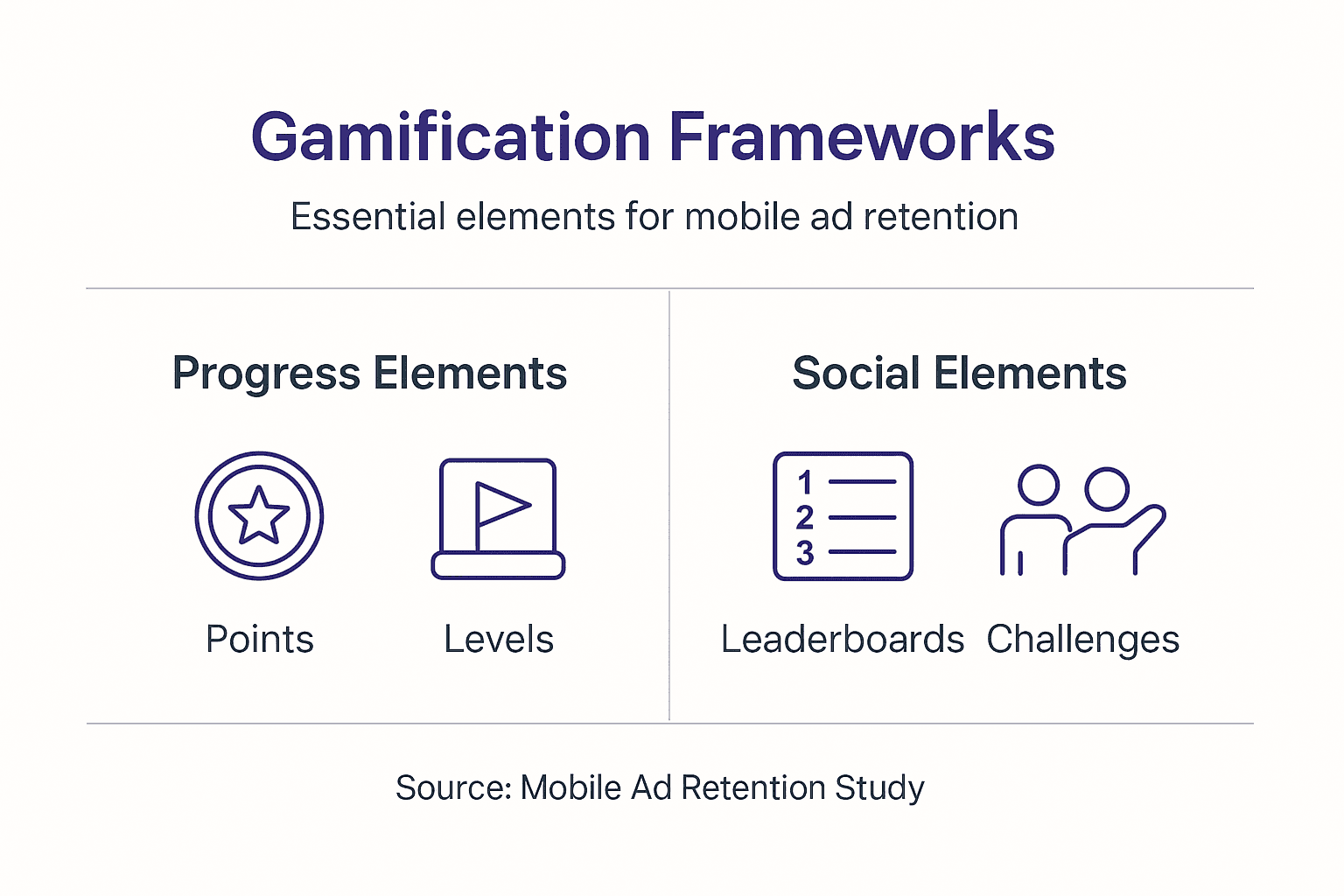
Social Elements leverage community and competition. Leaderboards rank performance. Challenges pit users against each other. Social sharing extends reach. These features engage users motivated by comparison and recognition. They work exceptionally well in ads gaming frameworks because mobile gamers already understand competitive mechanics.
Reward Elements incentivize specific behaviors. Badges commemorate achievements. Unlockables provide exclusive content. Points systems enable redemption. These mechanics drive action by promising tangible benefits for engagement.
| Framework Category | Primary Function | Best For | Example Mechanics |
|---|---|---|---|
| Progress | Show advancement | Achievement-oriented users | Points, levels, progress bars |
| Social | Enable competition | Community-focused users | Leaderboards, challenges, sharing |
| Rewards | Incentivize action | Goal-driven users | Badges, unlockables, redemption |
Selecting the right mix requires understanding your audience and campaign goals:
- Define what behavior you want to increase (installs, session time, social sharing)
- Identify which psychological drivers resonate with your target audience
- Choose framework elements that activate those specific drivers
- Design reward structures that reinforce desired behaviors
- Test and iterate based on engagement data
Pro Tip: Start with one element from each category rather than multiple elements from one. This breadth appeals to diverse user motivations and helps you identify which mechanics resonate strongest with your specific audience.
Frameworks enable cost-efficient implementation because you’re not building everything. You’re selecting proven components that match your needs. This targeted approach reduces development time and focuses resources on high-impact features. The framework guides decisions, eliminating expensive trial and error.
Leveraging No-Code Tools for Cost-Efficient Gamification
Traditional gamified ad development requires developers, designers, weeks of coding, and substantial budgets. No-code gamification platforms eliminate these barriers entirely. Marketing teams create, test, and launch campaigns without writing a single line of code.
Key advantages of no-code approaches:
- Remove developer dependency, freeing technical teams for core product work
- Enable rapid iteration with changes deployed in minutes, not days
- Dramatically reduce costs by eliminating custom development expenses
- Empower marketers to test ideas quickly without approval bottlenecks
- Accelerate time-to-market from weeks to hours for campaign launches
The drag and drop playable builder approach means you visually assemble gamification elements. Want a point system? Add it. Need a leaderboard? Drop it in. This visual construction matches how you think about campaigns, not how developers structure code.
Speed matters in mobile marketing. Trends shift quickly. Competitor campaigns launch unexpectedly. No-code tools let you respond immediately. Testing five gamification variations in a traditional development cycle might take months. With no-code platforms, you test five variations in a week, identify winners, and scale successful approaches while competitors are still in development.
Pro Tip: Use no-code platforms for rapid testing and validation. Once you identify winning gamification strategies through quick iteration, you can decide whether custom development makes sense for scaling or if the no-code solution continues meeting your needs efficiently.
Data-driven optimization becomes practical when changes don’t require development cycles. See leaderboards underperforming? Swap in achievement badges and measure results tomorrow. This agility transforms cost-efficient gamification from theoretical benefit to operational reality. You’re not locked into initial decisions. You adapt based on what users actually respond to.
Accessibility extends gamification beyond enterprise teams with large budgets and technical resources. Small marketing teams compete with major studios because no-code tools level the playing field. The advantages of no-code platforms include democratizing sophisticated marketing tactics that were previously exclusive to well-funded organizations.
Common Misconceptions and Pitfalls About Gamification
Misunderstandings about gamification cost marketers time and money. Clarifying these misconceptions prevents expensive mistakes and unrealistic expectations.
Misconception: Gamification requires complex coding. Reality: No-code solutions enable sophisticated gamification without technical expertise. You implement proven mechanics through visual interfaces, not programming languages.
Misconception: Gamification guarantees monetization increases. Reality: Gamification improves engagement and retention. Monetization depends on your conversion funnel, pricing strategy, and value proposition. Better engagement creates monetization opportunities, but doesn’t automatically convert to revenue.
Misconception: More gamification always means better results. Reality: Over-gamification causes user fatigue and cognitive overload. Users disengage when mechanics overwhelm core value. Balance matters more than quantity.
Misconception: Gamification equals building a game. Reality: Gamification borrows game elements for engagement, not entertainment. You’re enhancing existing experiences, not creating standalone games. The distinction matters for scope, budget, and expectations.
Misconception: All users respond equally to gamification. Reality: Different users prefer different mechanics. Achievement-oriented users love progress bars. Socially-motivated users engage with leaderboards. Effective gamification offers variety, letting users gravitate toward mechanics matching their preferences.
Pro Tip: Monitor engagement metrics by gamification element. If achievement badges show high engagement but leaderboards don’t, shift resources toward mechanics your specific audience prefers. Don’t force elements that aren’t resonating.
Pitfalls to actively avoid:
- Implementing mechanics that don’t align with user motivations creates confusion and disengagement
- Offering rewards that lack meaningful value wastes budget without driving behavior
- Copying competitor strategies without testing assumes your audience matches theirs
- Neglecting to update and refresh gamification elements allows staleness and declining interest
Understanding these gamification pitfalls before launching campaigns saves the cost of mid-flight corrections. Prevention costs less than cure, especially when campaigns are live and budgets are committed.
Case Studies of Successful Gamification in Mobile Contexts
Real-world examples validate gamification’s impact beyond theoretical benefits. TikTok’s implementation demonstrates how strategic gamification drives extraordinary engagement in mobile environments.
TikTok’s gamification approach layers multiple mechanics:
- Achievement badges reward content creation milestones and consistent activity
- Social comparison through views, likes, and follower counts creates competitive motivation
- Progress indicators show creators how close they are to viral thresholds
- Unlockable features reward engagement with access to premium editing tools
- Hybrid rewards combine status recognition with tangible platform privileges
The results are remarkable. TikTok users average 95 minutes daily on the platform. That’s not passive scrolling. Active participation reaches 83% of users creating content, not just consuming. This creator participation rate exceeds most social platforms by orders of magnitude.
What makes TikTok’s gamification effective? Multiple factors work together. Achievement badges provide clear goals. Leaderboard elements create competition. Hybrid rewards sustain long-term motivation. Most importantly, gamification enhances rather than replaces core value. The platform remains about content, with gamification amplifying engagement.
Mobile game marketers can extract several lessons. First, layer complementary mechanics rather than relying on single elements. Second, ensure gamification serves user goals, not just marketing objectives. Third, make progress visible and achievements shareable to activate social motivation. Fourth, refresh mechanics regularly to maintain novelty and interest.
These mobile game gamification examples demonstrate that scale doesn’t require complexity. TikTok’s individual gamification elements are straightforward. Their power comes from strategic combination and alignment with user behavior patterns. Small teams can apply these same principles using no-code tools, creating proportionally impactful results for their scale.
Boost Your Mobile Game Ads with Playablemaker
Applying these gamification strategies starts with the right tools. Playablemaker provides no-code solutions that let you implement points, badges, leaderboards, and hybrid rewards without developer involvement. Our platform enables the rapid testing and iteration that separates winning campaigns from wasted budgets.
Create engaging playable ads in hours, not weeks. Test multiple gamification approaches simultaneously to identify what resonates with your specific audience. Launch campaigns faster than competitors still waiting for development resources. The benefits of playable ads include dramatically higher engagement rates and lower cost per acquisition when you can iterate quickly based on real performance data.
FAQ
What is the most effective gamification element for mobile game ads?
Points and leaderboards consistently drive strong results by activating achievement motivation and social comparison simultaneously. However, effectiveness varies by audience and campaign goals, making testing essential.
How quickly can no-code gamification ads be created?
Playable ads can be built and deployed in hours to days using no-code platforms, dramatically faster than developer-built alternatives that require weeks. This speed enables rapid testing and optimization.
How do I measure gamification success in ads?
Track user retention rates, engagement time per session, and conversion rates alongside standard ad KPIs like click-through and install rates. Compare gamified versus non-gamified campaign performance to isolate impact.
Can too much gamification harm my campaign?
Yes, excessive game elements cause user fatigue, cognitive overload, and reduced focus on value-driven behaviors. Balance mechanics carefully and monitor engagement quality, not just quantity.
Are hybrid rewards necessary for gamification success?
While not mandatory, hybrid rewards combining game and real-world incentives significantly improve motivation sustainability by preventing post-reward engagement drops. They’re especially valuable for long-term retention goals.
Do all user segments respond equally to gamification?
No, different users prefer different mechanics based on their motivations. Achievement-oriented users engage with progress elements while socially-motivated users prefer leaderboards and challenges. Offer variety to appeal broadly.
Recommended
- What is User Retention? Understanding Its Importance – playablemaker.com What is User Retention? Understanding Its Importance
- Customer Acquisition and Retention – Winning Mobile Game Players – playablemaker.com Customer Acquisition and Retention – Winning Mobile Game Players
- What is User Engagement? Understanding Its Importance – playablemaker.com What is User Engagement? Understanding Its Importance
- Ad Gamification: Engaging Users Without Overspending – playablemaker.com Ad Gamification: Engaging Users Without Overspending
- 10 manieren om klanten te behouden – Ondernemers Plaza Online