User acquisition can quickly stall when traditional ads leave audiences cold, so finding ways to enhance user engagement through interactive elements is a constant challenge for mobile gaming startups in countries like Canada, Germany, and Japan. Gamification in playable ads lets users actually test your game within the advertisement, transforming passive impressions into memorable experiences. For teams hunting cost-effective no-code tools, this approach combines creative experimentation with measurable impact, making each advertising budget stretch further.
Table of Contents
- Gamification Defined In Playable Ad Context
- Types Of Gamification For Mobile Campaigns
- Core Elements And Mechanics That Drive Engagement
- Designing Cost-Effective Ads Using No-Code Tools
- Evaluating Performance: Success Metrics And Pitfalls
Key Takeaways
| Point | Details |
|---|---|
| Gamification Effectiveness | Gamified mobile ads transform passive viewing into active participation, enhancing user engagement and brand recall. |
| Types of Gamified Ads | Key categories include In-Game Advertising, Advergames, and Interactive Playable Ads, each with unique user experiences and branding potential. |
| Core Engagement Mechanics | Utilising elements like points systems, achievement badges, and rewards drives user interaction and deepens brand connections. |
| Performance Evaluation | Success metrics should focus on interaction time, completion rates, and brand recall to optimise gamified ad strategies effectively. |
Gamification Defined in Playable Ad Context
Gamification in playable mobile ads represents a strategic approach to transforming traditional advertising into interactive, engaging experiences. Game design elements integrated into advertising create voluntary, entertaining interactions that capture user attention more effectively than static advertisements.
At its core, gamification involves applying game mechanics and psychological principles to non-game contexts. In the realm of mobile advertising, this means converting passive viewing into active participation. Interactive elements are carefully designed to empower users, making the advertisement itself a micro-experience that users voluntarily engage with.
Key characteristics of gamified playable ads include:
- Voluntary user participation
- Clear interactive rules and objectives
- Immediate feedback mechanisms
- Elements of challenge and achievement
- Reward systems that motivate continued engagement
Engagement strategies in these ads typically leverage psychological triggers such as competition, progression, and instant gratification. Interactive application-like experiences enhance brand recall by allowing potential customers to essentially ‘test’ a product within the advertisement itself.
Pro tip: Design your playable ad’s interactive elements to feel more like a game challenge than an advertisement, focusing on user enjoyment and minimal friction.
Types of Gamification for Mobile Campaigns
Mobile advertising has evolved to incorporate various gamification design approaches that transform traditional marketing strategies into interactive experiences. The primary categories of gamification in mobile campaigns can be broadly classified into two distinct types: in-game advertising and advergames.
Gamification Types in mobile marketing encompass several strategic approaches:
- In-Game Advertising (IGA): Brands integrate their marketing messages directly within existing mobile games
- Advergames (AG): Standalone games created specifically for advertising purposes
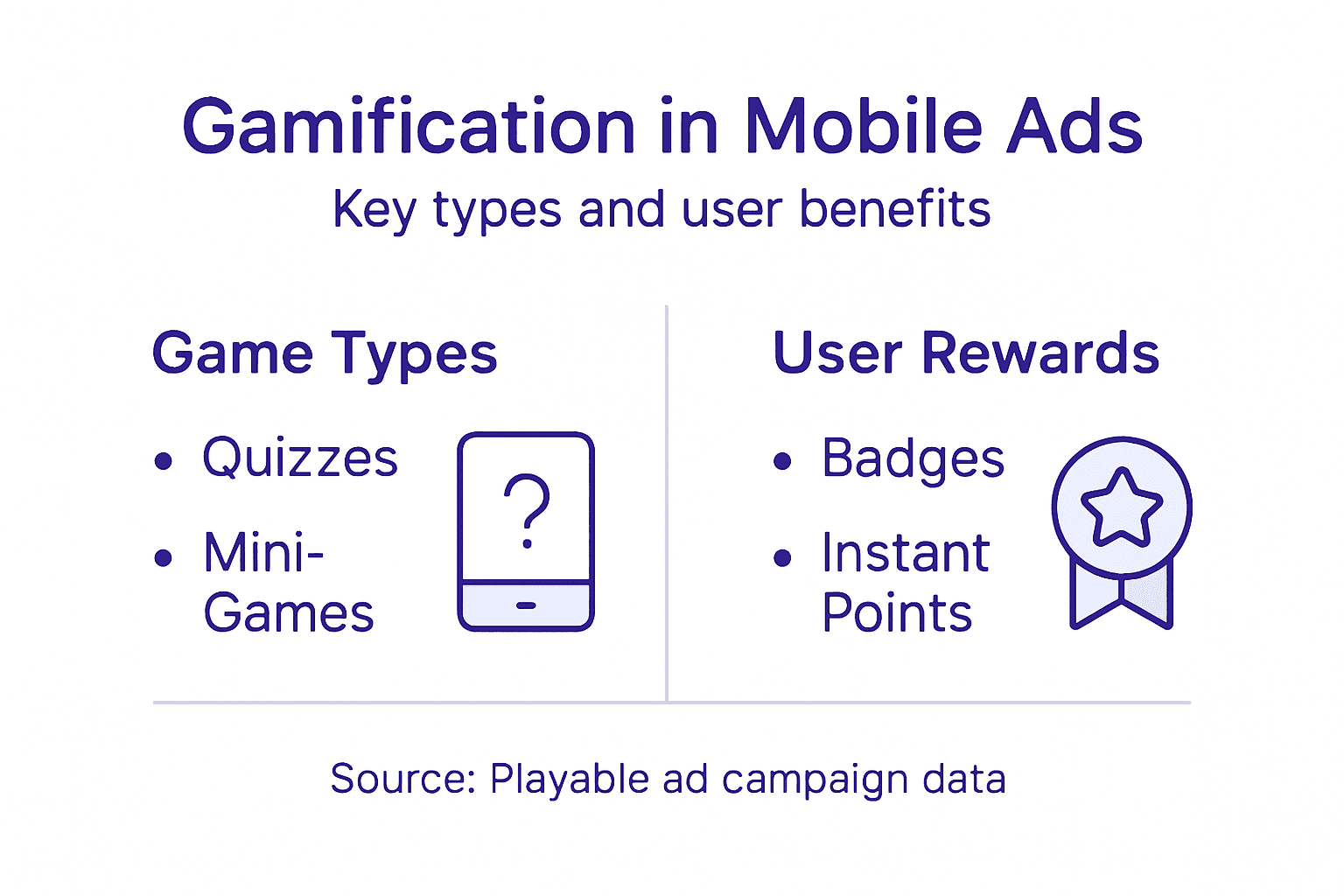
- Interactive Playable Ads: Mini-game experiences embedded within mobile advertisements
Mobile advertising techniques leverage specific game mechanics to enhance user engagement. These mechanics typically include:
- Points systems
- Achievement badges
- Progress tracking
- Competitive challenges
- Reward mechanisms
Each gamification approach aims to convert passive advertising consumption into an active, enjoyable user experience. By introducing elements of play, brands can capture attention more effectively and create memorable interactions that go beyond traditional marketing methods.
Pro tip: Select gamification mechanics that align closely with your target audience’s preferences and motivations to maximise engagement and advertising effectiveness.
Here’s a comparison of gamification types and their advertising impact:
| Gamification Type | User Experience | Branding Potential | Typical Applications |
|---|---|---|---|
| In-Game Advertising | Integrated with gameplay | Subtle brand exposure | Sponsor banners, branded items in games |
| Advergames | Standalone branded games | High brand control | Promotional mini-games, contests |
| Interactive Playable Ads | Embedded ad mini-games | Immediate user engagement | Demo products, instant-win game ads |
Core Elements and Mechanics That Drive Engagement
Gamification mechanics in mobile advertising represent sophisticated psychological triggers designed to transform passive user experiences into active, engaging interactions. These core elements tap into fundamental human motivations, creating powerful connections between brands and consumers.
Psychological Drivers of engagement include several key mechanics:
- Points Systems: Quantifiable progress tracking
- Achievement Badges: Visual recognition of user accomplishments
- Progression Levels: Structured advancement framework
- Competitive Challenges: Performance-based interactions
- Reward Mechanisms: Tangible and intangible incentives
Each mechanic serves a specific psychological function. Points systems provide immediate feedback, badges offer social validation, progression levels create a sense of accomplishment, challenges stimulate competitive instincts, and rewards reinforce desired behaviours.

Interactive advertising techniques leverage these mechanics to create immersive experiences that go beyond traditional marketing approaches. By addressing intrinsic motivations such as competence, autonomy, and relatedness, gamified ads can transform advertising from an interruption into an enjoyable interaction.
Pro tip: Design your gamification mechanics to align with your target audience’s specific psychological motivations, ensuring each interactive element feels genuinely rewarding and personalised.
Designing Cost-Effective Ads Using No-Code Tools
No-code platforms are revolutionising mobile advertising by democratising the development of interactive, gamified ad experiences. These innovative tools enable marketers with limited technical resources to create sophisticated, engaging advertisements without extensive coding knowledge.
Key Benefits of No-Code Gamification Tools:
- Rapid prototyping of interactive ad concepts
- Significant reduction in development costs
- Faster time-to-market for marketing campaigns
- Lower technical barrier to entry
- Easy customisation of game mechanics
The strategic advantages extend beyond cost savings. No-code technologies support sustainable marketing approaches by enabling quick iterations and continuous improvement of advertising content. Marketers can experiment with different gamification strategies, track performance, and refine their approaches without substantial financial investment.
Successful implementation requires understanding core design principles. Interactive elements must align with brand messaging, target audience preferences, and specific campaign objectives. No-code tools provide the flexibility to create tailored experiences that feel native and authentic, rather than forced or mechanical.
Pro tip: Start with simple gamification mechanics and progressively add complexity as you understand your audience’s engagement patterns, using no-code platforms to test and learn efficiently.
Evaluating Performance: Success Metrics and Pitfalls
Measuring playable ad performance requires a comprehensive approach that goes beyond traditional advertising metrics. Understanding the nuanced indicators of success can help marketers optimise their gamified mobile advertising strategies more effectively.
Key Performance Metrics for gamified mobile ads include:
- Interaction time
- Completion rates
- Click-through rates
- User engagement levels
- Brand recall percentage
- Conversion rates
Marketing teams must navigate potential pitfalls carefully. Interactive advertising evaluation reveals that over-complexity can deter user participation. The most successful ads strike a delicate balance between entertainment and clear brand messaging, ensuring the interactive experience feels natural rather than forced.
Contextual targeting remains critical. Not all gamification mechanics work universally, and what engages one audience might alienate another. Continuous testing, performance tracking, and audience segmentation are essential for refining ad strategies and maintaining relevance.
Pro tip: Implement a multi-metric tracking system that evaluates both quantitative performance indicators and qualitative user feedback to develop a holistic understanding of your gamified ad effectiveness.
For reference, here are common success metrics with their business relevance:
| Success Metric | Business Relevance | Strategic Benefit |
|---|---|---|
| Interaction Time | Measures ad engagement depth | Indicates content attractiveness |
| Completion Rate | Tracks user journey end | Reflects ad clarity and user motivation |
| Brand Recall | Assesses memory retention | Evaluates long-term advertising impact |
| Conversion Rate | Measures desired outcomes | Direct link to ROI and campaign success |
Unlock the Power of Gamification with Easy No-Code Playable Ads
The article highlights the challenge of turning traditional ads into interactive, engaging experiences without overwhelming costs or long development times. If you want to leverage game mechanics, reward systems, and immediate feedback to boost your mobile campaigns but struggle with technical barriers or budget constraints, this is the moment to act. Playable ads demand creativity and speed while connecting deeply with your audience — without exhausting your company resources.
At PlayableMaker, we understand these pain points and offer a no-code solution designed exactly for marketers and creators aiming to build sophisticated, gamified ads fast and affordably. Explore our practical guides in the Help Archives to get started. Ready to transform your advertising approach? Visit PlayableMaker now and create immersive playable ads that capture attention and drive results. Don’t wait to make your campaigns more interactive and cost-effective.
Frequently Asked Questions
What is gamification in the context of playable mobile ads?
Gamification in playable mobile ads refers to the integration of game design elements into advertising, creating interactive and engaging experiences that transform passive viewing into active participation.
How can gamification enhance user engagement in mobile advertising?
Gamification enhances user engagement by applying psychological triggers, such as competition, progression, and instant gratification, making the advertisement feel like a game challenge rather than a traditional ad.
What are the key characteristics of gamified playable ads?
Key characteristics include voluntary user participation, clear interactive rules and objectives, immediate feedback mechanisms, elements of challenge and achievement, and reward systems that motivate continued engagement.
What types of gamification strategies are used in mobile campaigns?
Mobile campaigns typically use strategies such as in-game advertising (IGA), advergames (standalone branded games), and interactive playable ads (mini-games embedded in advertisements) to create engaging advertising experiences.
Recommended
- Understanding Gamification in Marketing – playablemaker.com Understanding Gamification in Marketing
- 7 Inspiring Examples of Gamified Ads for Mobile Marketers – playablemaker.com 7 Inspiring Examples of Gamified Ads for Mobile Marketers
- 7 Best Examples of Mobile Game Ads and Why They Work – playablemaker.com 7 Best Examples of Mobile Game Ads and Why They Work
- What Is Ads Gaming? Complete Overview and Use Cases – playablemaker.com What Is Ads Gaming? Complete Overview and Use Cases
- Understanding Why Use Game Shows for Engagement and Learning – Blog