
TL;DR:
- Poor creative review processes delay campaign launches, increase rework, and hinder ad performance, especially when feedback resides in email threads. Establishing clear roles, dedicated review software, tiered timelines, and automation ensures faster approvals, accountability, and continuous process optimization. The key to scaling effective ad creative workflows is strong leadership, clear ownership, and integrating structured tools that align with team goals.
Poor creative review processes cost mobile gaming teams more than time. When feedback lives in email threads, approvals stall across time zones, and stakeholders pile on conflicting comments, campaigns miss their launch windows entirely. The ad creative review workflow sitting behind your ads directly shapes how fast you get to market, how much rework your team absorbs, and whether the final creative actually performs. This guide covers what to set up before you build a workflow, a step-by-step process tailored to mobile gaming marketing, the pitfalls most teams hit, and how to measure whether any of it is working.
Table of Contents
- Key takeaways
- Building the right ad creative review workflow
- Step-by-step ad creative review process
- Common pitfalls in the creative review process
- Measuring and optimising your workflow
- My perspective on workflow design and leadership
- How Playablemaker supports your review and approval process
- FAQ
Key takeaways
| Point | Details |
|---|---|
| Define roles before you start | Separate reviewers from approvers clearly to prevent bottlenecks and endless revision loops. |
| Use dedicated approval software | Teams switching from email to specialist tools reduce approval times by 50 to 65%. |
| Apply tiered timelines | Set 48 hours for feedback and 24 hours for final sign-off to keep campaigns on schedule. |
| Automate reminders and escalation | Routing and escalation automation removes the coordination failures that stall most review cycles. |
| Measure and adjust quarterly | Track approval times, delay causes, and stakeholder feedback to refine the process over time. |
Building the right ad creative review workflow
Before any workflow can function, your team needs three things in place: clear role definitions, centralised tooling, and agreed timelines. Without these, even the best-designed process collapses within a week.
Roles and ownership
The most common source of review delays is blurred reviewer and approver roles. Reviewers provide feedback. Approvers give final sign-off. These are different responsibilities carried by different people, and conflating them produces endless revision loops where nobody feels authorised to close the process. In mobile gaming campaigns, a typical structure assigns creative directors or performance marketing leads as approvers, while designers, copywriters, and brand managers act as reviewers.
Content ownership matters just as much. Each ad asset needs a named owner who is accountable for shepherding it through the process. Without that, assets drift and deadlines slip without anyone noticing.
Tool selection
Email is the wrong medium for creative review. Centralised feedback platforms with version control replace fragmented comment threads with a single source of truth. When a reviewer annotates directly on a video frame or banner, there is no ambiguity about which version they are commenting on or what change they want. Version history also protects you during audits and reduces the risk of publishing an outdated asset.
Look for platforms that support visual annotations, multi-stage approval chains, and the ability for external stakeholders to review without needing a login. These three features alone reduce friction and speed sign-off considerably.
Timelines
Not all ad creatives carry the same risk or complexity. A static banner for a social post requires less scrutiny than a playable ad for a major game launch. Set tiered review timelines based on content type. For standard assets, 48 hours for feedback and 24 hours for final approval is a realistic benchmark used by high-performing teams. For complex or high-spend creative, build in an extra review stage with a dedicated sign-off meeting.

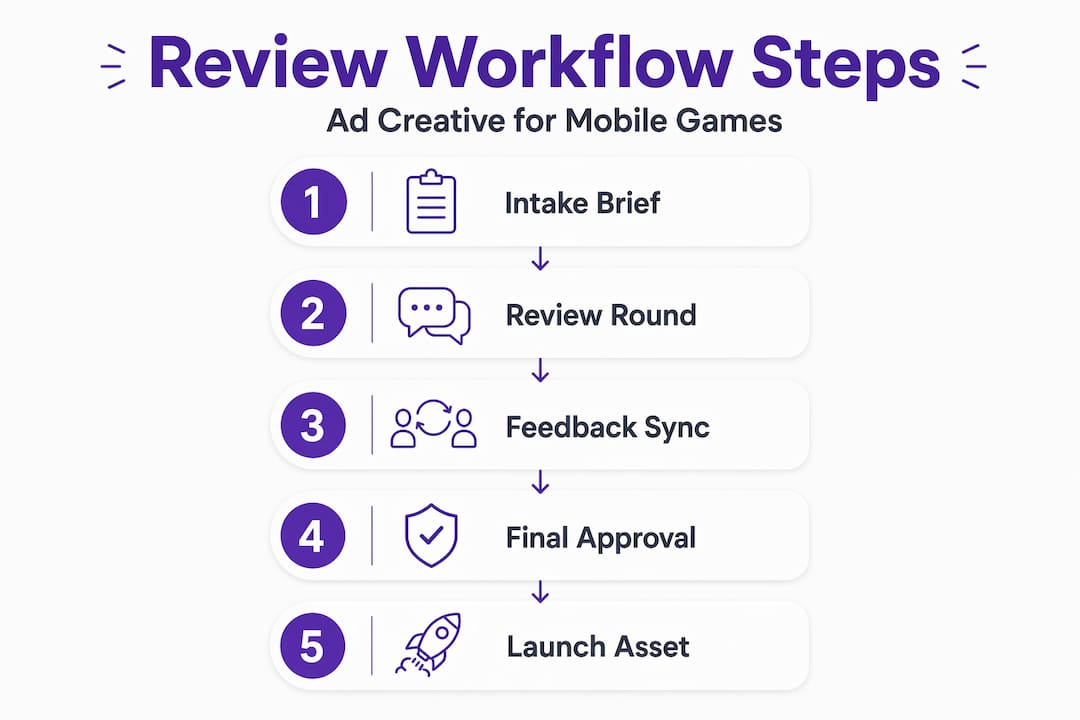
Pro Tip: Create a brief creative intake form that each asset must accompany. Include the campaign objective, target audience segment, platform specs, and any mandatory brand or legal requirements. This single step cuts misaligned feedback by forcing stakeholders to evaluate the creative against its actual brief, not their personal preferences.
Step-by-step ad creative review process
A structured advertising creative approval process does not need to be complicated. What it does need is consistency. The following sequence is designed specifically for mobile gaming marketing teams managing multiple ad formats across several platforms simultaneously.
-
Map your current process. Before building anything new, document what actually happens today. Identify where assets sit longest, who tends to be the slowest respondent, and which types of creative generate the most revision rounds. This audit takes a few hours and gives you a baseline to measure against.
-
Segment assets by complexity and risk. Group your creative assets into tiers: routine social content, mid-tier campaign ads, and high-priority launch creatives. Each tier gets a different review depth and timeline. Routine assets might go through one reviewer and one approver. A launch playable ad might require four stakeholders across two rounds.
-
Schedule batch review sessions. Weekly batch approval sessions consistently outperform scattered individual reviews for decision speed. Blocking a fixed one-hour slot each week for reviewing queued assets reduces the cognitive load of constant context switching and gives your team a predictable rhythm.
-
Implement multi-stage approval chains with deadlines. Each stage in the chain needs a named assignee and a hard deadline. Stage one might be a creative lead reviewing for brand compliance within 48 hours. Stage two could be the performance marketing manager approving for platform and audience fit within 24 hours. Deadlines without consequences are suggestions. Build escalation logic into your workflow so that a missed response window automatically alerts a senior stakeholder.
-
Use online proofing with visual annotations. Instead of written descriptions like “make the CTA bigger in the bottom right,” reviewers pin comments directly to the element on the asset. This removes ambiguity and significantly reduces the back-and-forth between designer and reviewer. It also keeps all feedback in one place rather than spread across emails, Slack messages, and verbal notes from a meeting.
-
Automate routing, reminders, and escalation. Creative workflow automation handles the coordination tasks that typically fall through the cracks: routing an asset to the next reviewer when the previous stage is complete, sending reminders before a deadline expires, and escalating to a manager when a response window closes without action. This removes the need for a project manager to manually chase every approval.
-
Maintain a revision log and audit trail. Every change, every piece of feedback, and every approval decision should be recorded automatically by your platform. This serves two purposes: it holds stakeholders accountable and it protects the team if a compliance question arises after launch.
Pro Tip: When you introduce automated escalation, communicate the rules clearly to your team first. If people discover they are being escalated over without prior warning, it creates friction and resentment. Frame escalation as a structural safety net, not a punishment for slow responders.
Common pitfalls in the creative review process
Most approval process failures are structural rather than personal. Unclear ownership, over-involvement of stakeholders, and reliance on email cause the majority of delays. Knowing the patterns in advance lets you design against them.
-
Conflating reviewers and approvers. When too many people have sign-off authority, nobody commits. A RACI matrix, which explicitly maps who is Responsible, Accountable, Consulted, and Informed, prevents blurred responsibilities and gives every stakeholder a clearly bounded role.
-
Over-involving stakeholders. More feedback is not always better feedback. Involving six people in a routine banner review generates contradictory notes that waste the designer’s time and erode creative quality. Limit review access to stakeholders who have a direct stake in the outcome.
-
Skipping deadline enforcement. A 48-hour feedback window means nothing if there is no consequence for missing it. Build automated escalation mechanisms into your process so that silence does not equal approval and delays surface immediately.
-
Fragmented feedback channels. When one reviewer emails notes, another comments in a shared drive, and a third sends a voice note, the designer cannot consolidate the feedback without significant effort. A single feedback platform is not a luxury. It is a prerequisite for a functioning process.
-
Treating the workflow as permanent. The process you design today will need adjustment in three months. Teams grow, campaign volumes change, and new ad formats arrive. Building in a quarterly review of the workflow itself is the difference between a process that improves and one that quietly calcifies into a new version of the old chaos.
Measuring and optimising your workflow
Knowing whether your ad creative review workflow is working requires tracking the right data points. A well-designed dashboard makes underperformance visible before it becomes a crisis.
| Metric | What it measures | Review frequency |
|---|---|---|
| Average approval time | End-to-end time from submission to final sign-off | Weekly |
| Revision rounds per asset | Number of times an asset returns for further changes | Per campaign |
| Feedback resolution rate | Percentage of comments addressed before re-submission | Per sprint |
| Stakeholder response time | Individual reviewer turnaround against deadlines | Monthly |
| Rework rate | Assets requiring significant revision after approval | Quarterly |
Track these figures at the campaign level and at the team level. If one reviewer consistently misses their 48-hour window, the data surfaces that pattern. If a specific ad format generates three times the revision rounds of others, the brief or the review criteria for that format needs attention.
Use data dashboards to make this monitoring continuous rather than retrospective. Version history in your proofing platform also lets you trace exactly where rework originated, which is far more useful than a post-mortem conversation weeks after the campaign ended.
Gather qualitative feedback from your reviewers and approvers every quarter. Ask whether the timelines feel realistic, whether the brief quality is sufficient, and whether the tooling is genuinely helping. Numbers tell you what is happening. People tell you why.
My perspective on workflow design and leadership
I have worked with mobile gaming marketing teams that ran at extraordinary speed and produced mediocre creative, and I have seen smaller teams with tighter processes produce ads that genuinely moved performance metrics. The difference was rarely talent. It was ownership.
What I have learned is that scaling creative is fundamentally a leadership challenge, not a process one. You can build the most technically sound workflow in the world, and if the person with final approval authority is unclear about what they are actually approving for, the creative output drifts. Quality without a named guardian is a shared responsibility, which in practice means nobody’s responsibility.
The teams I have seen get this right do one thing others do not: they distinguish between creative direction and creative approval. The creative director shapes the work. The approver verifies it meets the brief. When those two roles collapse into one, approvals become creative sessions and the process never ends.
I am also cautious about AI integration in the review process. Tools that lock in creative structures before generative rendering can protect brand consistency, but they require someone to make deliberate decisions about those structures upfront. The risk is that teams adopt AI tooling to speed up the process without first resolving the human ownership questions underneath. Speed without clarity just produces more of the wrong thing, faster.
— Ondrej
How Playablemaker supports your review and approval process
Playablemaker is built specifically for mobile gaming marketing teams who need to produce and review high-quality playable and interactive ads without the cost and delays that typically come with the format. The platform supports multi-stage approval workflows, visual annotations, version control, and automated reminders, all within a no-code environment designed to fit alongside your existing campaign schedule.
Teams using dedicated creative platforms report approval time reductions of up to 65% compared to email-based processes. Playablemaker integrates that efficiency directly into the creative production cycle, so your review stages sit inside the same environment where your ads are built. Explore playable ads for mobile marketers to understand how a structured creative workflow pairs with ad formats that consistently outperform static alternatives.
If you are rethinking how your team approaches effective ad creative processes, Playablemaker gives you the infrastructure to do it without expanding your budget or your development team.
FAQ
What is an ad creative review workflow?
An ad creative review workflow is a structured process for routing ad assets through defined stages of feedback, revision, and approval before publication. It assigns clear roles, deadlines, and tools to manage the process from first submission to final sign-off.
How long should the creative approval process take?
High-performing teams set 48 hours for reviewer feedback and 24 hours for final approval at each stage. Complex or high-spend creative may require an additional review round, but total approval time across all stages should rarely exceed five business days.
What causes most ad creative approval delays?
Most delays are structural, caused by unclear role ownership, too many stakeholders with sign-off authority, and the use of email as the primary feedback channel. Fixing these structural issues resolves the majority of bottlenecks.
How do you measure whether a creative review workflow is working?
Track average approval time, revision rounds per asset, and stakeholder response rates against defined deadlines. A quarterly review of these metrics, combined with qualitative feedback from the team, gives a reliable picture of where the process is performing and where it needs adjustment.
When should I use automated escalation in the review process?
Automated escalation should trigger whenever a reviewer misses their assigned response window. A mandatory response window of 24 to 48 hours with automatic escalation to a senior stakeholder prevents reviews from stalling without requiring manual follow-up from a project manager.
Recommended
- Ad creative feedback process: a guide for UA teams – playablemaker.com Ad creative feedback process: a guide for UA teams
- Creative Testing for Mobile Games: Step-by-Step Success – playablemaker.com Creative Testing for Mobile Games: Step-by-Step Success
- Why Creatives Matter for Mobile Game Ad Success – playablemaker.com Why Creatives Matter for Mobile Game Ad Success
- How to Scale Ad Creatives for Mobile Games Effectively – playablemaker.com How to Scale Ad Creatives for Mobile Games Effectively