Scaling engaging mobile game ad creatives can feel like an uphill battle when budgets are tight and developer time is scarce. For user acquisition managers, the struggle lies in delivering captivating experiences that fit both performance goals and player expectations. With interactive and reward-based ads now preferred by 78 percent of players, adopting efficient creative strategies aligned with clear campaign objectives has never mattered more for achieving measurable results in a competitive market.
Table of Contents
- Step 1: Define Campaign Goals And Creative Requirements
- Step 2: Streamline Asset Creation With No-Code Tools
- Step 3: Customise And Adapt Creatives For Audience Segments
- Step 4: Automate Creative Version Testing And Iteration
- Step 5: Analyse Performance Data And Refine Creatives
Quick Summary
| Key Point | Explanation |
|---|---|
| 1. Define Clear Campaign Goals | Establish specific objectives like user acquisition and retention to guide creative development effectively. |
| 2. Utilise No-Code Tools | Leverage user-friendly platforms for efficient ad asset creation, simplifying production and maintaining quality. |
| 3. Customise for Audience Segments | Tailor ad creatives to diverse demographics and player types for enhanced engagement and conversion rates. |
| 4. Automate Testing Processes | Implement automated systems for testing creative variations to optimise performance and reduce manual workload. |
| 5. Analyse Performance Data Regularly | Continuously examine key metrics to refine creatives based on audience interaction and engagement patterns. |
Step 1: Define Campaign Goals and Creative Requirements
Successfully scaling mobile game ad creatives requires a strategic approach to setting clear campaign objectives and design parameters. This initial phase establishes the foundation for creating compelling, performance-driven advertising assets that resonate with your target audience.
To develop an effective creative strategy, start by precisely defining your campaign’s core objectives. Are you aiming to increase user acquisition, improve player retention, or drive in-app purchases? Interactive mobile ad insights suggest aligning your creative formats directly with these specific key performance indicators (KPIs).
Key campaign goal considerations include:
- User Acquisition Targets: Specific number of new player installations
- Retention Metrics: Expected player engagement duration
- Conversion Goals: Desired in-app purchase rates
- Budget Allocation: Maximum spend per creative iteration
When establishing creative requirements, focus on designing mobile-centric experiences that leverage native hardware interactions. IAB creative guidelines recommend creating ads that feel intrinsic to the mobile gaming experience, incorporating elements like:
- Intuitive touch and swipe interactions
- Reward-based engagement mechanisms
- Concise and transparent ad disclosures
- Seamless gameplay integration
Effective ad creatives should feel like a natural extension of the gaming experience, not an interruption.
Insider Recommendation: Always prototype and test multiple creative variations to understand which design elements drive the highest user engagement and conversion rates.
Step 2: Streamline Asset Creation with No-Code Tools
Streamlining your mobile game ad creative production requires leveraging powerful no-code technologies that democratise game asset development. By adopting these innovative platforms, you can dramatically reduce development time and complexity while maintaining high-quality visual standards.

No-code game development platforms have revolutionised how designers and marketers approach asset creation, offering intuitive drag-and-drop interfaces that eliminate traditional programming barriers. These tools enable rapid prototyping and asset generation without requiring extensive technical expertise.
Key advantages of no-code asset creation tools include:
- Drag-and-Drop Interfaces: Simplify complex design processes
- Built-in Asset Libraries: Access pre-designed game elements
- Visual Scripting: Create interactive components without coding
- Rapid Iteration: Quickly modify and test ad creatives
When selecting a no-code tool, consider the following critical factors:
- Compatibility with mobile gaming platforms
- Asset export capabilities
- Integration with existing design workflows
- Scalability of creative production
No-code tools transform game asset creation from a complex technical challenge into an accessible, creative endeavour.
Expert Recommendation: Experiment with multiple no-code platforms to identify the tool that best matches your specific mobile ad creative requirements and workflow.
Step 3: Customise and Adapt Creatives for Audience Segments
Customising mobile game ad creatives for different audience segments is crucial for maximising user engagement and conversion rates. By developing targeted, personalised advertising content, you can dramatically improve the effectiveness of your mobile game marketing strategy.
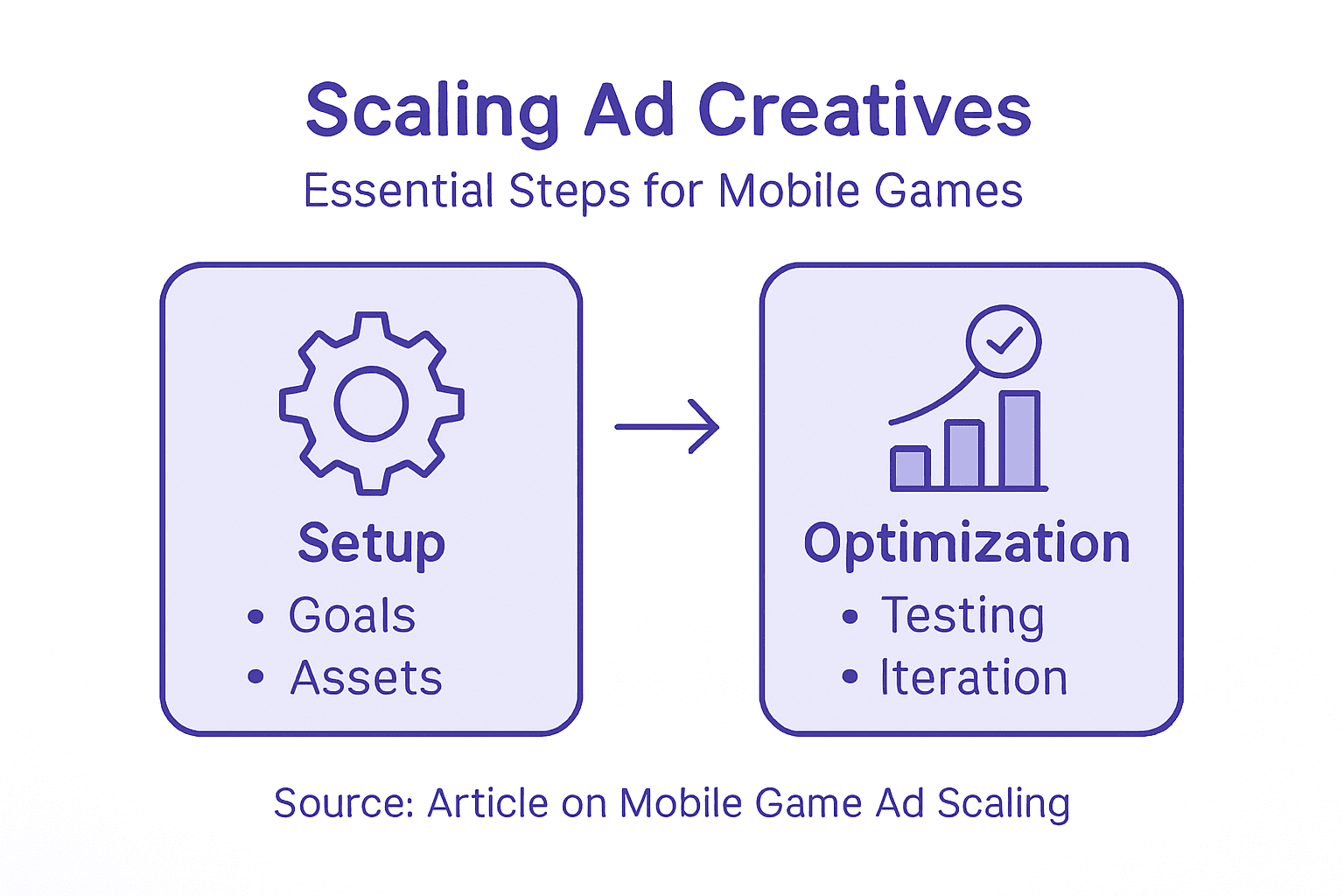
Mobile ad creative strategies demonstrate that tailoring visual and interactive elements to specific player profiles can significantly enhance user acquisition performance. Understanding the unique preferences and motivations of different audience segments allows for more precise and compelling ad experiences.
Key approaches for audience segment customisation include:
- Demographic Targeting: Adjust visuals for age, gender, and location
- Player Skill Levels: Create ads matching beginner to advanced players
- Gaming Preferences: Highlight specific game mechanics that appeal to different player types
- Emotional Triggers: Develop creatives that resonate with distinct player motivations
Strategic customisation techniques involve:
- Analyse audience data and behavioural insights
- Create multiple creative variations
- Implement A/B testing for performance evaluation
- Continuously refine and iterate creative approaches
Successful ad creatives speak directly to the unique interests and aspirations of each audience segment.
Expert Recommendation: Leverage data-driven insights and continuously experiment with creative variations to discover the most engaging content for each distinct audience segment.
Step 4: Automate Creative Version Testing and Iteration
Automating creative version testing transforms mobile game advertising from a manual, time-consuming process into a streamlined, data-driven strategy. By implementing systematic testing approaches, you can continuously optimise ad performance while reducing the resource intensity of creative development.
Creative testing strategies provide a framework for establishing clear performance benchmarks and systematically evaluating ad creative variations. Automation allows you to rapidly generate insights, minimise human bias, and make precise, objective decisions about which creative elements drive the most engagement.
Key automation testing techniques include:
- Performance Tracking: Set up real-time monitoring of key metrics
- Variant Generation: Create multiple creative iterations automatically
- Statistical Analysis: Use machine learning to evaluate creative performance
- Continuous Optimisation: Implement algorithmic refinement of ad assets
Critical steps for effective creative testing automation:
- Define precise performance indicators
- Configure automated testing infrastructure
- Establish statistical significance thresholds
- Create feedback loops for continuous improvement
Successful creative testing is less about individual variations and more about building a systematic, data-driven approach to understanding audience preferences.
Expert Recommendation: Invest in robust analytics platforms that can seamlessly track, compare, and recommend creative iterations without manual intervention.
Step 5: Analyse Performance Data and Refine Creatives
Performance analysis is the cornerstone of successful mobile game ad creative optimisation. By systematically examining key metrics and player interactions, you can transform raw data into actionable insights that continuously improve your advertising effectiveness.
Mobile gaming analytics enable developers to decode complex player behaviour patterns and refine marketing strategies with precision. Understanding the nuanced relationship between creative elements and user engagement allows for targeted, intelligent improvements that drive better conversion rates.
Critical performance metrics to track include:
- Click-Through Rates: Measure initial ad engagement
- Conversion Rates: Evaluate actual player acquisition
- Retention Metrics: Assess long-term player value
- Cost Per Acquisition: Monitor marketing efficiency
Strategic data analysis steps:
- Collect comprehensive performance data
- Segment results by creative variation
- Identify statistically significant patterns
- Develop hypotheses for creative refinement
Performance data reveals the story behind your ad creatives, transforming guesswork into strategic insight.
Expert Recommendation: Implement a continuous feedback loop where performance insights directly inform your next creative iteration, creating a dynamic, self-improving marketing approach.
For reference, here’s how various creative elements influence audience response:
| Creative Element | Potential Audience Impact | Example Application |
|---|---|---|
| Touch Interactions | Increases immersion and engagement | Swiping through mini-games |
| Demographic Visuals | Improves personal relevance | Age-appropriate graphics |
| Reward Mechanics | Drives action and retention | In-game currency bonuses |
| Narrative Integration | Strengthens emotional connection | Story-driven ad cutscenes |
Here is a summary of how each campaign stage supports mobile ad creative success:
| Campaign Stage | Core Aim | Key Value Provided |
|---|---|---|
| Goal and Requirements Setting | Establish clear direction and KPIs | Aligns creatives with business metrics |
| Asset Creation | Efficient production using no-code | Accelerates delivery and ideation |
| Audience Customisation | Tailored messaging and visuals | Boosts engagement and conversion rates |
| Automated Testing | Ongoing and objective evaluation | Ensures creative effectiveness |
| Performance Analysis | Data-driven refinement | Supports continuous improvement |
Unlock Effortless Scaling of Mobile Game Ad Creatives with PlayableMaker
The challenge of efficiently scaling mobile game ad creatives lies in balancing rapid, budget-friendly asset creation with the need for targeted audience customisation and continuous performance testing. This article highlights pain points such as resource intensive development, complexity in producing multiple creative variations, and the demand for a data-driven approach to optimise campaigns. If you want to harness the power of no-code solutions that enable quick prototyping and streamlined iteration without straining your budget, PlayableMaker is designed precisely for that.
Discover how PlayableMaker allows you to build interactive, playable ads fast without relying on developers or costly tools. With our platform, you can easily create and adjust creatives to meet diverse audience needs while automating version testing to maximise engagement and conversion rates. Take control of your ad creative workflow using Publishing Archives – playablemaker.com for best practices and support from our Help Archives – playablemaker.com. Do not let traditional challenges hold back your mobile game marketing success. Visit PlayableMaker today to start scaling your ad creatives smarter, quicker, and with full creative freedom.
Frequently Asked Questions
How can I define clear campaign goals for scaling ad creatives in mobile games?
To define clear campaign goals, identify the specific objectives you wish to achieve, such as increasing user acquisitions or driving in-app purchases. Start by establishing measurable key performance indicators (KPIs) to track your progress, ensuring they align with your overall marketing strategy.
What are the advantages of using no-code tools for mobile game ad creative production?
No-code tools allow for rapid asset creation without the need for extensive programming skills. By utilising these platforms, you can streamline the design process, so aim to reduce development times by about 30% while maintaining high visual standards.
How can I customise mobile game ad creatives for different audience segments?
Customisation involves tailoring your ad content to match the preferences of specific player demographics and skill levels. Conduct audience analysis and create multiple variations of your ads, adjusting visuals and messaging to enhance engagement for each segment.
What steps should I follow to automate creative version testing?
To automate creative version testing, establish a system for tracking performance metrics and generating multiple ad variations. Implement real-time monitoring tools, define your performance indicators, and create a feedback loop to optimise your creatives continuously.
How can I analyse performance data effectively to refine my ad creatives?
Analysing performance data involves collecting and segmenting ad metrics such as click-through and conversion rates. Review the data to identify significant patterns and areas for improvement, and then refine your creatives accordingly to enhance their effectiveness over time.
Recommended
- How to Repurpose Ad Creatives for Mobile Gaming Success – playablemaker.com How to Repurpose Ad Creatives for Mobile Gaming Success
- 7 Essential Ad Design Tips for Mobile Games in 2025 – playablemaker.com 7 Essential Ad Design Tips for Mobile Games in 2025
- Master the Dynamic Ad Creative Process for Mobile Gaming – playablemaker.com Master the Dynamic Ad Creative Process for Mobile Gaming
- Master Effective Ad Creative Processes for Mobile Gaming – playablemaker.com Master Effective Ad Creative Processes for Mobile Gaming
- How to Manage Social Media Ads for Ecommerce Success