Struggling to attract truly engaged players while keeping acquisition costs under control is a familiar challenge for mobile gaming marketers. Playable ads stand out as interactive advertising tools that reduce user annoyance and increase engagement by allowing users to try out games within the ad itself. Choosing cost-effective, no-code testing solutions lets you optimise creative performance and conversion rates quickly, making it possible to boost your user acquisition strategy without overspending.
Table of Contents
- What Are Playable Ads And Why Test Them
- Key Playable Ad Types For User Acquisition
- Core Features And Testing Workflow Explained
- Impact Of Playable Ads On Conversion Rates
- Cost Efficiency Versus Traditional Ad Formats
- Common Pitfalls And Best Testing Practices
Key Takeaways
| Point | Details |
|---|---|
| Playable Ads Enhance Engagement | Interactive ads provide users with direct gameplay experience, leading to improved user engagement and higher conversion rates. |
| Testing Optimises Performance | Rigorous testing methodologies are essential for refining playable ads and understanding user interactions effectively. |
| Cost Efficiency Over Traditional Ads | Playable ads are more cost-effective compared to traditional advertising formats, reducing customer acquisition costs while increasing engagement. |
| Target Audience Segmentation is Key | Effective playable ads require careful audience segmentation to ensure that the ad format resonates with different user demographics. |
What Are Playable Ads And Why Test Them
Playable ads are an innovative mobile advertising format that allows potential users to experience a brief, interactive preview of a mobile game directly within an advertisement. Unlike traditional static or video ads, these interactive experiences give viewers a hands-on opportunity to engage with game mechanics before downloading.
These advertisements work by providing a short, compelling gameplay snippet that demonstrates the core entertainment value of a mobile game. Interactive advertising tools help reduce user annoyance by offering meaningful interactions that go beyond passive viewing.
Key characteristics of playable ads include:
- Immediate interaction with game mechanics
- Short, focused gameplay demonstrations
- Low-friction user experience
- Direct pathway to app installation
Testing playable ads is crucial for several important reasons. Platforms switching to playable ads demonstrate promising potential in increasing user acquisition rates, but this requires careful optimization and strategic evaluation.
The primary objectives of testing playable ads include:
- Measuring viewer engagement levels
- Tracking conversion rates
- Understanding user interaction patterns
- Optimising ad creative elements
Pro tip: Always ensure your playable ad represents the most enjoyable 15-30 seconds of gameplay to maximise user interest and potential downloads.
Key Playable Ad Types For User Acquisition
Playable ad types vary significantly, designed to target different user segments and achieve specific mobile game marketing objectives. Targeted advertising strategies reveal three primary categories of interactive mobile game advertisements that can dramatically improve user acquisition performance.
The main types of playable ads include:
- Trial-based playables: Offer direct gameplay experience
- Reward-based playables: Provide incentives for interaction
- Narrative-driven playables: Incorporate storytelling elements
Each ad type serves a unique purpose in engaging potential users. Audience segmentation techniques help marketers select the most appropriate playable ad format based on user demographics and behavioural patterns.
Trial-based Playables
These ads focus on demonstrating core gameplay mechanics quickly and effectively. They allow users to experience a small, representative portion of the game, giving an immediate sense of gameplay style and entertainment value.

Reward-based Playables
By offering in-game rewards or virtual currency for engaging with the ad, these playables create additional motivation for users to interact and potentially download the full game. The incentive structure can significantly boost conversion rates.
Narrative-driven Playables
These sophisticated ads integrate storytelling elements to create emotional connections. By presenting a compelling micro-narrative within the ad, they aim to intrigue users and draw them into the game’s larger universe.
The table below contrasts core playable ad types with their main strategic focus and best-use scenario:
| Playable Ad Type | Strategic Focus | Ideal Usage Context |
|---|---|---|
| Trial-based Playables | Highlight core mechanics | Demonstrating game depth quickly |
| Reward-based Playables | Drive user motivation | Boosting short-term conversions |
| Narrative-driven Playables | Foster emotional engagement | Attracting story-focused audiences |
Successful playable ad strategies require careful consideration of:
- Target audience preferences
- Game genre specifics
- Interaction complexity
- Reward mechanism design
Pro tip: Design your playable ad to showcase the most engaging 15-30 seconds of gameplay, focusing on what makes your game uniquely enjoyable.
Core Features And Testing Workflow Explained
Playable ad testing represents a sophisticated approach to validating mobile game marketing strategies. Scientific workflow methodologies provide a structured framework for ensuring comprehensive evaluation of interactive advertising performance.
The core testing workflow encompasses several critical stages:
- Initial design and conceptualisation
- User interaction mapping
- Performance metric identification
- Iterative optimisation
- Data analysis and insights generation
Key Testing Components
Comprehensive testing processes require a multi-dimensional approach to assessing playable ad effectiveness. The workflow typically involves:
- Planning and scoping
- Detailed execution strategy
- User engagement tracking
- Performance metric analysis
- Continuous refinement
Each stage demands meticulous attention to detail and a data-driven methodology. Marketers must focus on capturing nuanced user interactions, measuring response times, and understanding engagement patterns that translate into actual game downloads.
Performance Metrics to Track
Successful playable ad testing involves monitoring several critical metrics:
Here is a summary of key performance metrics and their business implications in playable ad testing:
| Metric | Business Impact | Example Insight |
|---|---|---|
| Interaction Duration | Reveals ad engagement strength | Longer playtime shows high interest |
| Conversion Percentage | Measures user acquisition cost efficiency | Higher rates lower ad costs |
| User Retention Indicator | Reflects long-term ad effectiveness | Indicates lasting game appeal |
- Interaction duration
- Click-through rates
- Conversion percentages
- User retention indicators
- Demographic engagement levels
The ultimate goal is creating a precise, repeatable process that transforms raw user interaction data into actionable insights for mobile game marketing strategies.
Pro tip: Implement a systematic A/B testing approach, comparing multiple ad variations simultaneously to identify the most compelling user acquisition strategies.
Impact Of Playable Ads On Conversion Rates
Playable ad conversion rates represent a transformative approach to mobile game user acquisition. Promotional interactive experiences significantly enhance user engagement by providing direct, immersive gameplay previews that dramatically improve installation probabilities.
Key conversion rate advantages include:
- Immediate user interaction
- Real-time game mechanic demonstration
- Reduced purchase hesitation
- Lower customer acquisition costs
- Enhanced user experience
Long-term experimental research reveals compelling insights into how interactive advertisements influence user behaviour. Traditional static advertisements often struggle to capture user attention, whereas playable ads create an emotional connection through direct engagement.
Conversion Performance Metrics
Successful playable ads typically demonstrate superior performance across multiple dimensions:
- Higher click-through rates
- Increased app installation percentages
- More qualified user acquisitions
- Enhanced user retention
- Lower bounce rates
Marketing teams can leverage these interactive formats to provide potential players with authentic gameplay experiences that transparently communicate a game’s core value proposition. By allowing users to experience game mechanics directly, playable ads reduce uncertainty and build immediate user confidence.
Comparative Conversion Analysis
Compared to traditional video or banner advertisements, playable ads consistently outperform alternative marketing strategies. The interactive nature transforms passive viewing into active user participation, creating a more compelling and memorable advertising experience.
Pro tip: Design your playable ad to showcase the most exciting 15-30 seconds of gameplay, focusing on unique mechanics that differentiate your mobile game from competitors.
Cost Efficiency Versus Traditional Ad Formats
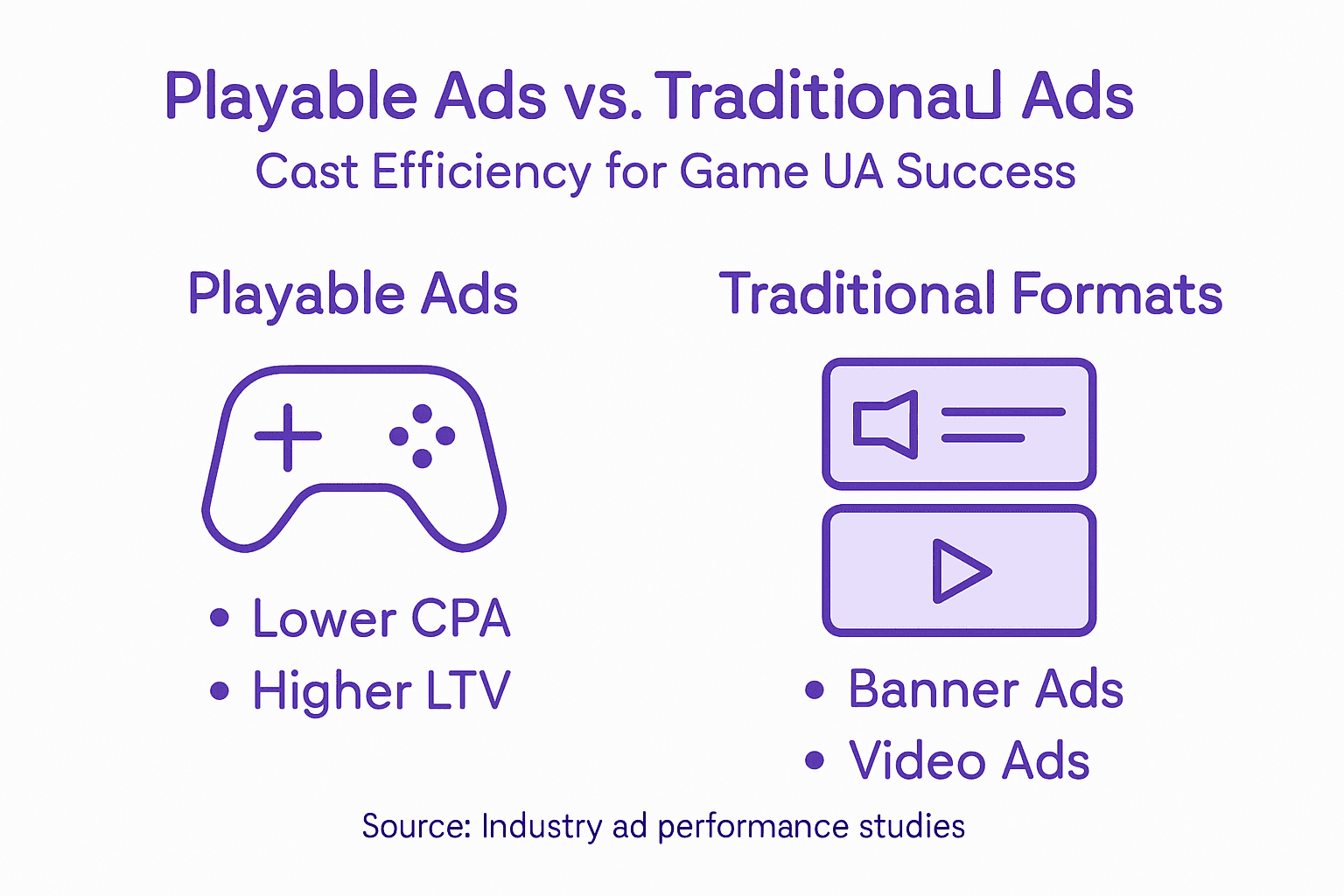
Digital advertising strategies are constantly evolving, with playable ads emerging as a remarkably cost-efficient marketing approach. These interactive advertisements offer superior budget allocation compared to traditional static or video ad formats, delivering more engaging user experiences at potentially lower costs.
Key cost efficiency advantages include:
- Lower customer acquisition expenses
- Higher engagement rates
- More precise targeting capabilities
- Improved conversion tracking
- Reduced advertising waste
Digital advertising comparisons demonstrate that interactive ads provide substantial benefits over conventional marketing channels. While traditional television and print advertisements maintain broad reach, playable ads offer granular performance metrics and more direct user interaction.
Cost Comparison Metrics
Comparing advertising formats requires examining multiple financial dimensions:
- Cost per user acquisition
- Engagement rate efficiency
- Conversion percentage
- Long-term user retention value
- Precise audience targeting
Playable ads significantly reduce marketing expenditure by creating more meaningful interactions. Traditional advertisements typically operate on a passive viewing model, whereas interactive ads transform potential customers into active participants, thereby increasing the likelihood of game installation.
The economic advantages extend beyond immediate conversion rates. By providing users with direct gameplay experiences, these advertisements minimise uncertainty and build immediate user confidence, ultimately reducing long-term marketing expenses associated with traditional acquisition strategies.
Pro tip: Calculate your playable ad’s return on investment by tracking user acquisition costs and comparing them against lifetime player value to understand true marketing efficiency.
Common Pitfalls And Best Testing Practices
Playable ad testing requires a strategic and comprehensive approach to ensure maximum effectiveness. Comprehensive testing methodologies emphasise structured evaluation techniques that go beyond superficial performance metrics.
Common pitfalls in playable ad testing include:
- Inadequate user segmentation
- Incomplete performance tracking
- Lack of iterative refinement
- Narrow testing parameters
- Overlooking demographic variations
Successful testing strategies demand a multifaceted approach that combines several critical elements. Marketing teams must develop adaptive testing frameworks that respond dynamically to changing user behaviours and technological landscapes.
Testing Methodology Best Practices
Effective playable ad testing requires implementing a robust evaluation framework:
- Define clear testing objectives
- Develop comprehensive user segments
- Implement hybrid testing approaches
- Continuously monitor post-launch performance
- Create iterative improvement mechanisms
The most successful testing strategies integrate multiple assessment techniques, including automated analytics, manual user feedback, and sophisticated performance tracking. This comprehensive approach ensures a nuanced understanding of ad effectiveness across different user demographics and engagement contexts.
Performance Evaluation Techniques
Marketers should focus on collecting granular data points that reveal deeper insights into user interactions. This means moving beyond surface-level metrics like click-through rates and examining more sophisticated indicators of user engagement and potential long-term value.
Pro tip: Implement a systematic A/B testing protocol that compares multiple ad variations simultaneously, tracking both immediate conversion rates and long-term user retention metrics.
Unlock the Full Potential of Your Playable Ads Testing
Testing playable ads to boost mobile game user acquisition can be complex and resource-intensive. The article highlights challenges like optimising ad creative elements, tracking user engagement, and running iterative A/B tests to discover what truly resonates. If you are struggling with costly development time, limited creative flexibility, or complicated workflows that slow down your testing cycles, you are not alone.
At PlayableMaker, we understand that creating and testing interactive ads should be easy, fast, and budget-friendly. Our no-code solution empowers you to build engaging playable ads without draining company resources or requiring developer hours. This is ideal for marketers aiming to increase conversion rates with trial-based, reward-based, or narrative-driven playables while keeping costs low and processes streamlined.
Ready to accelerate your playable ads strategy and make testing simpler and more effective Take a look at our Publishing Archives for tips on launching successful campaigns. If you want to learn all about how our platform can transform your user acquisition efforts, start your journey today at PlayableMaker. Have questions As you dive in our Help Archives provide the answers you need to get started quickly.
Frequently Asked Questions
What are playable ads and how do they work?
Playable ads are interactive mobile advertisements that allow users to experience a short, engaging preview of a mobile game. They provide a hands-on opportunity for potential users to interact with core gameplay mechanics before deciding to download the game.
Why is it important to test playable ads?
Testing playable ads is crucial for optimising user acquisition strategies. It helps measure viewer engagement, track conversion rates, understand user interaction patterns, and enhance ad creative elements, leading to improved marketing performance.
What are the main types of playable ads?
The primary types of playable ads include trial-based playables, which focus on showcasing core gameplay mechanics; reward-based playables, which provide incentives for user interaction; and narrative-driven playables, which incorporate storytelling elements to intrigue viewers.
How can I measure the success of my playable ads?
The success of playable ads can be measured through various performance metrics such as interaction duration, conversion rates, user retention indicators, and demographic engagement levels. Monitoring these metrics can provide valuable insights into the effectiveness of your ads.
Recommended
- What Is AB Testing? Complete Guide for Mobile Gaming – playablemaker.com What Is AB Testing? Complete Guide for Mobile Gaming
- Ad A/B Testing Guide for Higher Mobile Game ROI – playablemaker.com Ad A/B Testing Guide for Higher Mobile Game ROI
- What Is an AB Test? Complete Guide for Mobile Marketing – playablemaker.com What Is an AB Test? Complete Guide for Mobile Marketing
- 7 Essential Steps for Effective Mobile Ad A/B Tests – playablemaker.com 7 Essential Steps for Effective Mobile Ad A/B Tests
- App Landing Page