
TL;DR:
- Playable UX involves interactive ads that enhance user engagement and retention performance.
- No-code platforms enable rapid, cost-effective creation and testing of playable ads.
- Simple, rewarding interactions lead to higher engagement, better recall, and increased install rates.
Playable UX is reshaping how mobile game advertisers attract and retain quality users, yet many UA teams still treat it as an expensive luxury rather than a core acquisition strategy. The assumption that interactive ads require dedicated developer time and significant budget has held back countless campaigns. That assumption is increasingly out of date. No-code platforms have fundamentally changed the economics of playable ad creation, making high-quality interactive experiences accessible to teams of any size. This guide explains what playable UX actually means, why it outperforms traditional formats, and how you can implement it efficiently without draining your development resources.
Table of Contents
- What is playable UX? Core concepts explained
- How no-code platforms empower playable UX
- The impact of playable UX on user engagement and retention
- Best practices for creating high-impact playable UX
- Our take: Why most brands underutilise playable UX in UA
- Next steps: Unlock the power of playable UX in your campaigns
- Frequently asked questions
Key Takeaways
| Point | Details |
|---|---|
| Playable UX defined | Playable UX lets users interact with ads, boosting engagement compared to traditional formats. |
| No-code advantages | Modern tools make building, testing, and scaling playable ads faster and more affordable. |
| Proven performance | Playable UX ads deliver higher CTR, retention, and ROI based on industry benchmarks. |
| Best practice focus | Simple, rewarding, and data-driven approaches drive the best playable ad results. |
What is playable UX? Core concepts explained
Playable UX refers to ad experiences that users can actively interact with, rather than passively watch or scroll past. In mobile advertising, this typically means a mini-game demo, an interactive app preview, or a short challenge that mirrors the core loop of the advertised product. The user touches, taps, swipes, or makes decisions within the ad itself before being prompted to install.
This is fundamentally different from a video or a static banner. A video tells users what an app feels like. A playable ad lets them feel it directly. That distinction matters enormously for user quality. Someone who installs after genuinely engaging with a playable unit already understands the core mechanic, which means they are far more likely to remain active after Day 1.
The range of creative ad formats available today is broad, but playable UX sits at the top for engagement potential. Here is why the format consistently outperforms alternatives:
- Higher click-through rates: Users who interact are already invested, making the tap-to-install feel natural rather than forced.
- Better ad recall: Interactive experiences create stronger memory traces than passive viewing.
- Improved user quality: Players who install after a playable demo have realistic expectations, reducing early churn.
- Broader applicability: Playable UX works across mobile games, app install campaigns, and brand awareness objectives.
The performance data is striking. Playable ads achieve 3%+ CTR, 2.5x ad recall, and 20x more installs versus banners. Those are not marginal gains. They represent a structural advantage for teams willing to invest in the format.
Browsing examples of mobile game ads reveals a consistent pattern: the most effective playable units are simple, immediately rewarding, and clearly branded. They do not try to replicate the full game. They isolate the single most satisfying moment and build the ad experience around it.
Statistic: Playable ads generate 20x more installs than standard banner formats, with CTR consistently exceeding 3% across major mobile networks.
How no-code platforms empower playable UX
Having established what playable UX is, let us explore how modern no-code tools make it accessible to all UA teams. Historically, building a playable ad required a developer, a designer, a QA pass, and several weeks of production time. The cost and timeline made rapid iteration nearly impossible. Most teams could afford to produce one or two playable variants per quarter, which severely limited their ability to test and learn.
No-code platforms like PlayableMaker and Playable Factory have changed that model entirely. Marketers can now build, preview, and export playable ads using drag-and-drop interfaces, pre-built templates, and visual logic editors. No programming knowledge is required. The creative process moves from weeks to days, sometimes hours.
The practical difference between the two workflows is significant:
| Factor | Traditional dev workflow | No-code workflow |
|---|---|---|
| Production time | 3 to 6 weeks | 1 to 3 days |
| Cost per creative | £2,000 to £8,000 | £200 to £800 |
| Iterations per quarter | 2 to 4 | 20 to 40 |
| Developer dependency | High | None |
| A/B testing speed | Slow | Rapid |
No-code platforms reduce production time by 50 to 70% and costs by 25 to 50%. For UA teams managing multiple campaigns simultaneously, that efficiency compounds quickly. You can test more hypotheses, respond faster to performance data, and scale winning creatives without waiting for developer availability.

The shift toward no-code ad building also democratises the creative process. UA managers, performance marketers, and even growth analysts can contribute directly to ad production. This removes the bottleneck that has traditionally slowed down playable UX adoption.
Pro Tip: Start with a proven template rather than building from scratch. Use your first playable unit to establish a baseline, then run structured A/B tests on a single variable at a time. Changing the core mechanic, the end card, or the reward animation each in isolation gives you clean data to inform the next iteration.
The drag-and-drop creation tools available today are mature enough to handle complex interactions, animations, and conditional logic without writing a single line of code. The barrier to entry has genuinely fallen.
The impact of playable UX on user engagement and retention
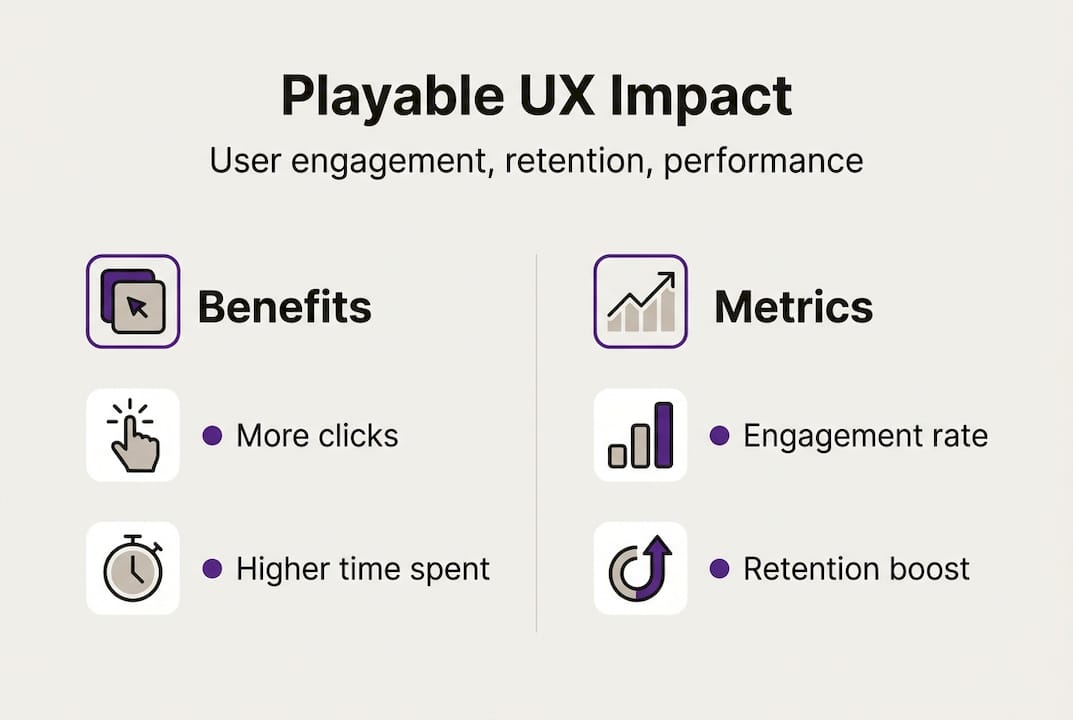
With tools in place, it is important to understand why playable UX outperforms traditional ad formats in real-world results. The numbers tell a clear story, but understanding the mechanism behind them helps UA teams make smarter creative decisions.
“Engagement rates can reach 72% with playable ads, compared to 12% for traditional ads, with Day 7 retention boosted by 15 to 30%.”
That gap exists because interactivity creates active processing. When a user taps through a playable mechanic, their brain encodes the experience differently than when they passively watch a video. They form an association between the action and the reward, which is precisely the loop that keeps players returning to mobile games.
Here is how playable UX benchmarks compare to passive formats:
| Metric | Playable ads | Video ads | Banner ads |
|---|---|---|---|
| Engagement rate | Up to 72% | ~25% | ~12% |
| Ad recall | 2.5x higher | Baseline | Below baseline |
| D7 retention lift | +15 to 30% | Minimal | None |
| CPI reduction | Significant | Moderate | None |
| Install intent | High | Medium | Low |
The engagement techniques that drive these results share common characteristics. Effective playable UX consistently uses:
- Challenge: A clear objective that creates mild tension and motivates completion.
- Reward: Immediate positive feedback when the user succeeds, reinforcing the desire to install.
- Instant feedback: Visual and audio responses to every user action, making the experience feel responsive and alive.
- Clarity: Simple instructions that require no reading. Users should understand what to do within two seconds.
Understanding how to make engaging ads means recognising that the goal is not to showcase every feature of your game. It is to deliver one satisfying moment that leaves the user wanting more. That emotional residue is what drives install intent.
Best practices for creating high-impact playable UX
Understanding the impact of playable UX, let us detail the actionable steps for building effective interactive ad experiences. The process is straightforward when you follow a structured approach.
- Define the core moment. Identify the single most satisfying mechanic in your game or app. This becomes the centrepiece of your playable ad. Avoid the temptation to include multiple features.
- Prototype rapidly. Use a no-code platform to build a rough version of the interaction. Focus on the mechanic first, polish second. Speed here is more valuable than perfection.
- Test with real users. Share the prototype internally or with a small test audience. Watch where users hesitate or drop off. Those friction points are your first optimisation targets.
- Iterate on one variable at a time. Change the end card, the difficulty level, or the visual feedback in isolation. This gives you interpretable data rather than noise.
- Launch and monitor closely. Track IPM, CTR, D1 and D7 retention, and CPI from day one. Set clear thresholds for pausing or scaling each variant.
Pro Tip: Resist the urge to make your playable ad complex. Playable ads outperform videos and banners in almost every measurable metric precisely because the best ones are simple and immediately satisfying. Two taps to understand, three seconds to feel rewarded. That is the target.
The game ad creation guide principle of keeping interactions to one or two core actions is supported by performance data across thousands of campaigns. Users abandon playable ads that feel confusing or demanding. Snackable, rewarding, and clear is the formula that consistently converts.
Brand integration also matters. Your logo, colour palette, and character design should be visible throughout the experience, not just on the end card. Users should associate the enjoyment of the interaction with your specific product. Reviewing effective ad techniques confirms that brand-consistent playable units outperform generic templates on recall and install quality.
Our take: Why most brands underutilise playable UX in UA
Most brands that adopt playable UX do so tentatively. They produce one or two units, run them alongside their existing video and banner mix, and treat the format as a creative experiment rather than a strategic pillar. When results are positive, they celebrate. When they are not, they retreat. Neither response reflects a mature understanding of what playable UX can actually do.
The real opportunity lies in treating playable UX as an analytics-driven growth loop. Teams using no-code tools can produce and test twice as many variants as those relying on developers. That volume of experimentation compounds over time. Each iteration teaches you something specific about your audience’s preferences, tolerance for difficulty, and response to reward structures.
The brands that pull ahead are not the ones with the most sophisticated playable ads. They are the ones that iterate fastest and learn most efficiently. Creative UA concepts that perform well rarely emerge fully formed. They are the product of disciplined testing and honest analysis.
Stop treating playable UX as a garnish on your campaign strategy. Build it into your core acquisition workflow, measure it rigorously, and let the data drive your creative direction.
Next steps: Unlock the power of playable UX in your campaigns
Inspired to reimagine your creative process? The evidence for playable UX is compelling: higher engagement, better retention, lower CPI, and stronger brand recall. Understanding why playable ads are so effective comes down to the psychology of active participation. Users who interact remember more and install with greater intent.
PlayableMaker’s drag-and-drop playable builder puts that capability directly in your hands, without requiring a single line of code or a developer on standby. You can build, test, and iterate at the speed your campaigns actually demand. If you are ready to move from passive ad formats to interactive experiences that genuinely convert, start building on PlayableMaker today and see the difference for yourself.
Frequently asked questions
What exactly is playable UX in mobile advertising?
Playable UX means creating ad experiences users can interact with, such as mini-game demos or interactive app previews, rather than passively watching a video or static format. The interaction itself is what drives higher engagement and install intent.
How do no-code platforms benefit UA teams?
No-code platforms cut production time by 50 to 70% and costs by 25 to 50%, allowing UA teams to rapidly create, iterate, and deploy interactive ads without relying on developers at every stage.
What are the real engagement metrics for playable UX?
Playable ads can deliver up to 72% engagement rates and 15 to 30% higher Day 7 retention compared to traditional ad formats, making them one of the highest-performing formats in mobile user acquisition.
What makes a playable ad high performing?
Simple mechanics, clear instructions delivered within two seconds, and immediately rewarding user actions consistently produce the strongest results across engagement, retention, and cost-per-install metrics.
Recommended
- 7 Key Advantages of Interactive Ads for Mobile Games – playablemaker.com 7 Key Advantages of Interactive Ads for Mobile Games
- 7 Creative Ad Formats List Every Mobile Marketer Needs – playablemaker.com 7 Creative Ad Formats List Every Mobile Marketer Needs
- User Engagement in Ads: Unlocking Mobile Success – playablemaker.com User Engagement in Ads: Unlocking Mobile Success
- Game Ad Engagement Techniques for Playable Ad Success – playablemaker.com Game Ad Engagement Techniques for Playable Ad Success
- Role of User Experience Design for Local Business Websites