Contrary to popular belief, you don’t need coding skills to create high-performing playable ads anymore. Playable demos are interactive mini-game ads that let potential users experience your game before installing, and they’re transforming user acquisition for mobile marketers. This guide explains what playable demos are, why they outperform traditional ad formats, and how no-code platforms make creating them fast and affordable.
Table of Contents
- Understanding What A Playable Demo Is
- Why Playable Demos Matter In User Acquisition
- How No-Code Solutions Revolutionise Playable Demo Creation
- Common Misconceptions About Playable Demos
- Comparing Traditional Versus No-Code Playable Demo Creation
- Implementing Playable Demos In Your Marketing Strategy
- Discover No-Code Tools To Create Playable Demos Effortlessly
- Frequently Asked Questions About Playable Demos
Key takeaways
| Point | Details |
|---|---|
| Playable demos boost engagement | Interactive ads increase click-through rates by 3 to 4 times compared to static or video formats. |
| No-code tools empower marketers | Create playable ads without developers, cutting production time by over 60% and slashing costs. |
| Retention improves significantly | Playable ads deliver 30% higher Day 7 retention rates, ensuring better long-term user value. |
| Common myths hold teams back | Outdated beliefs about complexity and cost prevent adoption despite proven benefits. |
| Implementation follows proven steps | A five-stage framework ensures successful playable ad campaigns from ideation to optimisation. |
Understanding what a playable demo is
A playable demo is an interactive mini-game embedded directly into an advertisement. Instead of watching a video or viewing a static image, users actually play a simplified version of your mobile game.
This hands-on experience creates genuine engagement. Users tap, swipe, and interact with core gameplay mechanics in under 30 seconds. The brief interaction builds trust and interest far more effectively than passive formats.
Engagement rates tell the story clearly. Playable ads produce on average 3 to 4 times higher CTR than traditional ad formats across mobile games. That dramatic difference comes from giving users control rather than asking them to watch.
Here’s what makes playable demos effective:
- Users experience actual gameplay before committing to an install
- Interactive elements trigger emotional responses and curiosity
- The format filters out uninterested users, improving downstream metrics
- Short duration prevents fatigue whilst maintaining high engagement
Typical playable demos last 15 to 30 seconds. This sweet spot balances engagement without overwhelming users. Longer experiences cause fatigue and hurt conversion rates.
The technology behind playable demos has evolved rapidly. What once required specialised developers and weeks of work now happens in hours using intuitive platforms. Marketers control the entire process without writing a single line of code.
For mobile game marketers, understanding playable ads explained opens new acquisition channels that traditional formats simply can’t match.
Why playable demos matter in user acquisition
Playable demos transform user acquisition performance across every major metric that matters to mobile game marketers.
Click-through rates jump dramatically. Whilst standard video ads might achieve 1% to 2% CTR, playable demos consistently deliver 4% to 8%. That three to four times improvement means more qualified traffic from the same ad spend.
Retention metrics improve even more impressively. Playable ads increase user retention post-install, with reported retention rates 30% higher after 7 days compared to installs from video ads. Users who interact before installing understand your game better and stick around longer.
Cost efficiency follows naturally from better targeting. When playable demos filter out uninterested users, your cost per install drops by up to 25%. You’re paying only for users genuinely interested in your gameplay.
Here’s why the format works so well:
- Users self-select based on actual interest, not just creative appeal
- Interactive experience creates emotional investment before installation
- Hands-on trial reduces surprise and disappointment post-install
- Better user quality improves lifetime value calculations
Brand impact extends beyond immediate conversions. Users remember interactive experiences longer than passive ads. This improved recall strengthens your position in crowded mobile game markets.
The benefits of playable ads compound over time. Better retention means higher lifetime values. Higher lifetime values justify increased acquisition spending. The cycle creates sustainable growth.
30% higher Day 7 retention represents thousands of pounds in additional revenue for scaled campaigns. That single metric change justifies the shift to playable formats for most mobile game marketers.
How no-code solutions revolutionise playable demo creation
No-code platforms have completely transformed who can create playable ads and how quickly production happens.
Traditional playable ad development required hiring specialised developers. These experts spent weeks coding interactive elements, testing across devices, and optimising file sizes. Costs ranged from £10,000 to £50,000 per playable ad.
No-code tools eliminate those barriers entirely. Marketers drag and drop gameplay elements, set interactions, and export production-ready ads in hours instead of weeks. No-code platforms reduce iteration cycles from weeks to days in the playable ad production workflow.

Production time drops by over 60% with no-code solutions. What took three to eight weeks now happens in three to five days. Faster turnaround means quicker testing, learning, and optimisation.
Cost savings prove equally dramatic:
- Traditional development: £10,000 to £50,000 per playable ad
- No-code platforms: £500 to £2,000 per playable ad
- Internal resources freed for strategy instead of execution
- Unlimited iterations without additional developer costs
Marketers gain unprecedented control over their campaigns. You can test five variations in the time it previously took to build one. Rapid iteration reveals winning concepts faster and cheaper.
Pro Tip: Start with your strongest gameplay mechanic when building your first no-code playable demo. The core loop that keeps players engaged in your full game works best in abbreviated playable format.
Limitations exist, of course. Complex 3D graphics or intricate game systems may still require traditional development. But for most mobile game marketing needs, no-code tools for playable ads deliver everything required.
The technology democratises playable ad creation. Small studios compete with major publishers. Marketing teams move faster than ever before.
Common misconceptions about playable demos
Several persistent myths prevent marketers from adopting playable demos despite overwhelming evidence of their effectiveness.
The biggest misconception claims playable ads require coding expertise. This belief made sense five years ago but ignores current no-code platforms. Modern tools let anyone create interactive ads using visual interfaces without writing code.
Some marketers worry playable ads damage brand experience. Research proves the opposite. Interactive formats improve brand recall and favourability compared to passive video or static ads. Users appreciate trying before installing.
Another myth suggests longer playable ads perform better. Actually, long playable ads can cause user fatigue and reduce conversions by 15%. The sweet spot remains 15 to 30 seconds. Brevity maintains engagement without overwhelming users.
Here are facts that counter common misconceptions:
- No-code platforms genuinely require zero coding knowledge
- Playable ads strengthen brand perception rather than harm it
- Shorter playable demos outperform longer versions
- Production costs have dropped 80% to 90% from traditional methods
- Small teams create playable ads as effectively as large studios
Complexity concerns also miss the mark. Whilst traditional development involved intricate coding, no-code platforms abstract that complexity. You focus on gameplay and user experience whilst the platform handles technical implementation.
Some teams hesitate because early playable ads from 2015 to 2018 performed inconsistently. Technology and best practices have matured significantly. Modern playable demos deliver reliable, measurable results.
Understanding playable ad myths debunked helps marketers move past outdated beliefs. The evidence supporting playable demos grows stronger every quarter.
Comparing traditional versus no-code playable demo creation
Choosing between traditional development and no-code platforms requires understanding trade-offs across cost, time, flexibility, and complexity.
| Factor | Traditional Development | No-Code Platforms |
|---|---|---|
| Cost per ad | £10,000 to £50,000 | £500 to £2,000 |
| Production time | 3 to 8 weeks | 3 to 5 days |
| Required skills | Advanced coding, game development | Basic computer literacy |
| Iteration speed | Slow, requires developer availability | Fast, marketer-controlled |
| Customisation | Unlimited, any gameplay possible | Limited to platform capabilities |
| Complexity ceiling | Very high, supports intricate systems | Moderate, best for core mechanics |
Traditional development offers complete creative freedom. Developers build any gameplay mechanic imaginable. Complex 3D environments, intricate physics, and novel interactions all become possible.
That flexibility comes at enormous cost. Specialised developers command premium rates. Each iteration requires scheduling, development time, and quality assurance. The process stretches across weeks or months.
No-code platforms prioritise speed and accessibility. Pre-built templates and drag-and-drop interfaces let marketers create playable ads in hours. Testing multiple variations happens quickly and cheaply.
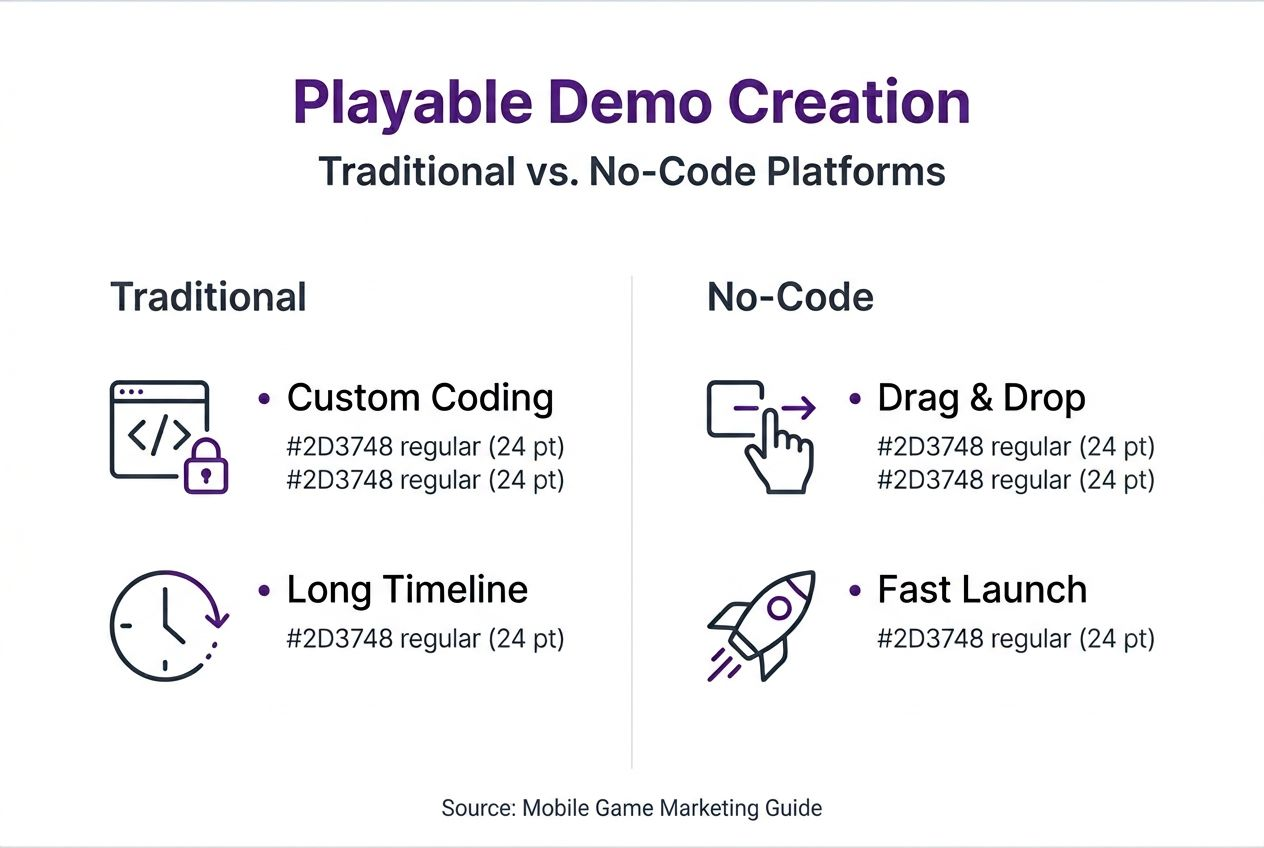
Limitations appear in complexity. Advanced 3D graphics or unique gameplay systems may exceed platform capabilities. Most mobile game marketing needs fit comfortably within no-code boundaries, however.
Here’s how to choose your approach:
- Use no-code for rapid testing, iteration, and standard gameplay mechanics
- Choose traditional development for highly complex or unique interactive experiences
- Consider hybrid approaches where no-code handles most ads whilst custom development tackles special campaigns
- Factor in your team’s technical skills and available resources
For detailed platform evaluations, review our playable ad platforms comparison to find the best fit for your needs.
Most mobile game marketers discover no-code solutions meet 80% to 90% of their playable ad requirements whilst delivering dramatically better efficiency.
Implementing playable demos in your marketing strategy
Successful playable ad campaigns follow a proven five-stage framework that maximises performance whilst minimising wasted effort.
-
Ideation: Identify your game’s core mechanic that’s most engaging and representative. Focus on the moment players find most satisfying. This becomes your playable demo foundation.
-
Design: Map out the user journey from first interaction to install prompt. Keep the experience under 30 seconds. Remove any friction or confusion.
-
Interactive scripting: Build the playable demo using your chosen platform. Configure touch responses, animations, and transitions. Test across devices.
-
Testing: Run the playable ad with small budgets across multiple networks. Monitor click-through rates, engagement duration, and conversion metrics.
-
Iterative optimisation: Analyse performance data and refine elements. Test variations of instructions, difficulty, and call-to-action placement.
A conceptual framework for playable demo creation involves stages: ideation, design, interactive scripting, testing, and iterative optimisation accelerated by no-code platforms.
Key metrics to track include:
- Click-through rate: measures initial interest and creative appeal
- Engagement duration: shows how long users interact before deciding
- Conversion rate: tracks installs per playable ad impression
- Day 1 and Day 7 retention: reveals user quality and game fit
- Cost per install: calculates efficiency against other acquisition channels
Pro Tip: Create three variations of your first playable demo with different difficulty levels. Track which converts best, then iterate from that winner rather than your initial assumption.
No-code platforms enable rapid iteration that traditional development can’t match. Launch a playable ad on Monday, analyse results by Wednesday, and deploy an improved version by Friday. This speed compounds learning and performance gains.
Continuous refinement matters more than perfect initial execution. Each iteration teaches you what resonates with your target users. Small improvements stack into substantial performance gains over time.
For detailed guidance on optimisation, explore our resource on iterating playable ads to maximise your user acquisition results.
Discover no-code tools to create playable demos effortlessly
You’ve learned how playable demos transform user acquisition and why no-code platforms make creation accessible to every marketer. Now it’s time to experience the efficiency yourself.
Our playable builder drag-and-drop creator requires zero coding skills whilst delivering professional results in hours instead of weeks. Build engaging playable ads that leverage the proven psychology behind interactive formats.
Understanding why playable ads are so effective helps you craft experiences that convert. Apply those psychological principles through rapid iteration using our platform.
Start creating playable demos today and discover how iterating playable ads for user acquisition accelerates your learning whilst reducing costs. Fast, affordable, and effective playable ad creation awaits.
Frequently asked questions about playable demos
What is the ideal length for a playable demo ad?
The optimal duration is 15 to 30 seconds. This timeframe maintains high engagement whilst preventing user fatigue. Playable ads exceeding 30 seconds typically see conversion rates drop by 15% as users lose interest or feel overwhelmed.
Can marketers create playable demos without developers?
Yes, modern no-code platforms enable marketers to build production-ready playable ads without any coding knowledge. Drag-and-drop interfaces and pre-built templates handle technical complexity whilst you focus on gameplay and user experience.
How do playable demos improve user retention?
Playable demos let users experience actual gameplay before installing, setting accurate expectations. Users who know what they’re getting stick around longer, resulting in Day 7 retention rates approximately 30% higher than installs from video ads.
Are there risks to using playable ads?
The main risk involves creating overly complex or lengthy playable demos that frustrate users rather than engage them. Keep experiences simple, under 30 seconds, and focused on your core gameplay mechanic to avoid this pitfall.
What metrics should I track for playable ad success?
Monitor click-through rate, engagement duration, conversion rate, Day 1 retention, Day 7 retention, and cost per install. These metrics reveal both immediate performance and downstream user quality, helping you optimise campaigns effectively.
Recommended
- 7 Best Examples of Interactive Ads for Mobile Gaming – playablemaker.com 7 Best Examples of Interactive Ads for Mobile Gaming
- 7 Engaging Playable Ad Campaign Ideas for Mobile Gaming – playablemaker.com 7 Engaging Playable Ad Campaign Ideas for Mobile Gaming
- Playable Content: Transforming Mobile Game Advertising – playablemaker.com Playable Content: Transforming Mobile Game Advertising
- How to Make Engaging Game Ads for Mobile Success – playablemaker.com How to Make Engaging Game Ads for Mobile Success
- HotUGC – AI-Generated UGC Videos for Your Ads | HotUGC