Every mobile user acquisition manager knows the challenge of capturing player attention without draining budgets or tech resources. As competition for quality installs intensifies across North American, European, and Asian markets, finding efficient ways to run truly engaging campaigns becomes essential. Playable ads offer a fundamental shift in mobile marketing, letting users actively try game mechanics within the ad itself—cutting through ad fatigue and driving higher engagement, brand recall, and conversion rates than any static or video format. This guide explores practical, no-code paths for creating compelling interactive ads that spark authentic interest and maximise your acquisition spend.
Table of Contents
- Defining Playable Content In Mobile Ads
- Major Types And Key Features Explained
- How Playable Content Drives Engagement
- Challenges, Costs, And Common Pitfalls
- Comparing Playable Content To Other Ad Formats
Key Takeaways
| Point | Details |
|---|---|
| Engagement Advantage | Playable ads significantly increase user engagement by transforming viewers into active participants, leading to better brand recall and higher conversion rates. |
| Cost-Effectiveness | Despite higher production costs, playable ads achieve much lower cost-per-install by targeting genuinely interested users, thus improving return on investment. |
| Simplified Design Focus | Effective playable ads centre on one compelling game mechanic, avoiding feature overload to enhance user understanding and retention. |
| Data-Driven Personalisation | Engagement metrics from playable ads provide insights for tailoring future content, ensuring continuous improvement in ad effectiveness. |
Defining Playable Content in Mobile Ads
Playable content represents a fundamental shift in how mobile games advertise themselves. Rather than showing static images or brief video clips, playable ads let users interact directly with a simplified version of your game before they decide to download.
What exactly is a playable ad?
A playable ad is an interactive advertisement that functions as a working demo of your game. Users tap, swipe, and make decisions within the ad itself—experiencing real gameplay mechanics instead of watching passively. This interactivity distinguishes playable ads from traditional banner ads, video ads, and other static formats.
The mechanics behind the experience
Playable ads operate using technologies like HTML5, which enables lightweight, fast-loading experiences across major ad platforms. The ads showcase a stripped-down version of your game, highlighting the core features that make it engaging. Users complete a simple task or objective within 30-60 seconds, gaining genuine hands-on experience before committing to a download.
Key characteristics of effective playable ads:
- Interactive gameplay – Users control character movement, solve puzzles, or progress through mini-objectives
- Fast loading times – HTML5-based ads load instantly without lag or buffering
- Platform compatibility – Works across Facebook, Google Play, App Store, and third-party networks
- Minimal file sizes – Keeps bandwidth requirements low whilst maintaining visual quality
- Clear call-to-action – Directs users to download after they’ve experienced the game
Why this format matters for your user acquisition
Interactive ads significantly increase consumer engagement by offering novelty, interactivity, and gamification elements. When players actually play your game within the ad, they develop investment in the experience before downloading. This dramatically improves brand recall and conversion rates compared to passive viewing formats.
The difference in cost-effectiveness is substantial. Because playable ads pre-qualify users by showing them actual gameplay, you attract users more likely to install and engage long-term. You’re not paying to show ads to users who’ll uninstall after five minutes—you’re targeting players who’ve already proven interest through interaction.
Playable ads transform passive viewers into active participants, creating genuine product experience within the advertising space itself.
Most playable ad formats follow a standard structure: hook (grab attention in the first few seconds), tutorial (explain core mechanics quickly), gameplay loop (let players experience your game’s main feature), and conversion point (clear install button when momentum peaks).
Pro tip Start by identifying your game’s single most compelling mechanic—the feature that hooks players fastest. Build your playable ad around demonstrating that one element flawlessly rather than cramming in multiple features that confuse viewers.
Major Types and Key Features Explained
Playable ads aren’t one-size-fits-all. Understanding the different types and their core features helps you choose the right format for your specific game and audience.
Main Types of Playable Ads
Three dominant formats dominate the market, each with distinct advantages.
HTML5 mini-games are coded specifically for advertising purposes. They’re lightweight, load instantly, and allow complete creative control over the gameplay experience. You design custom mechanics tailored to showcase your game’s best features.

Video hybrid ads combine pre-recorded gameplay footage with interactive overlays. Players watch a brief video segment, then tap or swipe to interact with elements on screen. This hybrid approach reduces development time whilst maintaining visual quality.
Interactive video overlays layer clickable buttons and decision points directly onto video content. Users make choices during playback—selecting character actions, choosing pathways, or completing simple tasks. This format bridges the gap between passive video and fully interactive gameplay.
Critical Features That Drive Results
Short duration formats lasting 15-30 seconds significantly improve completion rates. Players complete the experience without losing interest, and you capture engagement metrics more accurately.
Key features distinguishing high-performing playable ads:
- High interactivity levels – Users control outcomes through taps, swipes, and decisions
- Clear UI prompts – On-screen instructions guide users without confusing them
- Lightweight file sizes – Fast loading across 4G and 5G networks
- Measurable engagement data – Track playtime, completion rates, and install intent
- Strong call-to-action – Install button appears at peak momentum
The core mechanic focus matters tremendously. Rather than cramming multiple features into 30 seconds, effective playable ads isolate your game’s single most compelling mechanic. This reduces cognitive load and helps users understand exactly what they’ll experience after downloading.
User retention and install intent improve substantially when ads deliver immersive, interactive experiences. Players who actually played your game before installing are significantly more likely to remain active users.
The best playable ads feel like sneak peeks, not advertisements—users forget they’re watching an ad because they’re too engaged in playing.
Familiar UI patterns matter more than you’d think. Users recognise standard mobile game interfaces instantly—health bars, score displays, movement buttons. Maintaining these familiar elements keeps cognitive friction low.
Pro tip Test all three formats with small budgets before scaling. Different audience segments respond differently to HTML5 games versus video hybrids, so data from your actual players reveals which format delivers the highest return on ad spend.
How Playable Content Drives Engagement
Engagement isn’t just a vanity metric—it’s the bridge between ad impression and install. Playable content transforms how users interact with your advertising, fundamentally changing the relationship between your game and potential players.
The Interactivity Advantage
When users tap, swipe, and make decisions within your ad, something shifts psychologically. They’re no longer passive observers—they’re participants. This active involvement creates stronger emotional connections to your game than watching a video ever could.
Extended interaction times with playable ads reveal this power clearly. Users engage six times longer with playable content compared to standard video ads. Those extra seconds of engagement aren’t arbitrary—they’re moments where your game’s value proposition sinks in.
The mechanics driving this engagement are straightforward:
- Novelty – Playable ads feel different from typical mobile advertising
- Gamification – Players chase objectives, earn points, or complete challenges
- Relevance – Ads showcase exactly what players will experience after downloading
- Agency – Users control outcomes through their own decisions and actions
Building Memorability Through Play
Playable content increases brand recall by embedding your game’s core mechanics directly into users’ working memory. When someone plays through your ad mechanic, they don’t just see it—they experience it, remember it, and develop genuine intent to download.
Compare this to passive formats. A banner ad displays for two seconds. A video ad plays whether the user watches or not. A playable ad requires active participation. That participation creates cognitive engagement—the user’s brain is working, problem-solving, and enjoying the experience simultaneously.
Conversion rates reflect this difference dramatically. Players who engage with your playable ad demonstrate genuine interest before ever hitting the install button. You’re pre-qualifying users based on actual gameplay interest rather than guesswork.
Playable ads turn ad impressions into product trials, filtering for users genuinely interested in your specific game mechanics.
Personalisation Through Play Data
Playable ads generate actionable engagement data. You see exactly which game mechanics kept users engaged, where they dropped off, and what motivated them toward installation. This data reveals player preferences far better than demographic targeting alone.
You can then personalise future ad iterations based on these insights. Did users love the puzzle-solving element? Emphasise that in the next ad variant. Did combat mechanics drive higher install rates? Feature those prominently. This feedback loop continuously improves your ad performance.
The result is a virtuous cycle: better engagement drives better data, which drives better personalisation, which drives even higher engagement and conversion rates.
Pro tip Analyse engagement drop-off points in your playable ads using heatmaps and playtime metrics. If players consistently quit at the same moment, that’s your signal to simplify, clarify, or reorganise that section before scaling your ad budget.
Challenges, Costs, and Common Pitfalls
Playable ads deliver impressive results, but they’re not without friction. Understanding the real obstacles helps you navigate production efficiently and avoid budget-draining mistakes.
The Development Complexity Problem
Playable ads require specialised skills and significant production costs to create lightweight, engaging mini-games that run smoothly across diverse devices. Unlike video ads you can produce relatively quickly, playable ads demand interactive coding, design iteration, and extensive testing.
Your development team faces real constraints. They must build something engaging enough to hold attention, simple enough to load instantly on older devices, and representative enough to accurately reflect your full game. That’s a narrow target.
Device fragmentation complicates everything. An ad that runs perfectly on an iPhone 13 might lag on a mid-range Android device. Users don’t care about technical excuses—slow loading times trigger immediate abandonment.
Common Mistakes That Tank Performance
Overcomplicating gameplay is the most frequent pitfall. Developers want to showcase everything—multiple mechanics, stunning graphics, complex controls. Players experience cognitive overload instead.
Frequent cost-draining mistakes include:
- Feature overload – Cramming too many mechanics reduces completion rates
- Unclear UI guidance – Users don’t understand what to do or where to tap
- Poor call-to-action timing – Install button appears too early or too late
- Technical glitches – Crashes or performance issues on specific devices
- Misrepresenting gameplay – Ad mechanics don’t match the actual game experience
Playable ads commonly suffer from overly complicated designs that confuse users and reduce engagement. The solution seems counterintuitive—strip everything back. One mechanic. Clear instructions. Single objective.
The best playable ads feel restrictive by design because they force laser focus on what actually matters.
The Cost Reality
Production costs vary wildly based on complexity. A simple HTML5 mini-game might cost £2,000–£5,000. A polished video hybrid could reach £8,000–£15,000. Scale this across multiple ad variants and platform optimisations, and budgets accumulate quickly.
Many user acquisition managers discover too late that creating quality playable ads requires ongoing iteration costs. Your first version rarely performs optimally. Adjustments, refinements, and A/B testing add expense.
Technical maintenance presents hidden costs too. Device updates break compatibility. Ad network specifications change. Your ads need periodic refreshes to maintain performance across evolving platforms.
The following table summarises core development challenges and the resulting business impacts for playable ads:
| Development Challenge | Business Impact | Mitigation Approach |
|---|---|---|
| Device fragmentation | User loss on older devices | Extensive cross-device testing |
| Feature overload | Reduced completion, higher churn | Focus on one core mechanic |
| High production cost | Strained marketing budget | Start with minimal viable ad |
| Technical maintenance | Compatibility breaks, wasted spend | Schedule routine updates/re-tests |
Pro tip Start with a deliberately minimal playable ad—one core mechanic, essential graphics, clear instructions. Measure performance data before investing in complexity. Most high-performing ads succeed through simplicity, not feature richness, so you’ll likely discover your budget constraints actually improve your creative output.
Comparing Playable Content to Other Ad Formats
Playable ads don’t exist in isolation. Understanding how they compare to established formats reveals why user acquisition managers increasingly favour them for mobile games.
Static Banner Ads: The Baseline
Static banner ads remain the cheapest option, but they deliver the weakest results. A user scrolls past a static image lasting two seconds. No interaction. No engagement. No memorable impression.
Static ads rely entirely on visual appeal and messaging to convert. They sit passively waiting for a click. Most users ignore them completely. Cost-per-install tends to be significantly higher because you’re reaching far more uninterested users alongside the small percentage genuinely interested in your game.
Video Ads: Engaging but Passive
Video ads upgraded advertising by adding motion, sound, and storytelling. Users watch 15-30 second gameplay recordings or cinematic trailers. Engagement improves over static formats, but the experience remains fundamentally passive.
Videos play whether users watch or not. Auto-play with sound off means your key message disappears unheard. Users can dismiss videos instantly. Video ads feel like interruptions rather than opportunities to try something.
Playable Ads: The Conversion Advantage
Playable ads deliver 8-16 times better impression-to-install rates compared to video and static formats. That’s not a marginal improvement—that’s a fundamentally different performance category.
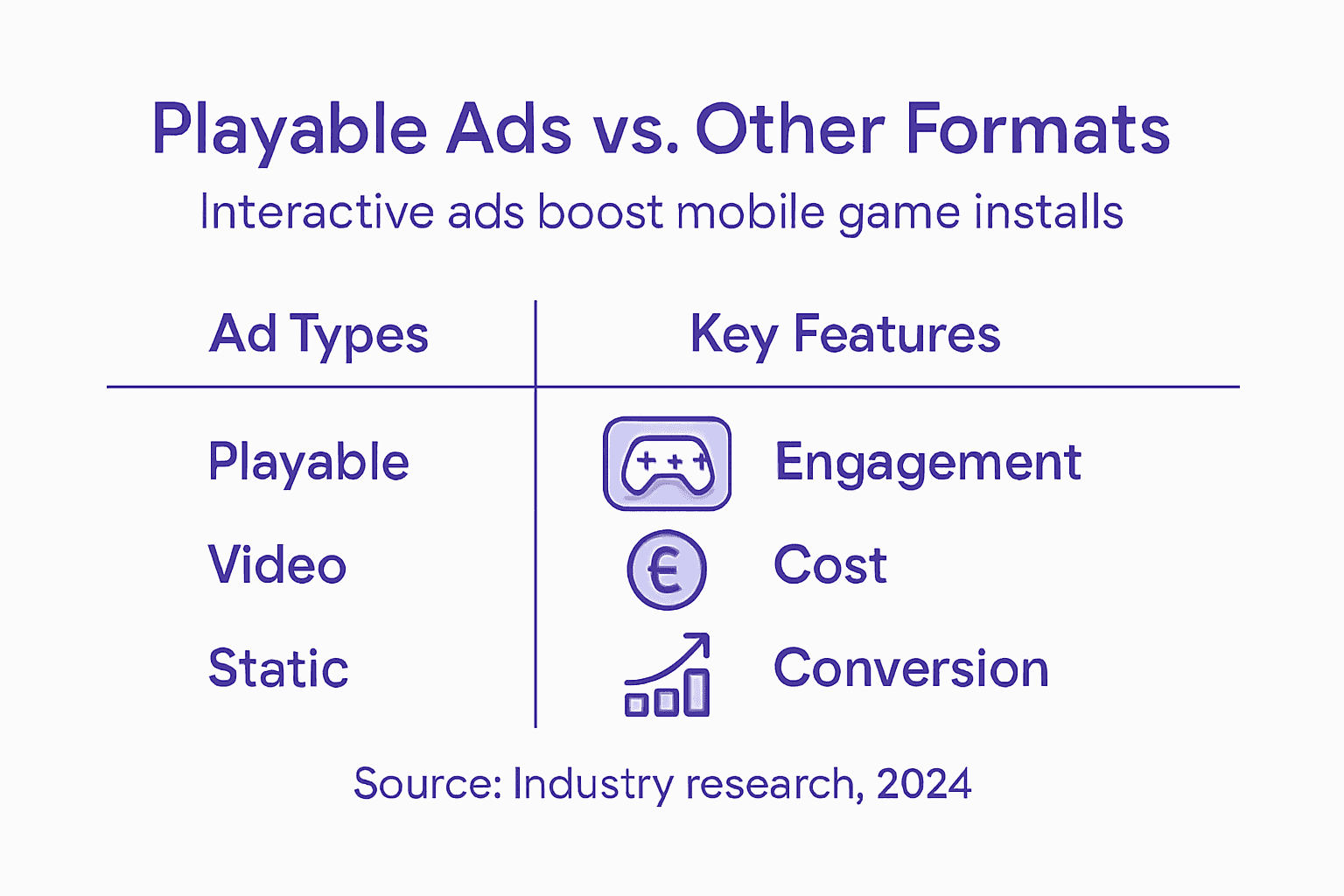
The difference comes down to one word: participation. Playable ads transform viewers into active players. When someone engages with your core mechanic directly, they develop genuine understanding of what they’re installing.
Key advantages playable ads hold over traditional formats:
- Higher conversion rates – Users who play convert 8-16x better than passive viewers
- Better user filtering – Only genuinely interested players install, reducing churn
- Superior brand recall – Hands-on experience embeds your game in memory far longer
- Measurable engagement – Playtime data reveals exactly what captures attention
- Lower cost-per-install – Fewer low-intent users wasted, higher ROI per pound spent
Playable ads achieve superior engagement because users experience core gameplay elements directly rather than watching passively. Static ads show. Videos demonstrate. Playable ads let users experience.
A player who spent 45 seconds actively playing your game mechanic is incomparably more likely to install than someone who watched a 30-second video without sound.
The Trade-Off: Cost Versus Return
Playable ads cost more to create than static or video formats. That’s the genuine trade-off. But the return on that investment is exponentially higher.
A £3,000 playable ad might generate twice the conversions of a £500 video ad. Your actual cost-per-install often decreases despite higher production costs.
Here is a concise comparison of mobile ad formats and their impact on user acquisition:
| Ad Format | Typical Cost Range | User Engagement Style | Cost-Per-Install Trend |
|---|---|---|---|
| Static Banner | £100–£1,000 | Passive, easily overlooked | Highest, many uninterested users |
| Video | £500–£5,000 | Passive watching, storytelling | Moderate, some engagement |
| Playable | £2,000–£15,000 | Interactive trial experience | Lowest, high user intent |
Pro tip Don’t abandon video and static formats entirely. Use them for awareness campaigns reaching broad audiences, then reserve playable ads for mid-funnel users showing genuine game interest. This tiered approach maximises reach whilst capturing high-intent players through interactive experiences.
Simplify Playable Ad Creation and Maximise Your Mobile Game Success
Struggling with high development costs and time-consuming production for playable ads is a common challenge highlighted in recent discussions on mobile game advertising. If you want to showcase your game’s core mechanic with fast-loading, interactive content but find technical complexity and budget constraints holding you back you are not alone. The key is to focus on simplicity, quick iteration, and delivering immersive experiences without draining your resources.
At PlayableMaker we offer a no-code, budget-friendly solution designed to help you build playable ads quickly without relying heavily on your development team. Our platform lets you create lightweight interactive ads that load instantly across devices allowing you to test concepts, measure engagement and optimise with ease. To get practical guidance and insights visit our Help Archives or explore our Publishing Archives for tips on scaling your campaigns. Don’t let complex development slow you down. Take control of your user acquisition strategy today and build effective playable ads faster than ever at PlayableMaker.
Frequently Asked Questions
What are playable ads in mobile gaming?
Playable ads are interactive advertisements that allow users to engage directly with a simplified version of a mobile game, giving them hands-on experience before deciding to download.
How do playable ads improve user engagement compared to traditional ads?
Playable ads encourage active participation, leading to stronger emotional connections and significantly increased engagement times compared to passive formats like static and video ads.
What are the main types of playable ads?
The three dominant types of playable ads are HTML5 mini-games, video hybrid ads, and interactive video overlays, each offering different levels of interactivity and engagement.
What common mistakes should developers avoid when creating playable ads?
Developers should avoid feature overload, unclear user interface guidance, poor timing for call-to-action buttons, and misrepresenting gameplay to improve engagement and completion rates.
Recommended
- 7 Essential Types of In-Game Ads for Mobile App Success – playablemaker.com 7 Essential Types of In-Game Ads for Mobile App Success
- 7 Best Examples of Mobile Game Ads and Why They Work – playablemaker.com 7 Best Examples of Mobile Game Ads and Why They Work
- What Two Main Ad Formats Can Be Used in Mobile Gaming? – playablemaker.com What Two Main Ad Formats Can Be Used in Mobile Gaming?
- Mobile Gaming Ad Formats: Boosting Global User Acquisition – playablemaker.com Mobile Gaming Ad Formats: Boosting Global User Acquisition