Every campaign manager knows the pressure to deliver higher engagement without ballooning costs. Playable ads are redefining how brands connect with users, offering an interactive preview as an immediate experience rather than a passive video. For specialists targeting global audiences in places like the United Kingdom, Canada, or Australia, the arrival of no-code platforms means rapid iteration, enabling quick optimisation and testing. This guide addresses common misconceptions and reveals how cost-effective, interactive ad formats can boost user engagement across industries.
Table of Contents
- Playable Ads Defined And Widespread Misconceptions
- Playable Ad Types And Their Unique Functions
- No-Code Platforms For Rapid Playable Ad Creation
- Testing, Analysing, And Optimising Playable Ads
- Financial Impact And Scaling With Minimal Resources
- Common Errors In Playable Ad Iteration To Avoid
Key Takeaways
| Point | Details |
|---|---|
| Playable Ads Are Versatile | Contrary to misconceptions, playable ads can be applied in various sectors beyond mobile gaming, including education and productivity tools. |
| Emphasise Engaging Experiences | Focus on delivering concise and compelling interactive experiences to capture user interest within the first 10-15 seconds. |
| Leverage No-Code Platforms | Utilising no-code platforms simplifies the creation of interactive ads, enabling rapid deployment and iteration without extensive programming skills. |
| Prioritise Testing and Optimisation | Implement structured testing frameworks to refine ads continually, ensuring they resonate with target audiences and drive conversions. |
Playable ads defined and widespread misconceptions
Playable ads represent an innovative digital advertising format that transforms user engagement by offering interactive previews of applications or games. Interactive digital advertisements enable potential users to experience product functionality directly within the advertisement itself, creating a dynamic and immersive marketing approach.
Understanding the core characteristics of playable ads requires dispelling several prevalent misconceptions:
- Myth 1: Playable ads are exclusively for mobile gaming
- Myth 2: These advertisements are intrusive and disruptive
- Myth 3: Interactive ads are too complex to develop
- Myth 4: Playable ads do not deliver measurable marketing results
Contrary to popular belief, playable ads transcend mobile gaming, offering versatile engagement opportunities across multiple industries. Sectors such as education, fitness applications, and productivity tools can leverage these interactive experiences to demonstrate product value quickly and effectively.
The fundamental mechanism of playable ads involves providing users a condensed, interactive sample of an application’s core functionality. This approach allows potential customers to evaluate product features, user experience, and entertainment value within seconds, dramatically reducing the uncertainty typically associated with traditional digital advertising.
Playable ads transform passive advertising into an active, engaging user experience that bridges imagination and actual product interaction.
Pro tip: Focus on creating concise, compelling interactive experiences that showcase your product’s most engaging features within the first 10-15 seconds of user interaction.
Playable ad types and their unique functions
Playable ads have evolved into a sophisticated digital marketing tool with diverse interactive formats that extend far beyond traditional advertising approaches. These innovative ad types are designed to provide immersive, engaging experiences that allow potential users to interact directly with product features before making a purchase decision.
The primary categories of playable ads include:
- Interactive Videos: Combine storytelling with interactive elements
- Quizzes and Surveys: Engage users through participatory content
- Mini-Games: Provide complete product experience in bite-sized format
- Product Demonstration Ads: Show core functionality in real-time
- Tutorial-Style Ads: Guide users through key product features
Each ad type serves a unique marketing objective, enabling brands to create tailored experiences that resonate with specific audience segments. For instance, a productivity app might use a mini-game demonstrating task management efficiency, while an educational platform could leverage an interactive quiz to showcase learning potential.
Interactive ad formats strategically bridge the gap between traditional advertising and user experience, allowing potential customers to sample products without commitment. This approach dramatically reduces purchase uncertainty by providing immediate, hands-on interaction with the product’s core value proposition.

To clarify the range of playable ad formats and their strategic uses, the table below provides a comparison of key ad types and their unique marketing objectives:
| Ad Type | Example Use Case | Marketing Objective |
|---|---|---|
| Interactive Videos | Product story with clickable demo | Boost product awareness |
| Quizzes and Surveys | Personality quiz for education | Drive user engagement |
| Mini-Games | Task simulation for productivity | Demonstrate core feature benefits |
| Product Demonstration | Live showcase of app tools | Reduce purchase hesitation |
| Tutorial-Style Ads | Step-by-step feature walk-through | Support user onboarding efforts |
Playable ads transform passive marketing into an active, user-driven exploration of product potential.
Pro tip: Design your playable ad to showcase the most compelling 10-15 seconds of your product’s unique value, focusing on the feature that differentiates you from competitors.
No-code platforms for rapid playable ad creation
No-code platforms have revolutionised digital advertising by democratising the creation of interactive advertisements. These innovative tools enable marketers and designers to construct compelling playable ads without requiring extensive programming skills, dramatically reducing both development time and technical barriers.
Key features of modern no-code platforms include:
- Drag-and-Drop Interfaces: Simple visual design tools
- Pre-Built Templates: Ready-to-use interactive ad frameworks
- Analytics Integration: Real-time performance tracking
- Cross-Platform Compatibility: Deployment across multiple advertising networks
- Rapid Iteration Capabilities: Quick modifications and testing
The strategic advantage of these platforms lies in their ability to transform complex technical processes into intuitive design experiences. Intuitive design tools allow marketers to focus on creating engaging user experiences rather than wrestling with complex coding requirements. This approach enables faster experimentation and more dynamic advertising strategies.
By eliminating traditional development bottlenecks, no-code platforms empower smaller teams and individual marketers to produce high-quality interactive advertisements that compete with larger, more resource-intensive marketing departments. The democratisation of ad creation represents a significant shift in digital marketing capabilities.
No-code platforms are transforming playable ad creation from a technical challenge into a creative opportunity.
Pro tip: Select a no-code platform that offers comprehensive analytics and allows seamless A/B testing to continuously refine your interactive ad performance.
Testing, analysing, and optimising playable ads
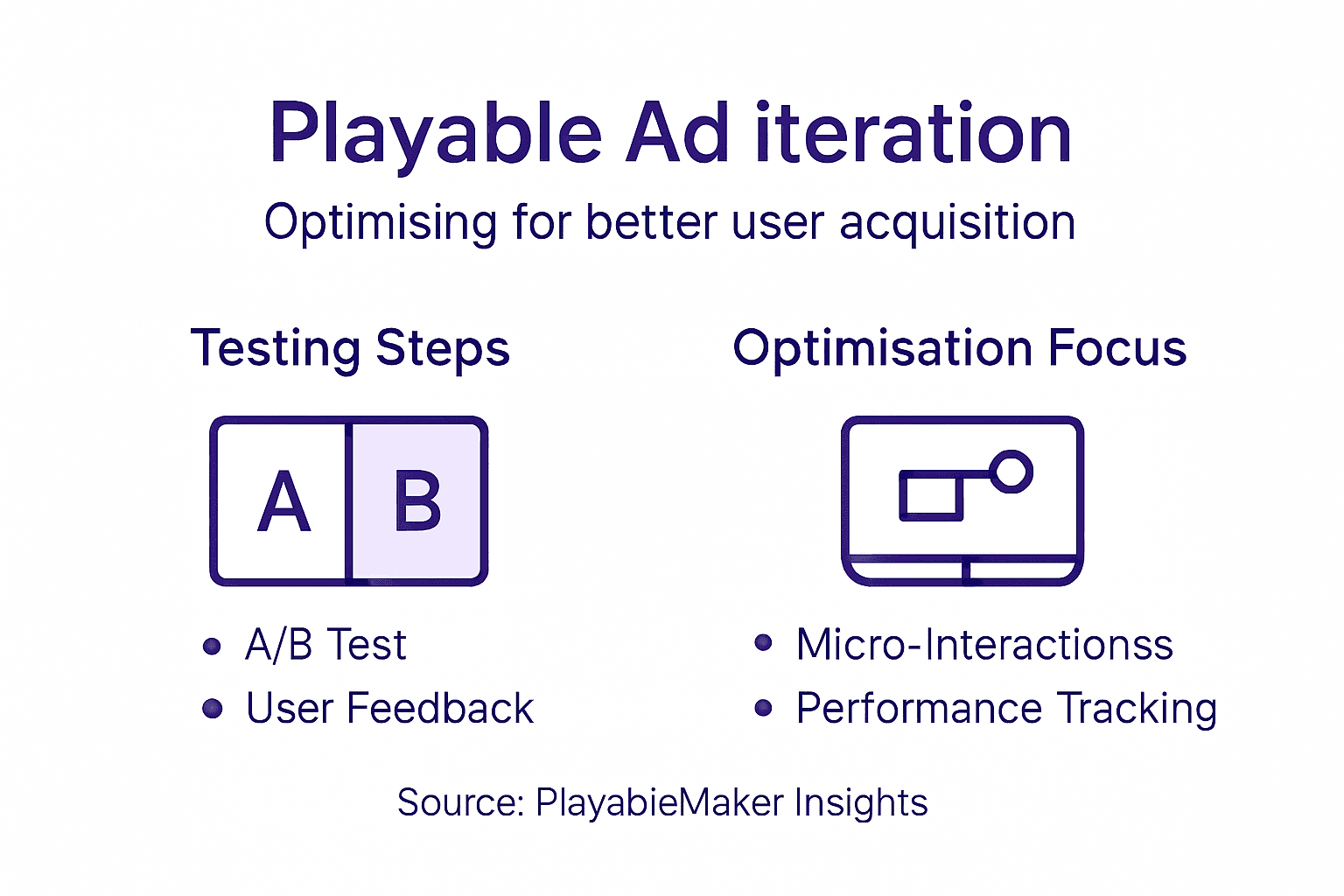
Strategic testing methodologies are fundamental to developing high-performing playable advertisements. Understanding user behaviour and continuously refining ad experiences allows marketers to create more engaging and conversion-driven interactive marketing materials.
Key components of comprehensive playable ad testing include:
- A/B Variation Testing: Comparing different creative elements
- User Interaction Analytics: Tracking engagement metrics
- Conversion Rate Monitoring: Measuring performance indicators
- Behavioural Segmentation: Understanding audience responses
- Performance Benchmark Comparison: Evaluating against industry standards
Systematic testing approaches reveal critical insights into user experience design. By implementing sophisticated analytics tools, marketers can identify precise interaction points, understand drop-off rates, and optimise ad experiences that resonate with target audiences.
The iterative process demands continuous refinement, where each test provides actionable data to enhance future ad iterations. Advanced mobile demand-side platforms enable granular targeting and real-time performance tracking, transforming playable ads from static marketing materials into dynamic, responsive user acquisition tools.
Effective playable ad optimization is a continuous journey of measurement, insight, and strategic adaptation.
Pro tip: Implement a structured testing framework that captures micro-interactions and user behaviour patterns to incrementally improve your playable ad performance.
Financial impact and scaling with minimal resources
Playable ad strategies offer remarkable financial advantages by dramatically reducing user acquisition costs while simultaneously improving campaign performance. Small marketing teams can leverage these innovative advertising approaches to achieve outsized results without exponential budget increases.
Key financial benefits of playable ads include:
- Lower Cost Per Install: Reducing traditional acquisition expenses
- Higher User Retention: Decreasing long-term marketing expenditures
- Improved Conversion Rates: Maximising return on advertising investment
- Precise Audience Targeting: Minimising wasted marketing resources
- Rapid Iteration Capabilities: Enabling cost-effective campaign optimisation
Efficient scaling methodologies enable brands to expand marketing efforts without proportional resource investments. By utilising data-driven targeting and adaptive budgeting techniques, organisations can create sophisticated advertising campaigns that deliver substantial performance improvements at minimal additional cost.
The strategic implementation of playable ads transforms traditional marketing constraints, allowing smaller teams to compete effectively with larger, more resource-intensive competitors. Advanced no-code platforms and sophisticated analytics tools democratise high-performance advertising, making sophisticated user acquisition strategies accessible to businesses of all sizes.
Intelligent resource allocation through playable ads represents a paradigm shift in cost-effective digital marketing.
Pro tip: Prioritise incremental testing and granular performance tracking to progressively optimise your playable ad campaigns while maintaining strict budget discipline.
Common errors in playable ad iteration to avoid
Common pitfalls in playable ad design can dramatically undermine user engagement and conversion potential. Marketing teams must navigate complex interactive experiences with precision, understanding that even minor missteps can result in significant user drop-off and reduced campaign effectiveness.
Critical errors to avoid during playable ad iteration include:
- Overcomplicated Gameplay: Creating confusing user experiences
- Unclear Instructions: Failing to guide users intuitively
- Misaligned User Expectations: Not matching ad experience with actual product
- Excessive Interactive Elements: Overwhelming users with complexity
- Neglecting First-Second Engagement: Losing audience attention immediately
Strategic iteration techniques require marketers to focus on seamless, coherent user journeys that authentically demonstrate product value. Successful playable ads must strike a delicate balance between providing enough interactive depth to engage users while maintaining simplicity and immediate comprehension.
The most fundamental challenge lies in creating an experience that feels natural, intuitive, and rewarding within an extremely condensed timeframe. Marketers must design ads that communicate core product value proposition within seconds, using minimal instructions and maximising immediate user understanding.
This summary table highlights common design errors in playable ads, their impact, and recommended preventative strategies:
| Error Type | Impact on Users | Prevention Strategy |
|---|---|---|
| Overcomplicated Gameplay | User confusion, early drop-off | Simplify interaction and rules |
| Unclear Instructions | User frustration, misclicks | Guide with clear, brief prompts |
| Misaligned Expectations | Negative brand perception | Accurately reflect main product |
| Excessive Interactivity | Overwhelm, disengagement | Focus on one key feature |
| Poor First-Second Engagement | Immediate loss of interest | Show value instantly in ad outset |
Playable ads are not about complexity, but about creating instant, meaningful user connections.
Pro tip: Conduct rapid user testing with diverse audience segments to identify potential points of friction in your playable ad experience before full deployment.
Accelerate Your Playable Ad Iteration with No-Code Simplicity
The challenge of iterating playable ads often lies in balancing rapid testing and optimisation with limited resources and technical constraints. This article highlights common pitfalls such as overcomplicated gameplay, unclear instructions, and poor first-second engagement that can cause user drop-off and reduce conversion rates. Your goal is to create compelling, easy-to-understand interactive experiences that rapidly capture user attention while delivering measurable marketing results.
With PlayableMaker, you can overcome these challenges by building playable ads fast without draining your budget or relying heavily on developer time. Our no-code platform empowers you to simplify the iteration process, enabling quick adjustments based on real-time insights. Explore best practices and expert tips in our Help Archives to sharpen your strategy and seamlessly publish your ads through our Publishing Archives. Ready to transform your user acquisition efforts with easy, impactful playable ads Start building your next ad today at PlayableMaker and experience the power of rapid, budget-friendly creation.
Frequently Asked Questions
What are playable ads and how do they work?
Playable ads are interactive digital advertisements that allow users to engage with a product, such as an app or game, through a condensed experience. This format enables potential customers to directly interact with key features of the product, facilitating informed decision-making.
What types of playable ads are available for marketers?
There are various types of playable ads including interactive videos, quizzes and surveys, mini-games, product demonstration ads, and tutorial-style ads. Each type serves unique marketing objectives and can be tailored to showcase specific features of a product effectively.
How can no-code platforms assist in creating playable ads?
No-code platforms enable marketers and designers to easily create playable ads without extensive programming skills. These tools offer drag-and-drop interfaces and pre-built templates, significantly reducing the time and complexity involved in developing interactive advertisements.
What are the common pitfalls to avoid when iterating playable ads?
Common errors include creating overly complicated gameplay, providing unclear instructions, misaligning user expectations, overwhelming users with too many interactive elements, and failing to engage users in the crucial first seconds. Avoiding these pitfalls is essential for improving user engagement and conversion rates.
Recommended
- The History of User Acquisition and Playable Ads: Strategies, Benefits, and Best Practices – playablemaker.com The History of User Acquisition and Playable Ads: Strategies, Benefits, and Best Practices
- Master User Acquisition Ad Strategies for Mobile Games – playablemaker.com Master User Acquisition Ad Strategies for Mobile Games
- Understanding What is User Acquisition in Mobile Gaming – playablemaker.com Understanding What is User Acquisition in Mobile Gaming
- 7 Essential Steps for a Winning UA Campaign Checklist – playablemaker.com 7 Essential Steps for a Winning UA Campaign Checklist
- 7 Key Content Personalization Trends for Digital Marketers