Traditional static and video ads often leave user acquisition specialists searching for ways to stand out in the crowded mobile gaming space. Playable ads offer a breakthrough by turning passive viewers into active participants, letting users explore game mechanics firsthand before ever downloading. This hands-on approach increases engagement and significantly improves brand recall, as confirmed by research. Discover how interactive experiences and no-code tools can help you attract high-quality users while keeping production costs and timelines under control.
Table of Contents
- What Makes Playable Ads Unique
- Types and Formats of Playable Ads
- How Playable Ads Drive Engagement
- Reducing Costs and Increasing Installs
- Challenges and Common Mistakes
Key Takeaways
| Point | Details |
|---|---|
| Engagement & Interaction | Playable ads transform passive viewing into interactive experiences, significantly enhancing user engagement and brand recall. |
| Cost Efficiency | These ads reduce user acquisition costs while driving higher install rates by attracting more engaged users. |
| Common Mistakes | Key pitfalls include failing to capture attention quickly and overcomplicating gameplay, which can diminish user interest. |
| First Impressions | Prioritise showcasing the most compelling features of the app within the first few seconds to maximise user curiosity and interaction. |
What Makes Playable Ads Unique
Playable ads represent a revolutionary approach to digital advertising, transforming passive viewing into an engaging, interactive experience. Unlike traditional static advertisements, these innovative ad formats allow users to directly interact with a mini-version of an app or game before downloading, creating a dynamic preview that captures attention and builds genuine interest.
The core uniqueness of playable ads stems from several distinctive features:
- Interactive Engagement: Users can test the product’s functionality in real-time
- Reduced Purchase Uncertainty: Provides a risk-free way to experience an application before commitment
- Enhanced User Control: Gives potential users agency over their advertising interaction
- Gamification Elements: Turns advertising into an entertaining, participatory experience
Research demonstrates that playable ads excel by generating more positive consumer attitudes compared to traditional advertising formats. By offering users direct interaction and perceived control, these ads effectively mitigate psychological reactance – the negative response people often have to feeling pressured by conventional marketing techniques.
Moreover, playable ads significantly improve user understanding and brand recall. The interactive experience allows potential users to personally explore an app’s features, functionality, and entertainment value within seconds. This hands-on approach transforms advertising from a passive consumption model to an active discovery process.
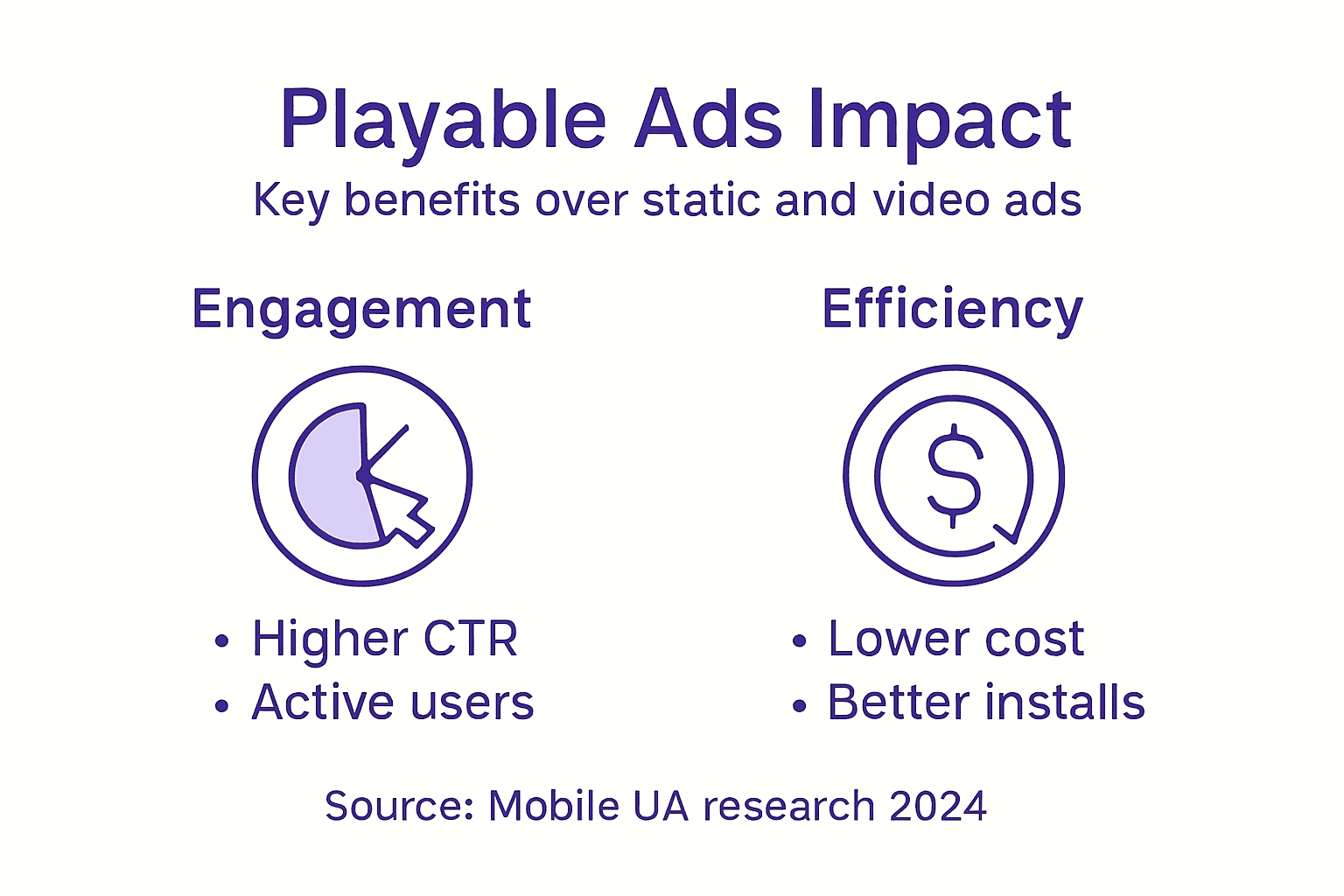
Here’s how playable ads differ from traditional static and video ads in key business areas:
| Aspect | Playable Ads (Interactive) | Static Ads | Video Ads |
|---|---|---|---|
| User Engagement | Very high, active participation | Low, passive viewing | Moderate, passive viewing |
| Brand Recall | Enhanced through interaction | Limited, often ignored | Moderate, depends on content |
| Conversion Rate | Highest, leads to more installs | Lowest, limited action | Moderate, depends on CTA |
| User Quality | More likely to retain and engage | Less targeted audience | Broad, less targeted |
Pro tip: Design your playable ad to showcase the most compelling and unique aspects of your game within the first 5-10 seconds to maximise user engagement.
Types and Formats of Playable Ads
Playable ads represent a diverse and innovative advertising format that goes far beyond traditional static advertisements. These interactive experiences are designed to engage users by offering a dynamic, immersive preview of an app or game, characterised by voluntary gamification that allows users to actively participate in the content.
The primary types of playable ads can be categorised into several distinctive formats:
- HTML Playable Ads: Lightweight interactive demos using game assets
- Interactive Video Ads: Combining game footage with interactive HTML elements
- Mini-Game Ads: Short, engaging game-like experiences
- Quiz-Based Ads: Interactive questionnaires that showcase product features
- Interactive Map Ads: Allowing users to explore product environments
These formats are not limited exclusively to gaming contexts. Interactive advertising techniques extend across various industries, incorporating game mechanics to create compelling user experiences. The key differentiator is the ability to provide a ‘try-before-you-buy’ approach that transforms passive advertising into an interactive discovery process.
The technical implementation of playable ads varies, with HTML5 technology enabling complex interactions that blur traditional boundaries between advertisements and actual product experiences. This approach allows potential users to genuinely test an app’s functionality, entertainment value, and core features within seconds of engagement.
This summary compares the most common playable ad formats and their primary use cases:
| Format | Typical Use Case | Level of Interaction | Best Suited For |
|---|---|---|---|
| HTML Demo | Quick game/app preview | High | Mobile games, utilities |
| Mini-Game Experience | Entertainment, engagement | Very high | Casual and hyper-casual games |
| Quiz Questionnaire | Feature demonstration | Moderate | Educational, lifestyle apps |
| Interactive Map | Environment exploration | High | Travel, real estate, games |
| Video + Interaction | Highlighting main features | Moderate | Social apps, storytelling |
Pro tip: Optimise your playable ad’s first interaction to demonstrate the most compelling and unique aspects of your product within the initial 5-10 seconds to maximise user curiosity and engagement.
How Playable Ads Drive Engagement
Playable ads have revolutionised digital marketing by transforming passive advertising into an interactive, immersive experience that captivates user attention. Empirical research confirms that these innovative ad formats significantly enhance consumer engagement through direct interaction and gamification elements.
The engagement metrics for playable ads are remarkably impressive:
- Click-Through Rates: 2-4 times higher than traditional video ads
- Install Conversion Rates: 3-5 times more effective
- User Attention: Hold viewer interest over six times longer than standard videos
- Brand Recall: Substantially improved through interactive experiences
The core mechanism driving engagement lies in the user empowerment principle. By allowing potential users to experience a product directly within the advertisement, playable ads eliminate uncertainty and create an immediate, tangible connection. This approach transforms advertising from a passive, interruptive experience to an active, voluntary interaction where users choose to engage with the content.
Moreover, the psychological impact of playable ads extends beyond immediate metrics. Interactive advertising techniques tap into fundamental human desires for control, exploration, and personal agency, making the advertising experience itself inherently more enjoyable and memorable.
Pro tip: Design your playable ad to provide a genuine, compressed experience of your product’s most exciting features within the first 5-7 seconds to maximise user curiosity and engagement.
Reducing Costs and Increasing Installs
Playable ads have emerged as a game-changing strategy for mobile game developers seeking to optimise user acquisition while minimising advertising expenditure. Digital advertising studies demonstrate that these interactive ad formats can significantly reduce user acquisition costs by attracting higher-quality, more engaged users.
Key cost and performance advantages include:
- Cost Per Install (CPI): As low as £0.60 on Android platforms
- Install Volume: Drive up to 20 times more installs compared to banner ads
- User Quality: Attract more engaged and retained user segments
- Conversion Efficiency: Higher conversion rates with lower marketing spend
The economic efficiency of playable ads stems from their unique ability to pre-qualify potential users through interactive experiences. By allowing users to sample game mechanics before downloading, these ads naturally filter out less interested audiences, resulting in more targeted and cost-effective user acquisition strategies.

Mobile marketing research indicates that these interactive ad formats not only reduce acquisition costs but also attract users with higher long-term retention potential. The upfront engagement provided by playable ads creates a more meaningful connection between the game and potential players, ultimately delivering superior return on advertising investment.
Pro tip: Focus on creating a compelling 5-second interactive preview that captures your game’s most unique and exciting gameplay elements to maximise user interest and installation rates.
Challenges and Common Mistakes
Creating effective playable ads is not without its complexities, and developers frequently encounter significant hurdles that can undermine their user acquisition strategies. Common pitfalls in playable ad design reveal critical areas where mobile game marketers must exercise careful strategic planning.
The most prevalent challenges include:
- Attention Deficit: Failing to capture user interest within the first 3 seconds
- Gameplay Complexity: Overwhelming users with intricate mechanics
- Unclear Value Proposition: Not demonstrating the game’s core excitement quickly
- Technical Performance: Slow loading or laggy interactive experiences
- Misleading Representations: Creating demos that differ significantly from actual gameplay
Successful playable ads require a delicate balance between providing an engaging preview and maintaining simplicity. Developers must design experiences that are immediately intuitive, visually appealing, and representative of the game’s fundamental entertainment value. This means stripping down gameplay to its most compelling core elements and ensuring that users can understand the basic mechanics within moments of interaction.
Moreover, technical execution plays a crucial role in playable ad effectiveness. Poor performance, excessive loading times, or clunky interactions can rapidly erode user interest. Marketers must invest in optimising the technical infrastructure of their interactive advertisements, ensuring smooth, responsive experiences that feel like natural extensions of the game itself.
Pro tip: Conduct rigorous user testing on your playable ad prototype, focusing on the first 5 seconds of interaction to validate whether it genuinely captures and maintains user attention.
Unlock Efficient User Acquisition with No-Code Playable Ads
The article highlights the challenges of creating playable ads that capture user attention quickly while reducing costs and improving installation rates. Many developers struggle with complex development processes, high costs, and achieving effective user engagement within the crucial first few seconds. Playable ads bring interactive experiences that drive higher conversions and quality users but building them traditionally can drain resources and time.
This is where PlayableMaker steps in to solve those pain points. Our no-code platform lets you build playable ads fast and budget-friendly without burdening your developers or company resources. Whether you want to showcase your game’s most captivating features or deliver a smooth engaging experience, PlayableMaker makes it easy to create, test, and publish. Explore proven strategies and insights in our Publishing Archives to perfect your campaigns.
Ready to boost your game’s user acquisition efficiency now with interactive ads that truly convert Try PlayableMaker today at https://app.playablemaker.com and learn more tips in our Help Archives to optimise your success.
Frequently Asked Questions
What are playable ads and how do they work?
Playable ads are interactive advertisements that allow users to engage with a mini-version of an app or game before downloading it. They transform the passive viewing of traditional ads into interactive experiences, providing a dynamic preview that encourages user engagement.
How do playable ads improve user acquisition?
Playable ads enhance user acquisition by offering a risk-free way for potential users to experience an app or game before downloading it. This leads to higher conversion rates, more installs, and attracts higher-quality users who are likely to engage and retain longer.
What are the key features that make playable ads unique?
The unique features of playable ads include interactive engagement, reduced purchase uncertainty, enhanced user control, and gamification elements. These features create a more memorable and enjoyable advertising experience that captures user interest effectively.
What are the common challenges in creating effective playable ads?
Common challenges include failing to capture user interest quickly, creating overly complex gameplay, not clearly demonstrating the game’s value, and technical performance issues like slow loading times. It’s crucial to design simple, engaging ads that represent the game’s core features accurately.
Recommended
- Maximizing User Acquisition with Playable Ads: A Strategic Guide – playablemaker.com Maximizing User Acquisition with Playable Ads: A Strategic Guide
- Master the Playable Ad Optimisation Process for Success – playablemaker.com Master the Playable Ad Optimisation Process for Success
- Introduction to Playable Ads in Mobile Game Marketing – playablemaker.com Introduction to Playable Ads in Mobile Game Marketing
- 7 Key Differences: Video vs Playable Ads for UA Success – playablemaker.com 7 Key Differences: Video vs Playable Ads for UA Success