
TL;DR:
- Mobile ad fraud, which involves generating false impressions, clicks, or installs, costs advertisers billions annually and is highly pervasive in mobile channels. Detecting fraud requires continuous monitoring of click-to-install times, conversion rates, and post-install behaviour, with prevention best achieved through layered controls and interaction-based ad formats. Relying solely on platform defaults or self-reporting is risky, as sophisticated operations like click injection and multi-stage schemes can evade basic detection without independent verification.
Mobile advertising fraud is one of the most costly and misunderstood threats facing digital marketers today. Billions of pounds in ad spend vanish annually not because campaigns underperform, but because they never reached a real human being in the first place. Understanding what is mobile ad fraud, how it operates beneath the surface, and what signals betray its presence is no longer optional for serious advertisers. With global ad fraud losses projected to exceed $172 billion by 2028, the financial stakes make this knowledge genuinely urgent.
Table of Contents
- Key takeaways
- What is mobile ad fraud: definitions and scope
- Common types of mobile ad fraud
- How to detect mobile ad fraud
- Strategies for mobile ad fraud prevention
- My perspective on where most advertisers go wrong
- How Playablemaker helps reduce your fraud exposure
- FAQ
Key takeaways
| Point | Details |
|---|---|
| Mobile ad fraud is pervasive | One in three mobile ad impressions globally involves invalid traffic, making fraud the norm rather than the exception. |
| Multiple fraud types exist | Click injection, click spamming, app spoofing, and ad stacking each operate through distinct mechanics requiring different detection approaches. |
| CTIT is your clearest signal | Click-to-install timing below 10 seconds is a primary indicator of click injection and should trigger immediate investigation. |
| Platform rules differ by OS | Fraud detection rules built for Android will not transfer directly to iOS due to fundamental differences in attribution data. |
| Prevention requires active monitoring | Passive reliance on platform defaults leaves significant ad budget exposed; real-time rules and specialist tools are required. |
What is mobile ad fraud: definitions and scope
Mobile ad fraud refers to deliberate activity designed to generate false impressions, clicks, or installs in order to extract payment from advertisers without delivering any genuine user engagement. The activity ranges from automated bots mimicking browsing behaviour to sophisticated malware that hijacks attribution systems.
The industry typically frames this under the broader term invalid traffic, or IVT. The Media Rating Council provides the foundational definitions that most measurement firms, including Pixalate, use to classify and report IVT. This matters because not all invalid traffic is deliberate fraud. Some IVT originates from misconfigured ad tags or measurement errors. Genuine fraud involves intent to deceive for financial gain. Keeping these categories separate is critical when assessing the true scale of your exposure.
The scale is striking. According to Pixalate’s Q3 2025 benchmarks, mobile app IVT sits at 33% globally. That figure is substantially higher than the 21% recorded for web and 19% for connected television, making mobile the most fraud-prone channel in digital advertising today.
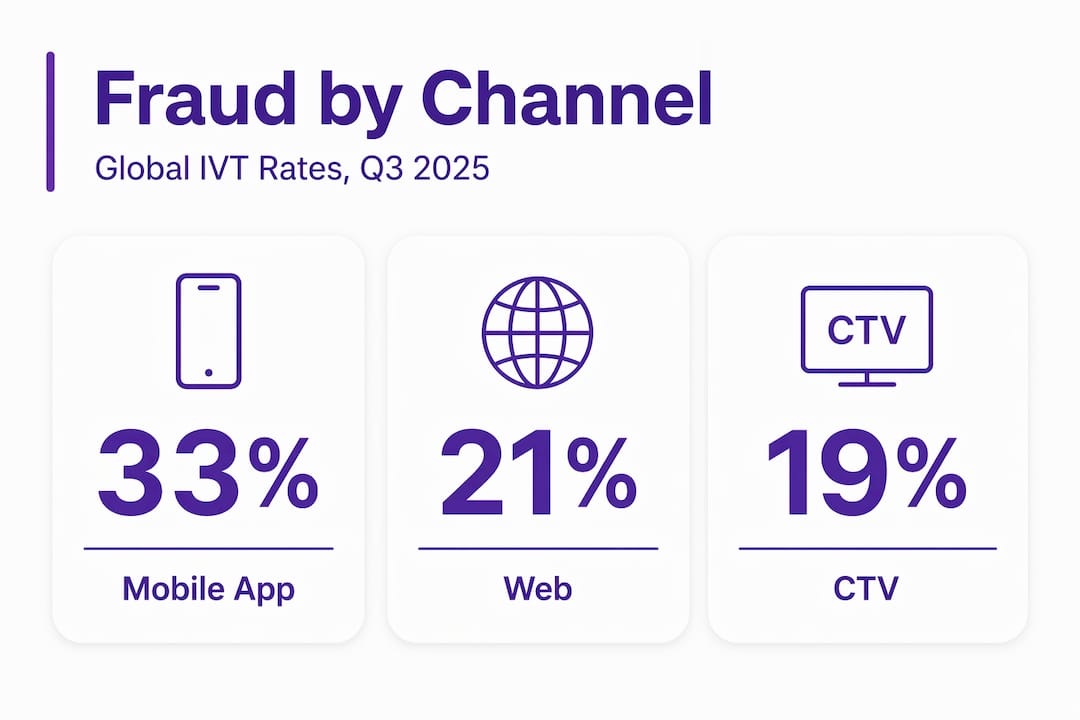
| Channel | Global IVT rate (Q3 2025) |
|---|---|
| Mobile app | 33% |
| Web | 21% |
| Connected TV | 19% |
Pro Tip: When reporting IVT figures internally, specify whether you are referencing general invalid traffic or confirmed fraudulent activity. Conflating the two inflates apparent fraud rates and undermines credibility when presenting findings to stakeholders.
Common types of mobile ad fraud
Understanding the mechanics behind each fraud type is what separates marketers who can spot anomalies from those who simply absorb losses.
Click injection
Click injection is widely regarded as the most surgical form of mobile ad fraud. Malware installed on a device monitors for app install broadcasts from the operating system. The moment a genuine install begins, the malware fires a fraudulent click, arriving just before the install completes. Because mobile attribution typically credits the last click, the fraudster claims the conversion and collects the cost-per-install payment. The advertiser pays for an install they had nothing to do with generating.
The tell-tale sign is a click-to-install time measured in seconds, often under ten. Real users take minutes or hours between clicking an ad and completing an install. A conversion rate near 100% from a particular source is another strong signal, since no legitimate traffic source converts at that level.
Click spamming
Click spamming, sometimes called click flooding, is less precise. Fraudsters generate enormous volumes of random clicks across many device IDs, hoping that some percentage of organic installs will be attributed to one of those phantom clicks. Unlike click injection, the timing is not calibrated. The fraudster relies on probability rather than precision.

App spoofing
App spoofing involves a low-quality or fraudulent app misrepresenting itself as a premium publisher within programmatic exchanges. Advertisers bid on what they believe is inventory within a reputable app. The impression is actually served inside a fraudulent environment where no genuine user sees it.
Ad stacking and hidden ads
Ad stacking places multiple ads on top of one another within a single placement. Only the top ad is visible, yet every ad in the stack records an impression. Hidden ads take this further by rendering ads at zero pixels or outside the visible screen area entirely. Both methods inflate impression counts without delivering any real exposure.
The Trapdoor operation: a case study in scale
These schemes rarely operate in isolation. The Trapdoor campaign, identified and disrupted by HUMAN Security’s Satori researchers, demonstrated how multi-stage fraud pipelines work in practice. The operation used 455 malicious Android apps and 183 threat-actor domains to produce up to 659 million fraudulent bid requests daily and 24 million fake installs. Hidden browsers within the apps simulated realistic user interactions including taps and scrolls, making the traffic appear indistinguishable from genuine engagement at surface level.
Pro Tip: Review your ad performance metrics regularly for sources showing abnormally high conversion rates or implausibly low cost-per-install figures. These patterns frequently point to click injection or click spamming before other signals appear.
How to detect mobile ad fraud
Detection is not a single test. It is a continuous analytical process applied across multiple dimensions of campaign data.
-
Monitor click-to-install times. Analyse the distribution of time between click and install across all traffic sources. Unnatural spikes under 10 seconds indicate click injection. A normal distribution for legitimate traffic peaks between 30 minutes and several hours after a click.
-
Examine conversion rates by source. Conversion rates above 30 to 40 percent from a single network or publisher warrant scrutiny. Rates approaching 100 percent are a near-certain fraud signal. Compare these figures against your known organic benchmark.
-
Audit impression-to-click ratios. Exceptionally high click-through rates on mobile display can indicate click flooding. Most legitimate mobile banner placements see click-through rates well below 1 percent.
-
Assess post-install behaviour. Fraudulent installs generate no meaningful downstream activity. If a cohort of installs shows zero session depth, zero purchases, and zero retention beyond day one, the installs are almost certainly fraudulent regardless of source.
-
Use attribution platform anomaly detection. Tools built into measurement platforms can flag suspicious patterns automatically. However, platform defaults alone are insufficient. You need to actively configure rules and set thresholds based on your own campaign data.
-
Distinguish Android from iOS signals. Attribution rule logic designed for Android typically cannot transfer to iOS. The click injection detection rule available in platforms like Branch relies on Google Play’s install timing fields, which do not exist in Apple’s ecosystem. iOS fraud detection requires different analytical approaches, including referrer data and SKAdNetwork validation.
Understanding Google Ads attribution mechanics is particularly valuable here, because attribution misconfigurations can mask fraud signals or generate false positives that distort your view of which sources are clean.
Pro Tip: Build a clean traffic baseline using your highest-trust sources, typically owned channels or well-verified direct publishers. Use that baseline’s CTIT distribution and post-install behaviour as your reference when evaluating new network partners.
Strategies for mobile ad fraud prevention
Prevention works best as a layered system rather than a single policy. No single rule or tool eliminates all fraud, but the combination of real-time controls, platform configuration, and third-party verification significantly reduces exposure.
-
Set CTIT thresholds in your attribution platform. Blocking clicks with click-to-install times under 30 seconds is a well-established and effective countermeasure against click injection on Android. Apply this rule immediately and monitor the impact on attributed install volume.
-
Whitelist publishers rather than blacklisting. Blacklisting fraudulent sources is reactive and slow. Working from an approved publisher list forces new traffic to earn inclusion through verified performance rather than exploiting gaps in your block list.
-
Segregate budgets by network maturity. Allocate smaller test budgets to new or unverified networks. Scale only after reviewing CTIT distributions and post-install data over a meaningful period.
-
Partner with a dedicated fraud detection service. Platforms such as those adhering to MRC measurement standards provide independent verification that attribution platforms cannot always supply on their own. Independent verification closes the gap between what networks self-report and what actually occurs.
-
Review contractual protections with your networks. Ensure your media buying agreements include clauses requiring fraud refunds or credits when IVT exceeds a defined threshold. Many networks will accept these terms if you negotiate them upfront.
-
Prioritise fraud-resilient ad formats. Ad formats requiring genuine user interaction, such as playable ads, are structurally harder to defraud than passive display impressions. An ad that requires a human gesture to progress cannot be completed by a bot firing simulated clicks in a hidden browser. You can find more on this approach in resources covering safer UA strategies in mobile gaming campaigns.
My perspective on where most advertisers go wrong
I’ve watched the conversation around mobile ad fraud mature considerably over the past several years, and one pattern still frustrates me: marketers who treat fraud prevention as a setup task rather than an ongoing practice.
In my experience, the most damaging losses do not happen because advertisers ignored fraud entirely. They happen because an initial round of rules was configured, fraud rates appeared to drop, and then monitoring became passive. Fraudsters adapt. The Trapdoor operation is a clear example. It combined malvertising with hidden WebViews and attribution manipulation in a self-funding loop that evaded standard detection for a sustained period. If you are only checking fraud signals monthly, you will miss that kind of evolution entirely.
My honest view is that most mobile marketers also underestimate the value of ad format choice as a prevention strategy. Sophisticated fraud operations target the weakest link in the measurement chain, which is usually the passive impression or background click. Formats that demand real interaction carry fewer fraud risks by design. That is not a marketing claim. It is a structural observation about where bots cannot go.
The other misconception I regularly see is over-reliance on network self-reporting. Networks have a financial incentive to show clean traffic. Independent measurement, even if it adds cost, consistently surfaces discrepancies that self-reported data does not. Treat every new traffic source as unverified until you have your own data to support it. Scepticism at the start is far cheaper than chargebacks later.
— Ondrej
How Playablemaker helps reduce your fraud exposure
Combating mobile advertising fraud is partly about detection and prevention tools, but it also starts with the creative formats you choose. At Playablemaker, we build no-code playable and interactive ad formats designed for mobile user acquisition. Because playable ads require a genuine human interaction to function, they are structurally resistant to the bot-driven click fraud that plagues passive display formats.
Advertisers using playable ads report stronger post-install engagement and more reliable attribution signals, precisely because the users they acquire have demonstrated real intent through interaction. When your attribution data reflects genuine behaviour, fraud signals become much easier to identify.
Explore what playable ads can do for your campaigns and how Playablemaker’s no-code tools make fraud-resilient creative formats accessible without the development overhead.
FAQ
What is mobile ad fraud in simple terms?
Mobile ad fraud is deliberate activity that generates false clicks, impressions, or installs to extract payment from advertisers without delivering real user engagement. It costs advertisers billions annually.
Which type of mobile ad fraud is hardest to detect?
Click injection is widely considered the most difficult to detect because it produces real install events with fraudulent attribution, making it appear indistinguishable from legitimate traffic without CTIT analysis.
How do I detect mobile ad fraud in my campaigns?
Monitor click-to-install time distributions for spikes under 10 seconds, review abnormally high conversion rates by source, and assess post-install behaviour for zero engagement cohorts. These three signals identify the majority of active fraud.
Do fraud detection rules work the same on Android and iOS?
No. Rules such as CTIT-based click injection detection rely on Google Play’s install timing fields and do not function on iOS. Each platform requires its own detection and prevention logic.
How much does mobile ad fraud cost advertisers globally?
Global digital ad fraud losses are projected to exceed $172 billion by 2028, with mobile accounting for a significant share given its 33% invalid traffic rate as of Q3 2025.
Recommended
- Combat ad fraud in mobile games: Safer UA strategies – playablemaker.com Combat ad fraud in mobile games: Safer UA strategies
- Why mobile ads fail: common pitfalls and how to fix them – playablemaker.com Why mobile ads fail: common pitfalls and how to fix them
- Role of Mobile Ads: Enhancing User Acquisition Results – playablemaker.com Role of Mobile Ads: Enhancing User Acquisition Results
- Mobile Ad Glossary: 60% CPI Spend Drives Gaming Growth – playablemaker.com Mobile Ad Glossary: 60% CPI Spend Drives Gaming Growth