Questions about ad formats and user response often lead to confusion for User Acquisition Managers working in mobile gaming. With options from playable ads to rewarded videos, making the right choice influences both engagement and user quality. Understanding digital advertisements specifically optimised for display on mobile devices reveals how precise targeting and no-code tools offer cost-effective ways to create interactive campaigns. This guide clears up common misconceptions and highlights practical solutions for maximising player acquisition without technical headaches.
Table of Contents
- Defining Mobile Ads And Common Misconceptions
- Key Mobile Ad Formats Used In Gaming
- How Mobile Ads Drive User Acquisition And Engagement
- Creative Iteration, Measurement, And No-Code Solutions
- Comparing Costs, Pitfalls, And Alternatives For Playable Ads
Key Takeaways
| Point | Details |
|---|---|
| Mobile Ads Offer Precision | Mobile ads enable real-time targeting for specific user segments, ensuring that promotional messages reach users when they are most receptive. |
| Engagement Through Personalisation | Personalised ads that reflect user behaviour and preferences yield higher engagement, making personalisation vital for successful campaigns. |
| Diverse Ad Formats for Different Goals | The effectiveness of ad formats varies; selecting the appropriate format—be it rewarded videos or interstitials—is critical for successful user acquisition strategies. |
| Measurement and Iteration are Essential | Continuous measurement and creative iteration improve campaign performance, making it important to test and refine approaches based on data. |
Defining Mobile Ads and Common Misconceptions
Mobile ads are digital advertisements specifically optimised for display on mobile devices such as smartphones and tablets. These ads reach users actively engaging with content through various formats and channels. Mobile advertising refers to delivering promotional messages to users on their mobile devices, leveraging mobile platforms to create personalised, context-aware experiences.
The core strength of mobile ads lies in their precision and immediacy. Your campaigns can target specific user segments in real time, delivering messages exactly when users are most receptive. Unlike traditional advertising, mobile ads offer measurable results and direct attribution to user behaviour.
Common Mobile Ad Formats
Mobile ads appear in several distinct formats, each serving different campaign objectives:
- Banner ads – static or animated rectangles displayed at top or bottom of the screen
- Interstitial ads – full-screen advertisements appearing between content transitions
- Video ads – short, engaging video content that can be skippable or non-skippable
- Native ads – ads designed to match the look and feel of host content
- Playable ads – interactive advertisements allowing users to experience a game or app before installing
Myth 1: Mobile Ads Are Always Intrusive
Many user acquisition professionals believe mobile ads inherently frustrate users or damage brand perception. This oversimplifies the reality. When strategically designed and targeted, mobile ads deliver highly personalised marketing messages that boost engagement and conversion rates globally.
The difference lies in execution. Poorly timed ads placed without context feel invasive. Well-crafted ads that respect user experience actually enhance engagement.
Myth 2: Mobile Ads Cannot Match Desktop Effectiveness
Some teams still assume desktop advertising generates superior results. Mobile users, however, exhibit higher engagement rates and quicker purchase decisions. Mobile advertising’s real-time delivery and targeting capabilities often outperform desktop campaigns for user acquisition.
Myth 3: All Mobile Ad Performance Metrics Are Equal
Another common misconception treats all performance indicators identically. Understanding metrics like cost per install (CPI), return on ad spend (ROAS), and engagement rates reveals the true impact of your campaigns.
Key metrics that matter for your gaming campaigns:
- Conversion rates and installation completion
- User retention and lifetime value alignment
- Cost efficiency relative to your target audience
- Engagement depth during the ad experience
Why These Misconceptions Persist
Older mobile advertising faced genuine limitations. Early banner ads lacked sophistication. Targeting options were crude. User experiences were often poor. The industry has evolved dramatically.
Today’s mobile advertising ecosystem combines advanced targeting, creative flexibility, and measurement precision. Understanding this evolution helps you avoid outdated assumptions that undermine your user acquisition strategy.
Mobile ads succeed when they respect user context, deliver genuine value, and match audience expectations. Poor execution creates frustration; smart execution drives results.
Pro tip: Test different ad formats with your target gaming audience rather than assuming any single format works universally. What resonates with casual puzzle game players differs significantly from action game enthusiasts.
Key Mobile Ad Formats Used in Gaming
Gaming audiences respond differently to various ad formats based on context, timing, and design. Understanding which formats work best for your user acquisition goals is essential for maximising your return on investment. Each format serves distinct purposes within the player journey, from discovery to installation.
Rewarded Video Ads
Rewarded video ads offer players incentives such as in-game currency, extra lives, or power-ups for watching promotional content. This format significantly boosts engagement because players choose to view the ad rather than having it forced upon them.
Why rewarded videos excel in gaming:
- Players willingly engage because they receive tangible value
- Ad recall increases substantially compared to non-rewarded formats
- User annoyance decreases, improving retention metrics
- Monetisation opportunities expand without frustrating your audience
Players feel they’ve made a fair exchange. They watch content and gain immediate in-game benefits. This voluntary participation creates positive brand associations.
Interstitial Ads
Interstitial ads appear full-screen between game levels, capitalising on natural gameplay breaks. These ads occupy the entire screen momentarily before returning control to the player.

This format works because timing feels natural. Players expect transitions between levels. The ad doesn’t interrupt active gameplay—it fills the space between content.
Banner Ads
Banner ads are smaller, persistent advertisements occupying a fixed position on your screen, typically at the top or bottom. They offer continuous visibility without dominating the interface.
Banners provide steady impressions but generate lower engagement rates than other formats. They work best as supplementary revenue streams rather than primary user acquisition drivers.
Native Ads
Native ads blend seamlessly with gaming content, matching the visual style and tone of your game. They enhance user experience because they feel like part of the game rather than external promotions.
Native ads maintain engagement by respecting the game’s aesthetic and flow. Players experience them as natural content rather than intrusive marketing.
Playable Ads
Playable ads allow users to interact with a mini version of your game before deciding to install. This format drives higher quality user acquisitions because potential players experience genuine gameplay before committing.
Playable ads reduce buyer’s remorse by letting users try before installing. They also capture attention through interactive engagement rather than passive viewing.
To clarify the impact of various mobile ad formats in gaming, here is a feature summary focused on player experience and campaign outcomes:
| Ad Format | Player Interaction | Impact on Retention | Revenue Potential |
|---|---|---|---|
| Rewarded Video | Voluntary, incentivised | Reduces user annoyance | Expands monetisation |
| Interstitial | Passive, between levels | Feels natural, minimal disruption | Provides acquisition opportunities |
| Banner | Passive, static display | Low impact on gameplay | Steady, low value stream |
| Native | Seamless, context-aware | Enhances game immersion | Improves brand trust |
| Playable | Interactive, trial-based | Strong engagement, attracts high-quality users | Drives quality installs |
Comparison of effectiveness:
| Format | Engagement Level | Installation Quality | Best Use |
|---|---|---|---|
| Rewarded video | High | Medium | Retention, monetisation |
| Interstitial | Medium | High | User acquisition |
| Banner | Low | Low | Supplementary revenue |
| Native | High | High | Engagement, brand fit |
| Playable | Very high | Very high | User acquisition |
The most effective format depends on your campaign stage. Early awareness campaigns benefit from playable and interstitial ads, whilst monetisation strategies lean towards rewarded videos.
Pro tip: Test two formats simultaneously within your target demographic—perhaps playable ads against interstitials—and measure quality metrics beyond just installation volume. Track day-7 retention and lifetime value to identify which format attracts players most likely to engage long-term.
How Mobile Ads Drive User Acquisition and Engagement
Mobile ads succeed because they reach the right person at the right moment with the right message. This precision targeting transforms casual viewers into committed players. Understanding the mechanics behind this conversion process reveals why mobile advertising remains a cornerstone of user acquisition strategy.
Precision Targeting and Real-Time Delivery
Mobile ads leverage precise targeting based on user behaviour, location, and demographics. Your campaigns reach users when they’re most receptive, not just when they’re scrolling randomly.
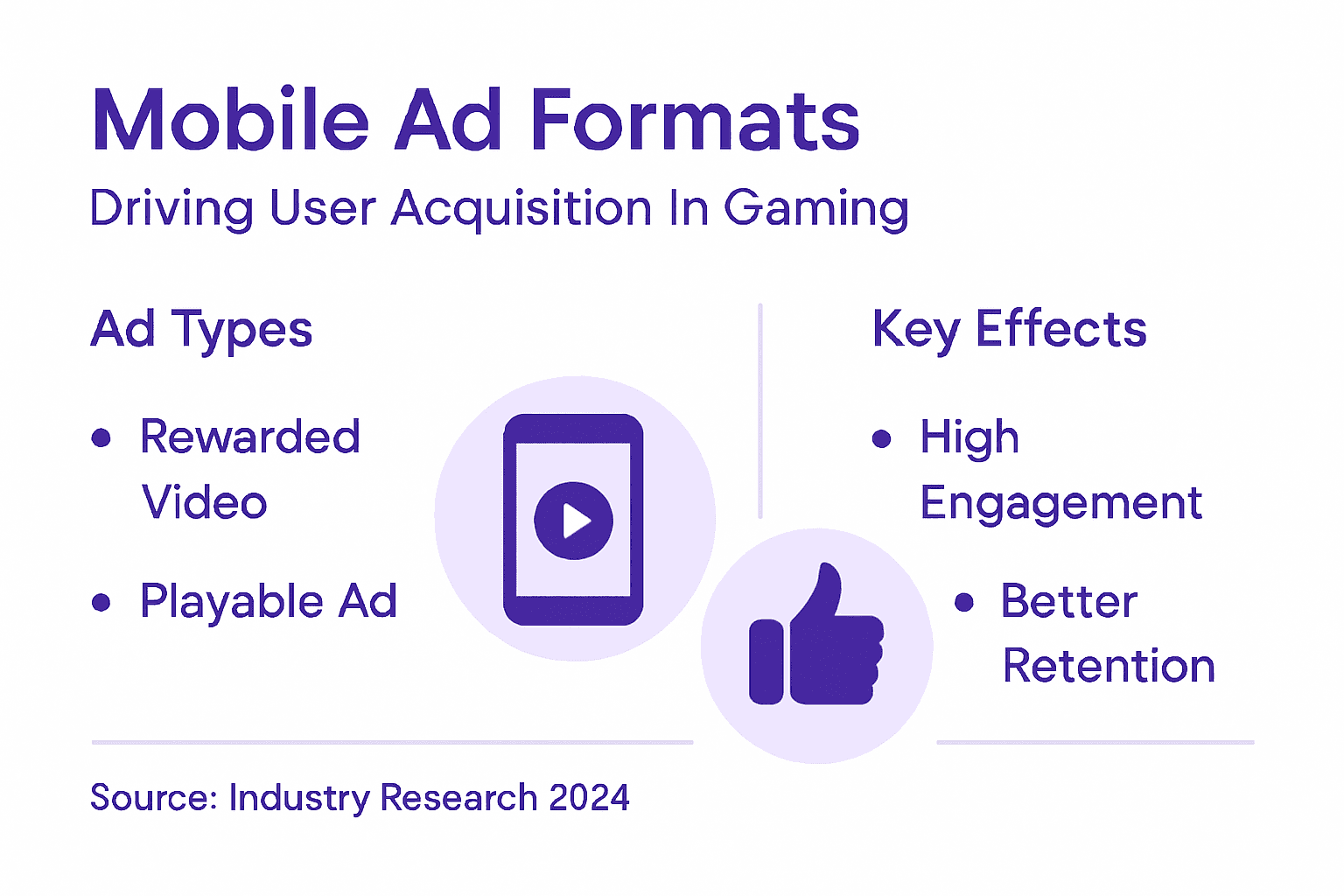
This contextual relevance dramatically improves performance metrics. A player searching for strategy games sees strategy game ads. A user in Manchester sees location-specific offers. Real-time delivery means your message arrives at peak engagement moments.
Personalisation Creates Loyalty
Personalisation is the cornerstone of modern mobile advertising. Ads that reflect user preferences, previous behaviour, and interests generate substantially higher engagement. Players respond positively when ads feel tailored rather than generic.
Key personalisation drivers include:
- User preference alignment with game genre
- Messaging that reflects player skill level or experience
- Timing based on when users typically engage with similar content
- Relevant incentives matching player motivations
When players see personalised ads, they perceive genuine value. This perceived usefulness transforms viewers into installers.
Interactive Formats Drive Deeper Engagement
Rewarded videos and playable ads create interactive experiences that passive banner ads cannot match. Players interact with content rather than simply viewing it, increasing mental engagement and brand recall.
Playable ads particularly excel because they let players experience genuine gameplay. This trial period reduces buyer’s remorse and attracts higher-quality users genuinely interested in your game.
Measuring Performance for Optimisation
You cannot optimise what you don’t measure. Programmatic buying and automated optimisation improve targeting efficiency, allowing you to refine campaigns continuously.
Key metrics to track include:
- Click-through rates—how many viewers progress from ad to landing page
- Conversion rates—what percentage of clicks result in installations
- Cost per install—your actual acquisition expense per player
- Retention metrics—whether acquired users remain engaged beyond day one
- Lifetime value—total revenue each user generates over time
Dayly analysis of these indicators reveals which targeting parameters, ad formats, and messaging drive the highest-quality users. This data-driven approach replaces guesswork with precision.
The Engagement Multiplier Effect
Mobile ads don’t simply acquire users—they establish first impressions that influence long-term engagement. Players who install after viewing compelling, personalised ads demonstrate higher retention and spending patterns than random installs.
Mobile ad effectiveness multiplies when personalisation, relevance, and interactive formats combine. Together, these elements convert passive viewers into engaged players who return repeatedly.
Pro tip: Start with a single high-performing ad format—perhaps playable ads—and measure day-7 and day-30 retention alongside installation volume. Quality metrics reveal user acquisition truth far better than raw download counts alone.
Creative Iteration, Measurement, and No-Code Solutions
Successful mobile ad campaigns aren’t built once and forgotten. They evolve through continuous testing, measurement, and refinement. The speed at which you iterate directly impacts your return on ad spend. Modern teams accomplish this through no-code solutions that eliminate technical barriers.
The Power of Creative Iteration
Creative iteration means testing different ad versions continuously to discover what resonates with your audience. One team tests a playable ad showing gameplay versus one highlighting character customisation. Results reveal player preferences instantly.
Why iteration matters:
- Different player segments respond to different messaging styles
- Seasonal trends shift what audiences find appealing
- Competitive pressure requires constant adaptation
- Data-driven decisions outperform intuition consistently
Without iteration, you’re guessing. With iteration, you’re optimising based on real player behaviour.
Measurement Drives Decision-Making
Measurement tools provide detailed analytics on ad performance, user behaviour, and ROI, enabling data-driven decisions across your campaigns. Tracking the right metrics transforms raw data into actionable insights.
Critical metrics for mobile gaming campaigns:
- Engagement rate—percentage of viewers who interact with your ad
- Conversion rate—proportion of viewers who install your game
- Cost per install—actual acquisition cost per player
- Retention curves—how many players remain active after day 1, day 7, day 30
- Lifetime value—total revenue generated per acquired user
These metrics work together. High volume with poor retention reveals acquisition problems. High-quality users with low volume suggests targeting precision issues.
A/B Testing Accelerates Learning
No-code platforms enable rapid A/B testing of ad creatives and placements. Test two playable ads simultaneously, measure results after 48 hours, and scale the winner immediately.
Effective A/B testing requires:
- Testing one variable at a time (messaging, visuals, or incentive structure)
- Sufficient sample size before declaring a winner
- Clear success metrics defined before launching
- Rapid deployment of winning variations
No-Code Solutions Remove Technical Barriers
No-code platforms democratise campaign creation and optimisation. User acquisition managers without development experience create sophisticated playable ads, launch campaigns, and optimise performance independently. This eliminates bottlenecks and accelerates campaign velocity.
Benefits of no-code solutions:
- Faster creative cycles from concept to live campaign
- Reduced dependency on engineering resources
- Lower campaign production costs
- Greater flexibility to adapt to market changes
- Empowered teams who test more frequently
Traditionally, creating a playable ad required developers, designers, and project coordination spanning weeks. No-code solutions compress this to days or hours.
Continuous Feedback Loops
The most effective campaigns maintain constant feedback loops. Launch an ad, collect performance data, identify the top-performing variant, test refinements, and repeat. This cycle never stops during active campaigns.
Measurement combined with rapid iteration creates compounding improvements. Each test teaches you something, moving closer to optimal performance week by week.
Pro tip: Start with two playable ad variations testing different game hooks—perhaps action-focused versus strategy-focused gameplay clips—and measure engagement and day-7 retention for each. Scale whichever format attracts higher-quality players, not just higher installation volume.
Comparing Costs, Pitfalls, and Alternatives for Playable Ads
Playable ads deliver impressive engagement rates, but they come with trade-offs. Understanding these costs, pitfalls, and alternatives helps you make informed decisions about your user acquisition budget and strategy. Not every campaign requires playable ads, and recognising when alternatives work better protects your budget.
The Real Cost of Playable Ads
Playable ads cost significantly more than static or video ads due to their interactive, game-like design requirements. Development complexity drives expenses upward. A simple banner ad costs hundreds of pounds. A quality playable ad often costs thousands, depending on scope and polish.
Why playable ads cost more:
- Game-like mechanics require programming expertise
- Testing across multiple devices adds complexity
- Iteration and refinement consume development time
- Quality assurance demands rigorous testing protocols
- Design assets must match your game’s aesthetic standards
This premium cost means playable ads work best for high-value games where acquisition quality justifies the investment.
Common Pitfalls to Avoid
Playable ads risk user frustration if the ad experience is poor or causes gameplay disruption. A broken playable ad damages brand perception rather than improving it. Poor performance or confusing mechanics drive users away.
Frequent pitfalls include:
- Technical bugs that crash the ad experience
- Unclear objectives leaving players confused
- Overly long tutorials frustrating time-conscious users
- Poor mobile optimisation causing lag or crashes
- Gameplay that misrepresents your actual game
One negative playable ad experience erases the benefits of ten good ones. Quality control determines success or failure.
Development Time and Resource Demands
Playable ads require longer development time and higher budget requirements compared to simpler formats. A rewarded video launches in days. A polished playable ad takes weeks or months without no-code solutions.
Resource intensity means:
- Dedicated developer time unavailable for core game development
- Designer involvement for ad-specific creative assets
- Quality assurance testing across devices and networks
- Ongoing iteration based on performance data
This commitment works only if your user acquisition budget justifies the investment.
Rewarded Video Ads as Alternatives
Rewarded videos offer lower complexity at reduced cost. Players watch 15-30 second videos in exchange for in-game currency. Development time shrinks from weeks to days.
Rewards videos excel when:
- Your budget cannot support playable ad development
- You need rapid campaign deployment
- Your audience prefers monetary incentives over gameplay trials
- Your user acquisition metrics target volume over quality
They generate decent engagement without playable ads’ technical complexity.
To support strategic decisions, here is a comparison of development demands and business suitability for popular gaming ad formats:
| Ad Format | Development Complexity | Campaign Suitability | Typical Timeline |
|---|---|---|---|
| Playable | High, requires coding | High-value games, quality focus | Weeks |
| Rewarded Video | Moderate, quick setup | Fast deployment, value incentives | Days |
| Interstitial | Low, simple creatives | Mass acquisition, cost-effective | Days |
| Banner | Minimal, template-based | Supplementary only, broad reach | Hours |
Interstitials as Cost-Effective Alternatives
Interstitial ads offer full-screen visibility at moderate cost. They appear between gameplay naturally, respecting user experience. Development requires no interactive mechanics, reducing costs substantially.
Interstitials work best for games with natural pause points and audiences tolerant of brief advertising breaks.
Comparing Format Effectiveness and Cost
| Format | Development Cost | Launch Timeline | Engagement Level | User Quality |
|---|---|---|---|---|
| Playable ads | High | Weeks | Very high | High |
| Rewarded video | Low | Days | Medium | Medium |
| Interstitial | Moderate | Days | Medium | Medium |
| Banner ads | Low | Hours | Low | Low |
Playable ads justify their cost only when your user acquisition budget exceeds typical thresholds and quality matters more than volume.
Pro tip: Start with rewarded videos or interstitials to establish baseline performance metrics and user quality benchmarks. Upgrade to playable ads only after proving that higher user quality justifies the additional investment and development effort.
Simplify Playable Ad Creation to Boost Your User Acquisition
The article highlights clear challenges with playable ads such as high development costs, resource intensity, and the risk of poor user experiences hurting engagement. These pain points slow down campaign iteration and limit the ability to deliver high-quality interactive ad experiences that truly resonate with players. If you want to transcend these limitations and make use of effective, no-code, quickly deployable playable ads for your mobile campaigns, there is a better way.
At PlayableMaker, we understand that creating playable ads should not drain your budget or consume your developers’ valuable time. Our platform empowers marketers and user acquisition professionals to build engaging, interactive ads fast without any coding required. With PlayableMaker you get the speed and flexibility necessary to continuously test, optimise, and scale your campaigns based on real data—not guesswork. Stop risking your user acquisition results with costly, time-consuming playable ad development and start crafting immersive ad experiences that drive better retention and higher-quality installs today with PlayableMaker.
Ready to elevate your mobile ads and unlock effortless playable ad creation benefits right now? Discover how easy and budget-friendly building interactive ads can be by visiting PlayableMaker today.
Frequently Asked Questions
What are mobile ads and how do they work?
Mobile ads are digital advertisements specifically optimised for display on mobile devices. They deliver promotional messages to users based on their behaviour, location, and demographics, reaching them when they’re most receptive to engage with content.
Why are mobile ads considered more effective than traditional advertising methods?
Mobile ads offer precision targeting and real-time delivery, which often results in higher engagement rates and quicker purchase decisions compared to traditional advertising. This immediacy and measurable results make them powerful tools for user acquisition.
What are the different formats of mobile ads used in gaming?
Common formats of mobile ads in gaming include rewarded video ads, interstitial ads, banner ads, native ads, and playable ads. Each format caters to specific user interactions and campaign objectives, enhancing the user experience and campaign effectiveness.
How do I choose the right mobile ad format for my campaign?
The choice of mobile ad format depends on your campaign goals and target audience. For example, rewarded video ads enhance user engagement by offering in-game incentives, while playable ads allow users to experience gameplay before installation, attracting higher-quality users.
Recommended
- Understanding Ad Placement Strategy in Mobile Gaming – playablemaker.com Understanding Ad Placement Strategy in Mobile Gaming
- Understanding What is Ad Placement in Mobile Gaming – playablemaker.com Understanding What is Ad Placement in Mobile Gaming
- 7 Essential Types of In-Game Ads for Mobile App Success – playablemaker.com 7 Essential Types of In-Game Ads for Mobile App Success
- 7 Best Examples of Mobile Game Ads and Why They Work – playablemaker.com 7 Best Examples of Mobile Game Ads and Why They Work