
Programmatic advertising is reshaping how brands reach people across the web. You might expect this automation to make advertising less personal, almost robotic. Yet, the opposite is true and it’s turning heads. With contextually relevant ads increasing user interaction rates by up to 70 percent, programmatic technology is actually fine-tuning marketing to each individual’s habits more than ever before.
Table of Contents
- What Is Programmatic Advertising And Why It Matters
- How Programmatic Advertising Works: The Mechanisms
- Key Concepts Of Programmatic Advertising In Mobile Gaming
- The Advantages Of Programmatic Advertising For User Acquisition
- Real-World Applications Of Programmatic Advertising In Mobile Marketing
Quick Summary
| Takeaway | Explanation |
|---|---|
| Programmatic advertising enables automated ad buying | Utilises algorithms for efficient purchasing across digital platforms, enhancing speed and precision. |
| Real-time bidding optimises ad placements | Ads are dynamically auctioned in milliseconds based on user behaviour and demographics, improving relevance. |
| Hyper-targeting leads to better ROI | Allows advertisers to segment audiences precisely, reducing wasted spend and increasing engagement rates. |
| Continuous performance tracking enhances campaigns | Facilitates real-time adjustments, improving effectiveness and adaptability in marketing strategies. |
| Cross-platform capabilities ensure scalability | Enables unified advertising strategies across various digital channels, enhancing reach and consistency. |
What is Programmatic Advertising and Why It Matters
Programmatic advertising represents a sophisticated, automated approach to digital advertising that transforms how businesses purchase and display online advertisements. Unlike traditional manual ad buying processes, programmatic advertising utilises advanced algorithms and real-time bidding technologies to streamline ad purchasing across multiple digital platforms.
The Core Mechanism of Programmatic Advertising
At its fundamental level, programmatic advertising operates through intricate digital ecosystems involving multiple key players. Demand-side platforms (DSPs) enable advertisers to automatically purchase digital ad inventory across various websites and mobile applications. These platforms connect with supply-side platforms (SSPs), which represent publishers looking to sell their available advertising spaces.
The entire transaction happens within milliseconds through an automated auction process. When a user loads a webpage or mobile app, an instantaneous bidding war occurs where advertisers compete to display their advertisement to that specific user based on sophisticated targeting parameters such as demographics, browsing history, and real-time user behaviour.
The following table summarises the key components within the programmatic advertising ecosystem, clarifying the role and function of each core technology or participant.
| Component | Function | Role in the Ecosystem |
|---|---|---|
| Demand-Side Platform (DSP) | Automates purchasing of digital ad inventory | Enables advertisers to buy ads across multiple platforms |
| Supply-Side Platform (SSP) | Facilitates sale of advertising spaces for publishers | Helps publishers monetise their available ad space |
| Ad Exchange | Market for advertisers and publishers | Connects buyers and sellers for real-time transactions |
| Advertiser | Buyer of ad inventory | Seeks to reach specific audiences with relevant messages |
| Publisher | Seller of ad inventory | Offers digital space for ads on websites or mobile apps |
| User | Receives the advertisement | Triggers bidding when visiting a site or app |
Why Programmatic Advertising Matters for Marketers
Programmatic advertising offers unprecedented precision and efficiency in digital marketing strategies. According to research from the Interactive Advertising Bureau, businesses can achieve significantly higher return on investment compared to traditional advertising methods.
Key advantages include:
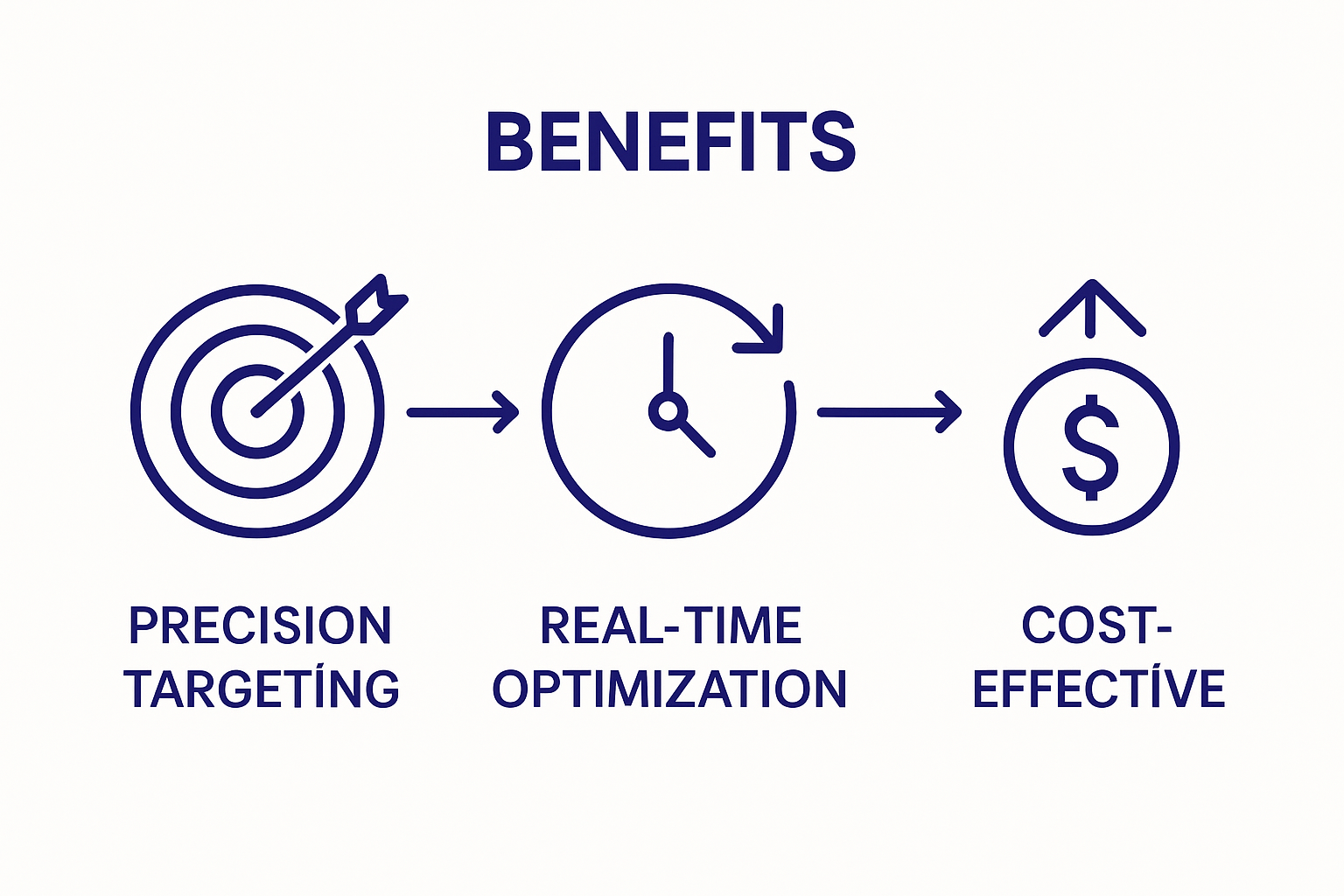
- Hyper-targeted advertising enabling granular audience segmentation
- Real-time optimization allowing immediate campaign adjustments
- Cost-effective approach reducing wasted ad spend
- Comprehensive data insights providing deeper understanding of campaign performance
For mobile gaming marketers specifically, programmatic advertising represents a powerful tool to reach precisely targeted gaming audiences, ensuring advertisements are displayed to users most likely to engage with the content.
By leveraging advanced machine learning algorithms, programmatic advertising transforms digital marketing from a broad, scattergun approach into a surgically precise engagement strategy that maximises both user experience and advertising effectiveness.
How Programmatic Advertising Works: The Mechanisms
Programmatic advertising operates through a complex digital infrastructure that enables near-instantaneous ad purchasing and placement across multiple platforms. This sophisticated ecosystem relies on advanced technological frameworks that transform digital advertising from a manual, time-consuming process into a lightning-fast, data-driven mechanism.
The Real-Time Bidding Ecosystem
At the heart of programmatic advertising lies real-time bidding (RTB), a dynamic auction process that occurs within milliseconds of a user loading a webpage or mobile application. When a user visits a digital platform, an immediate programmatic auction commences, where advertisers compete to display their advertisements based on sophisticated targeting parameters.
The entire transaction involves multiple technological components:
- Ad Exchange: A digital marketplace where advertisers and publishers negotiate ad placements
- Demand-Side Platforms (DSPs): Software enabling advertisers to purchase ad inventory automatically
- Supply-Side Platforms (SSPs): Tools that help publishers monetise their available advertising spaces
Targeting and Personalization Mechanisms
Programmatic advertising distinguishes itself through hyper-precise targeting capabilities. By leveraging vast amounts of user data, these systems can segment audiences with remarkable granularity. Advertisers can target users based on intricate parameters such as:
- Demographic information
- Browsing history
- Geographic location
- Device type
- Behavioural patterns
According to research from the Interactive Advertising Bureau, these advanced targeting mechanisms enable unprecedented precision in digital advertising strategies.
For mobile gaming marketers looking to understand advanced ad network strategies, programmatic advertising represents a revolutionary approach to audience engagement.
By combining machine learning algorithms, vast data repositories, and real-time computational capabilities, programmatic advertising transforms digital marketing into a dynamic, responsive, and incredibly efficient ecosystem that continuously adapts to user behaviour and market conditions.
Key Concepts of Programmatic Advertising in Mobile Gaming
Programmatic advertising in mobile gaming represents a sophisticated approach to digital marketing that leverages advanced technological capabilities to deliver highly targeted and contextually relevant advertisements. By understanding its core mechanisms, mobile game developers and marketers can significantly enhance user acquisition and monetisation strategies.
User Data and Audience Segmentation
Audience segmentation forms the cornerstone of effective programmatic advertising in mobile gaming. This process involves breaking down potential player populations into granular groups based on multiple sophisticated criteria. Mobile game marketers can create incredibly precise targeting profiles by analysing:
- Player demographics
- In-game behaviour patterns
- Device usage characteristics
- Historical engagement metrics
- Spending propensity
These detailed segments enable advertisers to craft hyper-personalised ad experiences that resonate deeply with specific player archetypes, dramatically improving conversion potential.
Contextual Relevance and Ad Placement
Successful programmatic advertising in mobile gaming hinges on contextual intelligence. This means delivering advertisements that seamlessly integrate with the user’s current gaming experience, minimising disruption and maximising engagement potential.
According to research from Mobile Marketing Association, contextually relevant ads can increase user interaction rates by up to 70% compared to generic placements.
For game developers seeking to understand modern mobile game monetisation strategies, programmatic advertising offers unprecedented precision and effectiveness.
Performance Tracking and Optimization
Modern programmatic advertising platforms provide real-time analytics that transform how mobile game marketers approach user acquisition. By continuously monitoring key performance indicators, advertisers can dynamically adjust targeting parameters, ad creatives, and bidding strategies.
Critical metrics for evaluation include:
- Click-through rates
- Conversion rates
- Cost per acquisition
- User retention statistics
- Return on advertising spend
Through machine learning algorithms and advanced data processing, programmatic advertising creates a responsive, intelligent ecosystem that constantly refines itself to deliver optimal marketing outcomes for mobile game developers.
The Advantages of Programmatic Advertising for User Acquisition
Programmatic advertising has revolutionised user acquisition strategies in mobile gaming by providing unprecedented precision, efficiency, and scalability. Unlike traditional advertising methods, this technology enables game developers to connect with potential players through highly targeted, data-driven approaches that maximise conversion potential.
Precision Targeting and Cost Efficiency
Granular audience targeting represents the most significant advantage of programmatic advertising for user acquisition. Mobile game marketers can now pinpoint exact player segments with remarkable accuracy, reducing wasted advertising expenditure and improving overall campaign performance.
Key targeting capabilities include:
- Demographic precision
- Behavioural pattern analysis
- Geographic location segmentation
- Device and platform specificity
- Interest-based clustering
These sophisticated targeting mechanisms enable advertisers to reach players most likely to engage with their specific game genre, dramatically reducing acquisition costs and improving return on investment.
Real-Time Performance Optimization
Programmatic advertising platforms provide instantaneous campaign performance tracking, allowing marketers to make dynamic adjustments in real-time. This capability transforms user acquisition from a static, predetermined process into an adaptive, responsive strategy.
According to research from eMarketer, real-time optimization can improve campaign performance by up to 45% compared to traditional advertising methods.

For mobile game developers looking to understand user acquisition strategies, programmatic advertising offers an unparalleled technological advantage.
Scalability and Cross-Platform Reach
The inherent flexibility of programmatic advertising enables mobile game developers to scale user acquisition efforts across multiple platforms and global markets seamlessly. Machine learning algorithms continuously refine targeting parameters, ensuring consistent performance across diverse digital ecosystems.
Critical scalability advantages include:
- Simultaneous multi-platform campaign management
- Automated budget allocation
- Rapid market penetration
- Global audience accessibility
- Consistent performance tracking
By leveraging advanced algorithmic technologies, programmatic advertising transforms user acquisition from a complex, resource-intensive process into a streamlined, data-driven strategy that delivers measurable, predictable results for mobile game developers.
This table outlines the main advantages of programmatic advertising for user acquisition in mobile gaming, highlighting how each benefit contributes to campaign success.
| Advantage | Description |
|---|---|
| Precision Targeting | Pinpoint exact player segments for engagement, reducing wasted ad spend |
| Cost Efficiency | Optimise budget through granular targeting and real-time allocation |
| Real-Time Performance Optimisation | Instantly track and adjust campaigns to maximise outcomes |
| Scalability | Seamlessly expand campaigns across multiple platforms and geographies |
| Cross-Platform Reach | Maintain consistent messaging and performance across devices and digital environments |
Real-World Applications of Programmatic Advertising in Mobile Marketing
Programmatic advertising has transformed mobile marketing by enabling sophisticated, data-driven strategies that deliver unprecedented targeting precision and engagement potential. By leveraging advanced technological capabilities, mobile marketers can now create highly personalised advertising experiences that resonate deeply with specific audience segments.
Mobile Gaming User Acquisition Strategies
Dynamic user acquisition represents one of the most compelling real-world applications of programmatic advertising in mobile marketing. Mobile game developers can now precisely target potential players based on complex behavioural and demographic parameters, dramatically improving recruitment efficiency.
Key application strategies include:
- Targeting players with similar game engagement histories
- Identifying high-value player archetypes
- Predicting potential player lifetime value
- Segmenting audiences across multiple gaming genres
- Creating lookalike audience models
These strategies enable mobile game marketers to reduce acquisition costs while simultaneously improving overall player quality and retention rates.
Performance Marketing and Conversion Optimization
Programmatic advertising platforms provide mobile marketers with real-time performance tracking capabilities that transform traditional marketing approaches. Marketers can now monitor campaign effectiveness instantaneously, making dynamic adjustments to maximise conversion potential.
According to research from Mobile Marketing Association, real-time optimization can improve mobile marketing campaign performance by up to 60% compared to static advertising methods.
For marketers seeking to understand global mobile trends, programmatic advertising offers an unparalleled technological advantage.
Cross-Platform Marketing Ecosystem
The flexibility of programmatic advertising enables mobile marketers to create seamless, integrated marketing experiences across multiple digital platforms. Machine learning algorithms continuously refine targeting parameters, ensuring consistent performance and message relevance.
Critical cross-platform advantages include:
- Unified campaign management
- Consistent brand messaging
- Adaptive targeting across devices
- Comprehensive audience insights
- Efficient budget allocation
By integrating advanced algorithmic technologies, programmatic advertising transforms mobile marketing from a fragmented, unpredictable process into a sophisticated, data-driven strategy that delivers measurable, scalable results.
Transform Programmatic Advertising with Effortless Playable Ad Creation
After learning how programmatic advertising brings powerful targeting and efficiency, many marketers face a new challenge. Creating engaging playable ads can be technical, labour-intensive and expensive. You may worry about straining your team, budget or timelines when all you want is to make the most of hyper-targeted programmatic opportunities.
Discover how you can avoid these common obstacles at PlayableMaker Publishing by using a no-code solution for playable ads. Creating interactive ads can be not only quick but also budget friendly. You do not need to sacrifice creative quality or worry about complicated workflows.

Experience the future of playable ad creation at PlayableMaker. Take advantage of automated advertising strategies with engaging formats that drive superior user acquisition. Turn your goals into results and start creating playable ads today. If you need help to get started, simply visit our Help Centre for step-by-step guidance.
Frequently Asked Questions
What is programmatic advertising?
Programmatic advertising is an automated approach to digital advertising that uses algorithms and real-time bidding to purchase and display online ads across various platforms, streamlining the ad buying process significantly.
How does programmatic advertising work?
Programmatic advertising works through a digital ecosystem involving advertisers, supply-side platforms (SSPs), demand-side platforms (DSPs), and ad exchanges, using real-time bidding to place ads instantly based on targeting parameters such as demographics and user behaviour.
What are the benefits of using programmatic advertising for marketers?
The benefits of programmatic advertising include hyper-targeted advertising, real-time optimisation, cost-effective strategies that reduce wasted ad spend, and comprehensive data insights that enhance understanding of campaign performance.
How does programmatic advertising improve user acquisition in mobile gaming?
Programmatic advertising enhances user acquisition in mobile gaming by offering precision targeting, real-time performance optimisation, and the ability to scale campaigns across multiple platforms, ensuring advertisements reach the most relevant audiences efficiently.
Recommended
- What is Ad Targeting? Understanding Its Importance and Mechanics
- What Is an Ad Network? Understanding Ad Networks in Mobile Gaming
- Understanding Ad Audience Targeting in Mobile Gaming
- What is Ad Optimization? Understanding Its Importance
- How to Effectively Reach Digital Marketing Audiences
- A Complete Guide to Types of Digital Ads for 2025