
Managing creative assets for mobile gaming user acquisition campaigns often feels overwhelming. You juggle multiple ad variations, track performance across platforms, and constantly refresh creatives to combat fatigue, all while controlling budgets and timelines. Interactive playable ads deliver exceptional engagement, yet traditional production demands significant development resources and costs that strain your team. No-code platforms and AI-powered tools now offer a practical solution, enabling you to produce high-quality interactive ads rapidly without technical dependencies. This guide presents a proven workflow that maximises engagement, reduces customer acquisition costs, and keeps your creative pipeline flowing efficiently throughout 2026.
Table of Contents
- Preparing Your Creative Assets Workflow
- Executing Your No-Code Creative Production And Testing
- Managing And Optimising Creative Fatigue
- Evaluating Results And Scaling Your Creative Workflow
- Discover PlayableMaker For Effortless Ad Creation
- Frequently Asked Questions
Key takeaways
| Point | Details |
|---|---|
| Efficient workflows combine planning with no-code production | Data-driven objectives and structured pipelines ensure consistent creative output and testing velocity |
| Weekly testing reduces acquisition costs significantly | High-velocity testing cuts CAC by 27% whilst maintaining quality standards |
| Playable ads outperform traditional formats dramatically | Interactive ads achieve 25% higher CTR and 319% more conversions than static or video alternatives |
| Creative fatigue demands regular refreshes | Ads lose effectiveness within 1-3 weeks depending on platform, requiring systematic refresh schedules |
| Hybrid AI-human approach optimises output | Combining AI volume generation with human creative oversight delivers both quantity and brand-aligned quality |
Preparing your creative assets workflow
Before launching into production, establish a solid foundation for your creative workflow that aligns with your user acquisition objectives. Start by defining clear, measurable goals for each campaign phase. What specific player personas are you targeting? Which gameplay mechanics or character designs resonate most with your ideal users? Document these insights to guide every creative decision.
Research competitor creatives systematically across your key advertising platforms. Analyse which visual hooks, gameplay demonstrations, and interactive elements drive the strongest engagement in your genre. Pay attention to successful patterns in character presentation, reward systems, and challenge structures that competitors use effectively. This competitive intelligence shapes your creative strategy and helps you identify white space opportunities.
Structure your production pipeline around consistent cadences that balance innovation with optimisation. Plan for weekly new concept generation, bi-weekly refinement cycles based on initial performance data, and monthly comprehensive performance analysis sessions. This rhythm ensures you maintain fresh creative supply whilst learning from each iteration.
Identify your core performance metrics before generating any assets. Track click-through rates, cost per install, return on ad spend, and day-one retention as primary indicators. Establish baseline benchmarks for each metric so you can quickly spot winning creatives and failing variations. Set clear thresholds that trigger creative refreshes or kill underperforming ads.
Define your testing cadence and ad audience targeting parameters upfront. Determine how many variations you’ll test simultaneously, what sample sizes constitute valid data, and how long each test runs before making decisions. Build in scheduled refresh points every one to three weeks to combat creative fatigue proactively rather than reactively.
Pro Tip: Create a centralised creative brief template that captures persona insights, key messaging, visual requirements, and success metrics for every new concept. This standardisation accelerates production whilst ensuring consistency across your entire creative library.
Executing your no-code creative production and testing
Select no-code platforms that align with your technical capabilities and budget constraints. Tools like PlayableMaker, Sett, and Creatify offer drag-and-drop interfaces that eliminate development bottlenecks. These platforms typically reduce production time by 50% whilst cutting creative costs to under £10 each compared to £150 or more for traditional development.
Begin with your playable builder’s drag-and-drop creator to construct your first interactive ad variations. Upload your game assets, including character sprites, background elements, and UI components. Use the platform’s AI generation features to rapidly create multiple versions with different hooks, gameplay demonstrations, or reward presentations. Aim for five to ten variations per concept to ensure robust testing.
Implement a systematic testing workflow that moves each creative through defined stages:
- Build the initial playable ad using your selected no-code platform’s templates and customisation options
- Preview the ad across target advertising networks to verify technical compatibility and user experience
- Launch small-scale initial tests with controlled budgets to gather preliminary performance data
- Monitor early signals for 24-48 hours to identify obvious winners or failures
- Scale budget allocation to winning variations whilst pausing underperformers
- Document learnings and iterate on successful patterns in your next creative batch
Track your production efficiency and performance systematically using a data table structure:
| Creative Variation | Production Time | Cost | CTR | CPI | ROAS |
|---|---|---|---|---|---|
| Playable A (character focus) | 2 hours | £8 | 4.2% | £1.20 | 2.8x |
| Playable B (gameplay demo) | 1.5 hours | £6 | 5.1% | £0.95 | 3.4x |
| Playable C (reward highlight) | 2 hours | £8 | 3.8% | £1.35 | 2.3x |
This documentation reveals patterns in what resonates with your audience and identifies which production approaches deliver the best return on effort. AI-powered workflows enable 5-10 new creatives weekly with a 10-15% win rate, making high-velocity testing economically viable.
Refresh your ad creatives before performance degradation becomes visible. Don’t wait until click-through rates plummet or costs spike. Build refresh cycles into your production calendar based on platform-specific fatigue patterns covered in the next section.

Pro Tip: Create a swipe file of your top-performing creatives with detailed annotations about what made them successful. Reference this library when generating new concepts to replicate winning patterns whilst maintaining freshness.
Managing and optimising creative fatigue
Creative fatigue manifests in two distinct forms that require different management approaches. Concept fatigue occurs when audiences tire of seeing similar creative themes or approaches across your entire ad portfolio. Single-ad fatigue happens when one specific creative loses effectiveness due to repeated exposure to the same users. Both types erode performance, but ads lose 38% effectiveness after five weeks if left unrefreshed.
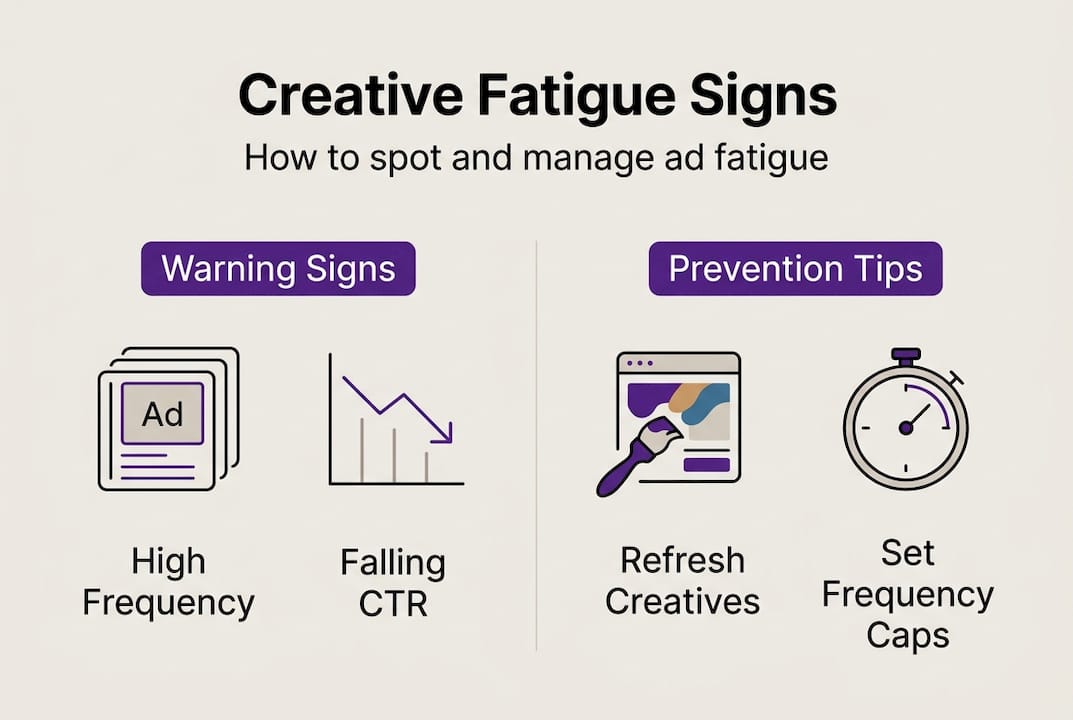
Monitor several key indicators that signal approaching fatigue. Track ad frequency metrics to identify when individual users see your ads too often. Watch for declining click-through rate trends even as impressions remain stable. Notice cost per install or cost per acquisition escalation that isn’t explained by seasonal factors or competitive changes. These signals typically appear before performance crashes completely, giving you time to intervene.
Refresh your ads based on platform-specific patterns. TikTok requires refreshes every 1-2 weeks due to its high-velocity content consumption model. Facebook and Instagram typically need updates every 2-3 weeks. Google Ads campaigns can run 4-6 weeks before requiring refreshes. Unity Ads and other gaming networks fall somewhere between at 2-4 weeks depending on your targeting breadth.
Choose between full and partial refresh strategies based on your creative performance:
| Refresh Strategy | Pros | Cons | Recommended Cadence |
|---|---|---|---|
| Full replacement | Completely fresh experience, resets all fatigue signals | Higher production cost, loses historical data | Every 3-4 weeks |
| Partial refresh (hook change) | Lower production effort, maintains core gameplay | May not fully address concept fatigue | Every 1-2 weeks |
| Partial refresh (visual update) | Quick turnaround, extends ad lifespan | Limited impact if core concept is fatigued | Every 2-3 weeks |
| Hybrid rotation | Balances freshness with efficiency | Requires larger creative library | Ongoing rotation |
Partial refresh methods work particularly well for effective playable ad techniques that have proven successful. Change the opening hook whilst keeping the core gameplay demonstration. Update character skins or visual themes whilst maintaining the interaction model. Modify reward presentations or end cards whilst preserving the playable mechanics. These tactical updates extend ad lifespan without complete rebuilds.
Implement frequency caps that limit how often individual users see each creative. Set caps at 2-3 impressions per user per week to prevent overexposure. Monitor frequency metrics above 3.0 that trigger CTR drops of 10-30% and corresponding cost increases. Adjust caps downward if you notice fatigue signals appearing earlier than expected.
Pro Tip: Use AI-powered monitoring tools that analyse performance trends and predict fatigue before it impacts your campaigns. Set up automated alerts when key metrics deviate from expected patterns, enabling pre-emptive refreshes rather than reactive fixes. For additional insights on creative performance strategies, explore ad creative performance strategies that complement your workflow.
Evaluating results and scaling your creative workflow
Review comprehensive performance data across multiple dimensions to identify your winning creatives. Examine click-through rates to measure initial appeal and hook effectiveness. Analyse cost per install to understand acquisition efficiency. Calculate return on ad spend to evaluate overall campaign profitability. Track retention rates at day one, day seven, and day thirty to assess user quality beyond the initial install.
Expect a 10-15% win rate among weekly tests when running high-velocity creative programmes. This means one or two creatives out of every ten you produce will significantly outperform the rest. Focus your scaling efforts on these winners whilst learning from the patterns that made them successful. Don’t chase marginal performers or try to salvage fundamentally weak concepts.
Playable ads deliver 25% higher CTR, 15% better retention, and 319% higher conversions than video or static alternatives. These dramatic performance differences justify the upfront investment in interactive creative production. When you identify a winning playable format, scale it aggressively across all relevant platforms and audience segments.
Scale your production volume using AI and no-code tools without sacrificing quality. A hybrid human-AI approach yields optimal results by leveraging AI for rapid volume generation whilst maintaining human oversight for brand alignment and strategic decisions. Let AI handle asset assembly, variation creation, and technical optimisation. Reserve human expertise for concept development, brand consistency, and complex creative judgments.
Follow these steps to scale your workflow systematically:
- Analyse performance data weekly to identify winning patterns and failing approaches
- Validate winners by testing them across additional audience segments and platforms
- Increase testing velocity by producing more variations of successful concepts
- Refresh fatigued ads proactively based on your established cadence
- Repurpose top creatives by adapting them for different platforms or seasonal themes
- Document learnings in your creative playbook to inform future production
Expand your audience targeting for mobile ads as you scale winning creatives. Test lookalike audiences based on your highest-value users. Explore interest-based targeting that aligns with your game’s core mechanics or themes. Experiment with broader targeting when you have highly effective creatives that can convert cold audiences.
Data-driven creative decisions separate successful user acquisition programmes from those that waste budget on unproven assumptions. Every creative test generates insights that compound over time, building an institutional knowledge base that accelerates future performance. Treat your creative workflow as a continuous learning system, not a one-time production exercise.
Maintain quality standards even as you increase production velocity. Establish clear brand guidelines that define acceptable visual styles, messaging tones, and gameplay representations. Create approval workflows that catch off-brand variations before they reach users. Balance speed with consistency to build recognisable creative equity across your entire ad portfolio.
Discover PlayableMaker for effortless ad creation
Implementing the workflow outlined in this guide becomes significantly easier with the right platform supporting your efforts. PlayableMaker provides a comprehensive drag-and-drop playable builder designed specifically for mobile gaming marketers who need to produce high-quality interactive ads without technical dependencies. The platform empowers you to create, test, and optimise playable ads efficiently whilst maintaining complete creative control.
AI-assisted generation features accelerate your production timeline by automating repetitive tasks and suggesting optimised variations based on performance patterns. Integrated testing and optimisation tools help you manage creative fatigue systematically and improve performance through data-driven iterations. The platform’s affordable pricing structure makes professional playable ad creation accessible for small to mid-sized mobile gaming teams operating on realistic budgets.
Explore the psychology behind playable ads to understand why interactive formats drive superior engagement. Discover additional no-code tools for playable ads that complement your workflow. Visit PlayableMaker pricing to find a plan that matches your production volume and budget requirements, then transform your creative assets workflow to boost campaign success throughout 2026.
Frequently asked questions
What is a creative assets workflow for ads?
A creative assets workflow defines the structured process from initial concept through production, testing, optimisation, and refresh of advertising creatives. For mobile gaming user acquisition, this workflow integrates no-code tools, data analysis, and systematic testing cadences to maximise efficiency and campaign impact. The workflow ensures consistent creative output whilst enabling rapid iteration based on performance signals.
How do no-code tools improve ad creative production?
No-code platforms enable marketers to rapidly build and iterate playable ads without developer involvement, cutting production costs dramatically and doubling creation speed. These tools provide drag-and-drop interfaces that eliminate technical bottlenecks whilst maintaining professional quality standards. AI features assist with volume generation, variation creation, and technical optimisation, allowing your team to focus on strategy and creative concepts rather than implementation details.
What is creative fatigue and how can I prevent it?
Creative fatigue describes the decline in advertising effectiveness that occurs when audiences see the same ads repeatedly, leading to reduced engagement and increased costs. Prevention requires systematic monitoring of frequency metrics, click-through rate trends, and cost escalation signals. Refresh your ads every one to three weeks depending on platform velocity, using either full replacements or partial updates to maintain audience interest and campaign performance.
Why are playable ads effective for mobile gaming user acquisition?
Playable ads promote direct interaction with gameplay mechanics, creating immersive preview experiences that static or video formats cannot match. This interactivity drives up to 25% higher click-through rates and 319% improved conversion rates compared to traditional ad formats. Interactive previews attract higher-quality installs because users self-select based on actual gameplay experience rather than passive observation, resulting in better retention and lifetime value.
Recommended
- Mastering Interactive Ads Workflow for Mobile Games – playablemaker.com Mastering Interactive Ads Workflow for Mobile Games
- How to Repurpose Ad Creatives for Mobile Gaming Success – playablemaker.com How to Repurpose Ad Creatives for Mobile Gaming Success
- How to Scale Ad Creatives for Mobile Games Effectively – playablemaker.com How to Scale Ad Creatives for Mobile Games Effectively
- Playable Ad Trends 2025: Build Engaging Ads Without Coding – playablemaker.com Playable Ad Trends 2025: Build Engaging Ads Without Coding
- Τι είναι το ad creative και πώς επηρεάζει τη διαφήμισή σας – maverix.gr